
Puck, 1877-12-26 · page 5 of 16
Puck — December 26, 1877 — page 5: what you’re looking at
What you’re looking at
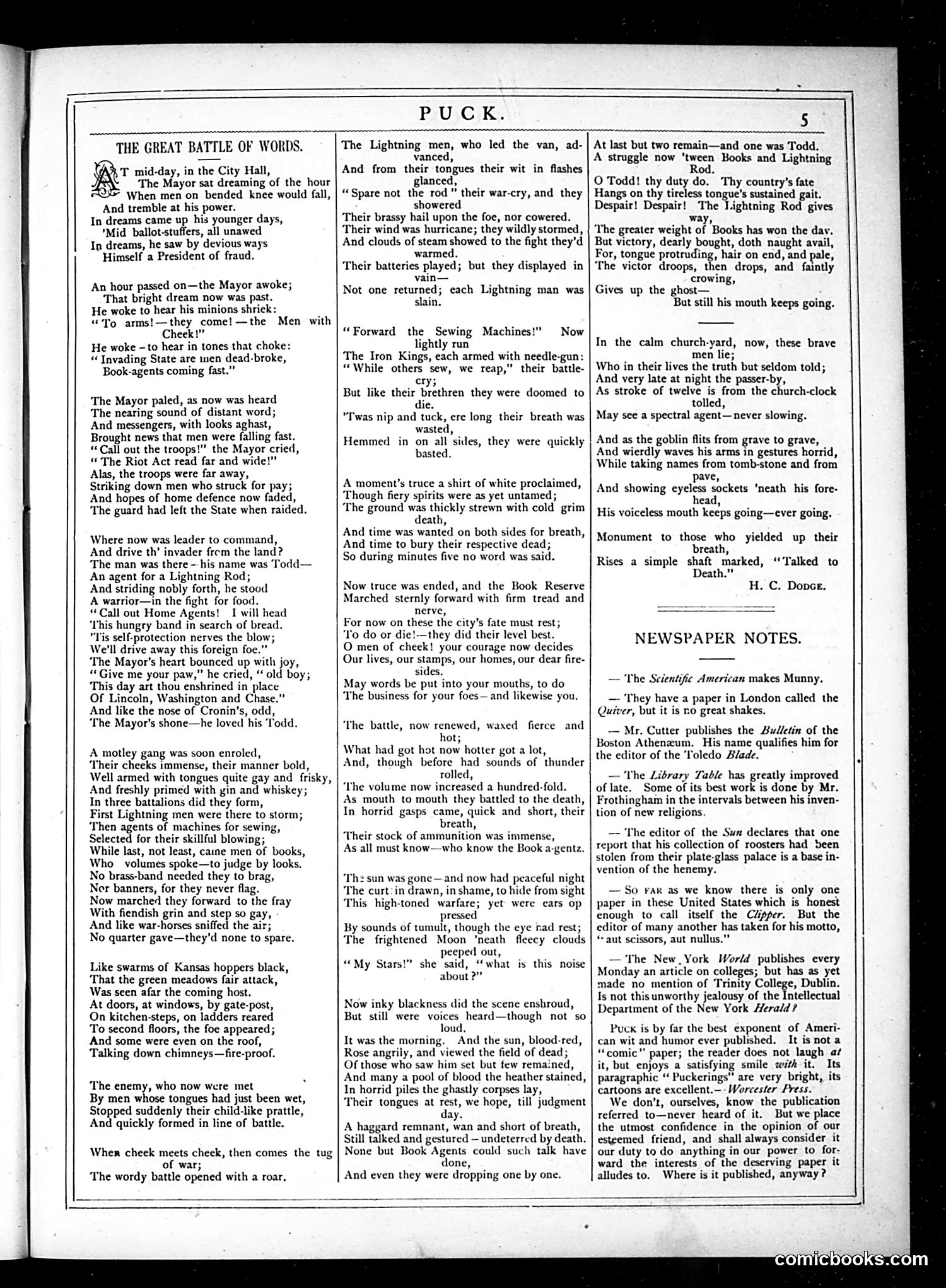
This satirical poem depicts a metaphorical battle between **Book Agents** and **Lightning Men** (Sewing Machine salesmen) competing for dominance in a city. The "Mayor" appears as a bewildered authority figure unable to control the chaos. The satire targets **aggressive door-to-door salesmanship** culture of the era—a common social complaint. Book agents armed with their products clash against sewing machine representatives, with both groups wielding their goods as "weapons." The poem mocks how merchants terrorized citizens with high-pressure sales tactics, treating commercial competition as literal warfare. The ghostly victim "Todd" and graveyard imagery suggest these salesmen metaphorically destroy peace and sanity. This reflects Gilded Age anxieties about commercialism overtaking civic order and public space.
📄 Transcribed text from this page (OCR, searchable)
Machine-transcribed from the original scan — historical spelling and the odd misread are preserved.
PUCK. 5 THE GREAT BATTLE OF WORDS. T mid-day, in the City Hall, ‘The Mayor sat dreaming of the hour When men on bended knee would fall, And tremble at his power. In dreams came up his younger days, 'Mid ballot-stuffers, all unawed In dreams, he saw by devious ways Himself a President of fraud. An hour passed on—the Mayor awoke; That bright dream now was past. He woke to hear his minions shriek: “To arms!—they come! —the Cheek!” He woke to hear in tones that choke: « Invading State are nen dead-broke, Book-agents coming fast.” Men with ‘The Mayor paled, as now was heard ‘The nearing sound of distant word; And messengers, with looks aghast, Brought news that men were falling fast. Call out the troops!” the Mayor cried, “ The Riot Act read far and wide!” Alas, the troops were far away, Striking down men who struck for pay; And hopes of home defence now faded, ‘The guard had left the State when raided. Where now was leader to command, And drive th’ invader from the land? The man was there - his name was ‘Todd— An agent for a Lightning Rod; And striding nobly forth, he stood A warrior—in the fight for food. “Call out Home Agents! I will head ‘This hungry band in search of bread. "Lis self-protection nerves the blow; We'll drive away this foreign foe.” ‘The Mayor's heart bounced up with joy, “Give me your paw,” he cried, “old boy; ‘This day art thou enshrined in place Of Lincoln, Washington and Chase.” And like the nose of Cronin’s, odd, ‘The Mayor's shone—he loved his ‘Todd. A motley gang was soon enroled, ‘Their cheeks immense, their manner bold, Well armed with tongues quite gay and frisky, And freshly primed with gin and whiskey; In three battalions did they form, First Lightning men were there to storm; Then seen of machines for sewing, Selected for their skillful blowing; While last, not least, caine men of books, Who volumes spoke—to judge by looks. No brass-band needed they to brag, Nor banners, for they never flag. Now marched they forward to the fray With fiendish grin and step so gay, And like war-horses sniffed the air; No quarter gave—they’d none to spare. Like swarms of Kansas hoppers black, That the green meadows fair attack, Was seen afar the coming host. At doors, at windows, by gate-post, On kitchen-steps, on ladders reared To second floors, the foe appeared; And some were even on the roof, Talking down chimneys—fire-proof. ‘The enemy, who now were met By men whose tongues had just been wet, Stopped suddenly their child-like prattle, And quickly formed in line of battle. When cheek meets cheek, then comes the tug of war; The wordy battle opened with a roar, The Lightning men, who led the van, ad- vanced, And from their tongues their wit in flashes lanced, “Spare not the rod" their war-cry, and they showered ‘Their brassy hail upon the foe, nor cowered. ‘Their wind was hurricane; they wildly stormed, And clouds of steam showed to the fight they'd warmed, ‘Their batteries played; but they displayed in vain— Not one returned; each Lightning man was slain, “Forward the Sewing Machines!” lightly run The Iron Kings, each armed with needle-gun: “While others sew, we reap,” their battle- Now cry; But like their brethren they were doomed to die. “Twas nip and tuck, ere long their breath was wasted, Hemmed in on all sides, they were quickly basted. A moment’s truce a shirt of white proclaimed, ‘Though fiery spirits were as yet untamed; ‘The ground was thickly strewn with cold grim death, And time was wanted on both sides for breath, And time to bury their respective dead; So during minutes five no word was said. Now truce was ended, and the Book Reserve Marched sternly forward with firm tread and nerve, For now on these the city’s fate must rest; ‘To do or die!—they did their level best. O men of cheek! your courage now decides Our lives, our stamps, our homes, our dear fire- sides. May words be put into your mouths, to do ‘The business for your foes—and likewise you. ‘The battle, now renewed, waxed fierce and hot; What had got hot now hotter got a lot, And, though before had sounds of thunder rolled, ‘rhe volume now increased a hundred-fold. As mouth to mouth they battled to the death, In horrid gasps came, quick and short, their breath, ‘Their stock of ammunition was immense, As all must know—who know the Book a-gentz. ‘Th: sun was gone—and now had peaceful night ‘The curt:in drawn, in shame, to hide from sight This high-toned warfare; yet were cars op pressed By sounds of tumult, though the eye nad rest; The frightened Moon ‘neath fieecy clouds peeped out, “My Stars!” she said, “what is this noise about ?”” Now inky blackness did the scene enshroud, But still were voices heard—though not so loud. It was the morning. And the sun, blood-red, Rose angrily, and viewed the field of dead; Of those who saw him set but few remained, And many a pool of blood the heather stained, In horrid piles the ghastly corpses lay, Their tongues at rest, we hope, till judgment day. A haggard remnant, wan and short of breath, Still talked and gestured — undeterred by death. None but Book Agents could such talk have done, And even they were dropping one by one. At last but two remain—and one was Todd. A struggle now ‘tween Books and Lightning Rod. O Todd! thy duty do.” Thy country’s fate Hangs on thy tireless tongue’ sustained gait, Despair! Despair! The Lightning Rod gives way, The greater weight of Books has won the dav. But victory, dearly bought, doth naught avail, For, tongue protruding, hair on end, and pale, ‘The victor droops, then drops, and faintly crowing, Gives up the ghost— But still his mouth keeps going. In the calm church-yard, now, these brave men lie; Who in their lives the truth but seldom told; And very late at night the passer-by, As stroke of twelve is from the church-clock tolled, May see a spectral agent—never slowing. And as the goblin flits from grave to grave, And wierdly waves his arms in gestures horrid, While taking names from tomb-stone and from pave, And showing eyeless sockets ‘neath his fore- head, His voiceless mouth keeps going—ever going. Monument to those who yielded up their breath, Rises a simple shaft marked, ‘Talked to Death.” NEWSPAPER NOTES. — The Scientific American makes Munny. ‘They have a paper in London called the Quiver, but it is no great shakes. — Mr. Cutter publishes the Budletin of the Boston Athenzum. His name qualifies him for the editor of the ‘Toledo Blade. — The Library Table has greatly improved of late. Some of its best work is done by Mr. Frothingham in the intervals between his inven- tion of new religions. — The editor of the Sun declares that one report that his collection of roosters had been stolen from their plate-glass palace is a base in- vention of the henemy. — So rar as we know there is only one paper in these United States which is honest enough to call itself the Céipper. But the editor of many another has taken for his motto, “aut scissors, aut nullus.”” — The New_York World publishes every Monday an article on colleges; but has as yet made no mention of Trinity College, Dublin. Is not this unworthy jealousy of the Intellectual Department of the New York Herald? Puck is by far the best exponent of Ameri- can wit and humor ever published. It is not a “comic” paper; the reader does not laugh a¢ it, but enjoys a satisfying smile with it. Its paragraphic “ Puckerings” are very bright, its cartoons are excellent.—-Worcester Press. We don’t, ourselves, know the publication referred to—never heard of it. But we place the utmost confidence in the opinion of our esteemed friend, and shall always consider it our duty to do anything in our power to for- ward the interests of the deserving paper it alludes to. Where is it published, anyway?