
Puck, 1877-12-26 · page 4 of 16
Puck — December 26, 1877 — page 4: what you’re looking at
What you’re looking at
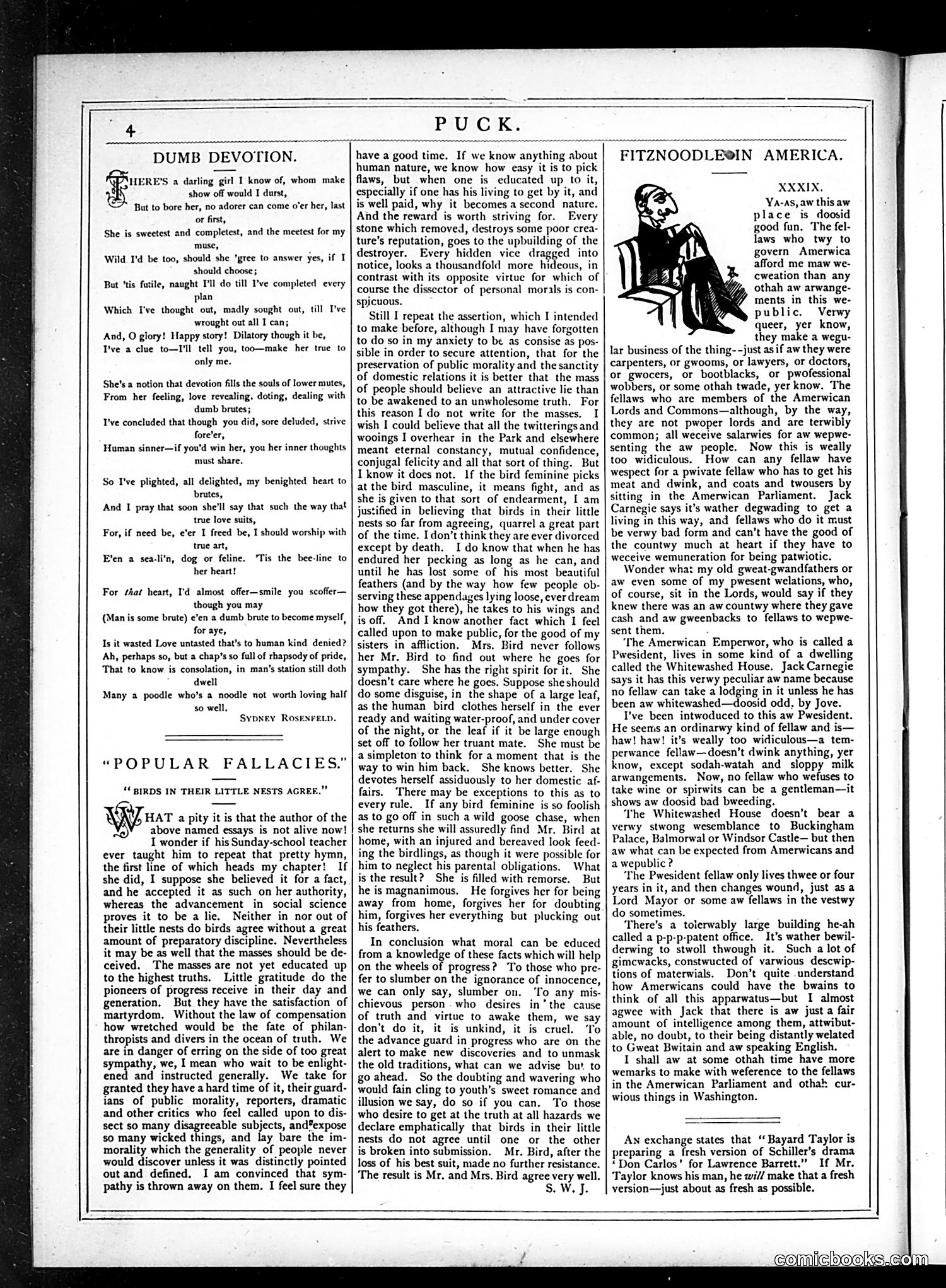
This page contains three distinct pieces: "Dumb Devotion" (a poem about a devoted woman), "Popular Fallacies: Birds in Their Little Nests Agree" (a satirical essay debunking the myth that birds live harmoniously), and "Fitznoodle in America" (a illustrated column). The "Fitznoodle" cartoon depicts a caricatured figure—likely representing a type rather than a specific person—seated and gesturing. The accompanying text discusses American public figures, politicians, and society, mocking what appears to be pretentious or hypocritical behavior among American elites and government officials. The satire focuses on social pretense and the gap between public morality and private conduct, typical of Puck's satirical approach to American politics and society.
📄 Transcribed text from this page (OCR, searchable)
Machine-transcribed from the original scan — historical spelling and the odd misread are preserved.
4 DUMB DEVOTION. HERE'S a darling girl I know of, whom make show off would I durst, But to bore her, no adorer can come o'er her, last or first, She is sweetest and completest, and the meetest for my muse, Wild I'd be too, should she ’gree to answer yes, if T should choose; But ’tis futile, naught I'll do till I’ve completed every plan Which I've thought out, madly sought out, till I've wrought out all I can; And, O glory! Happy story! Dilatory though it be, T've a clue to—I'll tell you, too—make her true to only me. She's a notion that devotion fills the souls of lower mutes, From her feeling, love revealing. doting, dealing with dumb brutes; T've concluded that though you did, sore deluded, strive fore'er, Human sinner—if you'd win her, you her inner thoughts must share. So I've plighted, all delighted, my benighted heart to brutes, And I pray that soon she'll say that such the way that true love suits, For, if need be, e'er I freed be, I should worship with true art, Even a sea-litn, dog or feline. her heart! "Tis the bee-line to For that heart, I'd almost offer—smile you scofier— though you may (Man is some brute) e’en a dumb brute to become myself, for aye, Is it wasted Love untasted that’s to human kind denied? Ah, perhaps so, but a chap’s so full of rhapsody of pride, ‘That to know is consolation, in man’s station still doth dwell Many a poodle who’s a noodle not worth loving half so well. Sypxry RosENreLp. “POPULAR FALLACIES.” ‘BIRDS IN THEIR LITTLE NESTS AGREE.” HAT a pity it is that the author of the above named essays is not alive now! I wonder if his Sunday-school teacher ever taught him to repeat that pretty hymn, the first line of which heads my chapter! If she did, I suppose she believed it for a fact, and he accepted it as such on her authority, whereas the advancement in social science proves it to be a lic. Neither in nor out of their little nests do birds agree without a great amount of preparatory discipline. Nevertheless it may be as well that the masses should be de- ceived. The masses are not yet educated up to the highest truths. Little gratitude do the pioneers of progress receive in their day and generation, But they have the satisfaction of martyrdom. Without the law of compensation how wretched would be the fate of philan- thropists and divers in the ocean of truth. We are in danger of erring on the side of too great sympathy, we, I mean who wait to be enlight- ened and instructed generally. We take for granted they have a hard time of it, their guard- ians of public morality, reporters, dramatic and other critics who feel called upon to dis- sect so many disagreeable subjects, and’expose so many wicked things, and lay bare the im- morality which the generality of people never would discover unless it was distinctly pointed out and defined. I am convinced that sym- pathy is thrown away on them. I feel sure they have a good time. If we know anything about human nature, we know how easy it is to pick flaws, but when one is educated up to it, especially if one has his living to get by it, and is well paid, why it becomes a second nature. And the reward is worth striving for. Every stone which removed, destroys some poor crea- ture’s reputation, goes to the upbuilding of the destroyer. Every hidden vice dragged into notice, looks a thousandfold_ more hideous, in contrast with its opposite virtue for which of course the dissector of personal morals is con- spicuous. Still I repeat the assertion, which I intended to make before, although I may have forgotten to do so in my anxiety to be as consise as pos- sible in order to secure attention, that for the preservation of public morality and the sanctity of domestic relations it is better that the mass of people should believe an attractive lie than to be awakened to an unwholesome truth. For this reason I do not write for the masses. I wish I could believe that all the twitterings and wooings I overhear in the Park and elsewhere meant eternal constancy, mutual confidence, conjugal felicity and all that sort of thing. But I know it docs not. 1f the bird feminine picks at the bird masculine, it means fight, and as she is given to that sort of endearment, [ am justified in believing that birds in their little nests so far from agreeing, quarrel a great part of the time. Idon’t think they are ever divorced except by death. I do know that when he has endured her pecking as long as he can, and until he has lost some of his most beautiful feathers (and by the way how few people ob- serving these appendages lying loose, ever dream how they got there), he takes to his wings and is off. And I know another fact which I feel called upon to make public, for the good of my sisters in affliction. Mrs. Bird never follows her Mr. Bird to find out where he goes for sympathy. She has the right spirit for it. She doesn’t care where he goes. Suppose she should do some disguise, in the shape of a large leaf, as the human bird clothes herself in the ever ready and waiting water-proof, and under cover of the night, or the leaf if it be large enough set off to follow her truant mate. She must be a simpleton to think for a moment that is the way to win him back. She knows better. She devotes herself assiduously to her domestic af- fairs. ‘There may be exceptions to this as to every rule. If any bird feminine is so foolish as to go off in such a wild goose chase, when she returns she will assuredly find Mr. Bird at home, with an injured and bereaved look feed- ing the birdlings, as though it were possible for him to neglect his parental obligations. What is the result? She is filled with remorse. But he is magnanimous. He forgives her for being away from home, forgives her for doubting him, forgives her everything but plucking out his feathers, In conclusion what moral can be educed from a knowledge of these facts which will help on the wheels of progress? ‘To those who pre- fer to slumber on the ignorance of innocence, we can only say, slumber on. ‘To any mis- chievous person. who desires in’ the cause of truth and virtue to awake them, we say don’t do it, it is unkind, it is cruel. ‘To the advance guard in progress who are on the alert to make new discoveries and to unmask the old traditions, what can we advise but to go ahead. So the doubting and wavering who would fain cling to youth’s sweet romance and illusion we say, do so if you can. To those who desire to get at the truth at all hazards we declare emphatically that birds in their little nests do not agree until one or the other is broken into submission. Mr. Bird, after the loss of his best suit, made no further resistance. ‘The result is Mr. and Mrs. Bird agree very well. FITZNOODLE®IN AMERICA. XXXIX, Ya-as, aw this aw place is doosid good fun. The fel- laws who twy to govern Amerwica afford me maw we- eweation than any othah aw arwange- ments in this we- public. Verwy queer, yer know, they make a wegu- lar business of the thing--just as if aw they were carpenters, or gwooms, or lawyers, or doctors, or gwocers, or bootblacks, or pwofessional wobbers, or some othah twade, yer know. The fellaws who are members of the Amerwican Lords and Commons—although, by the way, they are not pwoper lords and are terwibly common; all weceive salarwies for aw wepwe- senting the aw people. Now this is weally too widiculous. How can any fellaw have wespect for a pwivate fellaw who has to get his meat and dwink, and coats and twousers by sitting in the Amerwican Parliament. Jack Carnegie says it’s wather degwading to get a living in this way, and fellaws who do it must be verwy bad form and can’t have the good of the countwy much at heart if they have to weceive wemuneration for being patwiotic. Wonder what my old gweat-gwandfathers or aw even some of my pwesent welations, who, of course, sit in the Lords, would say if they knew there was an aw countwy where they gave cash and aw gweenbacks to fellaws to wepwe- sent them. « ‘The Amerwican Emperwor, who is called a Pwesident, lives in some kind of a dwelling called the Whitewashed House. Jack Carnegie says it has this verwy peculiar aw name because no fellaw can take a lodging in it unless he has been aw whitewashed—doosid odd, by Jove. I've been intwoduced to this aw Pwesident. He seems an ordinarwy kind of fellaw and is— haw! haw! it’s weally too widiculous—a tem- perwance fellaw—doesn’t dwink anything, yer know, except sodah-watah and sloppy milk arwangements. Now, no fellaw who wefuses to take wine or spirwits can be a gentleman—it shows aw doosid bad bweeding. ‘The Whitewashed House doesn’t bear a verwy stwong wesemblance to Buckingham Palace, Balmorwal or Windsor Castle— but then aw what can be expected from Amerwicans and a wepublic ? ‘The Pwesident fellaw only lives thwee or four years in it, and then changes wound, just as a Lord Mayor or some aw fellaws in the vestwy do sometimes. ‘There's a tolerwably large building he-ah called a p-p-p-patent office. It’s wather bewil- derwing to stwoll thwough it. Such a lot of gimcwacks, constwucted of varwious descwip- tions of materwials. Don’t quite understand how Amerwicans could have the bwains to think of all this apparwatus—but I almost agwee with Jack that there is aw just a fair amount of intelligence among them, attwibut- able, no doubt, to their being distantly welated to Gweat Bwitain and aw speaking English. I shall aw at some othah time have more wemarks to make with weference to the fellaws in the Amerwican Parliament and othah cur- wious things in Washington. Aw exchange states that “Bayard Taylor is preparing a fresh version of Schiller's drama “Don Carlos’ for Lawrence Barrett.” If Mr. Taylor knows his man, he wi// make that a fresh version—just about as fresh as possible.