
Puck, 1877-12-26 · page 11 of 16
Puck — December 26, 1877 — page 11: what you’re looking at
What you’re looking at
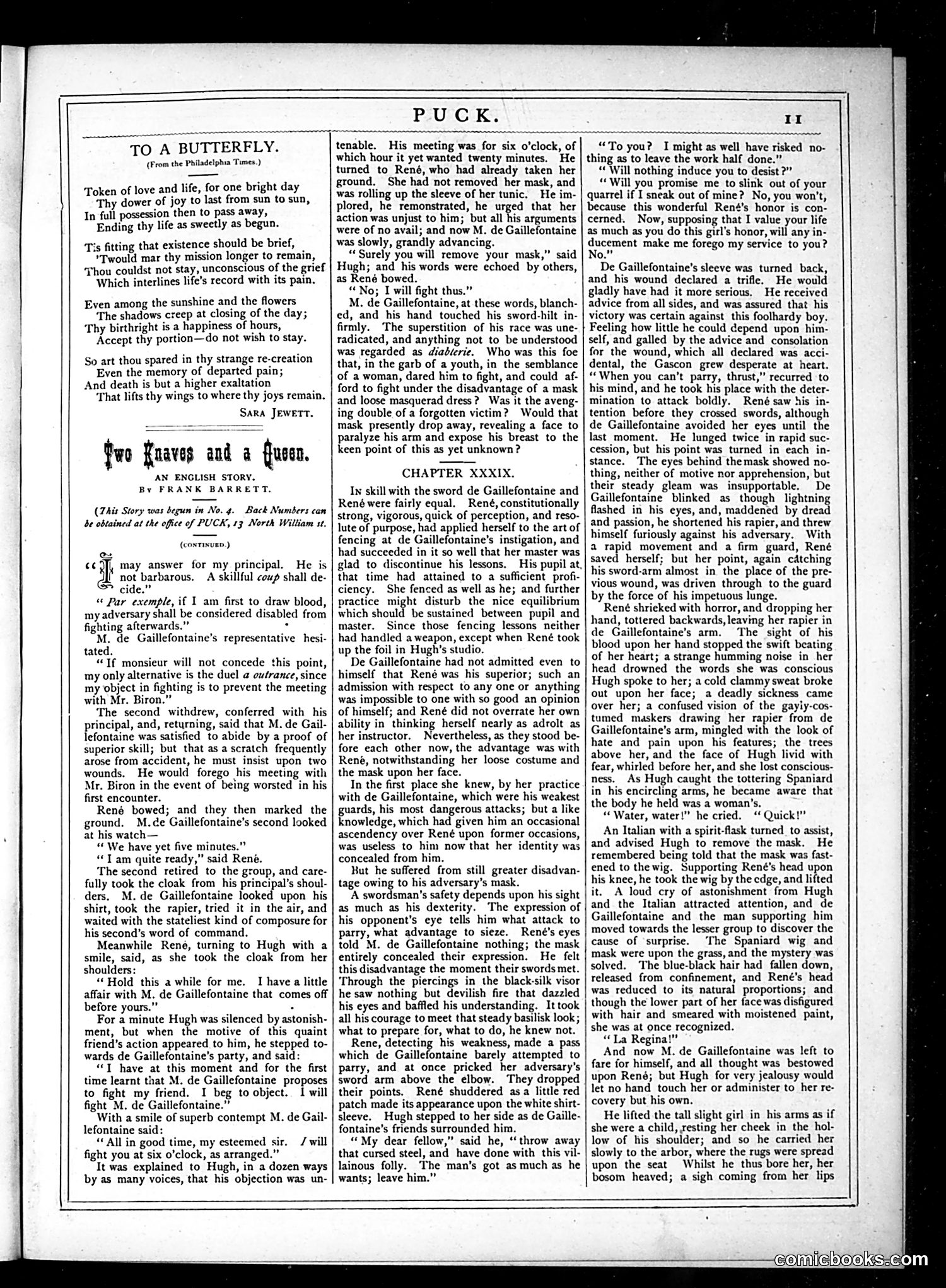
This page contains **no political cartoon**. Instead, it presents literary content: "To a Butterfly" (a poem), and the continuation of "Two Knaves and a Queen," an English short story by John De Morgan. The story section (Chapter XXXIX) depicts a fencing duel between characters named de Gaillefontaine and René over a masked woman. The narrative focuses on sword-fighting skill, honor, identity revelation, and romantic rivalry—typical melodramatic fiction of the era. Without visible illustrations accompanying the text, and given the purely narrative content, this appears to be a **literature-focused page** rather than satirical commentary. Puck, while primarily known for political cartoons, also published serialized fiction for its readers.
📄 Transcribed text from this page (OCR, searchable)
Machine-transcribed from the original scan — historical spelling and the odd misread are preserved.
PUCK. TO A BUTTERFLY. (From the Philadelphia Times.) Token of love and life, for one bright day Thy dower of joy to last from sun to sun, In full possession then to pass away, "Ending thy life as sweetly as begun. Tis fitting that existence should be brief, _ *Twould mar thy mission longer to remain, ‘Thou couldst not stay, unconscious of the grief Which interlines life's record with its pain. Even among the sunshine and the flowers ‘The shadows creep at closing of the day; ‘Thy birthright is a happiness of hours, Accept thy portion—do not wish to stay. So art thou spared in thy strange re-creation Even the memory of departed pain; And death is but a higher exaltation ‘That lifts thy wings to where thy joys remain. Sara Jewett. Guo Rnaves and a fueen. AN ENGLISH STORY. By FRANK BARRETT, (This Story was begun in No. 4. Back Numbers can be obtained at the office of PUCK, 13 North William st. ff oH (continue) may answer for my principal. He is not barbarous. A skillful coup shall de- cide.” « Par exemple, if 1 am first to draw blood, my adversary shall be considered disabled from fighting afterwards.” : M. de Gaillefontaine’s representative hesi- tated. “Tf monsieur will not concede this point, my only alternative is the duel @ outrance, since my object in fighting is to prevent the meeting with Mr. Biron.” The second withdrew, conferred with his principal, and, returning, said that M. de Gail- lefontaine was satisfied to abide by a proof of superior skill; but that as a scratch frequently arose from accident, he must insist upon two wounds. He would forego his meeting with Mr. Biron in the event of being worsted in his first encounter. René bowed; and they then marked the ground. M.de Gaillefontaine’s second looked at his watch— “We have yet five minutes.” “Tam quite ready,” said René. ‘The second retired to the group, and care- fully took the cloak from his principal's shoul- ders, M. de Gaillefontaine looked upon his shirt, took the rapier, tried it in the air, and waited with the stateliest kind of composure for his second’s word of command. Meanwhile René, turning to Hugh with a smile, said, as she took the cloak from her shoulders: “Hold this awhile for me. I have a little affair with M. de Gaillefontaine that comes off before yours.” . For a minute Hugh was silenced by astonish- ment, but when the motive of this quaint friend’s action appeared to him, he stepped to- wards de Gaillefontaine’s party, and said: “1 have at this moment and for the first time learnt that M. de Gaillefontaine proposes to fight my friend. I beg to object. 1 will fight M. de Gaillefontaine.” With a smile of superb contempt M. de Gail- lefontaine said: ‘All in good time, my esteemed sir. fight you at six o'clock, as arranged.” It was explained to Hugh, in a dozen ways by as many voices, that his objection was un- J will tenable. His meeting was for six o'clock, of which hour it yet wanted twenty minutes. He turned to René, who had already taken her ground. She had not removed her mask, and was rolling up the sleeve of her tunic. He im- plored, he remonstrated, he urged that her action was unjust to him; but all his arguments were of no avail; and now M. de Gaillefontaine was slowly, grandly advancing. “Surely you will remove your mask,” said Hugh; and his words were echoed by others, as René bowed. “No; I will fight thus.” M. de Gaillefontaine, at these words, blanch- ed, and his hand touched his sword-hilt in- firmly. ‘The superstition of his race was une- radicated, and anything not to be understood was regarded as diadierie. Who was this foe that, in the garb of a youth, in the semblance of a woman, dared him to fight, and could af- ford to fight under the disadvantage of a mask and loose masquerad dress? Was it the aveng- ing double of a forgotten victim? Would that mask presently drop away, revealing a face to paralyze his arm and expose his breast to the keen point of this as yet unknown? CHAPTER XXXIX. In skill with the sword de Gaillefontaine and René were fairly equal. René, constitutionally strong, vigorous, quick of perception, and reso- lute of purpose, had applied herself to the art of fencing at de Gaillefontaine’s instigation, and had succeeded in it so well that her master was glad to discontinue his lessons. His pupil at, that time had attained to a sufficient profi- ciency. She fenced as well as he; and further practice might disturb the nice equilibrium which should be sustained between pupil and master. Since those fencing lessons neither had handled a weapon, except when René took up the foil in Hugh’s studio. De Gaillefontaine had not admitted even to himself that René was his superior; such an admission with respect to any one or anything was impossible to one with so good an opinion of himself; and René did not overrate her own ability in ‘thinking herself nearly as adrolt as her instructor. Nevertheless, as they stood be- fore each other now, the advantage was with René, notwithstanding her loose costume and the mask upon her face. In the first place she knew, by her practice with de Gaillefontaine, which were his weakest guards, his most dangerous attacks; but a like knowledge, which had given him an occasional ascendency over René upon former occasions, was useless to him now that her identity was concealed from him, But he suffered from still greater disadvan- tage owing to his adversary’s mask. ‘A swordsman’s safety depends upon his sight as much as his dexterity. The expression of his opponent's eye tells him what attack to parry, what advantage to sieze. René’s eyes told M. de Gaillefontaine nothing; the mask entirely concealed their expression. He felt this disadvantage the moment their swords met. ‘Through the piercings in the black-silk visor he saw nothing but devilish fire that dazzled his eyes and baffled his understanding. It took all his courage to meet that steady basilisk look; what to prepare for, what to do, he knew not. Rene, detecting his weakness, made a pass which de Gaillefontaine barely attempted to parry, and at once pricked her adversary's sword arm above the elbow. They dropped their points. René shuddered asa little red patch made its appearance upon the white shirt- sleeve. Hugh stepped to her side as de Gaille- fontaine’s friends surrounded him. “My dear fellow,” said he, ‘throw away that cursed steel, and have done with this vil- lainous folly. The man’s got as much as he wants; leave him.” Ir “To you? I might as well have risked no- thing as to leave the work half done.” “Will nothing induce you to desist?” “Will you promise me to slink out of your quarrel if I sneak out of mine? No, you won't, because this wonderful René’s honor is con- cerned. Now, supposing that I value your li as much as you do this girl's honor, will any in- cucrment make me forego my service to you? 0" De Gaillefontaine's sleeve was turned back, and his wound declared a trifle. He would gladly have had it more serious, He received advice from all sides, and was assured that his victory was certain against this foolhardy boy. Feeling how little he could depend upon him- self, and galled by the advice and consolation for the wound, which all declared was acci- dental, the Gascon grew desperate at heart. “When you can’t parry, thrust,” recurred to his mind, and he took his place with the deter- mination to attack boldly. René saw his in- tention before they crossed swords, although de Gaillefontaine avoided her eyes until the last moment. He lunged twice in rapid suc- cession, but his point was turned in each in- stance. The eyes behind the mask showed no- thing, neither of motive nor apprehension, but their steady gleam was insupportable. | De Gaillefontaine blinked as though lightning flashed in his eyes, and, maddened by dread and passion, he shortened his rapier, and threw himself furiously against his adversary. With a rapid movement and a firm guard, René saved herself; but her point, again catching his sword-arm almost in the place of the pre- vious wound, was driven through to the guard by the force of his impetuous lunge. René shricked with horror, and dropping her hand, tottered backwards, leaving her rapier in de Gaillefontaine’s arm. The sight of his blood upon her hand stopped the swift beating of her heart; a strange humming noise in her head drowned the words she was conscious Hugh spoke to her; a cold clammy sweat broke out upon her face; a deadly sickness came over her; a confused vision of the gayiy-cos- tumed maskers drawing her rapier from de Gaillefontaine’s arm, mingled with the look of hate and pain upon his features; the trees above her, and the face of Hugh livid with fear, whirled before her, and she lost conscious- ness. As Hugh caught the tottering Spaniard in his encircling arms, he became aware that the body he held was a woman's, “ Water, water!” he cried.‘ Quick!” An Italian with a spirit-flask turned to assist, and advised Hugh to remove the mask. He remembered being told that the mask was fast- ened to the wig. Supporting René’s head upon his knee, he took the wig by the edge, and lifted it. A loud cry of astonishment from Hugh and the Italian attracted attention, and de Gaillefontaine and the man supporting him moved towards the lesser group to discover the cause of ‘surprise. ‘The Spaniard wig and mask were upon the grass, and the mystery was solved. The blue-black hair had fallen down, released from confinement, and René’s head was reduced to its natural proportions; and though the lower part of her face was disfigured with hair and smeared with moistened paint, she was at once recognized. “La Regina!” And now M. de Gaillefontaine was left to fare for himself, and all thought was bestowed upon René; but Hugh for very jealousy would let no hand touch her or administer to her re- covery but his own. He lifted the tall slight girl in his arms as if she were a child, resting her cheek in the hol- low of his shoulder; and so he carried her slowly to the arbor, where the rugs were spread upon the seat Whilst he thus bore her, her bosom heaved; a sigh coming from her lips