
A complete issue · 16 pages · 1877
Puck — December 12, 1877
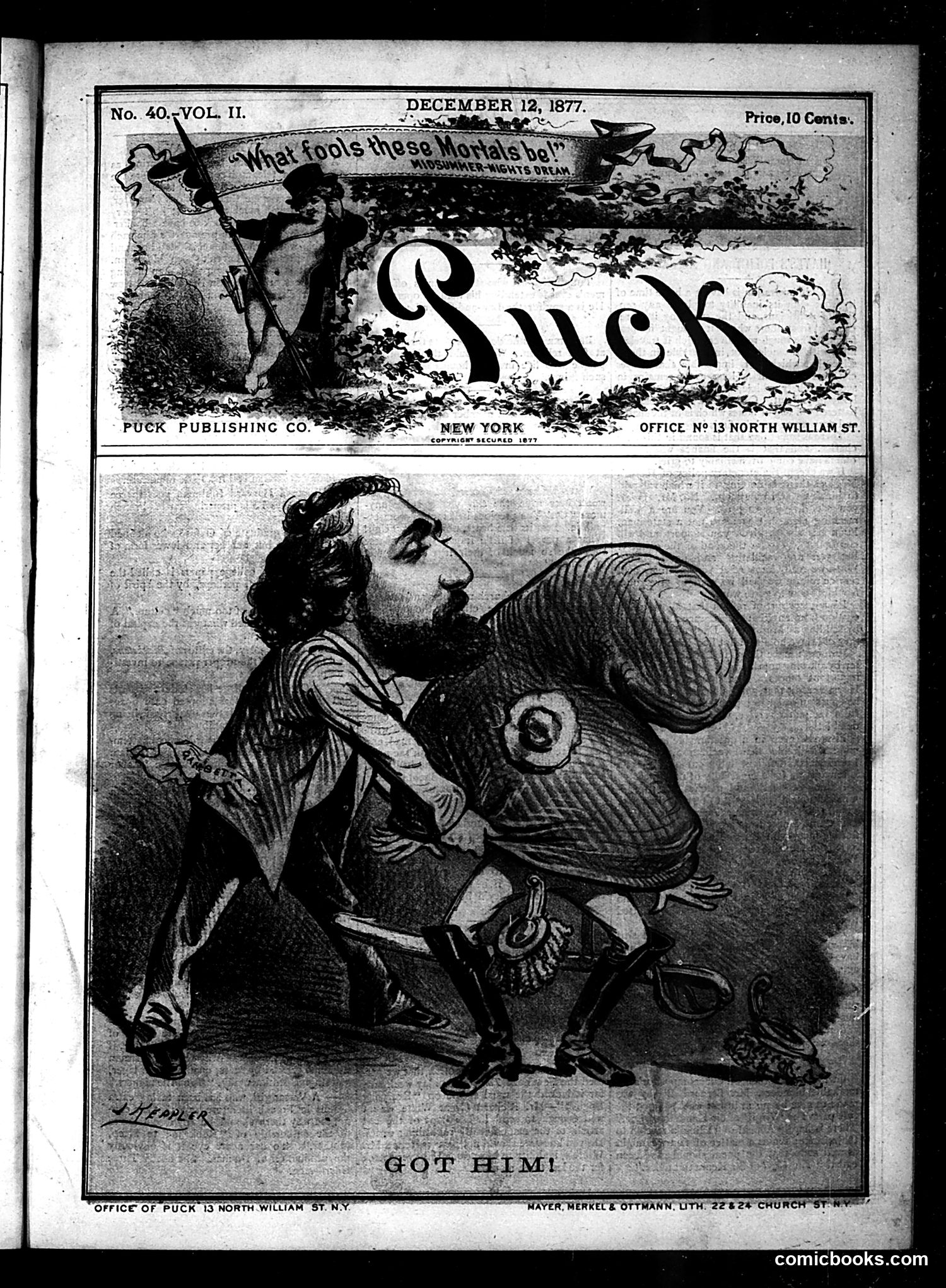
This satirical cartoon depicts a bearded man carrying a large sack labeled "S" on his back, with the caption "GOT HIM!" The top banner reads "What fools these Mortals be!"—a Shakespeare reference emphasizing human folly. The figure appears to represent someone who has "caught" or acquired something significant, though the specific identity and reference remain unclear from the image alone. The exaggerated physical caricature—the prominent facial hair and straining posture—suggests mockery of a public figure of the era. Without additional context, the exact political or social target cannot be definitively identified, though the composition suggests commentary on a notable capture, acquisition, or controversial acquisition from late 1877.
This page consists primarily of **editorial commentary and college notes rather than political cartoons**. The main content includes: **"Hayes's Policy and Message"** - A critique of President Rutherford B. Hayes's administration, discussing his challenges with party politics and reform efforts. The text suggests Hayes faced criticism for his approach to governance and civil service. **"Puckerings"** section - Brief satirical commentary on contemporary issues, including critiques of Oliver Cotter, the Law-and-Order League, and religious hypocrisy. **"College Notes"** - Humorous observations about university life and academic matters. The page contains **no prominent political cartoons visible**. It represents Puck's editorial voice through written satire rather than visual caricature, typical of 19th-century satirical journalism.
This cartoon satirizes congressional inefficiency and pointless debate. The central image depicts a figure being distilled or processed—a visual metaphor suggesting Congress extracts little of value from lengthy proceedings. The accompanying text mocks specific senators for wasting time on trivial matters. Senator Edmunds delayed Senate business over procedural disagreements; Senator Anthony proposed hearing about a President's message but got sidetracked; Senator Springer wanted information about Venezuelan government correspondence, prompting adjournment. The "essential oil" title is ironic—just as distillation concentrates substance, the cartoon suggests Congress's actual productivity is minimal despite endless talk. The satire targets institutional dysfunction and legislators prioritizing procedural complaints over substantive work.
This page contains **no political cartoon or satire**. Instead, it features two literary pieces: 1. **"The Lay of a Linen Rag"** — a humorous poem about a piece of linen cloth, written in the voice of the fabric itself, reflecting on its various uses in English domestic life. 2. **"Mythology on the Half-Shell: II. Orpheus"** — a prose essay retelling the Greek myth of Orpheus with apparent comedic intent, discussing his musical talents, his journey with the Argonauts, and his descent into the underworld. While *Puck* was primarily known for political satire and cartoons, this particular page showcases the magazine's literary content—humorous essays and verse that entertained readers beyond visual satire.
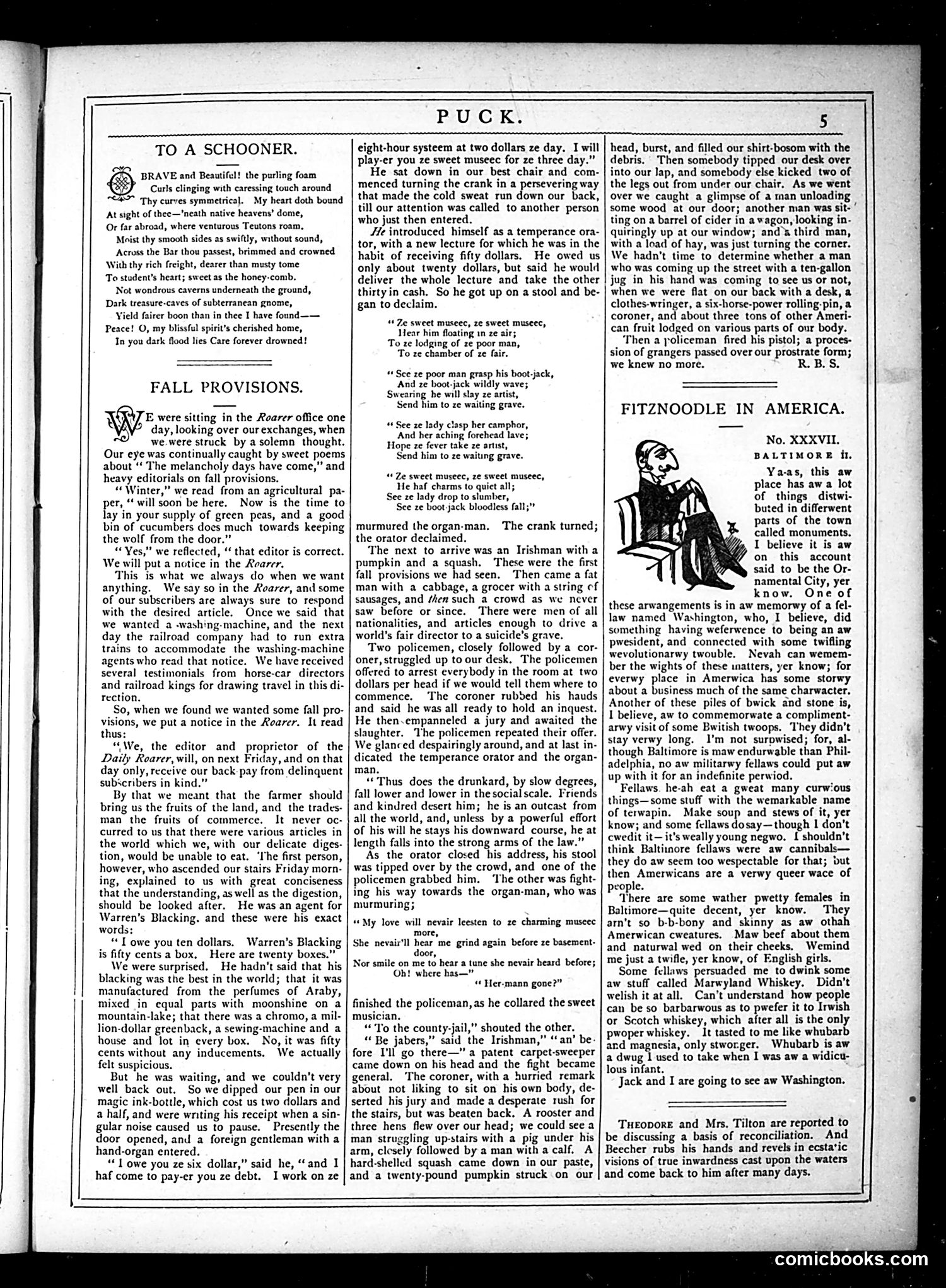
This page contains three distinct pieces: **"To a Schooner"** (top left): A poem praising a sailing ship, likely nostalgic commentary on maritime heritage. **"Fall Provisions"** (left column): An editorial discussing preparations for winter, including criticism of the editor's previous statements about fall provisions. This appears to be internal magazine commentary or self-satire about editorial consistency. **"Fitznoodle in America, No. XXXVII: Baltimore H."** (right): A illustrated story featuring a character named Fitznoodle observing American life. The cartoon shows a figure in a chair, likely depicting social commentary on American customs or immigrant observations. The text describes various Baltimore scenes—policemen, provisions, and social interactions—suggesting satirical observation of urban American life, possibly mocking either American behavior or a foreigner's confused reactions to it. The overall page mixes literary content with social satire typical of Puck's format.
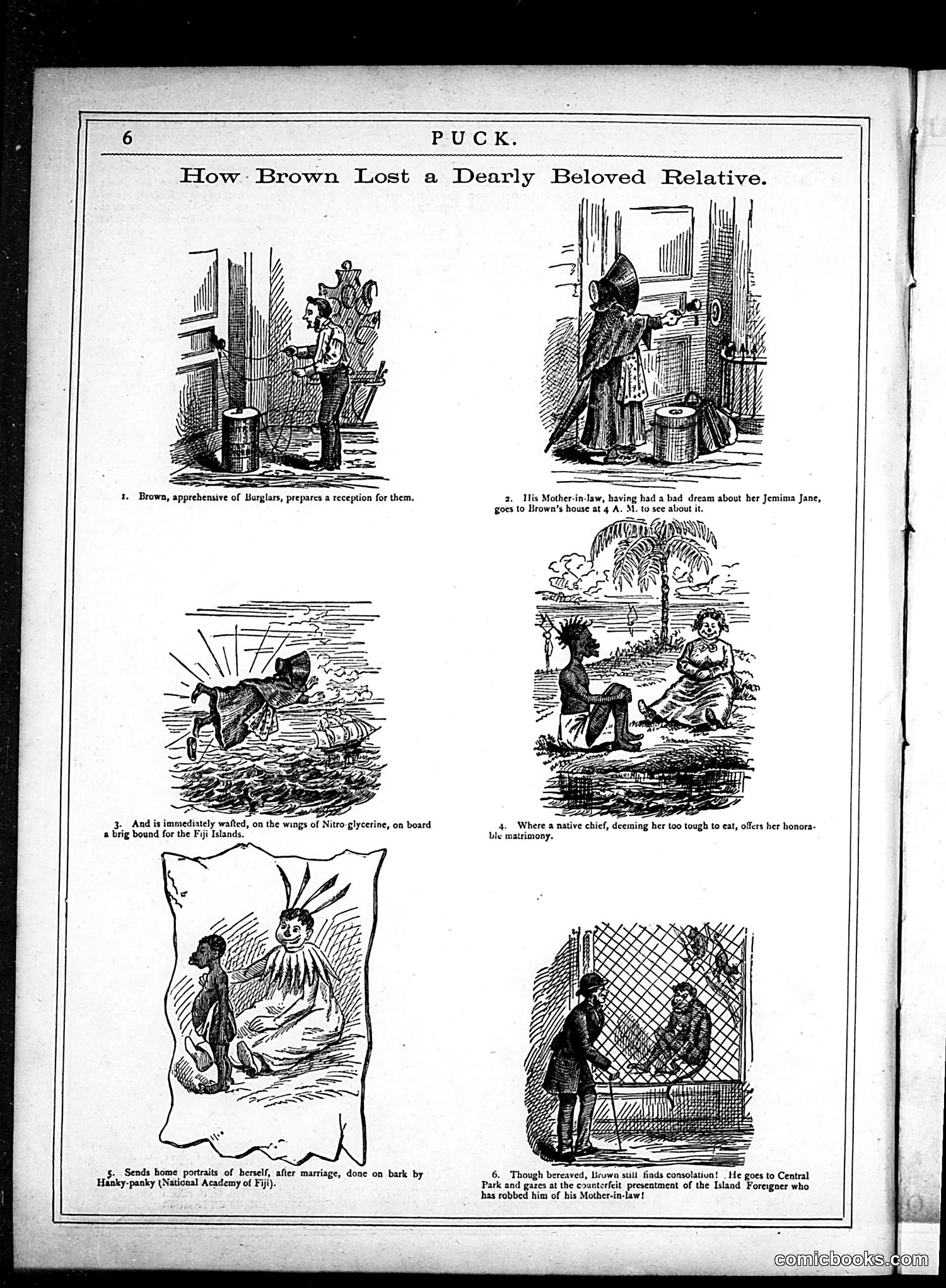
This is a satirical narrative about a character named Brown whose mother-in-law dies abroad. The six panels trace the sequence: Brown prepares to welcome burglars (panel 1), his mother-in-law has a bad dream and visits (panel 2), she's magically transported via "Nitro glycerine" to Fiji Islands (panel 3), where a native chief offers her marriage (panel 4). She sends her portrait home (panel 5), and finally Brown celebrates her departure by putting bars on a window (panel 6)—suggesting he's imprisoned or caged himself to avoid her return. The satire targets the common Victorian trope of the meddlesome mother-in-law. The absurd, fantastical journey to Fiji suggests Brown's fantasy of permanent separation. The joke's point: mothers-in-law were considered such nuisances that even magical banishment to remote islands seemed preferable to their presence.
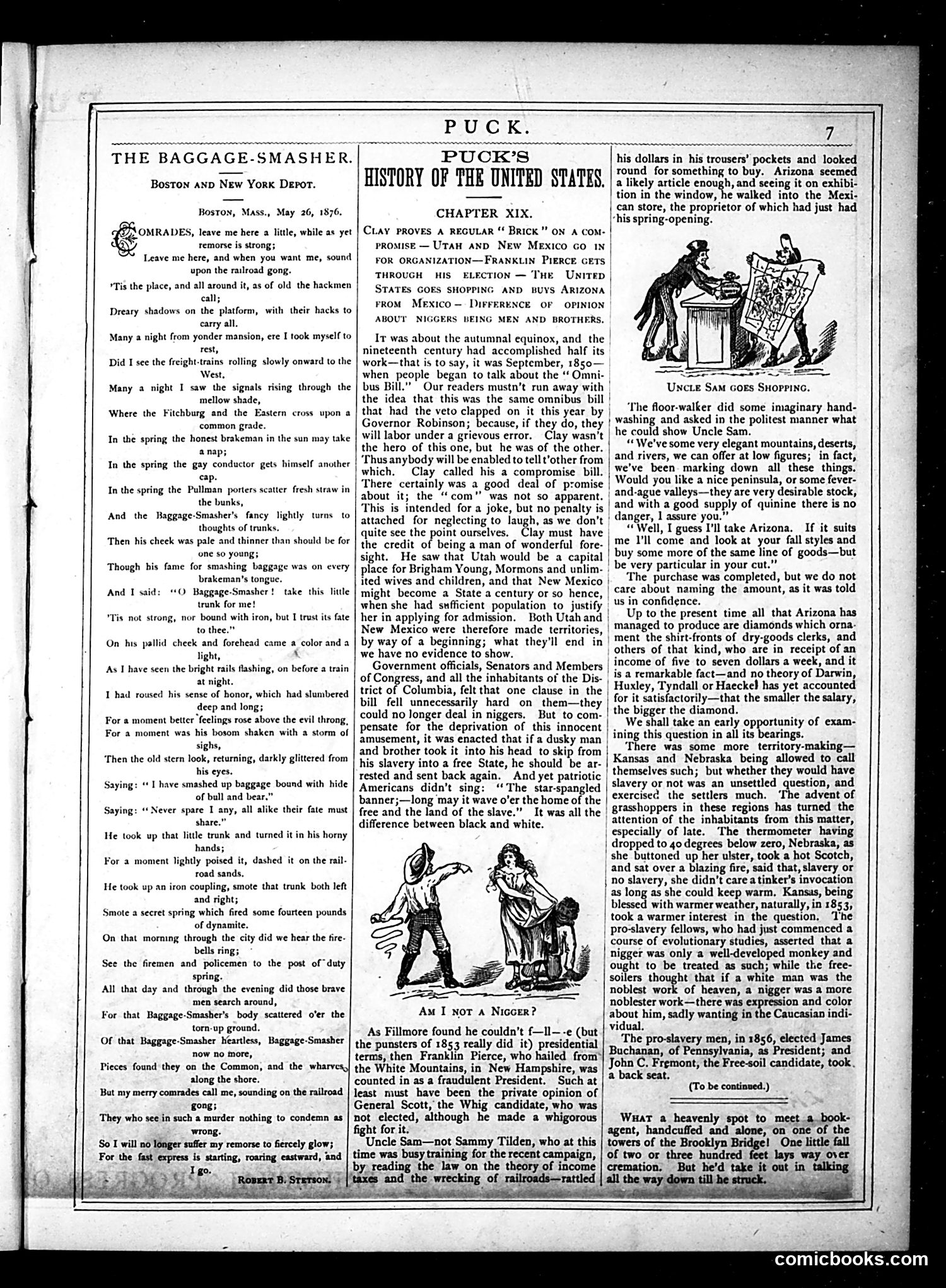
This page contains two distinct cartoons satirizing 1870s American politics and society. **"Uncle Sam Goes Shopping"** depicts Uncle Sam examining goods, likely referencing debates over territorial expansion and resource acquisition. The accompanying text discusses Utah and New Mexico statehood, slavery implications, and the "Omni-bill" controversy. **"Am I Not a Nigger?"** is a more complex political cartoon commenting on racial hypocrisy. The text references Fillmore's inability to become president, discussing how even Free-soil candidate John C. Frémont lost. The cartoon appears to satirize contradictions in American democratic rhetoric versus treatment of Black Americans, though the specific figures are unclear from the image alone. Both pieces reflect Puck's engagement with Reconstruction-era racial and political tensions.
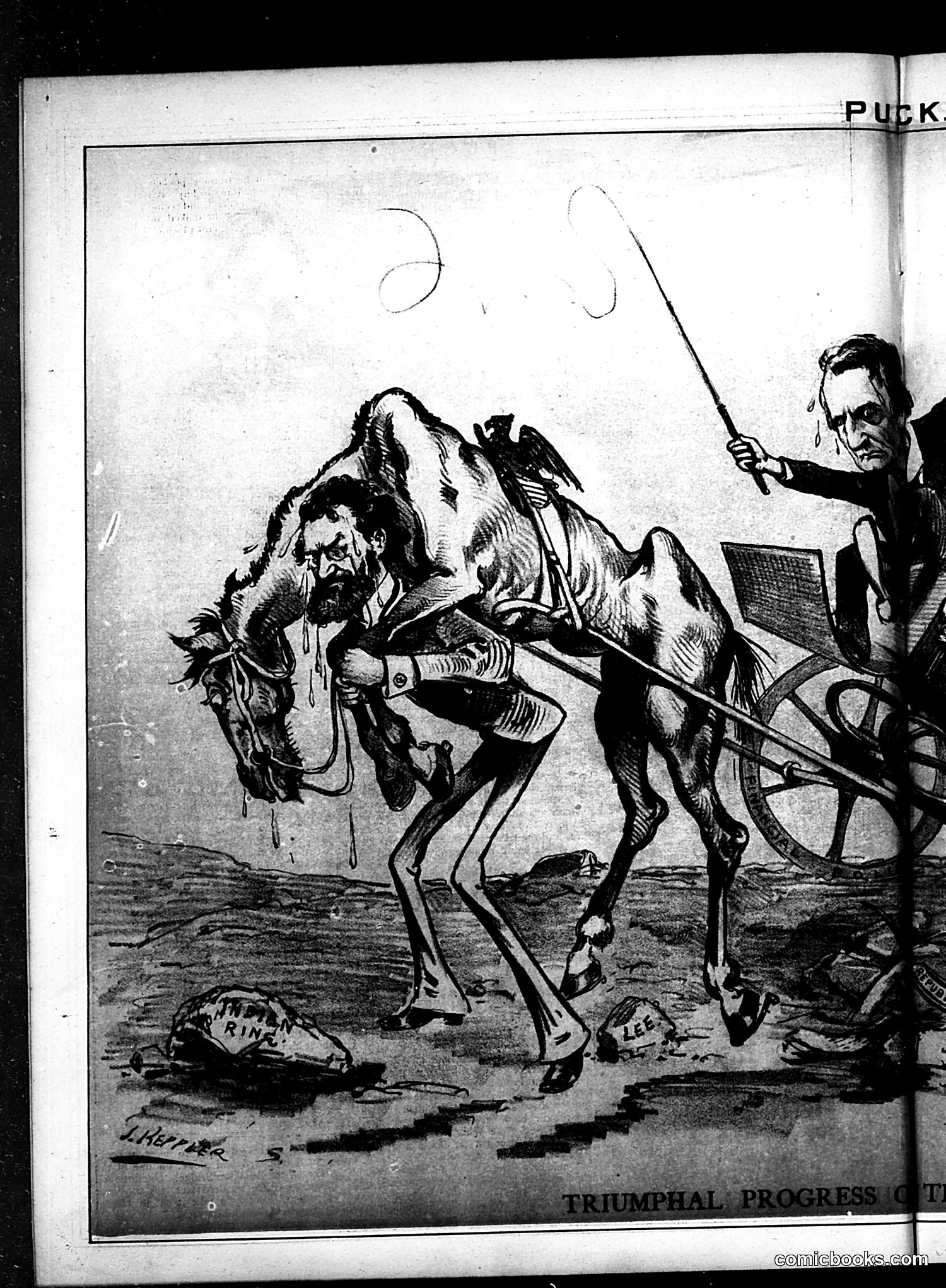
This political cartoon depicts a caricatured bearded figure being driven in a cart by an emaciated donkey, while a man on the right wields a whip overhead. The caption reads "TRIUMPHAL PROGRESS." The imagery is satirical: what appears to be a grand "triumphal" procession is actually degrading—the figure rides an underfed beast rather than a noble steed, suggesting failure or humiliation disguised as victory. The whip-wielder controls the proceedings, implying the bearded man is being manipulated or driven forward against his will. Without visible publication date or text identifying the specific figures, I cannot definitively name the political figures or historical event referenced. However, the cartoon clearly mocks someone being presented publicly as successful while actually experiencing diminishment or subjugation.
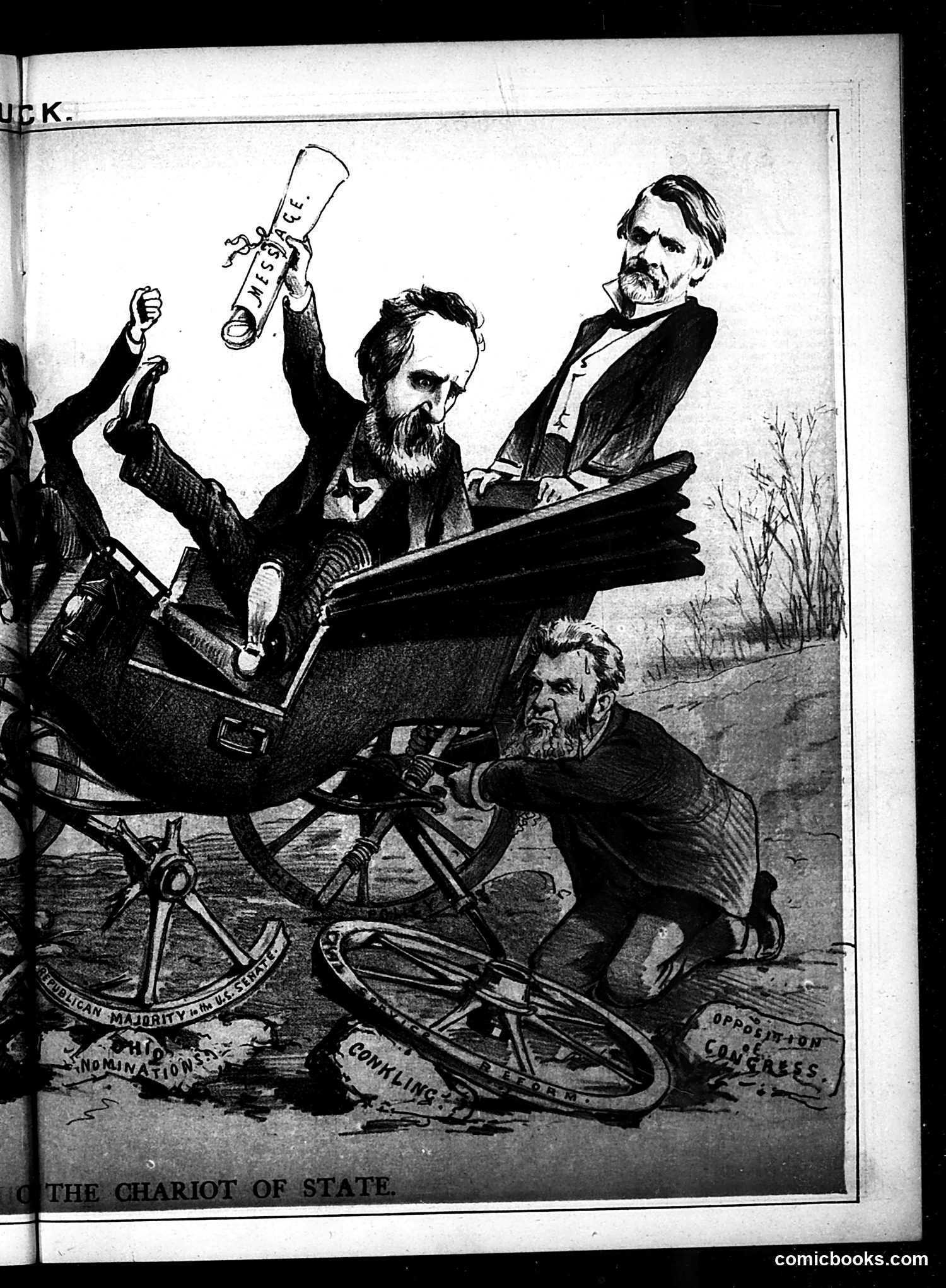
This political cartoon depicts four bearded men in a carriage labeled "The Chariot of State." The visible labels identify political factions: "Republican Majority," "Nomination," "Coalition," and "Opposition Candidates." One man sits elevated, holding what appears to be a telescope or instrument (suggesting vision/foresight). Another man is depicted crouching or struggling beneath the carriage, apparently pulling or supporting it. The satire comments on political maneuvering during what appears to be a presidential nomination period. The cartoon suggests tension between different Republican factions—the majority party struggling to maintain control while opposition elements and coalition partners compete for influence. The man beneath the carriage likely represents a subordinate or marginalized political faction bearing the burden of the party's ambitions.
This page contains theater reviews and dramatic criticism rather than political cartoons. The masthead shows "PUCK" with an illustrated jester figure. The main content discusses **theatrical productions and naming conventions for plays**. Key reviews mention: - **"Ingomar,"** a classical play adapted from Greek legend, praised for Miss Anderson's performance as Parthenia - **"Tangled,"** a new American comedy by James Steele Mackaye, which faced naming confusion with another Mackaye play, "Lost and Won" The satire appears directed at **theatrical producers' indecision and public confusion over play titles**—Mackaye reportedly changed his play's name multiple times within days, creating audience bewilderment. The "Dramatic Notes" section reviews other productions and performers of the era, providing cultural commentary on New York theater rather than political satire.
This page contains a serialized English short story by Frank Barrett rather than a political cartoon. The narrative concerns a gentleman's dispute over an insult to his cousin's honor, involving characters named Hugh Biron, De Gaillefontaine, and Rene. The story involves themes of dueling, apologies, and matters of honor—typical Victorian-era melodrama. A subplot involves a woman (implied to be "the Queen") whose actions or position affects the men's conduct. The page lacks explicit political satire or caricature. It appears to be entertainment fiction rather than topical commentary, representing Puck's occasional inclusion of literary content alongside its satirical cartoons.
This page is primarily **text content**, not a political cartoon. It contains the continuation of a serialized story ("Chapter XXXVII") featuring dialogue between characters named Hugh, René, and a young Spaniard discussing romantic entanglements and social propriety. The right column contains **"Puck's Jottings"**—brief satirical commentary on miscellaneous topics: marine animals talking, safe harbors, an uninterested Indian chief, frost affecting a hired girl, an Ohio man's suicide over office politics, and Nevada printing offices. These items are typical light satirical observations on American social oddities and news—the magazine's signature short-form humor—rather than focused political commentary. The page lacks prominent political cartoons or caricatures.
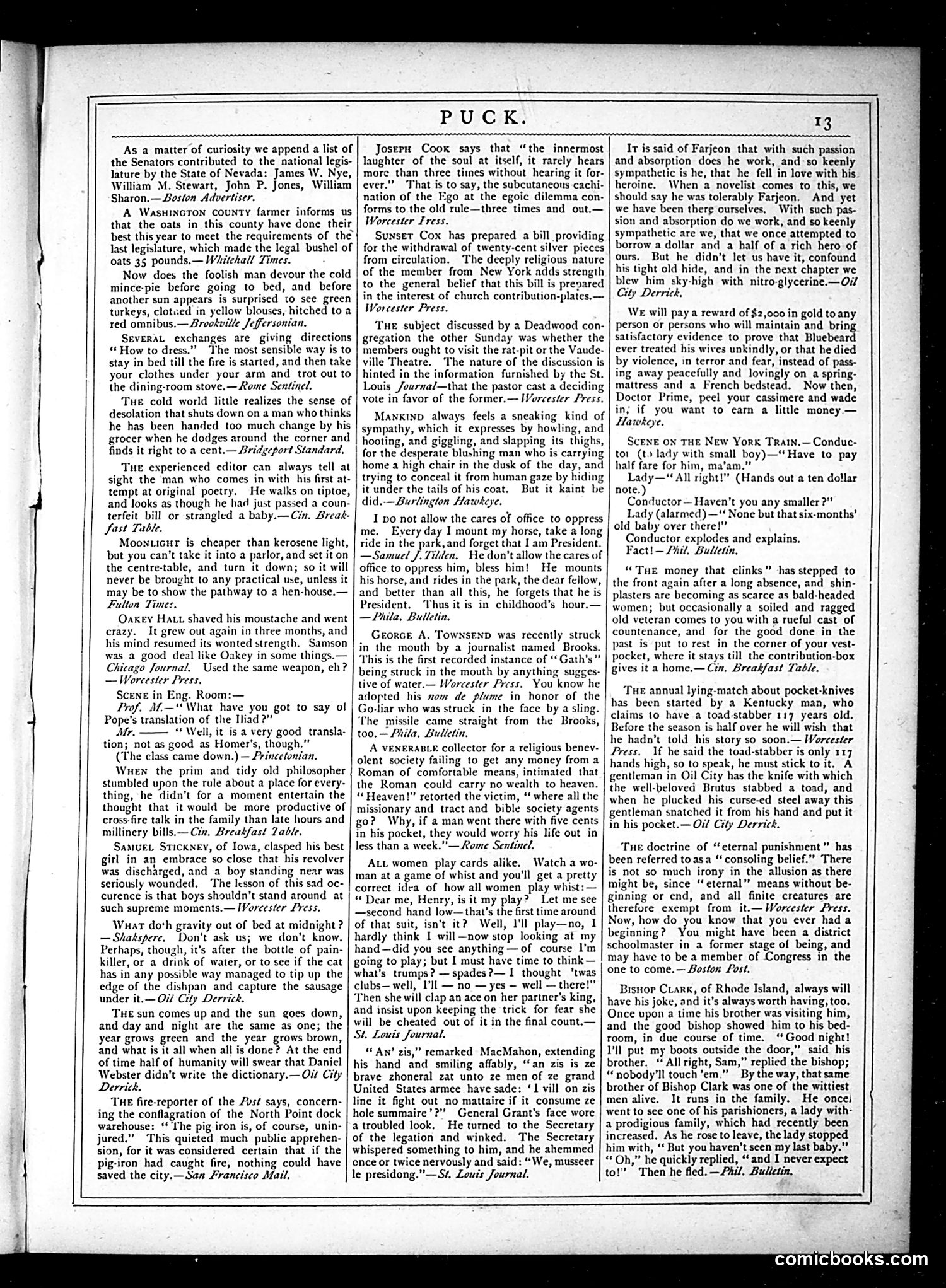
This Puck page is primarily text-based satirical commentary rather than illustrated cartoons. The content consists of brief humorous anecdotes and social observations targeting various topics: Nevada mining practices, religious controversies, gender dynamics (women playing cards and whist), workplace hierarchies, and political figures including references to President Grant and General Grant. One recurring joke involves a conductor on the New York Train demanding payment from a lady with a small boy. Another mocks a Kentucky man inventing a trick to win at cards by claiming his wife can play "poker knives." The satire targets middle-class social pretensions, gender role absurdities, and political incompetence of the Gilded Age. Without accompanying illustrations on this page, the humor relies entirely on witty observation and ironic commentary typical of Puck's literary approach.
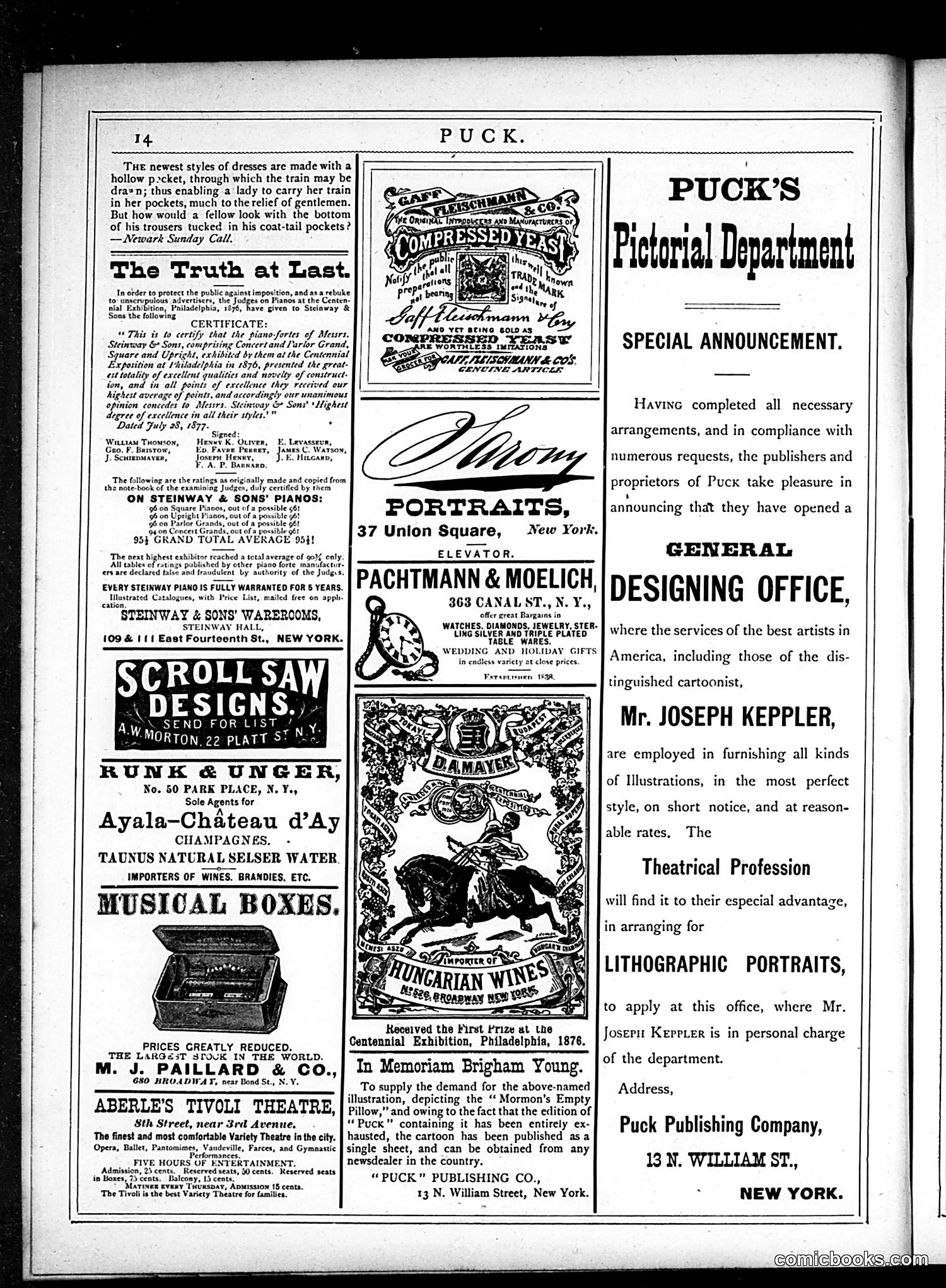
This is primarily an **advertising page** from Puck magazine, not a political cartoon page. The page contains various commercial advertisements for products and services available in late 19th-century New York, including: - Piano manufacturers and music boxes - Jewelry and watches (Pachtmann & Moelich) - Wine importers - A theater (Aberle's Tivoli Theatre) - A new "General Designing Office" for illustration services featuring cartoonist Joseph Keppler There is **no discernible political cartoon or satire** on this page. The only illustrated advertisement is a decorative label for Hungarian wine featuring classical imagery. The page serves as a historical record of commercial establishments and services of the era rather than satirical commentary.
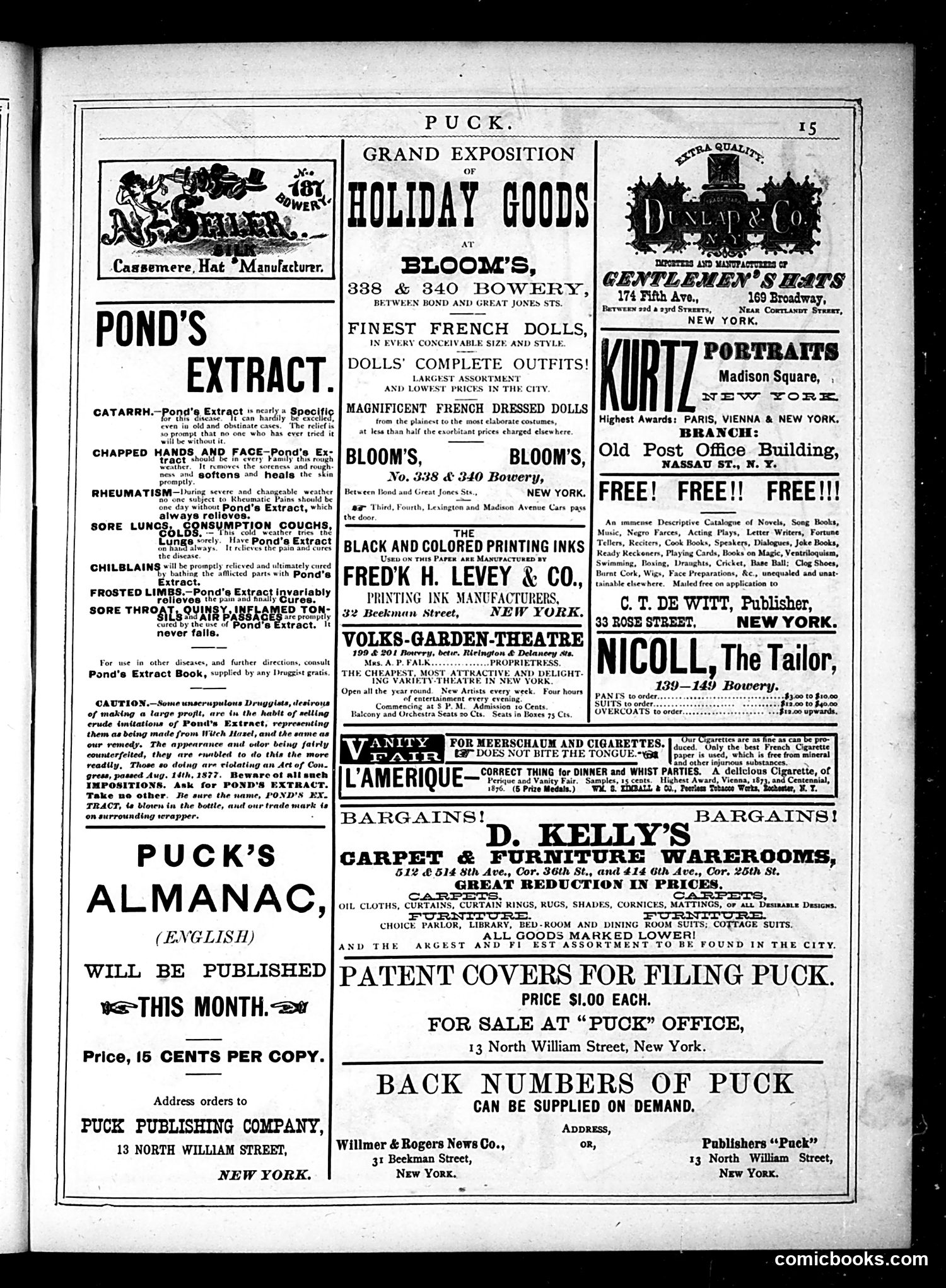
This page is primarily **advertisements and notices** rather than political cartoons or satirical content. The visible ads include: - **Pond's Extract** (a patent medicine claiming to cure catarrh, chapped hands, rheumatism, sore lungs, chilblains, and frosted limbs) - **D&Co Gentlemen's Hats** (New York haberdashery) - **Bloom's Holiday Goods** (French dolls and dressed dolls) - **Kurtz Portraits** (photography studio) - **Kelly's Carpet & Furniture Warerooms** (with "Great Reduction" sale) - **Patent Covers for Filing Puck** ($1.00 each) The page also announces **Puck's Almanac (English)** coming "this month" for 15 cents per copy. This appears to be a back page of the magazine devoted entirely to commercial advertising rather than satirical editorial content.
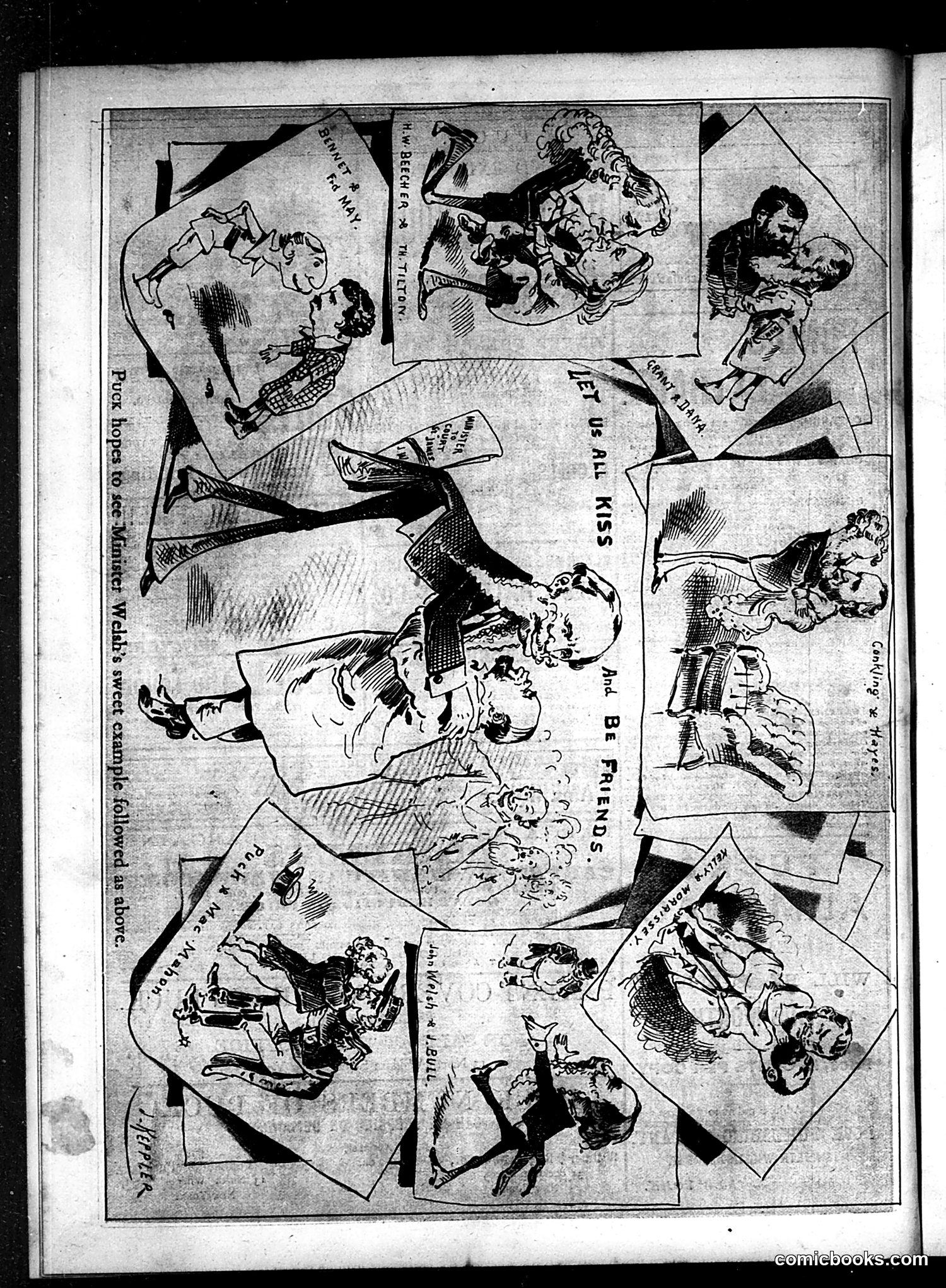
This page from *Puck* magazine presents a satirical comic strip titled "Let Us All Kiss and Be Friends," arranged in interconnected vignettes showing various figures in confrontational or reconciliatory poses. The central theme appears to be political or social reconciliation, with the repeated phrase "Let Us All Kiss and Be Friends" suggesting ironic commentary on forced peace-making between opposing groups or individuals. The cartoons depict exaggerated physical interactions—pushing, embracing, and dramatic gestures—typical of *Puck*'s style. However, **the specific historical context is unclear from the visible text alone**. Without a date or clearer identification of the caricatured figures, I cannot definitively identify which political conflict or scandal this addresses. The style suggests late 19th or early 20th-century American politics, but precise attribution requires additional documentation.