
Puck, 1877-12-12 · page 5 of 16
Puck — December 12, 1877 — page 5: what you’re looking at
What you’re looking at
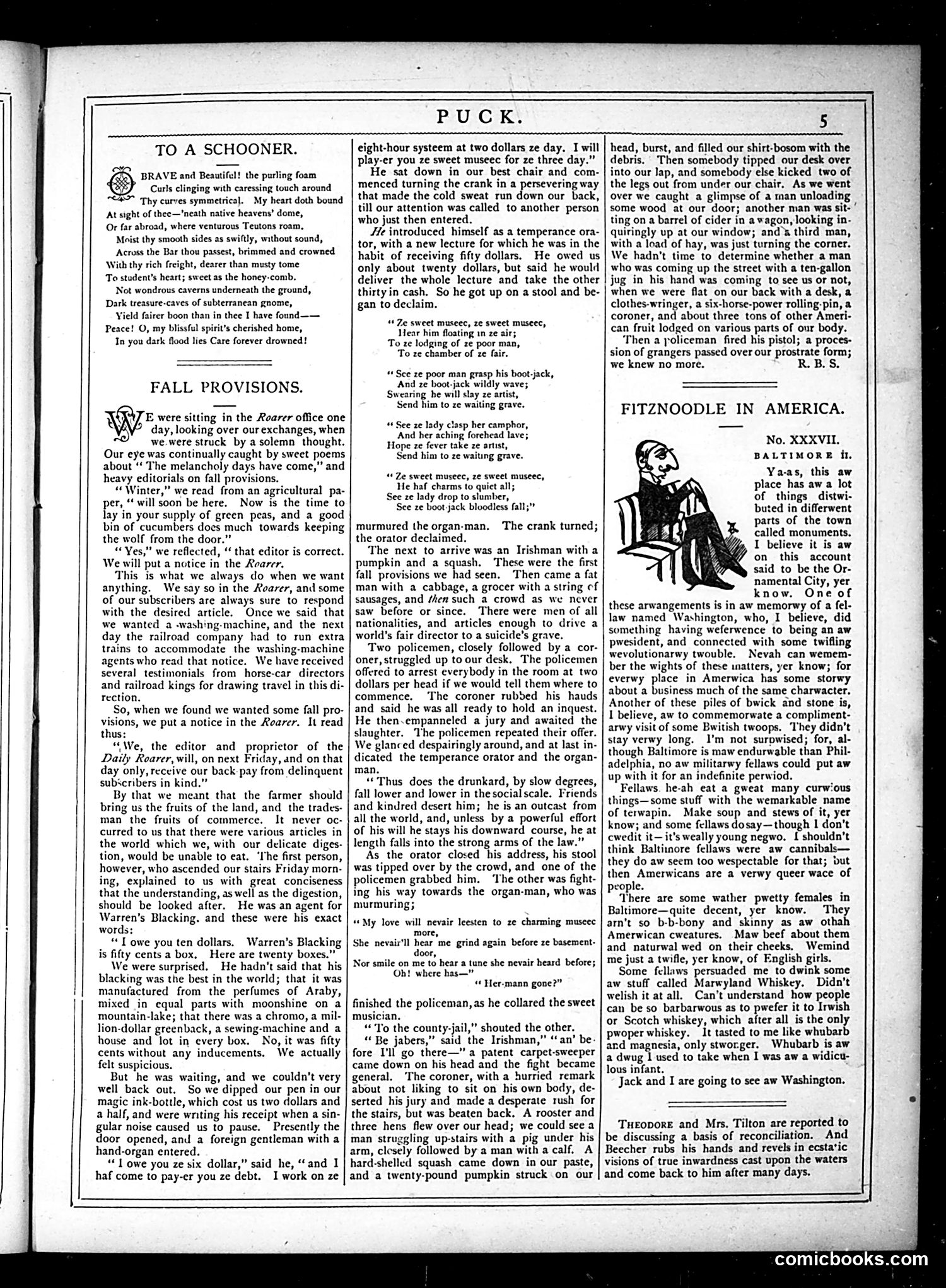
This page contains three distinct pieces: **"To a Schooner"** (top left): A poem praising a sailing ship, likely nostalgic commentary on maritime heritage. **"Fall Provisions"** (left column): An editorial discussing preparations for winter, including criticism of the editor's previous statements about fall provisions. This appears to be internal magazine commentary or self-satire about editorial consistency. **"Fitznoodle in America, No. XXXVII: Baltimore H."** (right): A illustrated story featuring a character named Fitznoodle observing American life. The cartoon shows a figure in a chair, likely depicting social commentary on American customs or immigrant observations. The text describes various Baltimore scenes—policemen, provisions, and social interactions—suggesting satirical observation of urban American life, possibly mocking either American behavior or a foreigner's confused reactions to it. The overall page mixes literary content with social satire typical of Puck's format.
📄 Transcribed text from this page (OCR, searchable)
Machine-transcribed from the original scan — historical spelling and the odd misread are preserved.
PUCK. 5 TO A SCHOONER. FQ, BRAVE and Beautifel! the purling foam Curls clinging with caressing touch around “42” Thy curves symmetrical. My heart doth bound ‘At sight of thee—'neath native heavens’ dome, Or far abroad, where venturous Teutons roam, Moist thy smooth sides as swiftly, without sound, ‘Across the Bar thou passest, brimmed and crowned With thy rich freight, dearer than musty tome To student's heart; sweet as the honey-comb. Not wondrous caverns underneath the ground, Dark treasure-caves of subterranean gnome, Yield fairer boon than in thee I have found—— Peace! O, my blissful spirit’s cherished home, In you dark flood lies Care forever drowned! FALL PROVISIONS. E were sitting in the Roarer office one day, looking over our exchanges, when we.were struck by a solemn thought. Our eye was continually caught by sweet poems about ‘‘ The melancholy days have come,” and heavy editorials on fall provisions. “Winter,” we read from an agricultural pa- per, ‘will soon be here. Now is the time to lay in your supply of green peas, and a good bin of cucumbers docs much towards keeping the wolf from the door.” “Yes,” we reflected, ‘ that editor is correct. We will put a notice in the Rearer. This is what we always do when we want anything. We say so in the Roarer, and some of our subscribers are always sure to respond with the desired article. Once we said that we wanted a «washing-machine, and the next day the railroad company had to run extra trains to accommodate the washing-machine agents who read that notice. We have received several testimonials from horse-car directors and railroad kings for drawing travel in this di- rection. So, when we found we wanted some fall pro- visions, we put a notice in the Reaver. It read thus: “We, the editor and proprietor of the Daily Roarer, will, on next Friday, and on that day only, receive our back-pay from delinquent subscribers in kind.” By that we meant that the farmer should bring us the fruits of the land, and the trades- man the fruits of commerce. It never oc- curred to us that there were various articles in the world which we, with our delicate diges- tion, would be unable to eat. ‘Ihe first person, however, who ascended our stairs Friday morn- ing, explained to us with great conciseness that the understanding, as well as the digestion, should be looked after. He was an agent for Warren's Blacking. and these were his exact words: “T owe you ten dollars. Warren's Blacking is fifty cents a box, Here are twenty boxes.” We were surprised. He hadn't said that his blacking was the best in the world; that it was manufactured from the perfumes of Araby, mixed in equal parts with moonshine on a mountain-lake; that there was a chromo, a mil- lion-dollar greenback, a sewing-machine and a house and lot in every box. No, it was fifty cents without any inducements. We actually felt suspicious. But he was waiting, and we couldn't very well back out. So we dipped our pen in our magic ink-bottle, which cost us two dollars and a half, and were wnting his receipt when a sin- gular noise caused us to pause. Presently the door opened, and a foreign gentleman with a hand-organ entered. “Lowe you ze six dollar,” said he, “and I haf come to pay-er you ze debt. I work on ze eight-hour systeem at two dollars ze day. I will play-er you ze sweet museec for ze three day. He sat down in our best chair and com- menced turning the crank in a persevering way that made the cold sweat run down our back, till our attention was called to another person who just then entered. He introduced himself as a temperance ora- tor, with a new lecture for which he was in the habit of receiving fifty dollars. He owed us only about twenty dollars, but said he would deliver the whole lecture and take the other thirty in cash. So he got up on a stool and be- gan to declaim. “Ze sweet museec, ze sweet museec, Hear him floating in ze air; To ze lodging of ze poor man, To ze chamber of ze fair. “« Sce ze poor man grasp his boot-jack, ‘And ze boot-jack wildly wave; Swearing he will slay ze artist, Send him to ze waiting grave. «« See ze lady clasp her camphor, ‘And her aching forehead lave; Hope ze fever take ze artist, Send him to ze waiting grave. Ze sweet muscec, ze sweel museec, He haf charms to quiet all; See ze lady drop to slumber, ‘See ze boot-jack bloodless fall;”” murmured the organ-man. The crank turned; the orator declaimed. The next to arrive was an Irishman with a pumpkin and a squash. These were the first fall provisions we had seen. Then came a fat man with a cabbage, a grocer with a string cf sausages, and /ien such a crowd as we never saw before or since. There were men of all nationalities, and articles enough to drive a world’s fair director to a suicide’s grave. Two policemen, closely followed by a cor- oner, struggled up to our desk. The policemen offered to arrest everybody in the room at two dollars per head if we would tell them where to commence, The coroner rubbed his hauds and said he was all ready to hold an inquest. He then.empanneled a jury and awaited the slaughter. ‘The policemen repeated their offer. We glanced despairingly around, and at last in- dicated the temperance orator and the organ- man. “Thus does the drunkard, by slow degrees, fall lower and lower in the social scale. Friends and kindred desert him; he is an outcast from all the world, and, unless by a powerful effort of his will he stays his downward course, he at length falls into the strong arms of the law.” As the orator closed his address, his stool was tipped over by the crowd, and one of the policemen grabbed him. ‘The other was fight- ing his way towards the organ-man, who was murmuring; “My love will nevair leesten to ze charming museec more, She nevair'll hear me grind again before ze basement: door, Nor smile on me to hear a tune she nevair heard before; Ob! where has—"” «« Her-mann gone?” finished the policeman, as he collared the sweet musician. “ To the county-jail,” shouted the other. “ Be jabers,” said the Irishman,” ‘an’ be- fore I'll go there—" a patent carpet-sweeper came down on his head and the fight became general. ‘The coroner, with a hurried remark about not liking to sit on his own body, de- serted his jury and made a desperate rush for the stairs, but was beaten back. A rooster and three hens flew over our head; we could see a man struggling up-stairs with a pig under his arm, clesely followed by a man with a calf. A hard-shelled squash came down in our paste, and a twenty-pound pumpkin struck on our head, burst, and filled our shirt-bosom with the debris. ‘Then somebody tipped our desk over into our lap, and somebody else kicked two of the legs out from under our chair, As we went over we caught a glimpse of a man unloading some wood at our door; another man was sit- ’ ting on a barrel of cider in a wagon, looking in- quiringly up at our window; and’s third man, with a load of hay, was just turning the corner. We hadn't time to determine whether a man who was coming up the street with a ten-gallon jug in his hand was coming to see us or not, when we were flat_on our back with a desk, a clothes-wringer, a six-horse-power rolling-pin, a coroner, and about three tons of other Ameri- can fruit lodged on various parts of our body. ‘Then a policeman fired his pistol; a proces- sion of grangers passed over our prostrate form; we knew no more. RBS. FITZNOODLE IN AMERICA. No. XXXVII. BALTIMORE it, Yaas, this aw place has aw a lot of things distwi- buted in differwent parts of the town called monuments. I believe it is aw on this account said to be the Or- namental City, yer know. One of these arwangements is in aw memorwy of a fel- law named Washington, who, I believe, did something having weferwence to being an aw pwesident, and connected with some twifling wevolutionarwy twouble. Nevah can wemem- ber the wights of these inatters, yer know; for everwy place in Amerwica has some storwy about a business much of the same charwacter. Another of these piles of bwick and stone is, I believe, aw to commemorwate a compliment- arwy visit of some Bwitish twoops. ‘They didn't stay verwy long. 1’m not surpwised; for, though Baltimore is maw endurwable than Phil- adelphia, no aw militarwy fellaws could put aw up with it for an indefinite perwiod. Fellaws. he-ah eat a gweat many curw‘ous things—some stuff with the wemarkable name of terwapin. Make soup and stews of it, yer know; and some fellaws dosay—though I don't cwedit it— it’s weally young negwo. I shouldn't think Baltiinore fellaws were aw cannibals— they do aw seem too wespectable for that; but then Amerwicans are a verwy queer wace of people. ‘There are some wather pwetty females in Baltimore—quite decent, yer know. They arn’t so b-b-bony and skinny as aw othah Amerwican cweatures. Maw beef about them and naturwal wed on their cheeks. Wemind me just a twifle, yer know, of English girls. Some fellaws persuaded me to dwink some aw stuff called Marwyland Whiskey. Didn't welish it at all. Can’t understand how people can be so barbarwous as to pwefer it to Irwish or Scotch whiskey, which after all is the only pwoper whiskey. It tasted to me like whubarb and magnesia, only stworger. Whubarb i a dwug 1 used to take when I was aw a wi lous infant. Jack and I are going to see aw Washington. Tueopore and Mrs. Tilton are reported to be discussing a basis of reconciliation. And Beecher rubs his hands and revels in ecsta‘ic visions of true inwardness cast upon the waters and come back to him after many days. comicbooks.com