
Puck, 1877-12-12 · page 12 of 16
Puck — December 12, 1877 — page 12: what you’re looking at
What you’re looking at
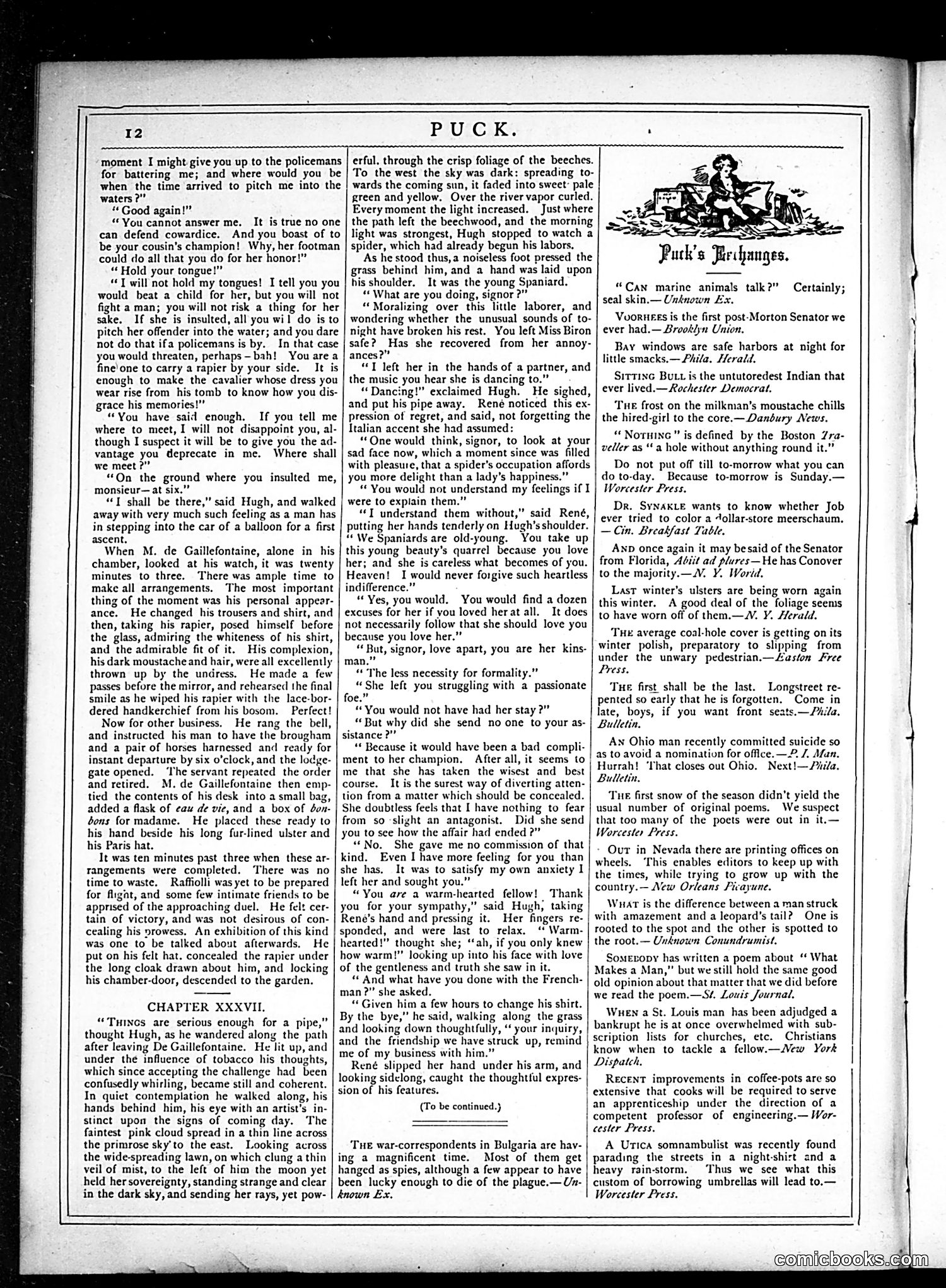
This page is primarily **text content**, not a political cartoon. It contains the continuation of a serialized story ("Chapter XXXVII") featuring dialogue between characters named Hugh, René, and a young Spaniard discussing romantic entanglements and social propriety. The right column contains **"Puck's Jottings"**—brief satirical commentary on miscellaneous topics: marine animals talking, safe harbors, an uninterested Indian chief, frost affecting a hired girl, an Ohio man's suicide over office politics, and Nevada printing offices. These items are typical light satirical observations on American social oddities and news—the magazine's signature short-form humor—rather than focused political commentary. The page lacks prominent political cartoons or caricatures.
📄 Transcribed text from this page (OCR, searchable)
Machine-transcribed from the original scan — historical spelling and the odd misread are preserved.
12 PUCK. moment I might give you up to the policemans for battering me; and where would you be when the time arrived to pitch me into the waters ?”” “Good again!” “You cannot answer me. It is true no one can defend cowardice. And you boast of to be your cousin’s champion! Why, her footman could do all that you do for her honor!” “ Hold your tongue!” “T will not hold my tongues! I tell you you would beat a child for her, but you will not fight a man; you will not risk a thing for her sake. If she is insulted, all you wil do is to pitch her offender into the water; and you dare not do that ifa policemans is by. In that case you would threaten, perhaps—bah! You area fine’one to carry a rapier by your side. It is enough to make the cavalier whose dress you wear rise from his tomb to know how you dis- grace his memories!" “You have said enough. If you tell me where to meet, I will not disappoint you, al- though I suspect it will be to give you the ad- vantage you deprecate in me. Where shall we meet 2” “On the ground where you insulted me, monsieur—at six.” “T shall be there,” said Hugh, and walked away with very much such feeling as a man has in stepping into the car of a balloon for a first ascent, When M. de Gaillefontaine, alone in his chamber, looked at his watch, it was twenty minutes to three. There was ample time to make all arrangements. The most important thing of the moment was his personal appear- ance. He changed his trousers and shirt, and then, taking his rapier, posed himself before the glass, admiring the whiteness of his shirt, and the admirable fit of it. His complexion, his dark moustache and hair, were all excellently thrown up by the undress. He made a few passes before the mirror, and rehearsed the final smile as he wiped his rapier with the lace-bor- dered handkerchief from his bosom. Perfect! Now for other business. He rang the bell, and instructed his man to have the brougham and a pair of horses harnessed and ready for instant departure by six o’clock, and the lodge- gate opened. ‘The servant repeated the order and retired. M. de Gaillefontaine then emp- tied the contents of his desk into a small bag, added a flask of eau de vie, and a box of bon- bons for madame. He placed these ready to his hand beside his long fur-lined ulster and his Paris hat. It was ten minutes past three when these ar- rangements were completed. There was no time to waste. Raffiolli was yet to be prepared for fligat, and some few intimate friends to be apprised of the approaching duel. He felt cer- tain of victory, and was not desirous of con- cealing his prowess. An exhibition of this kind was one to be talked about afterwards. He put on his felt hat. concealed the rapier under the long cloak drawn about him, and locking his chamber-door, descended to the garden. CHAPTER XXXVII. “‘Tuincs are serious enough for a pipe,” thought Hugh, as he wandered along the path after leaving De Gaillefontaine. He lit up, and under the influence of tobacco his thoughts, which since accepting the challenge had been confusedly whirling, became still and coherent. In quiet contemplation he walked along, his hands behind him, his eye with an artist's i stinct upon the signs of coming day. faintest pink cloud spread in a thin line across the primrose sky’to the east. Looking across the wide-spreading lawn, on which clung a thin veil of mist, to the left of him the moon yet held her sovereignty, standing strange and clear erful, through the crisp foliage of the beeches. To the west the sky was dark: spreading to- wards the coming sun, it faded into sweet: pale green and yellow. Over the river vapor curled. Every moment the light increased. Just where the path left the beechwood, and the morning light was strongest, Hugh stopped to watch a spider, which had already begun his labors. As he stood thus, a noiseless foot pressed the grass behind him, and a hand was laid upon his shoulder. It was the young Spaniard. “What are you doing, signor 2” “ Moralizing over this little laborer, and wondering whether the unusual sounds of to- night have broken his rest. You left Miss Biron safe? Has she recovered from her annoy- ances?” “1 left her in the hands of a partner, and the music you hear she is dancing to.” “Dancing!” exclaimed Hugh. He sighed, and put his pipe away. René noticed this ex- pression of regret, and said, not forgetting the Italian accent she had assumed: *©One would think, signor, to look at your sad face now, which a moment since was filled with pleasure, that a spider's occupation affords you more delight than a lady’s happiness.” * You would not understand my feelings if I were to explain them.” “*T understand them without,” said René, putting her hands tenderly on Hugh's shoulder. “We Spaniards are old-young. You take up this young beauty’s quarrel because you love her; and she is careless what becomes of you. Heaven! I would never forgive such heartless indifference.” “Yes, you would. You would find a dozen excuses for her if you loved herat all. It does not necessarily follow that she should love you because you love her.” “But, signor, love apart, you are her kins- man.” “The less necessity for formality.” “She left you struggling with a passionate foe.” “You would not have had her stay ?” “But why did she send no one to your as- sistance ?”” “* Because it would have been a bad compli- ment to her champion, After all, it seems to me that she has taken the wisest and best course. It is the surest way of diverting atten- tion from a matter which should be concealed. She doubtless feels that I have nothing to fear from so slight an antagonist. Did she send you to see how the affair had ended ?” **No. She gave me no commission of that kind. Even I have more feeling for you than she has. It was to satisfy my own anxiety I left her and sought you.” “You are a warm-hearted fellow! Thank you for your sympathy,” said Hugh; taking René’s hand and pressing it. sponded, and were last to relax. ‘* Warm- hearted!” thought she; “ah, if you only knew how warm!” looking up into his face with love of the gentleness and truth she saw in it. “ And what have you done with the French- man?” she asked. “ Given him a few hours to change his shirt. By the bye,” he said, walking along the grass and looking down thoughtfully, “ your inquiry, and the friendship we have struck up, remind me of my business with him.” René slipped her hand under his arm, and looking sidelong, caught the thoughtful expres- sion of his features. (To be continued.) ‘Tue war-correspondents in Bulgaria are hav- ing a magnificent time. Most of them get hanged as spies, although a few appear to have been lucky enough to die of the plague.— Un- in the dark sky, and sending her rays, yet pow- known Ex, Her fingers re- | “Can marine animals talk?” Certainly; seal skin.— Unknown Ex. Vooruess is the first post-Morton Senator we ever had.— Brooklyn Union, Bay windows are safe harbors at night for little smacks.— Phila. Herald, SittinG Butt is the untutoredest Indian that ever lived.— Rochester Democrat. E frost on the milkman’s moustache chills the hired-girl to the core.— Danbury News. “ Norninc” is defined by the Boston Zra- veller as “a hole without anything round it.” Do not put off till to-morrow what you can do to-day. Because to-morrow is Sunday.— Worcester Press. Dr. SyNakte wants to know whether Job ever tried to color a 4ollar-store meerschaum. —Cin. Breakfast Table. Anp once again it may besaid of the Senator from Florida, Adésit ad plures—He has Conover to the majority.—. ¥. World. Last winter's ulsters are being worn again this winter. A good deal of the foliage seems to have worn off of them.—/. Y. Herald. Tue average coal-hole cover is getting on its winter polish, preparatory to slipping. from under the unwary pedestrian.—Laston Free Press. ‘Tue first shall be the last. Longstreet re- pented so early that he is forgotten. Come in late, boys, if you want front seats.—/%ila. Bulletin. Aw Ohio man recently committed suicide so as to avoid a nomination for office. —P. /. Man. Hurrah! ‘That closes out Ohio. Next!—/%i/a. Bulletin. ‘Tue first snow of the season didn’t yield the usual number of original poems. We suspect that too many of the poets were out in it.— Worcester Press. Our in Nevada there are printing offices on wheels. This enables editors to keep up with the times, while trying to grow up with the country.— New Orleans Picayune. Wuat is the difference between a man struck with amazement and a leopard’s tail? One is rooted to the spot and the other is spotted to the root.— Unknown Conundrumist. Sometopy has written a poem about ‘ What Makes a Man,” but we still hold the same good old opinion about that matter that we did before we read the poem.—S¢. Louis Journal. Wuen a St. Louis man has been adjudged a bankrupt he is at once overwhelmed with sub- scription lists for churches, etc. Christians know when to tackle a fellow.—Mew York Dispatch. Recent improvements in coffee-pots are so extensive that cooks will be required to serve an apprenticeship under the direction of a competent professor of engineering.— Wor- cester Press. A Urica somnambulist was recently found parading the streets in a night-shirt and a heavy rain-storm. Thus we see what this custom of borrowing umbrellas will lead to.— Worcester Press. comichooks. — Eee I}