
Puck, 1877-12-12 · page 10 of 16
Puck — December 12, 1877 — page 10: what you’re looking at
What you’re looking at
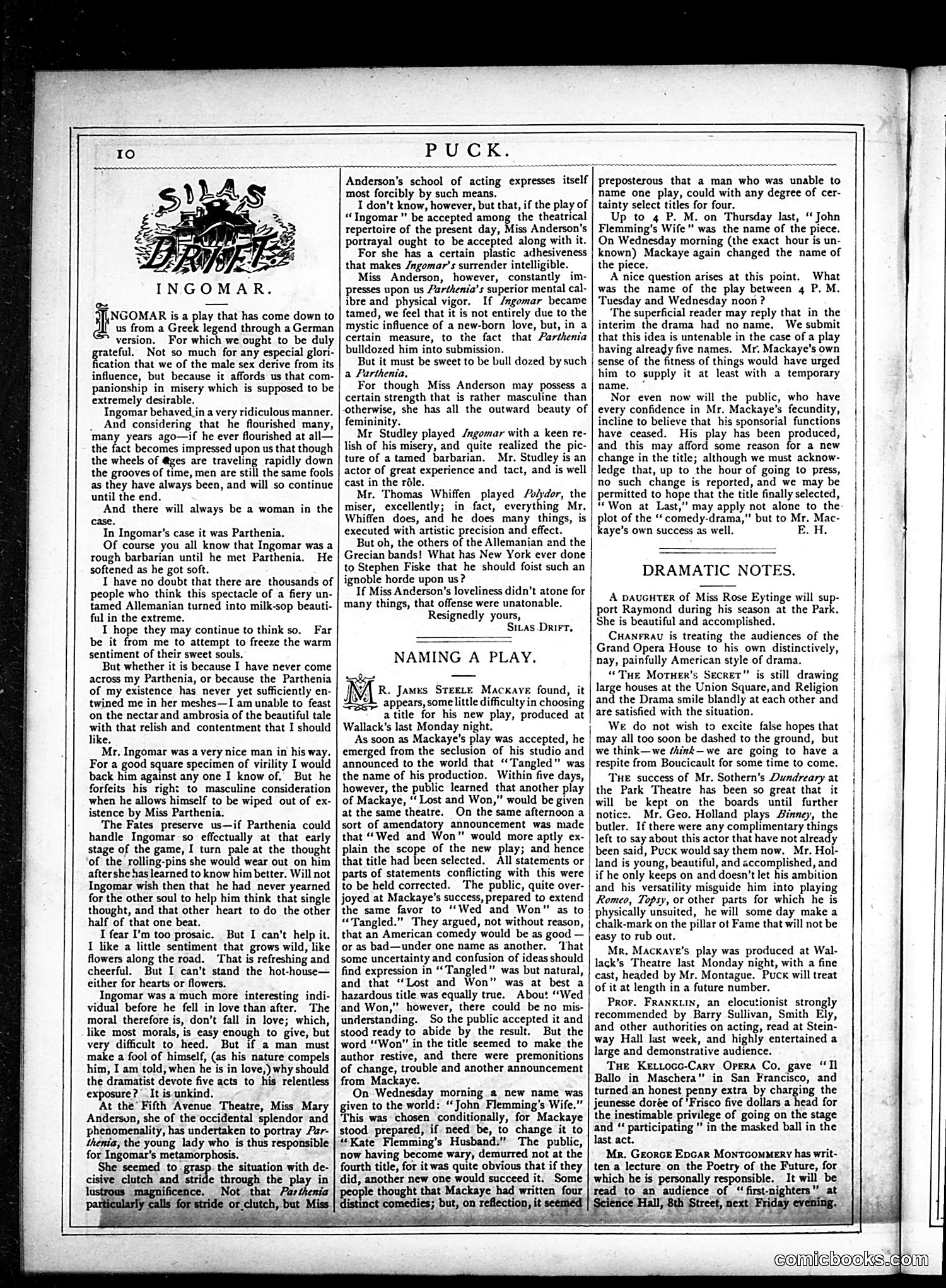
This page contains theater reviews and dramatic criticism rather than political cartoons. The masthead shows "PUCK" with an illustrated jester figure. The main content discusses **theatrical productions and naming conventions for plays**. Key reviews mention: - **"Ingomar,"** a classical play adapted from Greek legend, praised for Miss Anderson's performance as Parthenia - **"Tangled,"** a new American comedy by James Steele Mackaye, which faced naming confusion with another Mackaye play, "Lost and Won" The satire appears directed at **theatrical producers' indecision and public confusion over play titles**—Mackaye reportedly changed his play's name multiple times within days, creating audience bewilderment. The "Dramatic Notes" section reviews other productions and performers of the era, providing cultural commentary on New York theater rather than political satire.
📄 Transcribed text from this page (OCR, searchable)
Machine-transcribed from the original scan — historical spelling and the odd misread are preserved.
PUCK. legend through a German version. For which we ought to be duly rateful. Not so much for any especial glori- ication that we of the male sex derive from its influence, but because it affords us that com- panionship in misery which is supposed to be extremely desirable. Ingomar behaved in a very ridiculous manner. . And considering that he flourished many, many years ago—if he ever flourished at all— the fact becomes impressed upon us that though the wheels of @ges are traveling rapidly down the grooves of time, men are still the same fools as they have always been, and will so continue until the end. And there will always be a woman in the case. In Ingomar’s case it was Parthenia. Of course you all know that Ingomar was a rough barbarian until he met Parthenia. He softened as he got soft. I have no doubt that there are thousands of people who think this spectacle of a fiery un- tamed Allemanian turned into milk-sop beauti- ful in the extreme. I hope they may continue to think so. Far be it from me to attempt to freeze the warm sentiment of their sweet souls. But whether it is because 1 have never come across my Parthenia, or because the Parthenia of my existence has never yet sufficiently en- twined me in her meshes—I am unable to feast on the nectar and ambrosia of the beautiful tale with that relish and contentment that I should like. Mr. Ingomar was a very nice man in his way. For a good square specimen of virility 1 would back him against any one I know of. But he forfeits his right to masculine consideration when he allows himself to be wiped out of ex- istence by Miss Partheni The Fates preserve us—if Parthenia could handle Ingomar so effectually at that early stage of the game, I turn pale at the thought ‘of the rolling-pins she would wear out on him after she has learned to know him better. Will not Ingomar wish then that he had never yearned for the other soul to help him think that single thought, and that other heart to do the other half of that one beat. I fear I’m too prosaic. But I can’t help it. I like a little sentiment that grows wild, like flowers along the road. ‘hat is refreshing and cheerful. But I can’t stand the hot-house— either for hearts or flowers. Ingomar was a much more interesting indi- vidual before he fell in love than after. The moral therefore is, don’t fall in love; which, like most morals, is easy enough to give, but very difficult to heed. But if a man must make a fool of himself, (as his nature compels him, I am told, when he is in love,) why should the dramatist devote five acts to his relentless exposure? It is. unkind. At the’ Fifth Avenue Theatre, Miss Mary Anderson, she of the occidental splendor and phenomenality, has undertaken to portray Par- thenia, the young lady who is thus responsible for Ingomar’s metamorphosis. She seemed to grasp. the situation with de- cisive clutch and stride through the play in lustrous _magnificen Not. that Parthenic NGOMAR is a pity that has come down to us from a Greel Anderson's school of acting expresses itself most forcibly by such means. I don’t know, however, but that, if the play of “Ingomar” be accepted among the theatrical repertoire of the present day, Miss Anderson's portrayal ought to be accepted along with it. For she has a certain plastic adhesiveness that makes /ngomar’s surrender intelligible. Miss Anderson, however, constantly im- presses upon us Parthenia’s superior mental cal- ibre and physical vigor. If /ngomar became tamed, we feel that it is not entirely due to the mystic influence of a new-born love, but, in a certain measure, to the fact that Parthenia bulldozed him into submission. But it must be sweet to be bull dozed by such a Farthenia. For though Miss Anderson may possess a certain strength that is rather masculine than otherwise, she has all the outward beauty of femininity. Mr Studley played /ngomar with a keen re- lish of his misery, and quite realized the pic- ture of a tamed barbarian. Mr. Studley is an actor of great experience and tact, and is well cast in the réle. Mr. Thomas Whiffen played /oiydor, the miser, excellently; in fact, everything Mr. Whiffen does, and he does many things, is executed with artistic precision and effect. But oh, the others of the Allemanian and the Grecian bands! What has New York ever done to Stephen Fiske that he should foist such an ignoble horde upon us? If Miss Anderson’s loveliness didn’t atone for many things, that offense were unatonable. Resignedly yours, Sitas.Drirt, NAMING A PLAY. JIN/\ R. James Steere Mackaye found, it ANeL appears, some little difficulty in choosing atitle for his new play, produced at Wallack’s last Monday night. As soon as Mackaye’s play was accepted, he emerged from the seclusion of his studio and announced to the world that “Tangled” was the name of his production. Within five days, however, the public learned that another play of Mackaye, ‘“‘ Lost and Won,” would be given at the same theatre. On the same afternoon a sort of amendatory announcement was made that “Wed and Won” would more aptly ex- plain the scope of the new play; and hence that title had been selected. All statements or parts of statements conflicting with this were to be held corrected. The public, quite over- joyed at Mackaye’s success, prepared to extend the same favor to ‘Wed and Won” as to “Tangled.” They argued, not without reason, that an American comedy would be as good — or as bad—under one name as another. ‘That some uncertainty and confusion of ideas should find expression in ‘‘ Tangled” was but natural, and that ‘Lost and Won” was at best a hazardous title was equally true. About “Wed and Won,” however, there could be no mis- understanding. So the public accepted it and stood ready to abide by the result. But the word “Won” in the title seemed to make the author restive, and there were premonitions of change, trouble and another announcement from Mackaye. On Wednesday morning a new name was given to the world: “John Flemming’s Wife.” This was chosen conditionally, for Mackaye stood prepared, if need be, to change it to “Kate Flemming’s Husband:” The public, now having become wary, demurred not at the fourth title, for it was quite obvious that if they did, another new one would succeed it. Some people thought that Mackaye had written four distinct comedies; but, on i preposterous that a man who was unable to name one play, could with any degree of cer- tainty select titles for four. Up to 4 P. M. on Thursday last, “ John Flemming’s Wife” was the name of the piece. On Wednesday morning (the exact hour is un- known) Mackaye again changed the name of the piece. A nice question arises at this point. What was the name of the play between 4 P. M. Tuesday and Wednesday noon ? ‘The superficial reader may reply that in the interim the drama had no name, We submit that this idea is untenable in the case of a play having already five names. Mr. Mackaye's own sense of the fitness of things would have urged him to supply it at least with a temporary name. Nor even now will the public, who have every confidence in Mr. Mackaye’s fecundity, incline to believe that his sponsorial functions have ceased. His play has been produced, and this may afford some reason for a new change in the title; although we must acknow- ledge that, up to the hour of going to press, no such change is reported, and we may be permitted to hope that the title finally selected, “Won at Last,” may apply not alone to the plot of the ‘‘ comedy-drama,” but to Mr. Mac- kaye’s own success as well. E. H. DRAMATIC NOTES. A DAUGHTER of Miss Rose Eytinge will sup- port Raymond during his season at the Park. She is beautiful and accomplished. Cuanrrau is treating the audiences of the Grand Opera House to his own distinctively, nay, painfully American style of drama. “THe Motuer’s Secret” is still drawing large houses at the Union Square, and Religion and the Drama smile blandly at each other and are satisfied with the situation. We do not wish to excite false hopes that may all too soon be dashed to the ground, but we think—we shink—we are going to have a respite from Boucicault for some time to come. Tue success of Mr. Sothern’s Dundreary at the Park Theatre has been so great that it will be kept on the boards until further notice. Mr. Geo. Holland plays Binney, the butler. If there were any complimentary things left to say about this actor that have not already been said, Puck would say them now. Mr. Hol- land is young, beautiful, and accomplished, and if he only keeps on and doesn’t let his ambition and his versatility misguide him into playing Romeo, Topsy, or other parts for which he is physically unsuited, he will some day make a chalk-mark on the pillar ot Fame that will not be easy to rub out. Mr. Mackave’s play was produced at Wal- lack’s Theatre last Monday night, with a fine cast, headed by Mr. Montague. Puck will treat of it at length in a future numbe: Pror. FRANKLIN, an elocutionist strongly recommended by Barry Sullivan, Smith Ely, and other authorities on acting, read at Stein- way Hall last week, and highly entertained a large and demonstrative audience. Tue Ketiocc-Cary Opera Co. gave “Il Ballo in Maschera” in San Francisco, and turned an honest penny extra by charging the jeunesse dorée of 'Frisco five dollars a head for the inestimable privilege of going on the stage and “ participating ” in the masked ball in the last act. Mr. Georce Epcar Montcommery has writ- ten a lecture on the Poetry of the Future, for which he is personally responsible. It will be read to an audience of “‘first-nighters” at Bih Stret, nest Friday even Ct gah tht EE a PAS comichooks.gom