
Puck, 1877-12-12 · page 7 of 16
Puck — December 12, 1877 — page 7: what you’re looking at
What you’re looking at
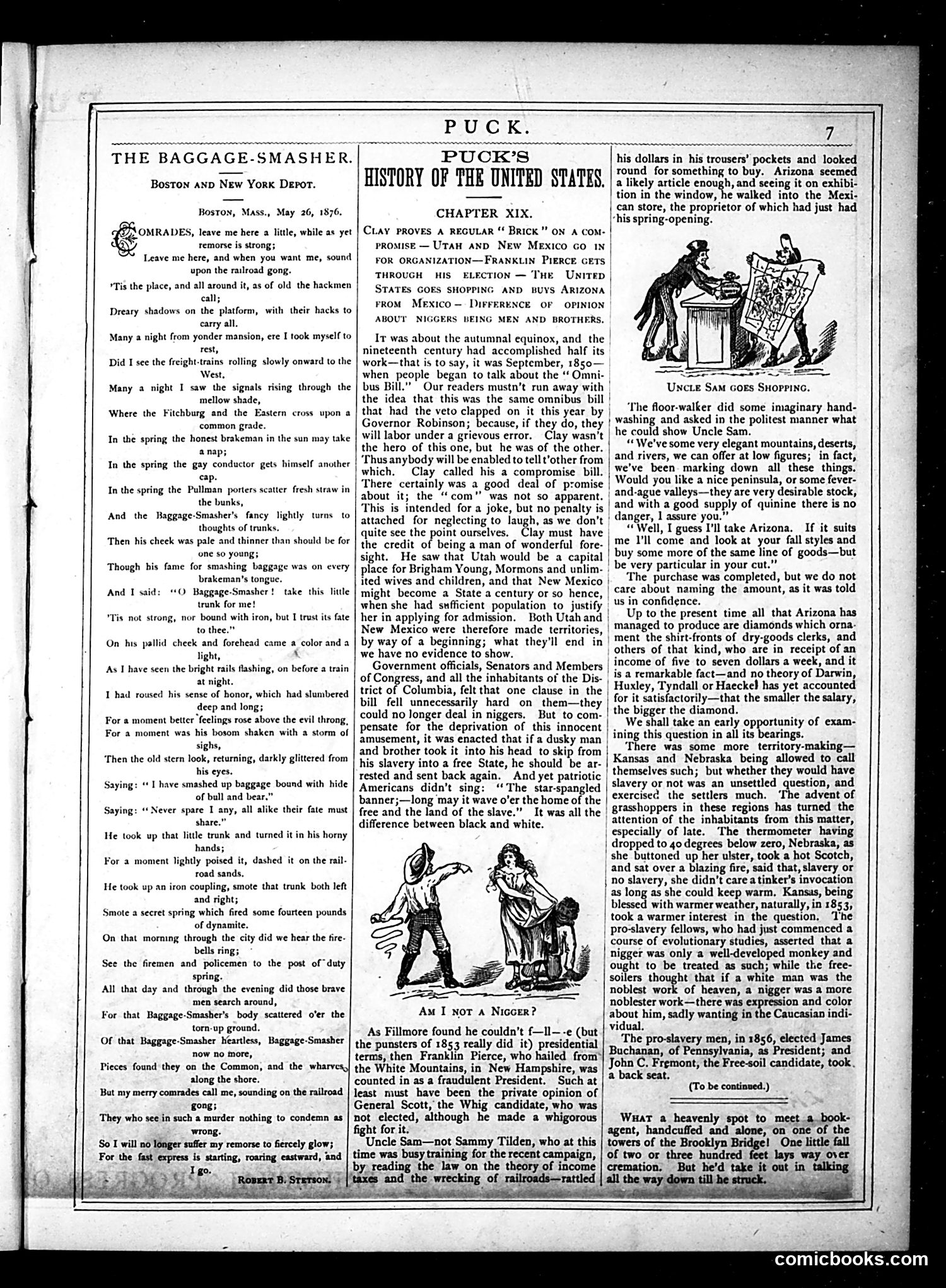
This page contains two distinct cartoons satirizing 1870s American politics and society. **"Uncle Sam Goes Shopping"** depicts Uncle Sam examining goods, likely referencing debates over territorial expansion and resource acquisition. The accompanying text discusses Utah and New Mexico statehood, slavery implications, and the "Omni-bill" controversy. **"Am I Not a Nigger?"** is a more complex political cartoon commenting on racial hypocrisy. The text references Fillmore's inability to become president, discussing how even Free-soil candidate John C. Frémont lost. The cartoon appears to satirize contradictions in American democratic rhetoric versus treatment of Black Americans, though the specific figures are unclear from the image alone. Both pieces reflect Puck's engagement with Reconstruction-era racial and political tensions.
📄 Transcribed text from this page (OCR, searchable)
Machine-transcribed from the original scan — historical spelling and the odd misread are preserved.
— Boston anp New York Depot. Boston, Mass., May 26, 1876, OMRADES, leave me here a little, while as yet remorse is strong; Leave me here, and when you want me, sound upon the railroad gong. ‘Tis the place, and all around it, as of old the hackmen. call; Dreary shadows on the platform, with their hacks to carry all. Many a night from yonder mansion, ere I took myself to rest, Did I see the freight-trains rolling slowly onward to the West, Many a night I saw the signals rising through the mellow shade, Where the Fitchburg and the Eastern cross upon a common grade. In the spring the honest brakeman in the sun may take anap; In the spring the gay conductor gets himself another cap. In the spring the Pullman porters scatter fresh straw in the bunks, And the Baggage-Smasher’s fancy lightly turns to thoughts of trunks. ‘Then his cheek was pale and thinner than should be for one so young; Though his fame for smashing baggage was on every brakeman’s tongue. +O Baggage-Smasher ! trunk for me! "Tis not strong, nor bound with iron, but I trust its fate to thee.” On his pallid cheek and forehead came a color and a light, 4 As I have seen the bright rails flashing, on before a train at night. I had roused his sense of honor, which had slumbered deep and long; For a moment better feelings rose above the evil throng, For a moment was his bosom shaken with a storm of sighs, Then the old stern look, returning, darkly glittered from his eyes. Saying: «I have smashed up bagga; of bull and beat Saying: “Never spare I any, all alike their fate must share.” He took up that little trunk and turned it in his horny hands; For a moment lightly poised it, dashed it on the rail- road sands. He took up an iron coupling, smote that trunk both left and right; Smote a secret spring which fired some fourteen pounds of dynamite. On that morning through the city did we hear the fire- bells ring; See the firemen and policemen to the post of” duty spring. All that day and through the evening did those brave men search around, For that Baggage-Smasher’s body scattered o'er the torn-up ground, Of that Baggage-Smasher heartless, Baggage-Smasher now no more, Pieces found they on the Common, and the wharves,| along the shore. But my merry comrades call me, sounding on the railroad gong; ‘They who see in such a murder nothing to condemn as wrong. So I will no longer suffer my remorse to fiercely glow; For the fast express is starting, roaring eastward, and And I said: take this litle bound with hide THE BAGGAGE-SMASHER. | which. HISTORY OF THE UNITED STATES. CHAPTER XIX. CLAY PROVES A REGULAR “ BRICK” ON A COM- PROMISE — UTAH AND New MExico Go 1N FOR ORGANIZATION—FRANKLIN PIERCE GETS THROUGH HIS ELECTION — ‘THE Unitep STATES GOES SHOPPING AND BUYS ARIZONA FROM MEXICO— DIFFERENCE OF OPINION ABOUT NIGGERS BEING MEN AND BROTHERS. It was about the autumnal equinox, and the nineteenth century had accomplished half its work—that is to say, it was September, 1850— when people began to talk about the “ Omni- bus Bill.” Our readers mustn’t run away with the idea that this was the same omnibus bill that had the veto clapped on it this year by Governor Robinson; becauserit they do, they will labor under a grievous error. Clay wasn’t the hero of this one, but he was of the other. ‘Thus anybody will be enabled to tell t’other from Clay called his a compromise bill. There certainly was a good deal of promise about it; the “com” was not so apparent. This is intended for a joke, but no penalty is attached for neglecting to laugh, as we don't quite see the point ourselves. Clay must have the credit of being a man of wonderful fore- sight. He saw that Utah would be a capital place for Brigham Young, Mormons and unlim- ited wives and children, and that New Mexico might become a State a century or so hence, when she had sufficient population to justify her in applying for admission. Both Utah and New Mexico were therefore made territories, by way of a beginning; what they'll end in we have no evidence to show. Government officials, Senators and Members of Congress, and all the inhabitants of the Dis- trict of Columbia, felt that one clause in the bill fell unnecessarily hard on them—they could no longer deal in niggers. But to com- pensate for the deprivation of this innocent amusement, it was enacted that if a dusky man and brother took it into his head to skip from his slavery into a free State, he should be ar- rested and sent back again. And yet patriotic Americans didn’t sing: ‘The star-spangled banner;—long may it wave o'er the home of the free and the land of the slave.” It was all the difference between black and white. Am I not a NIGGER? As Fillmore found he couldn’t f—Il—-e (but the punsters of 1853 really did it) presidential terms, then the White Mountains, in New Hampshire, was counted in as a fraudulent President. Such at least must have been the private opinion of General Scott, the Whig candidate, who was not elected, although he made a whigorous fight for it. Uncle Sam—not Sammy Tilden, who at this time was busy training for the recent campaign, by, reading the law on the theory of income and the wrecking of railroads—rattled Franklin Pierce, who hailed from his dollars in his trousers’ pockets and looked round for something to buy. Arizona seemed a likely article enough, and seeing it on exhibi- tion in the window, he walked into the Mexi- can store, the proprietor of which had just had his spring-opening. | UNcLE Sam GoEs SHOPPING. ‘The floor-walker did some imaginary hand- washing and asked in the politest manner what he could show Uncle Sam. “We've some very elegant mountains, deserts, | and rivers, we can offer at low figures; in fact, | we've been. marking down all these things. | Would you like a nice peninsula, or some fever- and-ague valleys—they are very desirable stock, | and with a good supply of quinine there is no , danger, 1 assure you.”” “Well, I guess I'll take Arizona. If it suits me I'll come and look at your fall styles and buy some more of the same line of goods—but be very particular in your cut.” | The purchase was completed, but we do not | care about naming the amount, as it was told us in confidence. | Up to the present time all that Arizona has managed to produce are diamonds which orna- ment the shirt-fronts of dry-goods clerks, and others of that kind, who are in receipt of an | income of five to seven dollars a week, and it | is a remarkable fact—and no theory of Darwin, Huxley, Tyndall or Haeckel has yet accounted | for it satisfactorily—that the smaller the salary, | the bigger the diamond. We shall take an early opportunity of exam- | ining this question in all its bearings. | There was some more territory-making— | Kansas and Nebraska being allowed to call | themselves such; but whether they would have | slavery or not was an unsettled uestion, and | exercised the settlers much. e advent of | grasshoppers in these regions has turned the attention of the inhabitants from this matter, | especially of late. The thermometer having | dropped to 40 degrees below zero, Nebraska, as | she buttoned up her ulster, took a hot Scotch, | and sat over a blazing fire, said that, slavery or | no slavery, she didn't care a tinker’s invocation | as long as she could keep warm. Kansas, being blessed with warmer weather, naturally, in 1853, took a warmer interest in the question, The | pro-slavery fellows, who had just commenced a | course of evolutionary studies, asserted that a | nigger was only a well-developed monkey and | ought to be treated as such; while the free- soilers thought that if a white man was the noblest work of heaven, a nigger was a more noblester work—there was expression and color about him, sadly wanting in the Caucasian indi- vidual. The pro-slavery men, in 1856, elected James Buchanan, of Pennsylvania, as President; and John C. Fremont, the Free-soil candidate, took. a back seat. (To be continued.) { Wuat a heavenly spot to meet_a.book- agent, handcuffed and alone, on one of the powers of the Brookiya eas} One little fall of two or three hundred lays way over cremation. But he'd take it out in talking the wa till he struck. _ comicbooks.com