
Puck, 1877-12-12 · page 11 of 16
Puck — December 12, 1877 — page 11: what you’re looking at
What you’re looking at
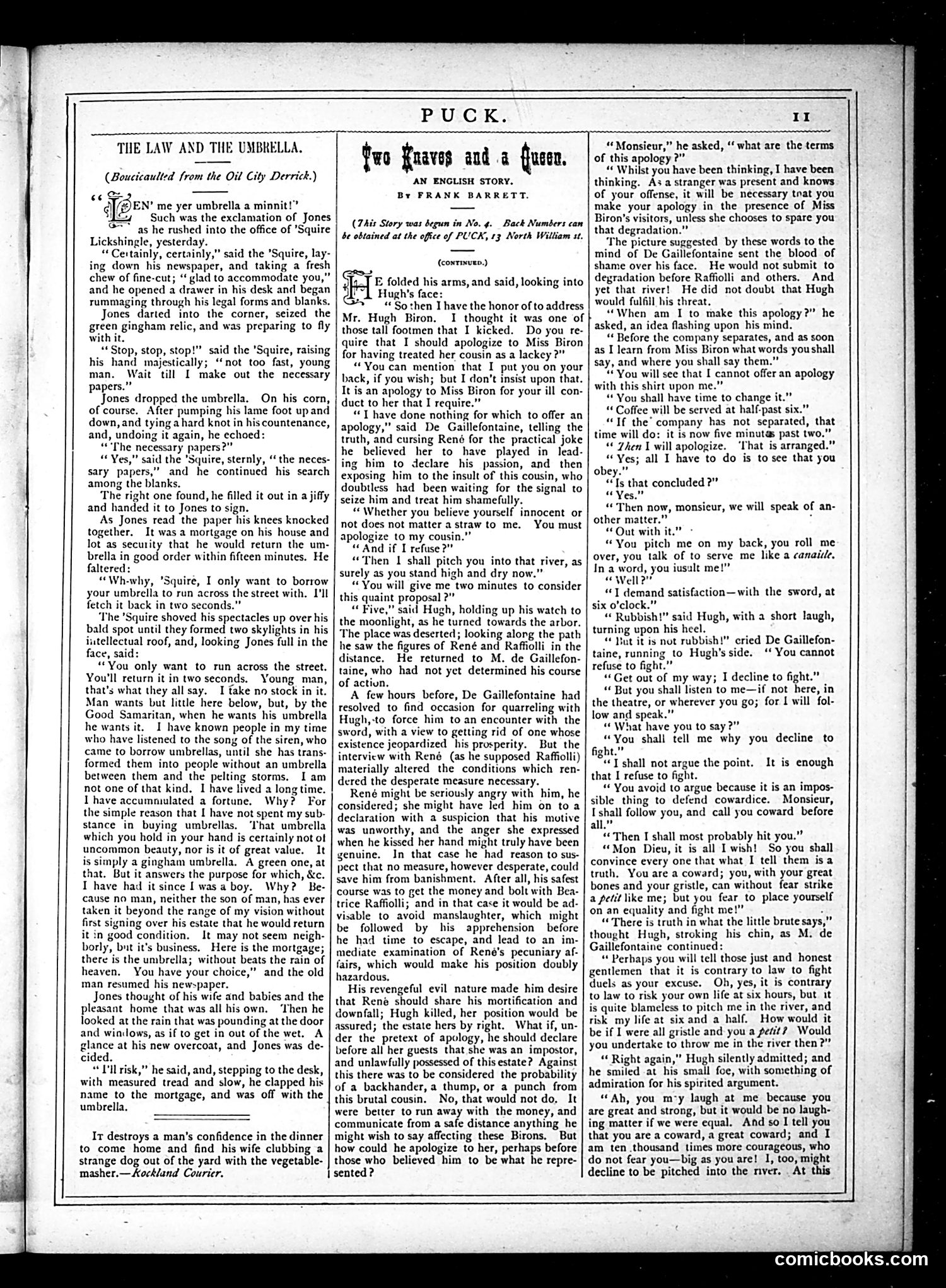
This page contains a serialized English short story by Frank Barrett rather than a political cartoon. The narrative concerns a gentleman's dispute over an insult to his cousin's honor, involving characters named Hugh Biron, De Gaillefontaine, and Rene. The story involves themes of dueling, apologies, and matters of honor—typical Victorian-era melodrama. A subplot involves a woman (implied to be "the Queen") whose actions or position affects the men's conduct. The page lacks explicit political satire or caricature. It appears to be entertainment fiction rather than topical commentary, representing Puck's occasional inclusion of literary content alongside its satirical cartoons.
📄 Transcribed text from this page (OCR, searchable)
Machine-transcribed from the original scan — historical spelling and the odd misread are preserved.
PUCK. II THE LAW AND THE UMBRELLA. (Boucicaulted from the Oil City Derrick.) <& Peery: EN’ me yer umbrella a minnit!” Such was the exclamation of Jones as he rushed into the office of ’Squire Lickshingle, yesterday. “Certainly, certainly,” said the Squire, lay- ing down his newspaper, and taking a fresh chew of fine-cut; ‘glad to accommodate you,” and he opened a drawer in his desk and began rummaging through his legal forms and blanks. Jones darted into the corner, seized the green gingham relic, and was preparing to fly with it. “Stop, stop, stop!” said the 'Squire, raising his hand majestically; ‘not too fast, young man. Wait till I make out the necessary papers.” Jones dropped the umbrella. On his corn, of course. After pumping his lame foot up and down, and tying a hard knot in his countenance, and, undoing it again, he echoed: “Phe necessary papers?” “ Yes," said the 'Squire, sternly, “the neces- sary papers,” and he continued his search among the blanks. The right one found, he filled it out in a jiffy and handed it to Jones to sign. As Jones read the paper his knees knocked together. It was a mortgage on his house and lot as security that he would return the um- brella in good order within fifteen minutes. He faltered: “Wh-why, ’Squire, I only want to borrow your umbrella to run across the street with. L'll fetch it back in two seconds.” ‘The 'Squire shoved his spectacles up over his bald spot until they formed two skylights in his ellectual roof, and, looking Jones full in the face, said: “You only want to run across the street. You'll return it in two seconds. Young man, that’s what they all say. I take no stock in it. Man wants but little here below, but, by the Good Samaritan, when he wants his umbrella he wants it. I have known people in my time who have listened to the song of the siren, who came to borrow umbrellas, until she has trans- formed them into people without an umbrella between them and the pelting storms. I am not one of that kind. 1 have lived a long time. Ihave accumnulated a fortune. Why? For the simple reason that I have not spent my sub- stance in buying umbrellas. ‘That umbrella which you hold in your hand is certainly not of uncommon beauty, nor is it of great value. It is simply a gingham umbrella. A green one, at that. But it answers the purpose for which, &c. I have had it since I was a boy. Why? Be- cause no man, neither the son of man, has ever taken it beyond the range of my vision without first signing over his estate that he would return it in good condition. It may not seem neigh- borly, but it's business. Here is the mortgage; there is the umbrella; without beats the rain of heaven. You have your choice,” and the old man resumed his newspaper. Jones thought of his wife and babies and the pleasant home that was all his own. ‘Then he looked at the rain that was pounding at the door and windows, as if to get in out of the wet. A glance at his new overcoat, and Jones was de- cided. L'il risk,” he said, and, stepping to the desk, with measured tread and slow, he clapped his name to the mortgage, and was off with the umbrella, It destroys a man’s confidence in the dinner to come home and find his wife clubbing a strange dog out of the yard with the vegetable- masher.—ockland Courier. Fuo fnaves anda ffueen. AN ENGLISH STORY. Br FRANK BARRETT. (This Story was begun in No. g. Back Numbers can be obtained at the office of PUCK, 13 North William st. (conrimven.) pon E folded his arms, and said, looking into AEA Hugh's face: > Sothen I have the honor of to address Mr. Hugh Biron. I thought it was one of those tall footmen that I kicked. Do you re- quire that I should apologize to Miss Biron for having treated her cousin as a lackey?” “You can mention that I put you on your back, if you wish; but I don’t insist upon that. It is an apology to Miss Biron for your ill con- duct to her that I require.” “T have done nothing for which to offer an apology,” said De Gaillefontaine, telling the truth, and cursing René for the practical joke he believed her to have played in lead- ing him to declare his passion, and then exposing him to the insult of this cousin, who doubtless had been waiting for the signal to seize him and treat him shamefully. “Whether you believe yourself innocent or not does not matter a straw to me. You must apologize to my cousin.” “And if I refuse?” “Then I shall pitch you into that river, as surely as you stand high and dry now.” “You will give me two minutes to consider this quaint proposal ?” “ Five,” said Hugh, holding up his watch to the moonlight, as he turned towards the arbor. The place was deserted; looking along the path he saw the figures of René and Raffiolli_in the distance. He returned to M. de Gaillefon- taine, who had not yet determined his course of actiun, A few hours before, De Gaillefontaine had resolved to find occasion for quarreling with Hugh,-to force him to an encounter with the sword, with a view to getting rid of one whose existence jeopardized his prosperity. But the interview with René (as he supposed Raffiolli) materially altered the conditions which ren- dered the desperate measure necessary. René might be seriously angry with him, he considered; she might have led him on to a declaration with a suspicion that his motive was unworthy, and the anger she expressed when he kissed her hand might truly have been genuine. In that case he had reason to sus- pect that no measure, however desperate, could save him from banishment. After all, his safest course was to get the money and bolt with Bea- trice Raffiolli; and in that case it would be ad- visable to avoid manslaughter, which might be followed by his apprehension before he had time to escape, and lead to an im- mediate examination of René’s pecuniary af- fairs, which would make his position doubly hazardous. His revengeful evil nature made him desire that René should share his mortification and downfall; Hugh killed, her position would be assured; the estate hers by right. What if, un- der the pretext of apology, he should declare before all her guests that she was an impostor, and unlawfully possessed of this estate? Against this there was to be considered the probability of a backhander, a thump, or a punch from this brutal cousin. No, that would not do, It were better to run away with the money, and communicate from a safe distance anything he might wish to say affecting these Birons. But how could he apologize to her, perhaps before those who believed him to be what he repre- I sented ? “Monsieur,” he asked, ‘ what are the terms of this apology ?” “ Whilst you have been thinking, I have been thinking. A3 a stranger was present and knows of your offense, it will be necessary tnat you make your apology in the presence of Miss Biron’s visitors, unless she chooses to spare you that degradation.” ‘The picture suggested by these words to the mind of De Gaillefontaine sent the blood of shame over his face. He would not submit to degradation before Raffiolli and others. And yet that river! He did not doubt that Hugh would fulfill his threat. “When am I to make this apology?” he asked, an idea flashing upon his mind. “ Before the company separates, and as soon as I learn from Miss Biron what words youshall say, and where you shall say them.” “You will see that I cannot offer an apology with this shirt upon me.” “ You shall have time to change it. “ Coffee will be served at half-past six.” “If the’ company has not separated, that time will do: it is now five minuta past two.” “ Zhen L will apologize. ‘That is arranged.” “Yes; all I have to do is to see that you obey.” “Ts that concluded ?” Yes," “Then now, monsicur, we will speak of an- other matter.” “Out with it.” ~ “You pitch me on my back, you roll me over, you talk of to serve me like a canaide, In a word, you iusult me!” “Well?” “*T demand satisfaction—with the sword, at six o'clock.” “ Rubbish!” said Hugh, with a short laugh, turning upon his heel. “ tut it is not rubbish!" cried De Gaillefon- taine, running to Hugh's side.‘ You cannot refuse to fight.” “Get out of my way; I decline to fight.” “ But you shall listen to me—if not here, in the theatre, or wherever you go; for 1 will fol- low and speak.” “« What have you to say?” “You shall tell me why you decline to fight.” “J shall not argue the point. that I refuse to fight. “ You avoid to argue because it is an impos- sible thing to defend cowardice. Monsieur, I shall follow you, and call you coward before all.” “Then I shall most probably hit you.” “Mon Dieu, it is all I wish! So you shall convince every one that what I tell them isa truth, You are a coward; you, with your great bones and your gristle, can without fear strike a petit like me; but you fear to place yourself on an equality and fight me!” : “ There is truth in what the little brute says,” thought Hugh, stroking his chin, as M. de Gaillefontaine continued: “ Perhaps you will tell those just and honest gentlemen that it is contrary to law to fight duels as your excuse. Oh, yes, it is contrary to law to risk your own life at six hours, but it is quite blameless to pitch me in the river, and risk my life at six and a half. How would it be if I were all gristle and you a pefit? Would you undertake to throw me in the river then ?”” “ Right again,” Hugh silently admitted; and he smiled at his small foe, with something of admiration for his spirited argument. “Ah, you mvy laugh at me because you are great and strong, but it would be no laugh- ing matter if we were equal. And so I tell you that you are a coward, a great coward; and I am ten thousand times more courageous, who do not fear you—big as you are! I, too, might It is enough decline to be pitched into the nver. . At this | B comicbooks.com