
Puck, 1877-12-12 · page 2 of 16
Puck — December 12, 1877 — page 2: what you’re looking at
What you’re looking at
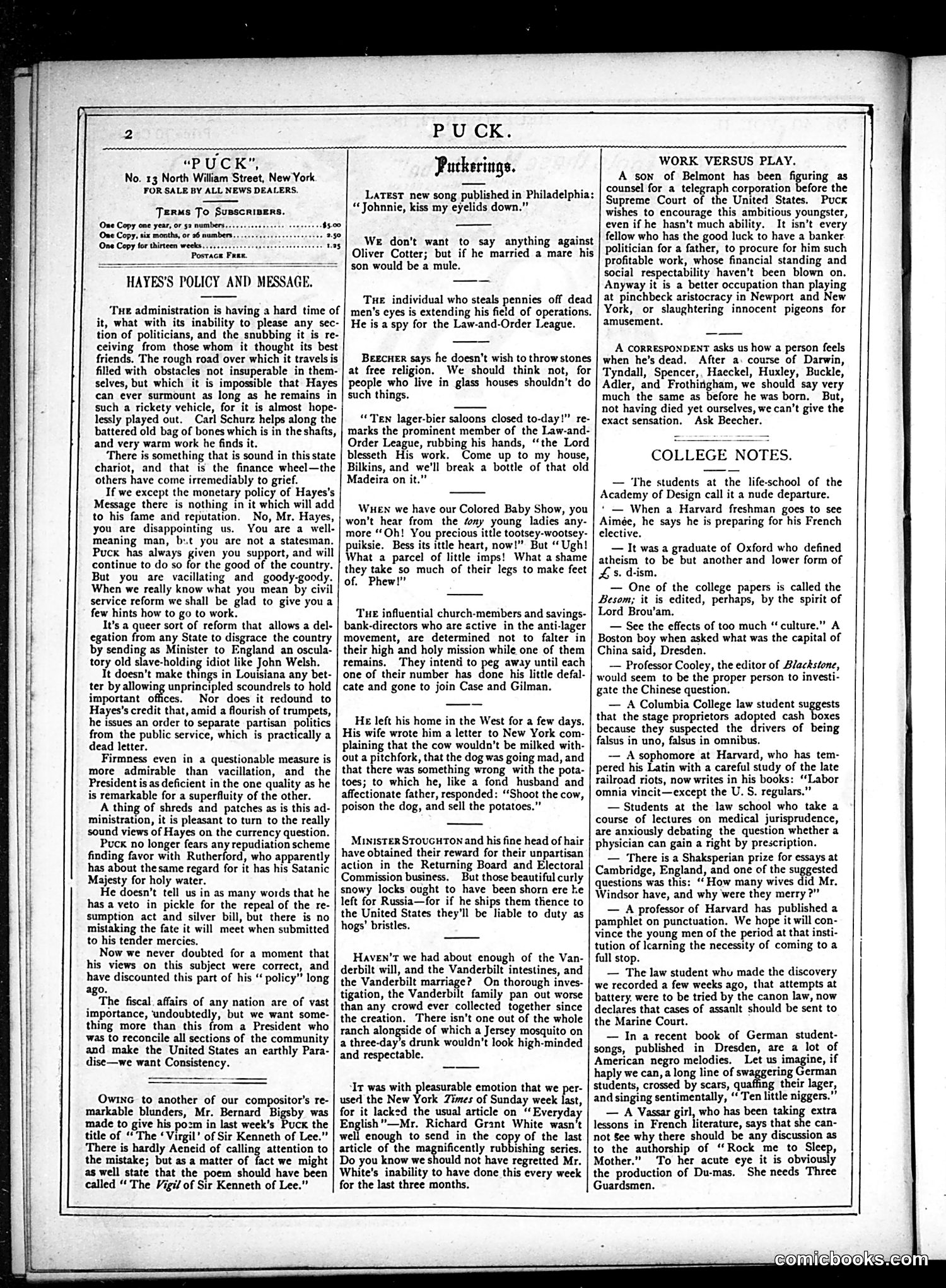
This page consists primarily of **editorial commentary and college notes rather than political cartoons**. The main content includes: **"Hayes's Policy and Message"** - A critique of President Rutherford B. Hayes's administration, discussing his challenges with party politics and reform efforts. The text suggests Hayes faced criticism for his approach to governance and civil service. **"Puckerings"** section - Brief satirical commentary on contemporary issues, including critiques of Oliver Cotter, the Law-and-Order League, and religious hypocrisy. **"College Notes"** - Humorous observations about university life and academic matters. The page contains **no prominent political cartoons visible**. It represents Puck's editorial voice through written satire rather than visual caricature, typical of 19th-century satirical journalism.
📄 Transcribed text from this page (OCR, searchable)
Machine-transcribed from the original scan — historical spelling and the odd misread are preserved.
2 PUCK. “PUCK”, No. 13 North William Street, New York. FOR SALE BY ALL NEWS DEALERS. Terms To Sunscripers One Copy one year, or 52 numbers One Copy, six months, or 26 numbers ‘One Copy for thirteen weeks... Postace Fae. ae HAY ES'S POLICY AND MESSAGE. ‘Tue administration is having a hard time of it, what with its inability to please any sec- tion of politicians, and the snubbing it is re- ceiving from those whom it thought its best friends. The rough road over which it travels is filled with obstacles not insuperable in them- selves, but which it is impossible that Hayes can ever surmount as long as he remains in such a rickety vehicle, for it is almost hope- lessly played out. Carl Schurz helps along the battered old bag of bones which is in the shafts, and very warm work he finds it. There is something that is sound in this state chariot, and that is the finance wheel—the others have come irremediably to grief. If we except the monetary policy of Hayes’s Message there is nothing in it which will add to his fame and reputation. No, Mr. Hayes, you are disappointing us. You are a well- meaning man, b:.t you are not a statesman. Puck has always given you support, and will continue to do so for the good of the country. But you are vacillating and goody-goody. When we really know what you mean by civil service reform we shall be glad to give youa few hints how to go to work. It’s a queer sort of reform that allows a del- egation from any State to disgrace the country by sending as Minister to England an oscula- tory old slave-holding idiot like John Welsh. It doesn't make things in Louisiana any bet- ter by allowing unprincipled scoundrels to hold important offices. Nor does it redound to Hayes's credit that, amid a flourish of trumpets, he issues an order to separate partisan politics from the public service, which is practically a dead letter. Firmness even in a questionable measure is more admirable than vacillation, and the President is as deficient in the one quality as he is remarkable for a superfluity of the other. A thing of shreds and patches as is this ad- ministration, it is pleasant to turn to the really sound views of Hayes on the currency question. Puck no longer fears any repudiation scheme finding favor with Rutherford, who apparently has about the same regard for it has his Satanic Majesty for holy water. He doesn’t tell us in as many words that he has a veto in pickle for the repeal of the re- sumption act and silver bill, but there is no mistaking the fate it will meet when submitted to his tender mercies. Now we never doubted for a moment that his views on this subject were correct, and have discounted this part of his “ policy” long ago. _ The fiscal. affairs of any nation are of vast importance, ‘undoubtedly, but we want some- thing more than this from a President who was to reconcile all sections of the community and make the United States an earthly Para- dise—we want Consistency. Ow1nc to another of our compositor’s re- markable blunders, Mr. Bernard Bigsby was made to give his pozm in last week’s Puck the title of ‘ The ‘Virgil’ of Sir Kenneth of Lee.” There is hardly Aeneid of calling attention to the mistake; but as a matter of fact we might as well state that the poem should have been called “ The Vigil of Sir Kenneth of Lee.” Packerings. Latest new song published in Philadelphia: “Johnnie, kiss my eyelids down.” We don’t want to say anything against Oliver Cotter; but if he married a mare his son would be a mule. Tue individual who steals pennies off dead men’s eyes is extending his field of operations. He is a spy for the Law-and-Order League. Begcuer says he doesn't wish to throw stones at free religion, We should think not, for people who live in glass houses shouldn't do such things. ‘Ten lager-bier saloons closed to-day!” re- marks the prominent member of the Law-and- Order League, rubbing his hands, ‘the Lord blesseth His work. Come up to my house, Bilkins, and we'll break a bottle of that old Madeira on it.” Wuen we have our Colored Baby Show, you won't hear from the sony young ladies any- more “Oh! You precious ittle tootsey-wootsey- puiksie. Bess its ittle heart, now!” But “Ugh! What a parcel of little imps! What a shame they take so much of their legs to make feet of. Phew!" Tue influential church-members and savings- bank-directors who are active in the anti-lager movement, are determined not to falter in their high and holy mission while one of them remains. They intenti to peg away until each one of their number has done his little defal- cate and gone to join Case and Gilman. HE left his home in the West for a few days. His wife wrote him a letter to New York com- plaining that the cow wouldn’t be milked with- out a pitchfork, that the dog was going mad, and that there was something wrong with the pota- toes; to which he, like a fond husband and affectionate father, responded: ‘Shoot the cow, poison the dog, and sell the potatoes.” MinisTER STOUGHTON and his fine head of hair have obtained their reward for their unpartisan action in the Returning Board and Electoral Commission business. But those beautiful curly snowy locks ought to have been shorn ere he left for Russia—for if he ships them thence to the United States they'll be liable to duty as hogs’ bristles. Haven't we had about enough of the Van- derbilt will, and the Vanderbilt intestines, and the Vanderbilt Cotes On thorough inves- tigation, the Vanderbilt family pan out worse than any crowd ever collected together since the creation. There isn't one out of the whole ranch alongside of which a Jersey mosquito on a three-day's drunk wouldn't look high-minded and respectable. “Ir was with pleasurable emotion that we per- used the New York Zimes of Sunday week last, for it lacked the usual article on “Everyda: English"—Mr. Richard Grant White wasn't well enough to send in the copy of the last article of the nificently rubbishing series. Do you know we should not have regretted Mr. White's inability to have done this every week for the last three months. WORK VERSUS PLAY. A son of Belmont has been figuring as counsel for a telegraph corporation before the Supreme Court of the United States. Puck wishes to encourage this ambitious youngster, even if he hasn't much ability. It isn’t every fellow who has the good luck to have a banker. politician for a father, to procure for him such profitable work, whose financial standing and social respectability haven’t been blown on. Anyway it is a better occupation than playing at pinchbeck aristocracy in Newport and New York, or slaughtering innocent pigeons for amusement. A CORRESPONDENT asks us how a person feels when he’s dead. After a: course of Darwin, Tyndall, Spencer, Haeckel, Huxley, Buckle, Adler, and Frothirigham, we should say very much the same as before he was born. But, not having died yet ourselves, we can’t give the exact sensation. Ask Beecher. COLLEGE NOTES. — The students at the life-school of the Academy of Design call it a nude departure. * — When a Harvard freshman goes to see Aimée, he says he is preparing for his French elective. — It was a graduate of Oxford who defined atheism to be but another and lower form of £8. d-ism, — One of the college papers is called the Besom; it is edited, perhaps, by the spirit of Lord Brou'am. — See the effects of too much “ culture.” A Boston boy when asked what was the capital of China said, Dresden. — Professor Cooley, the editor of Blackstone, would seem to be the proper person to investi- gate the Chinese question. — A Columbia College law student suggests that the stage proprietors adopted cash boxes because they suspected the drivers of being falsus in uno, falsus in omnibus. — A sophomore at Harvard, who has tem- pered his Latin with a careful study of the late railroad riots, now writes in his books: ‘Labor omnia vincit—except the U. S. regulars.” — Students at the law school who take a course of lectures on medical jurisprudence, are anxiously debating the question whether a physician can gain a right by prescription. — There is a Shaksperian prize for essays at Cambridge, England, and one of the suggested questions was this: “How many wives did Mr. Windsor have, and why Were they merry ?” — A professor of Harvard has published a pamphlet on punctuation. We hope it will con- vince the young men of the period at that insti- tution of Icarning the necessity of coming to a full stop. — The law student whu made the discovery we recorded a few weeks ago, that attempts at battery. were to be tried by the canon law, now declares that cases of assanlt should be sent to the Marine Court. — Ina recent book of German student- songs, published in Dresden, are a lot of American negro melodies. Let us imagine, if haply we can, a long line of swaggering German students, crossed by scars, quaffing their lager, and singing sentimentally, ‘‘ Ten little niggers.” — A Vassar girl, who has been taking extra lessons in French literature, says that she can- not See why there should be any discussion as to the authorship of “Rock me to Sleep, Mother." To her acute eye it is obviously the production of Du-mas. She needs Three Guardsmen.