
Puck, 1877-12-12 · page 4 of 16
Puck — December 12, 1877 — page 4: what you’re looking at
What you’re looking at
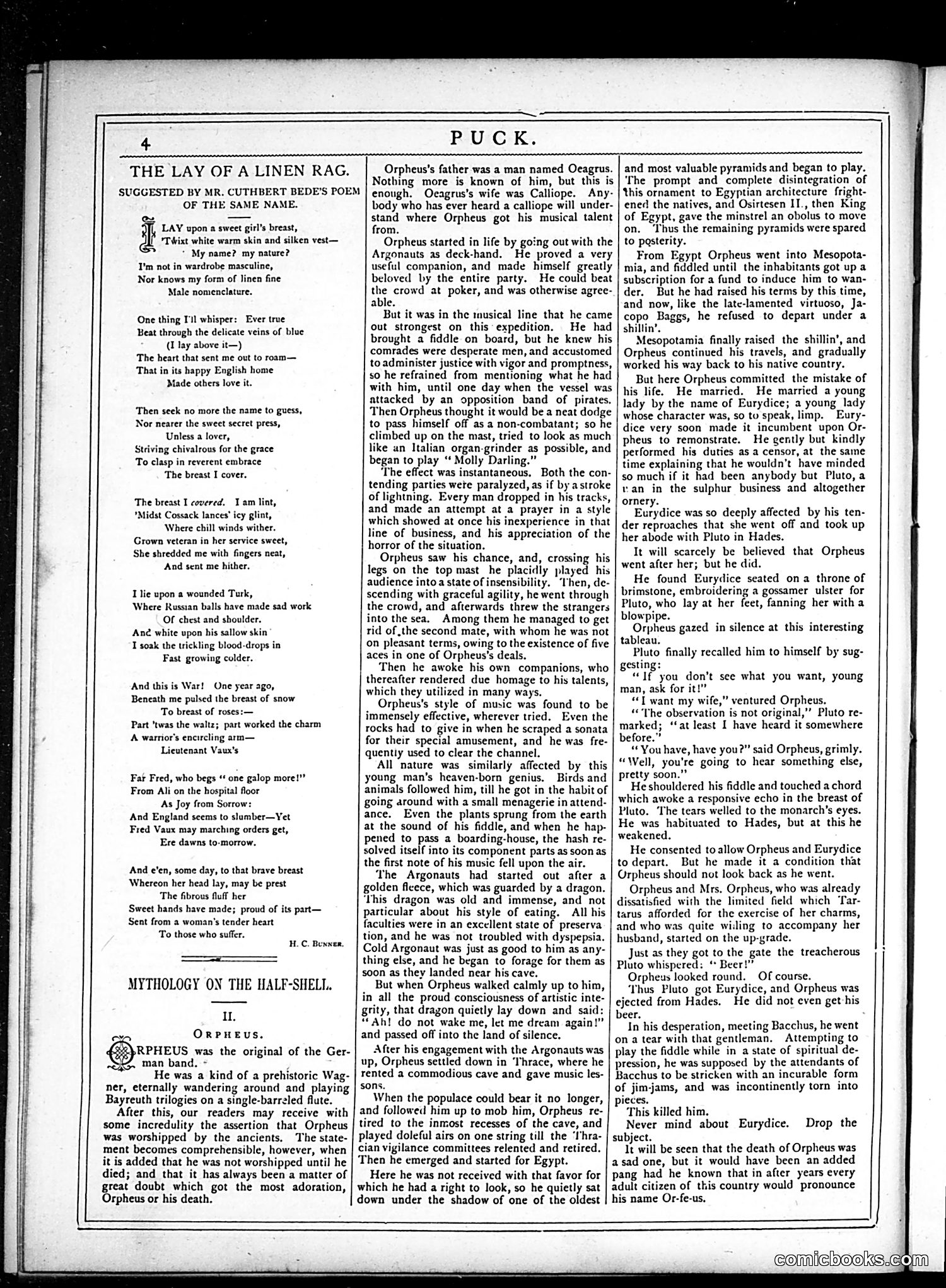
This page contains **no political cartoon or satire**. Instead, it features two literary pieces: 1. **"The Lay of a Linen Rag"** — a humorous poem about a piece of linen cloth, written in the voice of the fabric itself, reflecting on its various uses in English domestic life. 2. **"Mythology on the Half-Shell: II. Orpheus"** — a prose essay retelling the Greek myth of Orpheus with apparent comedic intent, discussing his musical talents, his journey with the Argonauts, and his descent into the underworld. While *Puck* was primarily known for political satire and cartoons, this particular page showcases the magazine's literary content—humorous essays and verse that entertained readers beyond visual satire.
📄 Transcribed text from this page (OCR, searchable)
Machine-transcribed from the original scan — historical spelling and the odd misread are preserved.
4 PUCK. THE LAY OF A LINEN RAG. SUGGESTED BY MR. CUTHBERT BEDE’S POEM OF THE SAME NAME. ee Bi "Thixt white warm skin and silken vest— * My name? my nature? T'm not in wardrobe masculine, Nor knows my form of linen fine Male nomenclature. LAY upon a sweet girl’s breast, One thing I'll whisper: Ever true Beat through the delicate veins of blue (I lay above it—) The heart that sent me out to roam— That in its happy English home Made others love it. ‘Then seek no more the name to guess, Nor nearer the sweet secret press, Unless a lover, Steiving chivalrous for the grace To clasp in reverent embrace ‘The breast I cover. The breast I covered. Tam lint, "Midst Cossack lances’ icy glint, Where chill winds wither. Grown veteran in her service sweet, She shredded me with fingers neat, ‘And sent me hither, I lie upon a wounded Turk, Where Russian balls have made sad work Of chest and shoulder. Ané white upon his sallow skin T soak the trickling blood-drops in Fast growing colder. And this is War! One year ago, Beneath me pulsed the breast of snow To breast of roses: Part ‘twas the waltz; part worked the charm A warrior’s encircling arm— Lieutenant Vaur's Fat Fred, who begs one galop more!”” From Ali on the hospital floor As Joy from Sorrow: And England seems to slumber—Yet Fred Vaux may marching orders get, Ere dawns to-morrow. And e’en, some day, to that brave breast ‘Whereon her head lay, may be prest The fibrous fluff her Sweet hands have made; proud of its part— Sent from a woman's tender heart To those who suffer. H.C. Bexwen, —— MYTHOLOGY ON THE HALF-SHELL. Il, Orpueus. ~ &)rrnevs was the original of the Ger- SE man band. - J He was a kind of a prehistoric Wag- ner, eternally wandering around and playing Bayreuth trilogies on a single-barreled flute. After this, our readers may receive with some incredulity the assertion that Orpheus was worshipped by the ancients. The state- ment becomes comprehensible, however, when it is added that he was not worshipped until he died; and that it has always been a matter of great doubt which got the most adoration, Orpheus or his death. Orpheus's father was a man named Oeagrus. Nothing more is known of him, but this is enough. Ocagrus’s wife was Calliope. Any- body who has ever heard a calliope will under- stand where Orpheus got his musical talent from. Orpheus started in life by going out with the Argonauts as deck-hand. He proved a very useful companion, and made himself greatly beloved by the entire party. He could beat the crowd at poker, and was otherwise agree- able. But it was in the musical line that he came out strongest on this expedition. He had brought a fiddle on board, but he knew his comrades were desperate men, and accustomed to administer justice with vigor and promptness, so he refrained from mentioning what he had with him, until one day when the vessel was attacked by an opposition band of pirates. ‘Then Orpheus thought it would be a neat dodge to pass himself off as a non-combatant; so he climbed up on the mast, tried to look as much like an Italian organ-grinder as possible, and began to play ‘ Molly Darling.” ‘The effect was instantaneous, Both the con- tending parties were paralyzed, as if by astroke of lightning. Every man dropped in his tracks, and made an attempt at a prayer in a style which showed at once his inexperience in that line of business, and his appreciation of the horror of the situation. Orpheus saw his chance, and, crossing his legs on the top mast he placidly played his audience intoa state of insensibility. ‘hen, de- scending with graceful agility, he went through the crowd, and afterwards threw the strangers into the sea, Among them he managed to get tid of the second mate, with whom he was not on pleasant terms, owing to the existence of five aces in one of Orpheus’s deals. Then he awoke his own companions, who thereafter rendered due homage to his talents, which they utilized in many ways. Orpheus's style of music was found to be immensely effective, wherever tried. Even the rocks had to give in when he scraped a sonata for their special amusement, and he was fre- quently used to clear the channel. All nature was similarly affected by this young man’s heaven-born genius. Birds and animals followed him, till he got in the habit of going around with a small menagerie in attend- ance. Even the plants sprung from the earth at the sound of his fiddle, and when he hap- pened to pas a boarding-house, the hash re- solved itself into its component parts as soon as the first note of his music fell upon the air. The Argonauts had started out after a golden fleece, which was guarded by a dragon. ‘This dragon was old and immense, and not particular about his style of eating. All his faculties were in an excellent state of preserva tion, and he was not troubled with dyspepsia. Cold Argonaut was just as good to him as any- thing else, and he began to forage for them as soon as they landed near his cave. But when Orpheus walked calmly up to him, in all the proud consciousness of artistic inte- grity, that dragon quietly lay down and said “Ah! do not wake me, let me dream again!” and passed off into the land of silence, After his engagement with the Argonauts was up, Orpheus settled down in ‘Thrace, where he rented a commodious cave and gave music les- sons. When the populace could bear it no longer, and followed him up to mob him, Orpheus re- tired to the inmost recesses of the cave, and played doleful airs on one string till the ‘Mhra- cian vigilance committees relented and retired. Then he emerged and started for Egypt. Here he was not received with that favor for which he had a right to look, so he quietly sat down under the shadow of one of the oldest and most valuable pyramids and began to play. ‘The prompt and complete disintegration of this ornament to Egyptian architecture fright- ened the natives, and Osirtesen II., then King of Egypt, gave the minstrel an obolus to move on, ‘Thus the remaining pyramids were spared to pasterity. From Egypt Orpheus went into Mesopota- mia, and fiddled until the inhabitants got up a subscription for a fund to induce him to wan- der. But he had raised his terms by this time, and now, like the late-lamented virtuoso, Ja- copo Baggs, he refused to depart under a shillin’, Mesopotamia finally raised the shillin’, and Orpheus continued his travels, and gradually worked his way back to his native country. But here Orpheus committed the mistake of his life. He married. He married a young lady by the name of Eurydice; a young lady whose character was, so to speak, limp. Eury- dice very soon made it incumbent upon Or- pheus to remonstrate. He gently but kindly performed his duties as a censor, at the same time explaining that he wouldn't have minded so much if it had been anybody but Pluto, a tan in the sulphur business and altogether ornery. Eurydice was so deeply affected by his ten- der reproaches that she went off and took up her abode with Pluto in Hades. It will scarcely be believed that Orpheus went after her; but he did. He found Eurydice seated ona throne of brimstone, embroidering a gossamer ulster for Pluto, who lay at her feet, fanning her with a blowpipe. Orpheus gazed in silence at this interesting tableau. Pluto finally recalled him to himself by sug- gesting: “If you don’t see what you want, young man, ask for it!" “T want my wife,” ventured Orpheus. «The observation is not original,” Pluto re- marked; ‘at least I have heard it somewhere before.” “You have, have you?” said Orpheus, grimly. “Well, you're going to hear something else, pretty soon.” He shouldered his fiddle and touched a chord which awoke a responsive echo in the breast of Pluto. ‘The tears welled to the monarch’s eyes. He was habituated to Hades, but at this he weakened. He consented to allow Orpheus and Eurydice to depart. But he made it a condition that Orpheus should not look back as he went. Orpheus and Mrs. Orpheus, who was already dissatisfied with the limited field which ‘Tar- tarus afforded for the exercise of her charms, and who was quite willing to accompany her husband, started on the up-grade. Just as they got to the gate the treacherous Pluto whispered: ‘ Beer!” Orpheus looked round. Of course. ‘Thus Pluto got Eurydice, and Orpheus was ejected from Hades. He did not even get his beer. In his desperation, meeting Bacchus, he went ona tear with that gentleman, Attempting to play the fiddle while in a state of spiritual de- pression, he was supposed by the attendants of Bacchus to be stricken with an incurable form of jim-jams, and was incontinently torn into pieces. This killed him, Never mind about Eurydice. subject. It will be seen that the death of Orpheus was asad one, but it would have been an added pang had he known that in after years every adult citizen of this country would pronounce Drop the his name Or-fe-us. TT, comichooks.