
Puck, 1877-12-12 · page 13 of 16
Puck — December 12, 1877 — page 13: what you’re looking at
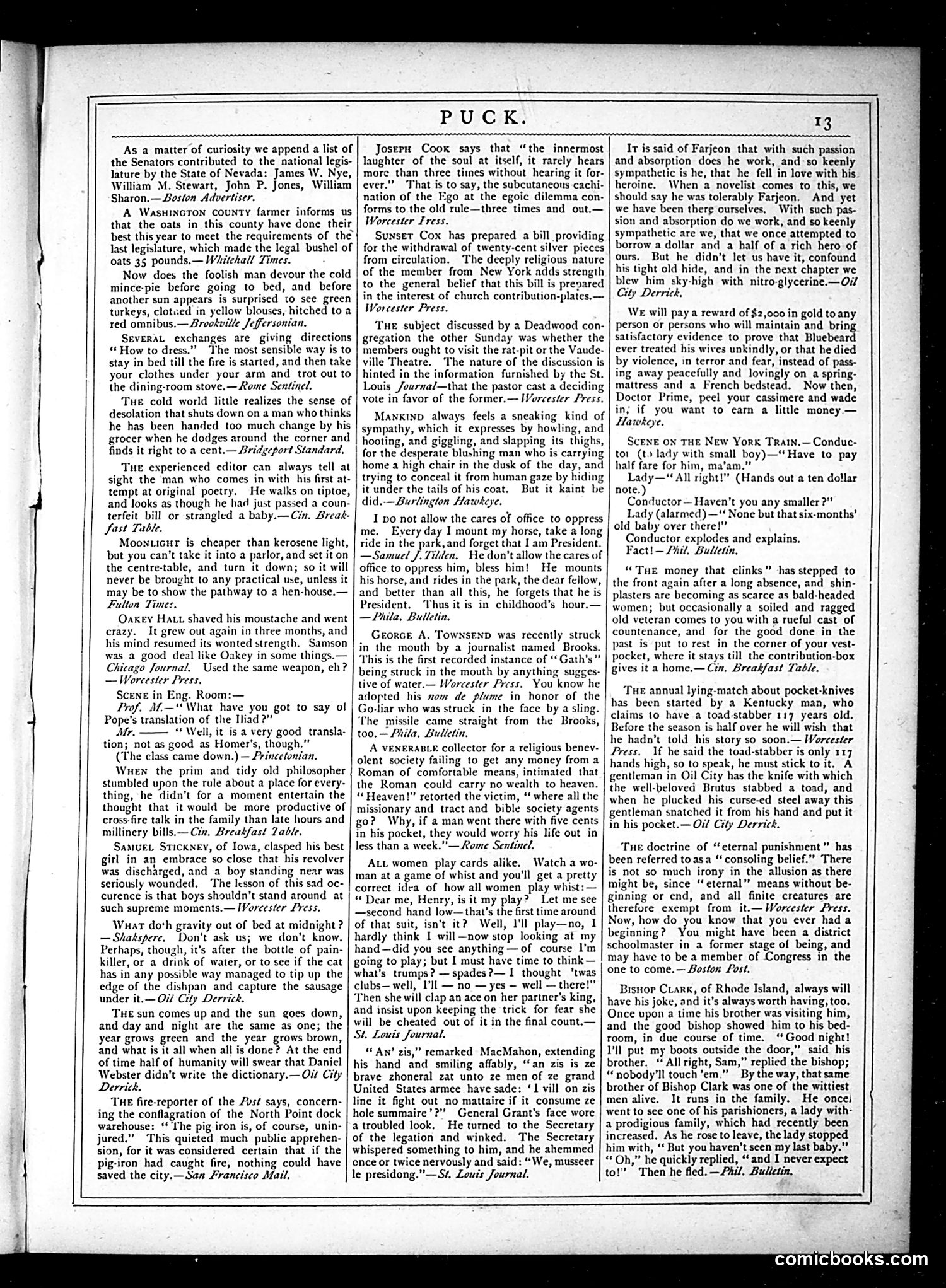
What you’re looking at
This Puck page is primarily text-based satirical commentary rather than illustrated cartoons. The content consists of brief humorous anecdotes and social observations targeting various topics: Nevada mining practices, religious controversies, gender dynamics (women playing cards and whist), workplace hierarchies, and political figures including references to President Grant and General Grant. One recurring joke involves a conductor on the New York Train demanding payment from a lady with a small boy. Another mocks a Kentucky man inventing a trick to win at cards by claiming his wife can play "poker knives." The satire targets middle-class social pretensions, gender role absurdities, and political incompetence of the Gilded Age. Without accompanying illustrations on this page, the humor relies entirely on witty observation and ironic commentary typical of Puck's literary approach.
📄 Transcribed text from this page (OCR, searchable)
Machine-transcribed from the original scan — historical spelling and the odd misread are preserved.
PUCK. ee | As a matter of curiosity we append a list of the Senators contributed to the national legis- lature by the State of Nevada: James W. Nye, William M. Stewart, John P. Jones, William Sharon.—Loston Advertiser. A Wasuincton county farmer informs us that the oats in this county have done their best this year to meet the requirements of the. last legislature, which made the legal bushel of oats 35 pounds.— Whitehall Times. Now does the foolish man devour the cold mince-pie before going to bed, and before another sun appears is surprised to sce green turkeys, clotved in yellow blouses, hitched to a red omnibus.— Brookville Jeffersonian, SEVERAL exchanges are giving directions * How to dress.” ‘The most sensible way is to stay in bed till the fire is started, and then take your clothes under your arm and trot out to the dining-room stove.— Rome Sentinel. Tue cold world little realizes the sense of desolation that shuts down on a man who thinks he has been handed too much change by his grocer when ke dodges around the corner and finds it right to a cent.— Bridgeport Standard. Tue experienced editor can always tell at sight the man who comes in with his first at- tempt at original poetry. He walks on tiptoe, and looks as though he had just passed a coun- terfeit bill or strangled a baby.—Cin. Break fast Table, Moonticur is cheaper than kerosene light, but you can’t take it into a parlor, and set it on the centre-table, and turn it down; so it will never be brought to any practical use, unless it may be to show the pathway to a hen-house.— Fulton Times, Oakey Hatt shaved his moustache and went crazy. It grew out again in three months, and his mind resumed its wonted strength. Samson was a good deal like Oakey in some things.— Chicago Journal, Used the same weapon, ch? —Woreester Press. Scene in Eng. Room:— Prof. M.—What have you got to say of Pope’s translation of the Iliad ?”” Mr. “Well, it isa very good transla- tion; not as good as Homer's, though.”” (The class came down.) — Princetonian. Wuen the prim and tidy old philosopher stumbled upon the rule about a place for every- thing, he didn’t for a moment entertain the thought that it would be more productive of cross-fire talk in the family than late hours and millinery bills.— Cin. Breakfast Zable. SamveL Stickney, of Iowa, clasped his best girl in an embrace so close that his revolver was discharged, and a boy standing near was seriously wounded. ‘The lesson of this sad oc- curence is that boys shouldn’t stand around at such supreme moments.— [Vorcester Press. Wuar doth gravity out of bed at midnight ? —Shakspere. Don't ask us; we don't know. Perhaps, though, it’s after the bottle of pain- killer, or a drink of water, or to see if the cat has in any possible way managed to tip up the edge of the dishpan and capture the sausage under it.— Oi City Derrick. THE sun comes up and the sun goes down, and day and night are the same as one; the year grows green and the year grows brown, and what is it all when all is done? At the end of time half of humanity will swear that Daniel Webster didn’t write the dictionary.— Out City Derrick. ‘Tue fire-reporter of the /vs¢ says, concern- ing the conflagration of the North Point dock warehouse: “The pig iron is, of course, unin- jured.” ‘his quieted much’ public apprehen- sion, for it was considered certain that if the pig-iron had caught fire, nothing could have Joserx Cook says that ‘the innermost laughter of the soul at itself, it rarely hears more than three times without hearing it for- ever.” That is to say, the subcutaneous cachi- nation of the Ego at the egoic dilemma con- forms to the old rule—three times and out.— Worcester Iress. Sunset Cox has prepared a bill providing for the withdrawal of twenty-cent silver pieces from circulation. The deeply religious nature of the member from New York adds strength to the general belief that this bill is prepared in the interest of church contribution-plates.— Worcester Press. Tue subject discussed by a Deadwood con- gregation the other Sunday was whether the members ought to visit the rat-pit or the Vaude- ville Theatre. ‘The nature of the discussion is hinted in the information furnished by the St. Louis /ourna/—that the pastor cast a deciding vote in favor of the former.— Worcester Press. Mankinp always feels a sneaking kind of sympathy, which it expresses by howling, and hooting, and giggling, and slapping its thighs, | for the desperate blushing man who is carrying home a high chair in the dusk of the day, and trying to conceal it from human gaze by hiding it under the tails of his coat. But it kaint be did.—Burlington Hawkeye. I vo not allow the cares of office to oppress me. Every day I mount my horse, take a long ride in the park, and forget that [ am President. —Samuel J. Tilden, He don't allow the cares of office to oppress him, bless him! He mounts his horse, and rides in the park, the dear fellow, and better than all this, he forgets that he is President. ‘Thus it is in childhood’s hour.— —Shila, Bulletin. Georce A. TowNsEND was recently struck in the mouth by a journalist named Brooks. ‘This is the first recorded instance of ‘Gath being struck in the mouth by anything sugges- tive of water.— Worcester Press. You know he adopted his nom de plume in honor of the Go-liar who was struck in the face by a sling. ‘The missile came straight from the Brooks, too. — Phila. Bulletin, A VENERABLE collector for a religious benev- olent society failing to get any money from a Roman of comfortable means, intimated that the Roman could carry no wealth to heaven. “ Heaven!" retorted the victim, ‘“ where all the missionary and tract and bible society agents go? Why, if a man went there with five cents in his pocket, they would worry his life out in less than a week.” — Rome Sentinel. ALL women play cards alike. Watch a wo- man at a game of whist and you'll get a pretty correct idea of how all women play whist:— “Dear me, Henry, is it my play? Let me see —second hand low—that’s the first time around of that suit, isn’t it? Well, I'll play—no, 1 hardly think I will—now stop looking at my hand—did you see anything —of course I'm going to play; but I must have time to think— what's trumps? — spades?— I thought ‘twas clubs— well, I'll — no — yes — well — there!” ‘Then she will clap an ace on her partner's king, and insist upon keeping the trick for fear she will be cheated out of it in the final count.— ‘St. Louis Journal. “ An’ zis,” remarked MacMahon, extending his hand and smiling affably, “an zis is ze brave zhoneral zat unto ze men of ze grand United States armee have sade: ‘1 vill on zis line it fight out no mattaire if it consume ze hole summaire’?” General Grant's face wore a troubled look. He turned to the Secretary of the legation and winked. The Secretary whispered something to him, and he ahemmed once or twice nervously and said: “We, musseer saved the ci an Francisco Mai le presidong. Louis Journai Ir is said of Farjeon that with such passion and absorption does he work, and-so keenly sympathetic is he, that he fell in love with his heroine. When a novelist comes to this, we should say he was tolerably Farjeon. And’ yet we have been therg ourselves. With such pas- sion and absorption do we work, and so keenly sympathetic are we, that we once attempted to borrow a dollar and a half of a rich hero of ours. But he didn’t let us have it, confound his tight old hide, and in the next chapter we blew him sky-high with nitro-glycerine—Oil City Derrick. We will pay a reward of $2,000 in gold toany person or persons who will maintain and brin, satisfactory evidence to prove that Bluebeard ever treated his wives unkindly, or that he died by violence, in terror and fear, instead of pass- ing away peacefully and lovingly on a spring- mattress and a French bedstead. Now then, Doctor Prime, peel your cassimere and wade in, if you want to earn a little money. — Hawkeye. Scene on THE New York Train.—Conduc- tor (t» lady with small boy)—‘*Have to pay half fare for him, ma’am,”” Lady—‘‘ All right!” (Hands out a ten dollar note.) Conductor — Haven't you any smaller?” Lady (alarmed) —‘“‘ None but that six-months’ old baby over there!” Conductor explodes and explains. Fact!—Piil. Bulletin, “Tue money that clinks” -has stepped to the front again after a long absence, and shin- plasters are becoming as scarce as bald-headed women; but occasionally a soiled and ragged old veteran comes to you with a rueful cast of countenance, and for the good done in the past is put to rest in the corner of your vest- pocket, where it stays till the contribution-box gives it a home.— Cin, Breakfast Table. THE annual lying-match about pocket-knives has been started by a Kentucky man, who claims to have a toad-stabber 117 years old. Before the season is half over he will wish that he hadn’t told story so soon.— Worcester Press. Vf he said the toad-stabber is only 117 hands high, so to speak, he must stick to it. A gentleman in Oil City has the knife with which the well-beloved Brutus stabbed a toad, and when he plucked his curse-ed steel away this gentleman snatched it from his hand and put it in his pocket.—Oi/ City Derrick, ‘Tue doctrine of “eternal punishment” has been referred to asa “consoling belief.” There is not so much irony in the allusion as there might be, since “eternal” means without be- ginning or end, and all finite creatures are therefore exempt from it.— Worcester Press. Now, how do you know that you ever hada beginning? You might have been a district schoolmaster in a former stage of being, and may have to be a member of Congress in the one to come.— Boston Post. Bisnop Crark, of Rhode Island, always will have his joke, and it’s always worth having, too. Once upon a time his brother was visiting him, and the good bishop showed him to his bed- room, in due course of time. ‘Good night! V'll put my boots outside the door,” said his brother. “Allright, Sam,” replied the bishop; “nobody’ll touch 'em.”” ‘By the way, that same brother of Bishop Clark was one of the wittiest men alive. It runs in the family. He oncej went to see one of his parishioners, a lady with- a prodigious family, which had recently been increased. As he rose to leave, the lady stopped him with, “But you haven't seen my last baby.” “Oh,” he quickly replied, “and I never expect to!’ Then he fled.—Phil. Bullei comicbooks.com