
A complete issue · 16 pages · 1877
Puck — December 5, 1877
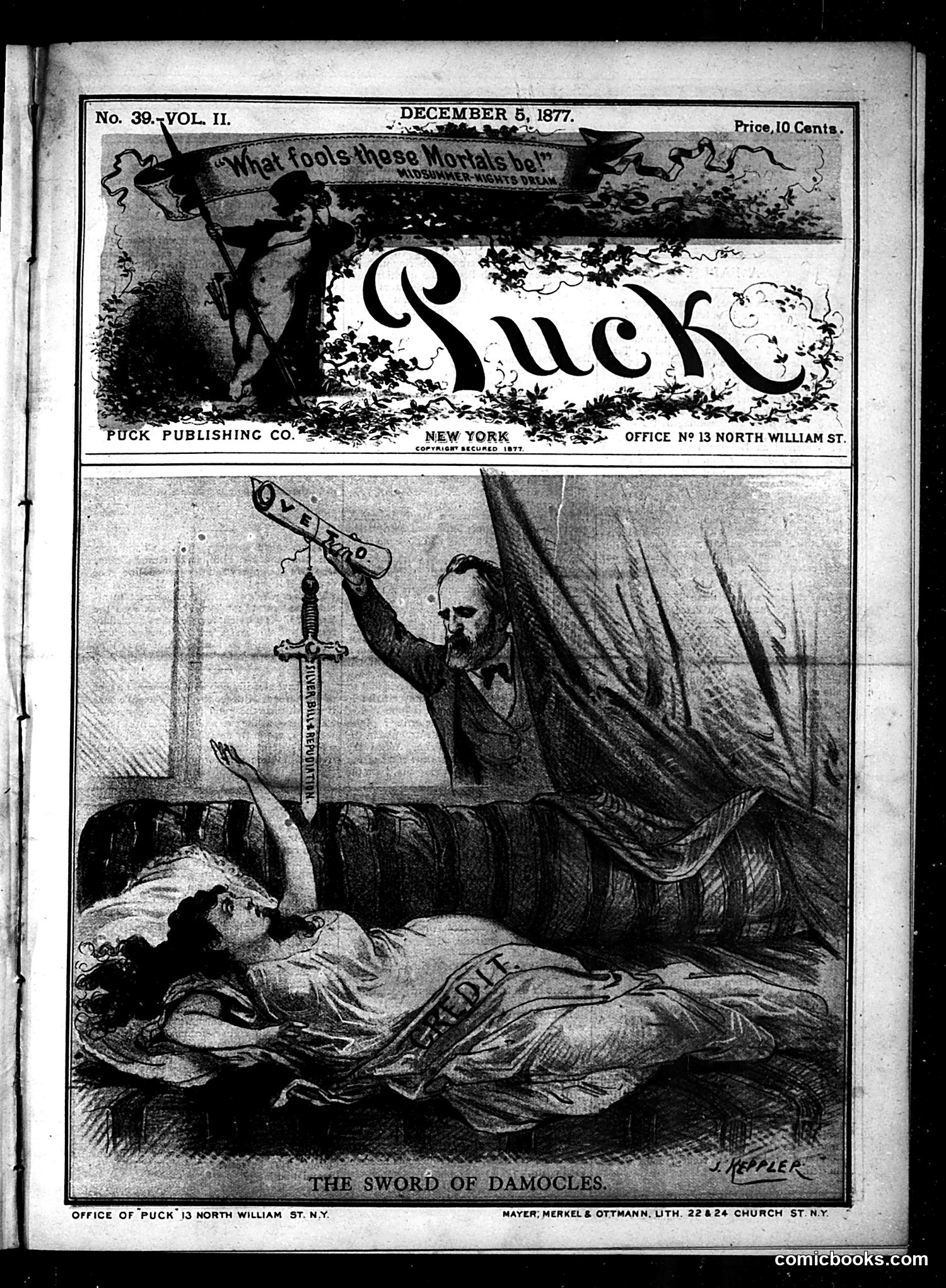
This political cartoon depicts a bearded man (identity unclear from image alone) holding a sword suspended over a reclining female figure labeled "ICIDE" (likely representing suicide or a related social concern). The sword bears an inscription reading "OVERDO" or similar. The "Sword of Damocles" reference invokes the classical allegory of impending danger or doom. The cartoon appears to satirize a threat—possibly related to excessive legislation, social policy, or political excess—that endangers a vulnerable population or concept. Without additional context from the magazine's articles or masthead, the specific political target remains ambiguous, though the dramatic imagery suggests contemporary anxiety about some governmental or social overreach.
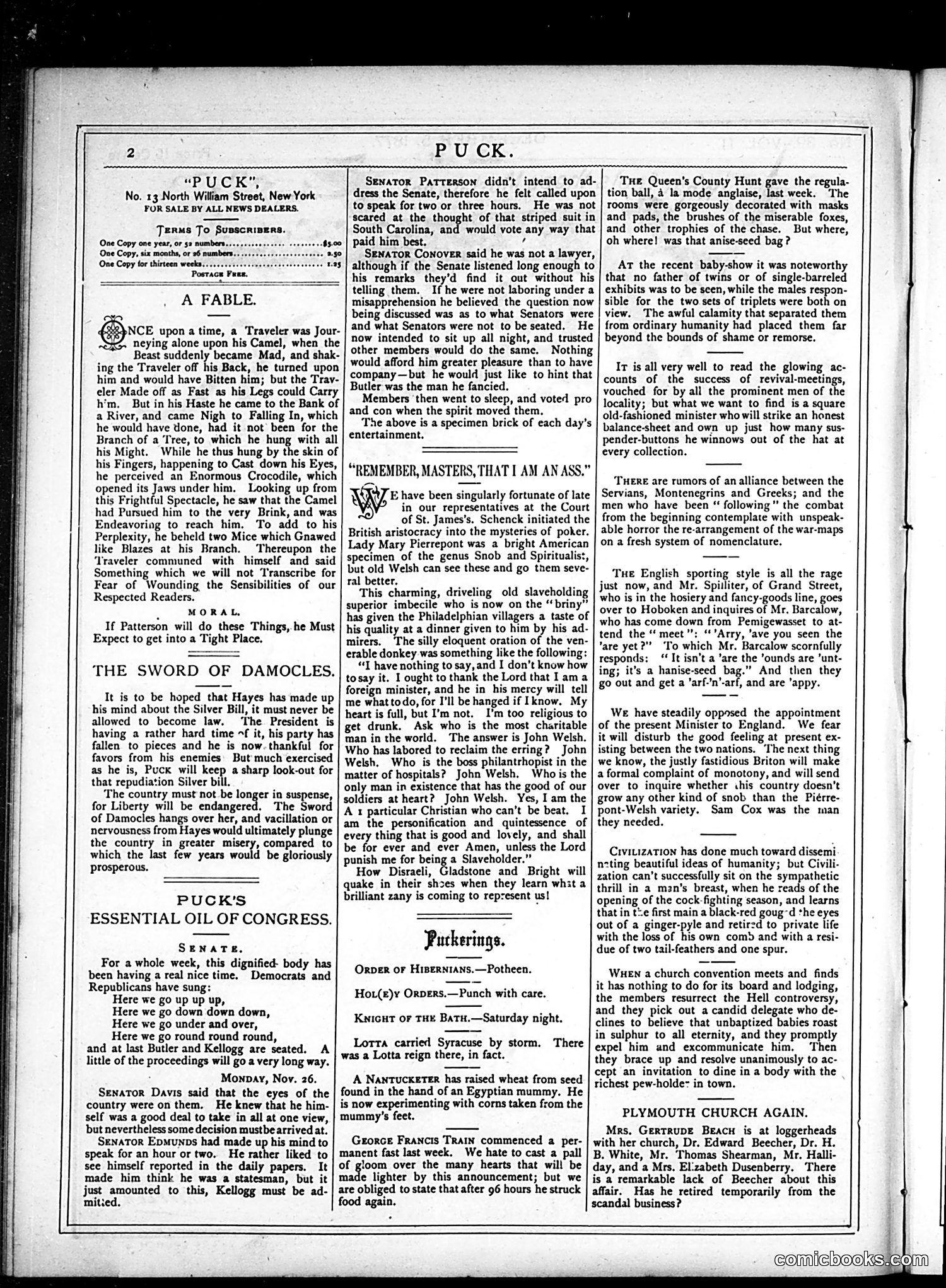
This page contains primarily satirical commentary and social humor rather than illustrated cartoons. The main content includes: **"A Fable"** mocking political hypocrisy—a traveler abandoned by his camel encounters progressively absurd situations involving mice, frogs, and crocodiles, ultimately criticizing senators who debate endlessly without action. **"The Sword of Damocles"** appears to reference political instability or economic anxiety, though the specific reference is unclear from this excerpt. **"Puck's Essential Oil of Congress"** satirizes Congressional dysfunction, with Senator Davis and others criticized for long-winded speeches and ineffectual debate. The **"Puckerings"** section contains brief satirical news items poking fun at various social figures and events—including references to Senator Patterson, baby shows, and church conventions. The overall tone targets political incompetence and social pretension typical of Puck's satirical mission.
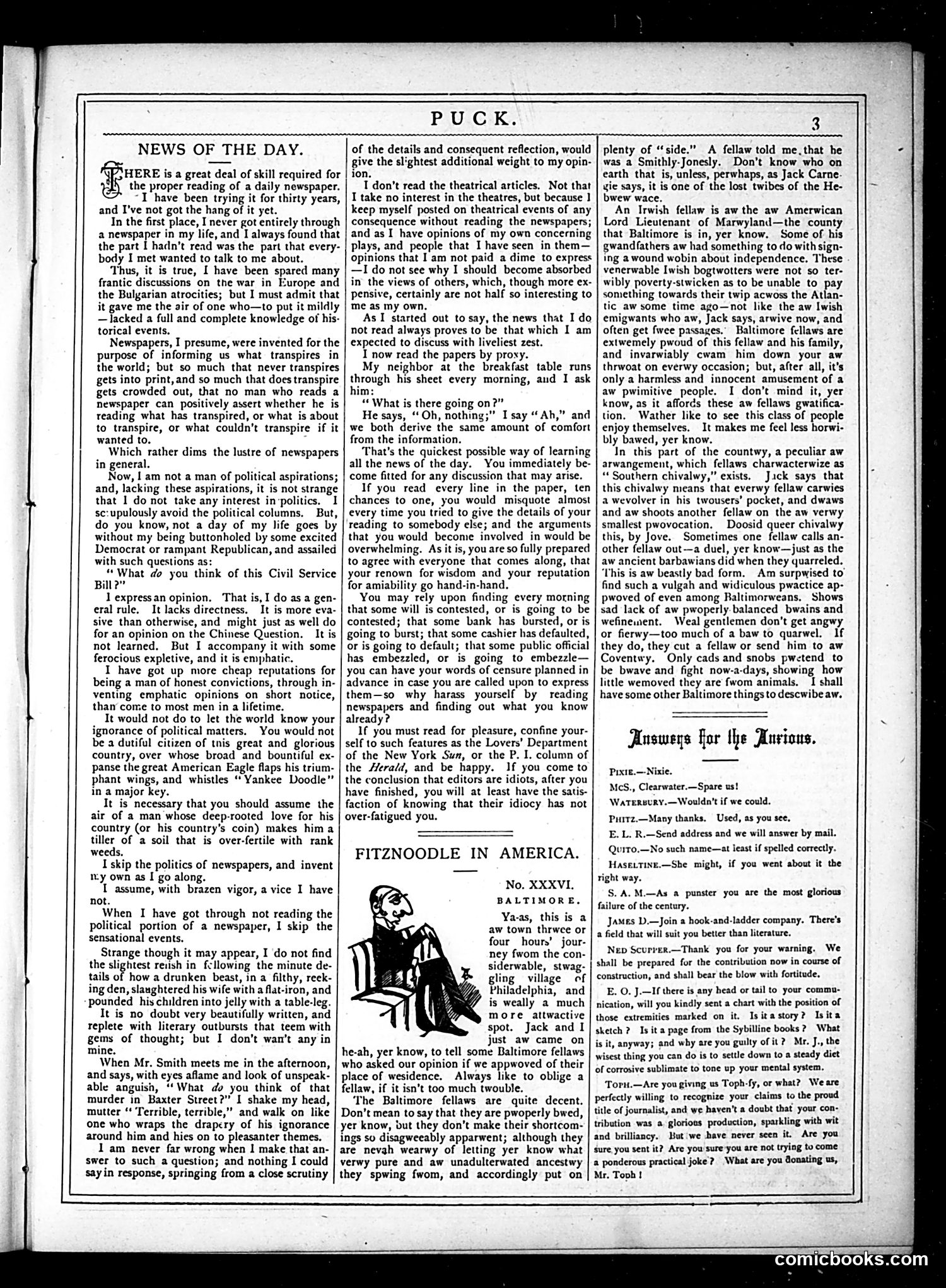
This page contains editorial commentary and humor columns rather than political cartoons. The main illustrated section is "Fitznoodle in America No. XXXVI: Baltimore," featuring a caricatured figure (labeled "Jack") discussing Baltimore's character. The "News of the Day" column discusses newspaper reading habits and political engagement—arguing readers shouldn't avoid newspapers' political content out of fear of bias. The author advocates for informed citizenship while acknowledging newspapers' inevitable editorial viewpoints. The "Answers for the Anxious" section provides humorous advice to readers on various topics. Without seeing specific illustrations beyond the Fitznoodle sketch, the page appears focused on social commentary and reader correspondence rather than direct political satire of identifiable figures or current events.
This page from *Puck* satirizes late-19th-century debates over infant care and babies' rights. The main article "Mass Meeting of Babies" mocks both medical paternalism and parental practices through fictional baby testimonies complaining about being treated as objects rather than individuals—swaddled, force-fed, kept awake, or exhibited like curiosities. The satire targets specific figures: "Baby" Lowndes Cobbley, a literal infant exhibited as a curiosity; and various named adults whose contradictory child-rearing philosophies are ridiculed. The central joke is babies "striking for freedom"—a labor-movement pun suggesting even infants deserve bodily autonomy and dignity. The right column reports on the Emperor of China's wall project, presenting unrelated foreign news. This juxtaposition creates satirical contrast between American domestic concerns and imperial Chinese ambitions.
This page from *Puck* contains a lengthy narrative poem titled "The Virgil of Sir Kenneth of Lee," credited to "The Ghost of Thomas Ingoldsby." The poem is a mock-heroic, medieval-styled narrative featuring characters named Sir Kenneth, Sir Ralph, Sir Herbert, and Sir Hubert engaged in dramatic sword combat and courtly intrigue involving a maiden and matters of honor. The work appears to be literary satire rather than political commentary—it parodies romantic medieval literature and chivalric conventions through absurdist scenarios (a duel triggered by a servant's insult, a corpse used as a plot device). Without additional historical context or knowing the specific individuals being mocked, the precise targets remain unclear, though the piece clearly ridicules pretentious literary conventions and artificial notions of honor.
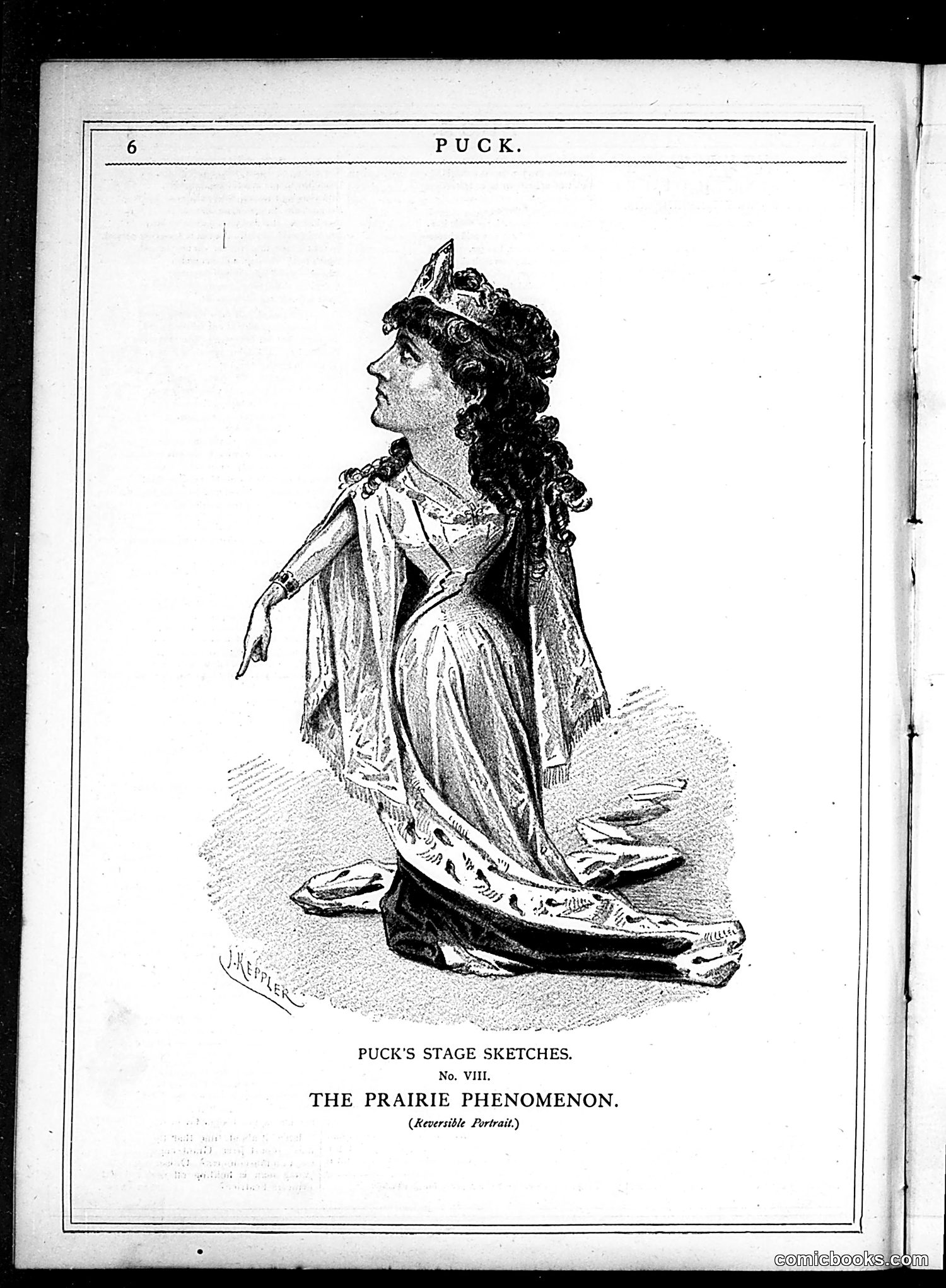
This is a portrait sketch from Puck's "Stage Sketches" series, depicting "The Prairie Phenomenon" with the subtitle "(Reversible Portrait.)" The illustration shows a woman in elaborate Victorian-era clothing with a feathered headdress, ornate draped fabrics, and flowing train. The "reversible portrait" subtitle suggests this sketch may contain satirical commentary about theatrical performance and artifice—possibly mocking either a specific actress or the broader phenomenon of touring entertainers from the American frontier who became celebrated on stage. The elaborate costuming contrasts with the "prairie" reference, likely satirizing the gap between humble origins and theatrical pretension. Without additional context about who specifically this references, the exact target remains unclear.
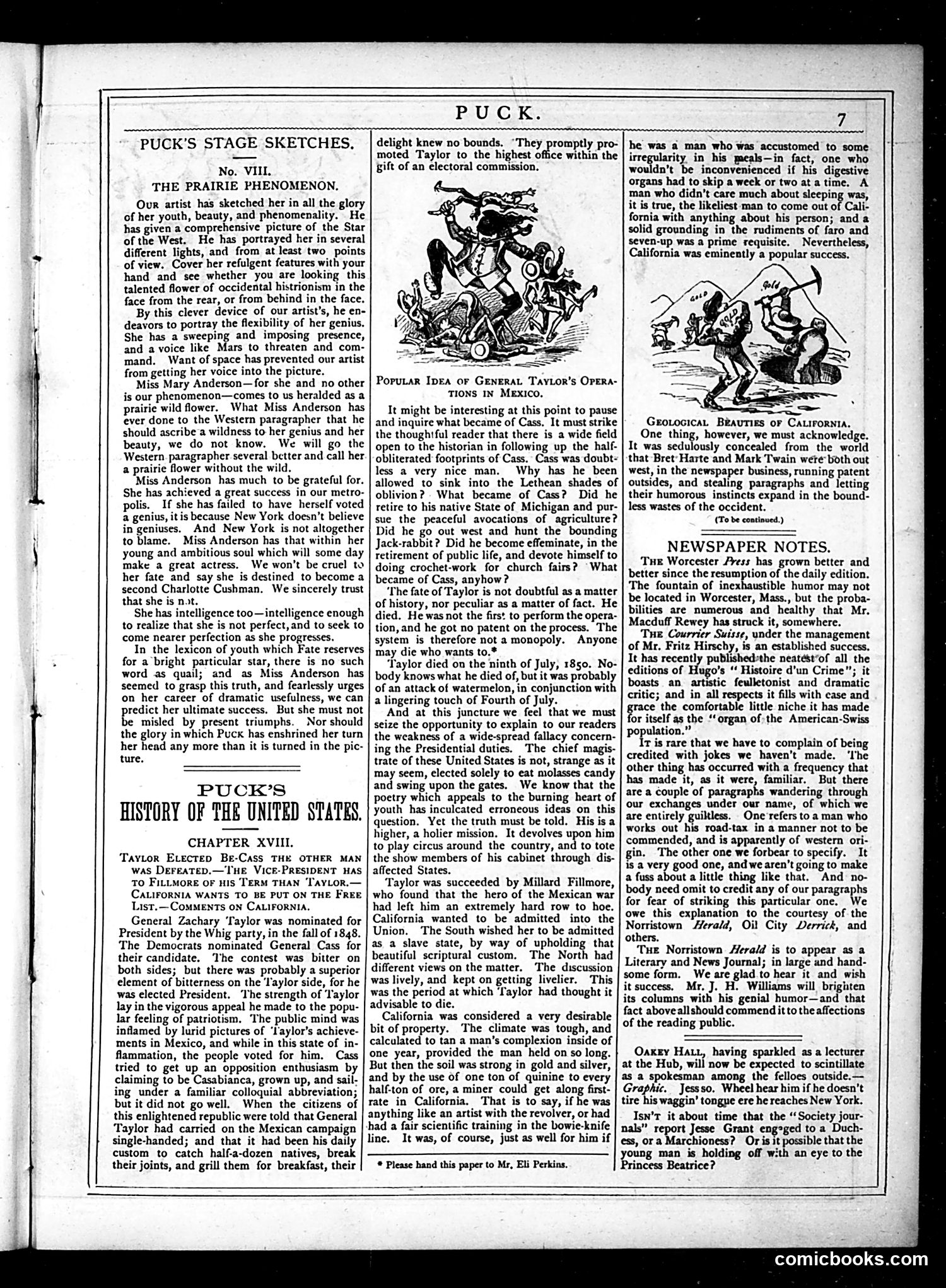
This page contains stage sketches and historical commentary rather than political cartoons. The main illustrated content includes: **"The Prairie Phenomenon"** sketch depicts Miss Mary Anderson, a Western actress praised for her talent and beauty. The accompanying text praises her ability to portray dramatic roles despite her youth. **"General Taylor's Operations in Mexico"** and **"Geological Beauties of California"** appear to be humorous illustrations related to Western expansion themes. The bulk of the page features **"Puck's History of the United States, Chapter XVIII,"** discussing President Taylor's 1848 election and California's admission to the Union. The satirical commentary critiques political debates over slavery expansion and California statehood, mocking politicians' hypocrisy regarding these contentious issues. The tone is characteristic of Puck's blend of theatrical gossip and political satire.
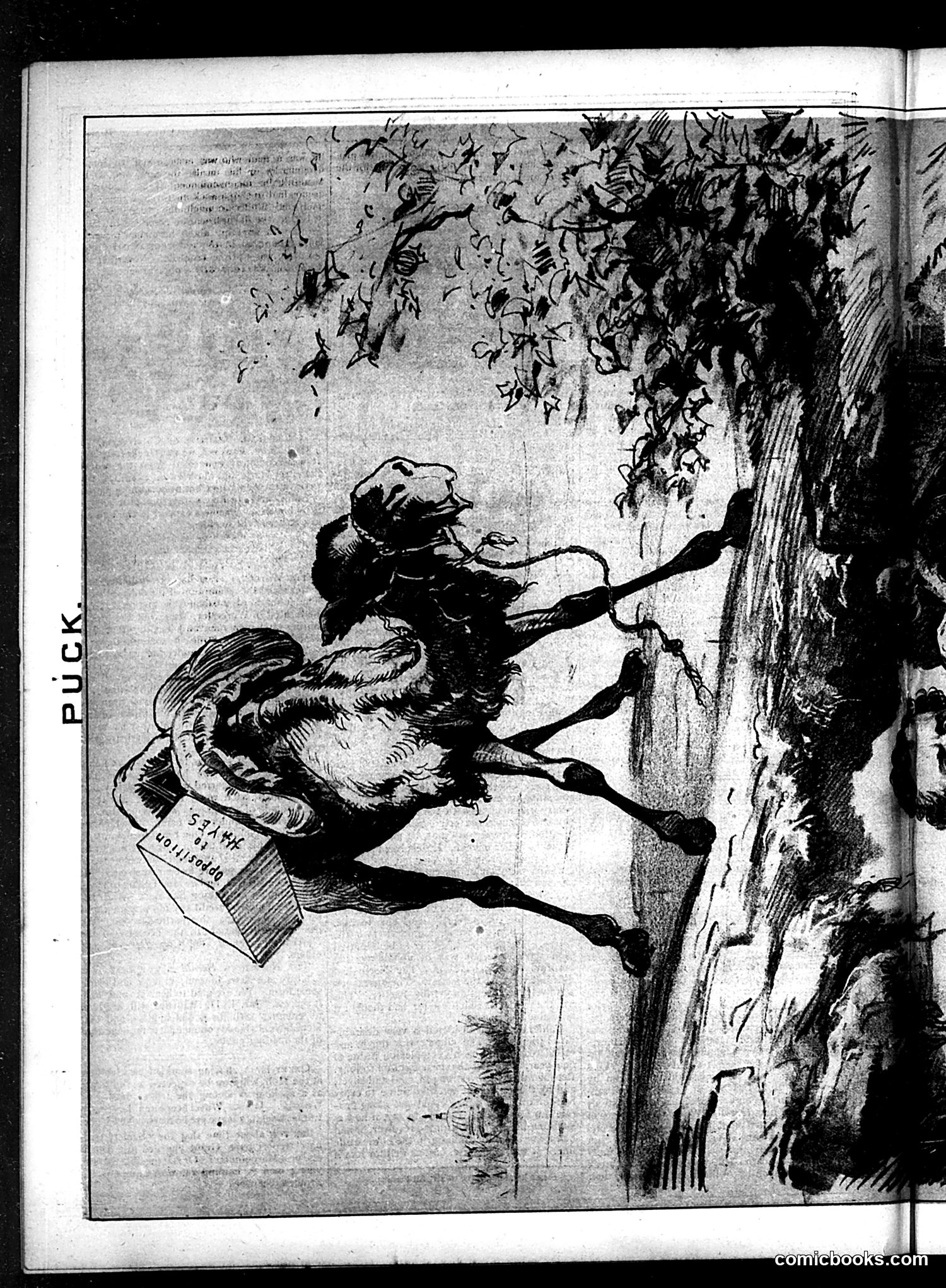
This is a satirical illustration labeled "PUCK" showing a figure attempting to pluck something from a tree. The character appears to be wearing period clothing and carries what looks like a labeled item or sign, though the specific text on it is not clearly legible in this image quality. The cartoon likely depicts a political or social commentary typical of Puck magazine's satirical style—possibly illustrating futile efforts, false promises, or the difficulty of achieving something desirable (represented by the tree's contents). The figure's straining posture suggests struggle or desperation. Without clearer visibility of the labels, specific names, or accompanying article text, I cannot definitively identify which historical figure, event, or political situation this references. The artistic style and format are consistent with late 19th or early 20th-century American satire.
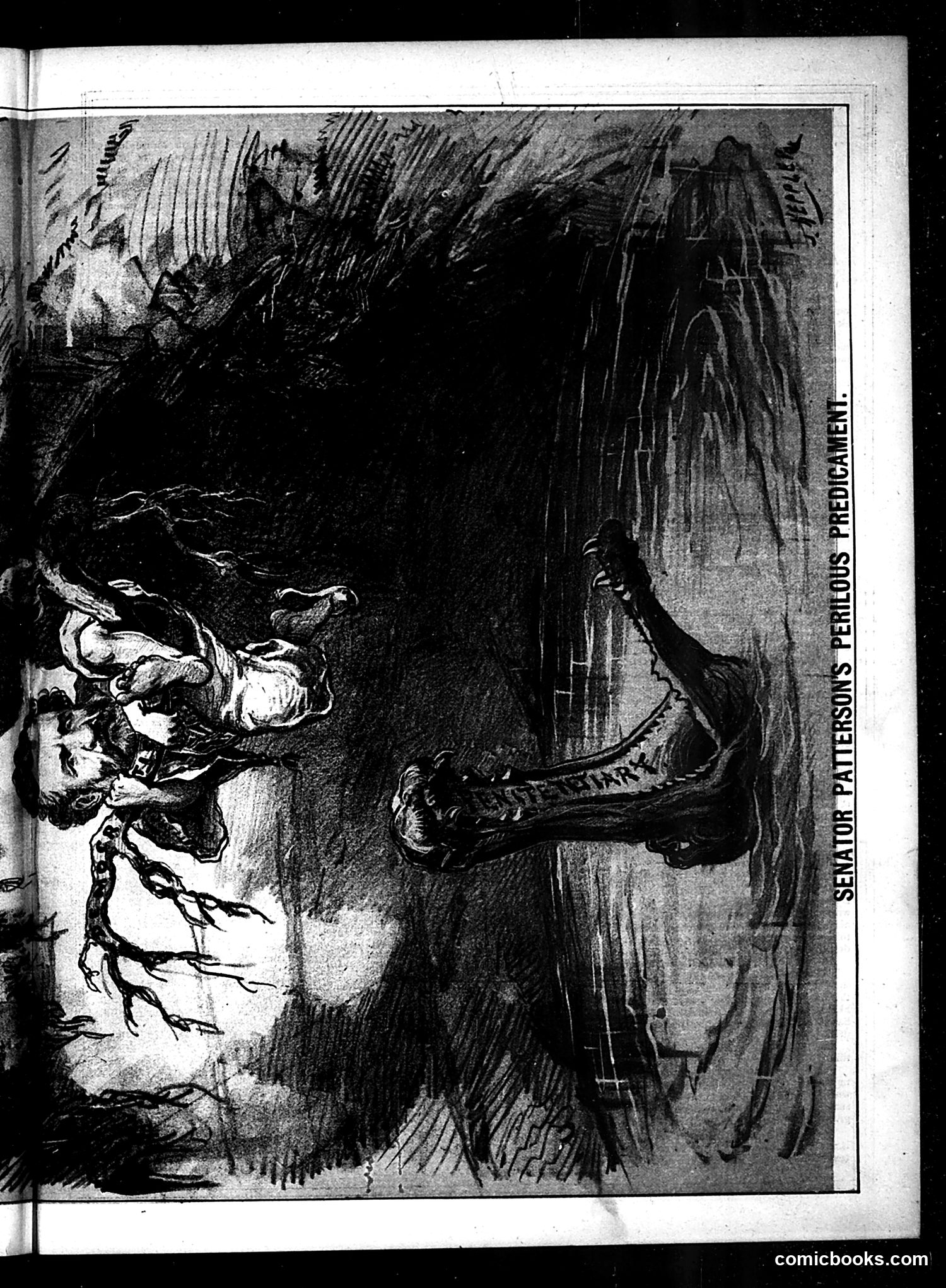
This appears to be a political cartoon from Puck magazine's satirical tradition. The image shows a grotesque caricatured figure on the right confronting what appears to be a skeletal or death-like figure on the left, rendered in dramatic cross-hatching typical of period editorial illustration. The caption reads "SENATOR PATTERSON'S PERILOUS PREDICAMENT," indicating the cartoon addresses a specific political controversy involving a senator named Patterson. However, without additional context about which Patterson this references or what specific "predicament" is depicted, I cannot confidently identify the historical event or the opposing figure's identity. The dark, ominous tone suggests criticism of the senator's position or actions, using visual metaphor (possibly death, consequences, or reckoning) to convey disapproval.
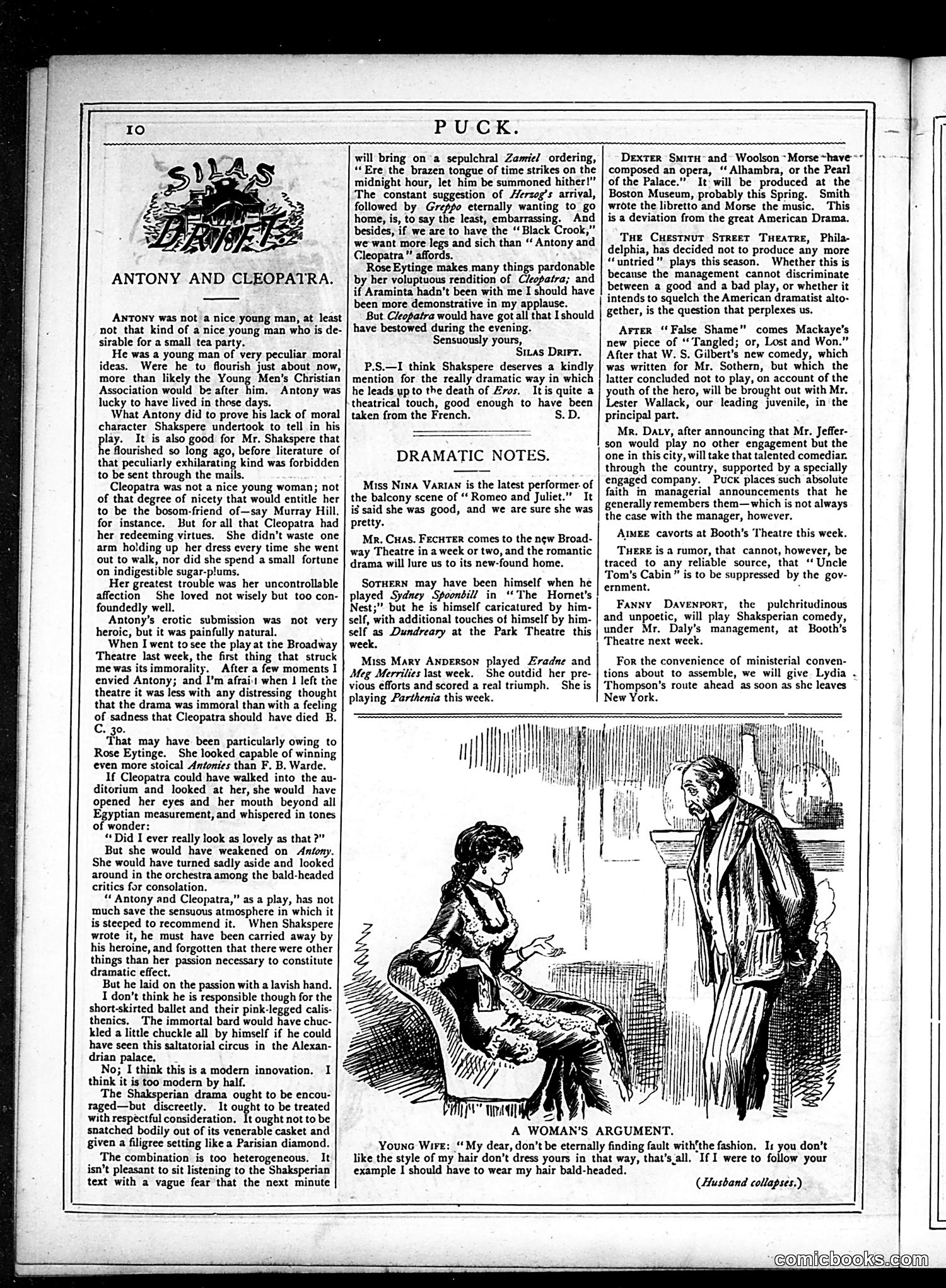
This page contains theatrical criticism rather than political satire. The main content discusses Shakespeare's *Antony and Cleopatra*, critiquing both the play itself and its performance standards of the era. The single illustration, captioned "A Woman's Argument," depicts a domestic dispute about hairstyling—a husband and wife debating fashion choices. The caption's joke relies on the husband's collapsing logic: he complains his wife's elaborate hairstyle doesn't suit her, then admits he'd wear his own hair identically if following her example, exposing the absurdity of his criticism. The "Dramatic Notes" section reviews contemporary theater performances, including mentions of Nina Varian and other performers. The satire here targets theatrical conventions rather than politics—poking fun at overwrought dramatic interpretations of Shakespeare.
This page contains a serialized story by Frank Barrett rather than political satire. The narrative follows Hugh, a young man, and his interaction with a woman named Renée and another character, De Gaillefontaine. The story involves romantic tension—Hugh believes Renée loves him, but she may be deceiving him regarding her true feelings and loyalties to De Gaillefontaine. The opening article, "The Rising Young Actor," discusses theatrical life—a young actor's ascent through charm and ambition in metropolitan theater, with commentary on his sentimental nature and relationships. This page is primarily **literary content** rather than political cartoon or social satire, featuring serialized fiction typical of Puck's entertainment offerings.
This page contains serialized fiction rather than political satire. The main content is Chapter XXXVI of a story involving characters named Raffoli, Hugh Hiron, and De Gaillefontaine in what appears to be a romantic drama. The only cartoon element is the small header illustration labeled "Puck's Forthrights" showing what appears to be cherubs or putti (classical figures) in a playful pose—a decorative masthead typical of Puck's style. The text discusses a costume fitting for "Cleopatra" and includes dramatic dialogue about love, rivalry, and theatrical production. This is serialized entertainment fiction rather than political or social commentary, which was common Puck content alongside its satirical cartoons.
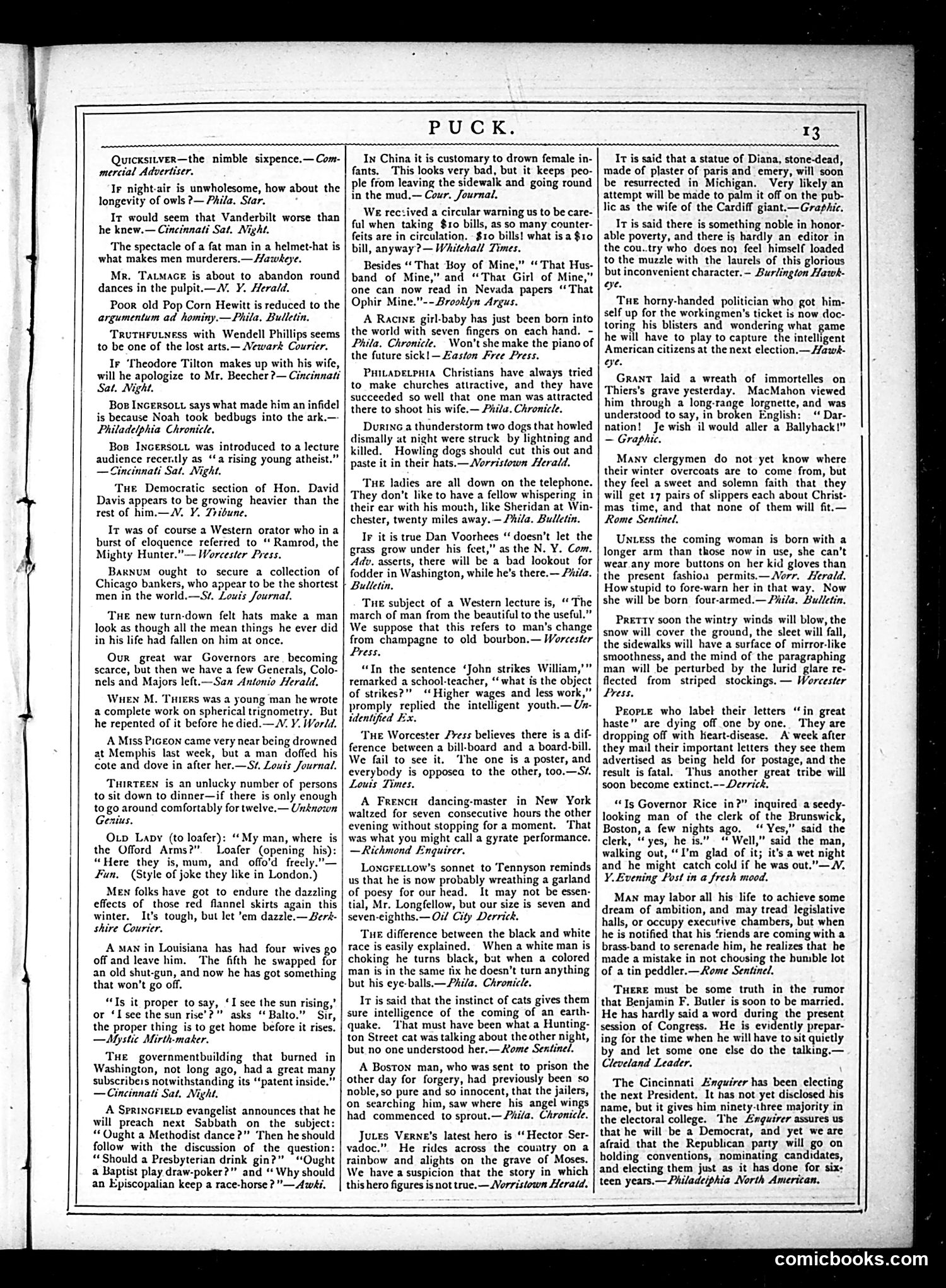
This appears to be a **text-only page** from Puck magazine consisting entirely of brief satirical quips and observations—not a cartoon page. The content includes short jokes mocking various topics: politicians (Hon. David Davis), social customs (drowning female infants in China), and contemporary figures like Wendell Phillips and a "Racing girl-baby." The humor targets politicians' incompetence, religious hypocrisy, gender roles (mocking overly-cautious women), and social pretension. Without visible illustrations, the satire relies on pithy one-liners rather than visual caricature. References are cryptic to modern readers—"That Hoy of Mine" and Nevada papers suggest 1870s-80s topical allusions now obscure. This represents Puck's **text-based satirical style**, using wordplay and social commentary as its primary weapon against targets ranging from politics to cultural absurdities.
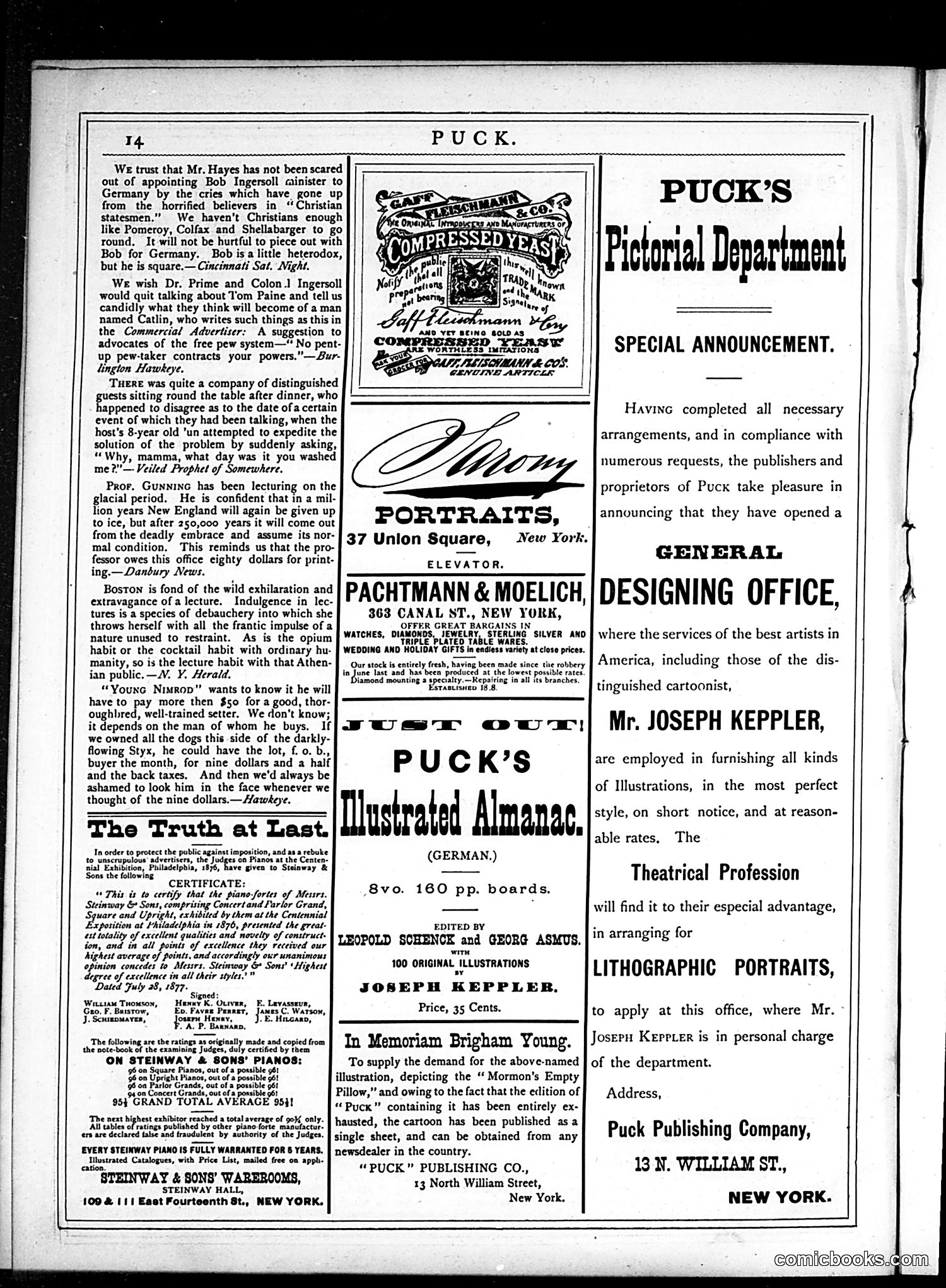
This page is primarily **advertising and announcements** for Puck Publishing Company rather than featuring political cartoons. The main content announces: 1. **Puck's new Pictorial Department** with a "General Designing Office" employing cartoonist Joseph Keppler (likely the magazine's founder/editor) 2. **Multiple product advertisements**, including: - Liebeszmann's Compressed Yeast - Cluny Portraits studio - Pachtmann & Moelich jewelry store - Puck's Illustrated Almanac (German edition) - Steinway pianos 3. **Various satirical commentary snippets** mocking figures like Bob Ingersoll, Dr. Pierce, and Colonel Ingersoll regarding religious and political topics The page functions as a business promotion for Puck's services rather than displaying editorial cartoons. The scattered commentary reflects typical Puck satire of the era—attacking religious hypocrisy and political figures—but lacks substantive visual content.
This page is primarily **advertising**, not editorial content or political cartoons. It contains numerous late 19th-century New York business advertisements for: - Patent medicines (Pond's Extract, promoted for rheumatism, coughs, chilblains) - Retail goods (dolls, hats, carpets, furniture) - Entertainment venues (theaters) - Services (tailoring, book binding) The Pond's Extract ad is notably large, listing various ailments it supposedly cures. Other prominent ads include D. Kelly's Carpet & Furniture Warerooms and Nicoll the Tailor. At the bottom, there's a notice that "Back Numbers of Puck Can Be Supplied on Demand." This represents the revenue model supporting satirical magazines—advertising subsidized content production. The page offers no political satire or cartoon commentary visible here.
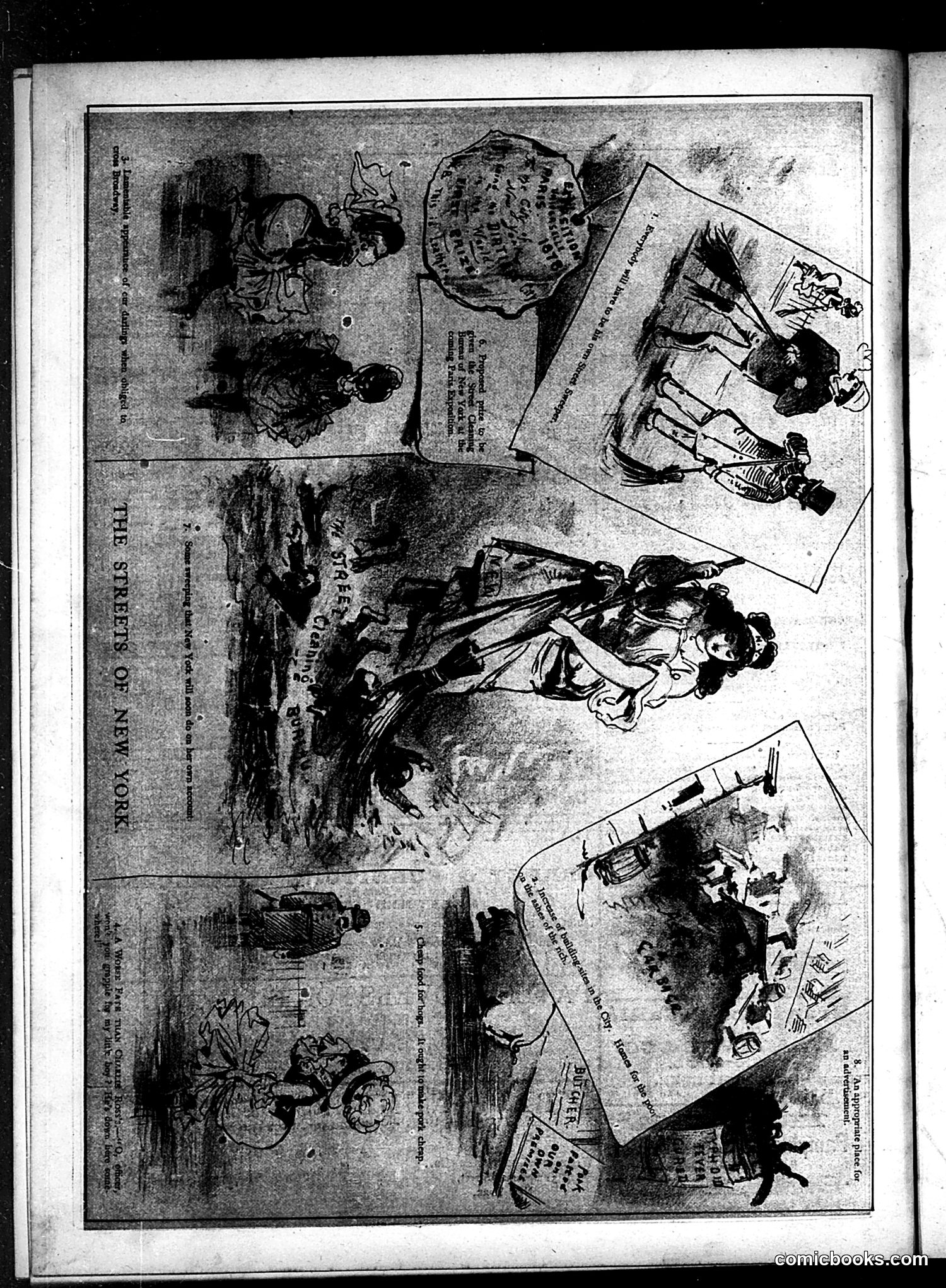
I can see this is a page from Puck magazine featuring multiple satirical illustrations and what appears to be "THE STREETS OF NEW YORK" as a main title (visible on the left side). However, the OCR text provided is blank, and the image quality makes it difficult to read the specific captions and text accompanying each cartoon with confidence. The page contains several separate illustrated panels depicting street scenes and characters in late 19th or early 20th-century New York. Without legible text identifying the specific figures, events, or social commentary being satirized, I cannot reliably explain the particular political or social references these cartoons are meant to convey to a modern reader. The illustrations appear to satirize urban life and street characters, but the specific targets and jokes remain unclear from this image alone.