
Puck, 1877-12-05 · page 3 of 16
Puck — December 5, 1877 — page 3: what you’re looking at
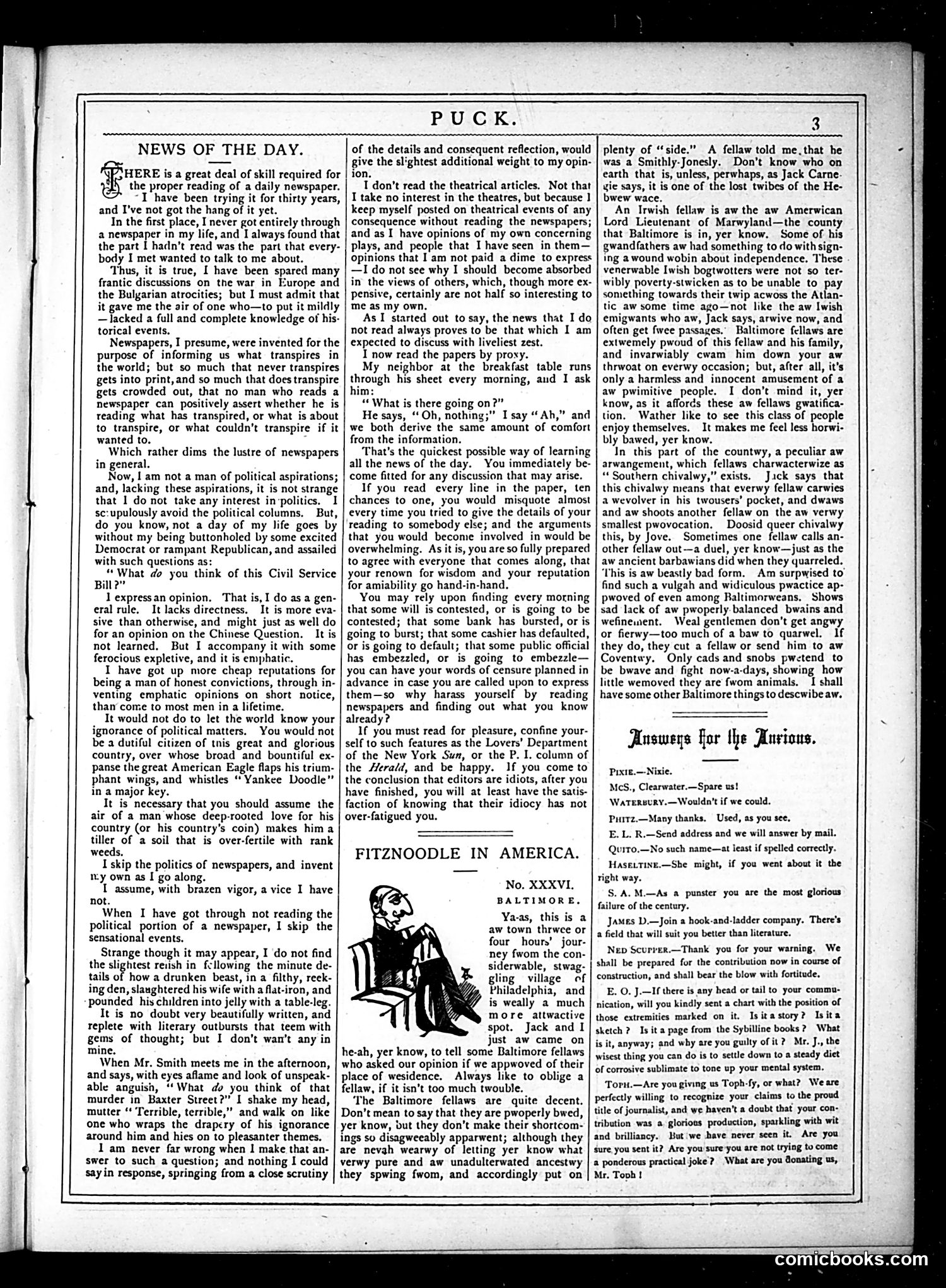
What you’re looking at
This page contains editorial commentary and humor columns rather than political cartoons. The main illustrated section is "Fitznoodle in America No. XXXVI: Baltimore," featuring a caricatured figure (labeled "Jack") discussing Baltimore's character. The "News of the Day" column discusses newspaper reading habits and political engagement—arguing readers shouldn't avoid newspapers' political content out of fear of bias. The author advocates for informed citizenship while acknowledging newspapers' inevitable editorial viewpoints. The "Answers for the Anxious" section provides humorous advice to readers on various topics. Without seeing specific illustrations beyond the Fitznoodle sketch, the page appears focused on social commentary and reader correspondence rather than direct political satire of identifiable figures or current events.
📄 Transcribed text from this page (OCR, searchable)
Machine-transcribed from the original scan — historical spelling and the odd misread are preserved.
aang ip wend eR N SW Suse aw 7, Dy SDD Sua Sea gS eS RASS Epa YA ites SS a a PUCK. NEWS OF THE DAY. q HERE is a great deal of skill required for rey the proper reading of a daily newspaper. “I have been trying it for thirty years, and I've not got the hang of it yet. In the first place, I never got entirely through a newspaper in my life, and I always found that the part I hadn’t read was the part that every- body I met wanted to talk to me about. Thus, it is true, I have been spared many frantic discussions on the war in Europe and the Bulgarian atrocities; but I must admit that it gave me the air of one who—to put it mildly —lacked a full and complete knowledge of his- torical events. Newspapers, I presume, were invented for the purpose of informing us what transpires in the world; but so much that never transpires gets into print, and so much that does transpire gets crowded out, that no man who reads a newspaper can positively assert whether he is reading what has transpired, or what is about to transpire, or what couldn't transpire if it wanted to. Which rather dims the lustre of newspapers in general. Now, I am not a man of political aspirations; and, lacking these aspirations, it is not strange that I do not take any interest in:politics. 1 sc:upulously avoid the political columns. But, do you know, not a day of my life goes by without my being buttonholed by some excited Democrat or rampant Republican, and assailed with such questions as: “What do you think of this Civil Service Bill?” lexpressan opinion. That is,I do as a gen- eral rule. It lacks directness. It is more eva- sive than otherwise, and might just as well do for an opinion on the Chinese Question. It is not learned. But I accompany it with some ferocious expletive, and it is emphatic. I have got up more cheap reputations for being a man of honest convictions, through in- venting emphatic opinions on short notice, than come to most men in a lifetime. It would not do to let the world know your ignorance of political matters. You would not be a dutiful citizen of tnis great and glorious country, over whose broad and bountiful ex- panse the great American Eagle flaps his trium- phant wings, and whistles ‘* Yankee Doodle” in a major key. It is necessary that you should assume the air of a man whose deep-rooted love for his country (or his country's coin) makes hima tiller of a soil that is over-fertile with rank weeds, I skip the politics of newspapers, and invent wy own as I go along. T assume, with brazen vigor, a vice I have not. When I have got through not reading the political portion of a newspaper, I skip the sensational events, Strange though it may appear, I do not find the slightest reiish in fcllowing the minute de- tails of how a drunken beast, in a filthy, reek- ing den, slaughtered his wife with a flat-iron, and pounded his children into jelly with a table-leg. It is no doubt very beautifully written, and replete with literary outbursts that teem with gems of thought; but I don’t wan’t any in mine. When Mr. Smith meets me in the afternoon, and says, with eyes aflame and look of unspeak- able anguish, ‘‘What do you think of that murder in Baxter Street?” I shake my head, mutter “‘ Terrible, terrible,” and walk on like one who wraps the drapery of his ignorance around him and hies on to pleasanter themes. 1 am never far wrong when | make that an- swer to such a question; and nothing I could sayin response, springing from a close scrutiny of the details and consequent reflection, would give the slightest additional weight to my opin- ion. I don’t read the theatrical articles. Not that I take no interest in the theatres, but because ] keep myself posted on theatrical events of any consequence without reading the newspapers; and as I have opinions of my own concerning plays, and people that I have seen in them— opinions that I am not paid a dime to express —I do not see why I should become absorbed in the views of others, which, though more ex- pensive, certainly are not half so interesting to me as my own. AsI started out to say, the news that I do not read always proves to be that which I am expected to discuss with liveliest zest. I now read the papers by proxy. My neighbor at the breakfast table runs through his sheet every morning, aud I ask hi “What is there going on?” He says, “Oh, nothing;” I say “Ah,” and we both derive the same amount of comfort from the information. ‘That's the quickest possible way of learning all the news of the day. You immediately be- come fitted for any discussion that may arise. If you read every line in the paper, ten chances to one, you would misquote almost every time you tried to give the details of your reading to somebody else; and the arguments that you would become involved in would be overwhelming. As it is, you are so fully prepared to agree with everyone that comes along, that your renown for wisdom and your reputation for amiability go hand-in-hand. You may rely upon finding every morning that some will is contested, or is going to be contested; that some bank has bursted, or is going to burst; that some cashier has defaulted, or is going to default; that some public official has embezzled, or is going to embezzle— you can have your words of censure planned in advance in case you are called upon to express them—so why harass yourself by reading newspapers and finding out what you know already? If you must read for pleasure, confine your- self to such features as the Lovers’ Department of the New York Sun, or the P. I. column of the Herald, and be happy. If you come to the conclusion that editors are idiots, after you have finished, you will at least have the satis- faction of knowing that their idiocy has not over-fatigued you. FITZNOODLE IN AMERICA. No. XXXVI. BALTIMORE, Ya-as, this is a aw town thrwce or four hours’ jour- ney fwom the con- siderwable, stwag- gling village of Philadelphia, and is weally a much more _attwactive spot. Jack and I just aw came on he-ah, yer know, to tell some Baltimore fellaws who asked our opinion if we appwoved of their place of wesidence. Always like to oblige a fellaw, if it isn’t too much twouble. The Baltimore fellaws are quite decent. Don’t mean to say that they are pwoperly bwed, yer know, but they don’t make their shortcom- ings so disagweeably apparwent; although they are nevah wearwy of letting yer know what verwy pure and aw unadulterwated ancestwy they spwing fwom, and accordingly put on plenty of “side.” A fellaw told me, that he was a Smithly-Jonesly. Don’t know who on earth that is, unless, perwhaps, as Jack Carne. gie says, it is one of the lost twibes of the He- bwew wace. An Irwish fellaw is aw the aw Amerwican Lord Lieutenant of Marwyland—the county that Baltimore is in, yer know. Some of his gwandfathers aw had something to do with sign- ing awound wobin about independence, These venerwable Iwish bogtwotters were not so ter- wibly poverty-stwicken as to be unable to pay something towards their twip acwoss the Atlan- tic aw some time ago—not like the aw Iwish emigwants who aw, Jack says, arwive now, and often get fwee passazes.’ Baltimore fellaws are extwemely pwoud of this fellaw and his family, and invarwiably cwam him down your aw thrwoat on everwy occasion; but, after all, it’s only a harmless and innocent amusement of a aw pwimitive people. I don’t mind it, yer know, as it affords these aw fellaws gwatifica- tion.’ Wather like to see this class of people enjoy themselves. It makes me feel less horwi- bly bawed, yer know. In this part of the countwy, a peculiar aw arwangement, which fellaws charwacterwize as “Southern chivalwy,” exists. Jack says that this chivalwy means that everwy fellaw carwies a wevolver in his twousers’ pocket, and dwaws and aw shoots another fellaw on the aw verwy smallest pwovocation, Doosid queer chivalwy this, by Jove. Sometimes one fellaw calls an- other fellaw out—a duel, yer know—just as the aw ancient barbawians did when they quarreled. ‘This is aw beastly bad form. Am surpwised to find such a vulgah and widiculous pwactice ap- pwoved of even among Raltimorweans. Shows sad lack of aw pwoperly-balanced bwains and wefinement. Weal gentlemen don’t get angwy or fierwy—too much of a baw to quarwel. if they do, they cut a fellaw or send him to aw Coventwy. Only cads and snobs pwetend to be bwave and fight now-a-days, showing how little wemoved they are fwom animals. I shall have some other Baltimore things to descwibe aw. Answers for the Aurious. Pixie. . McS., Clearwater.—Spare us! Watersury.—Wouldn’t if we could. Purrz.—Many thanks, Used, as you see, E. L. R.—Send address and we will answer by mail. QUITo.—No such name—at least if spelled correctly. Hasevtine.—She might, if you went about it the right way. S.A. M.—As a punster you are the most glorious failure of the century, James D.—Join a hook-and-ladder company. There's ‘a field that will suit you better than literature. Nep Scurver.—Thank you for your warning. We shall be prepared for the contribution now in course of construction, and shall bear the blow with fortitude, E. O. J.—If there is any head or tail to your commu- nication, will you kindly sent a chart with the position of those extremities marked on it. Is it a story? a sketch ? Is it a page from the Sybilline books ? What is it, anyway; and why are you guilty of it? Mr. J., the wisest thing you can do is to settle down to a steady diet of corrosive sublimate to tone up your mental system. Toru.—Are you giving us Toph-fy, or what? Weare perfectly willing to recognize your claims to the proud title of journalist, and we haven't a doubt that your con- tribution was a. glorions production, sparkling with wit and brilliancy. But iwe have never seen it. Are you Sure you sent it? Are you sure you are not trying to come a ponderous practical joke’? What are you donating us, Mr. Toph !