
Puck, 1877-12-05 · page 11 of 16
Puck — December 5, 1877 — page 11: what you’re looking at
What you’re looking at
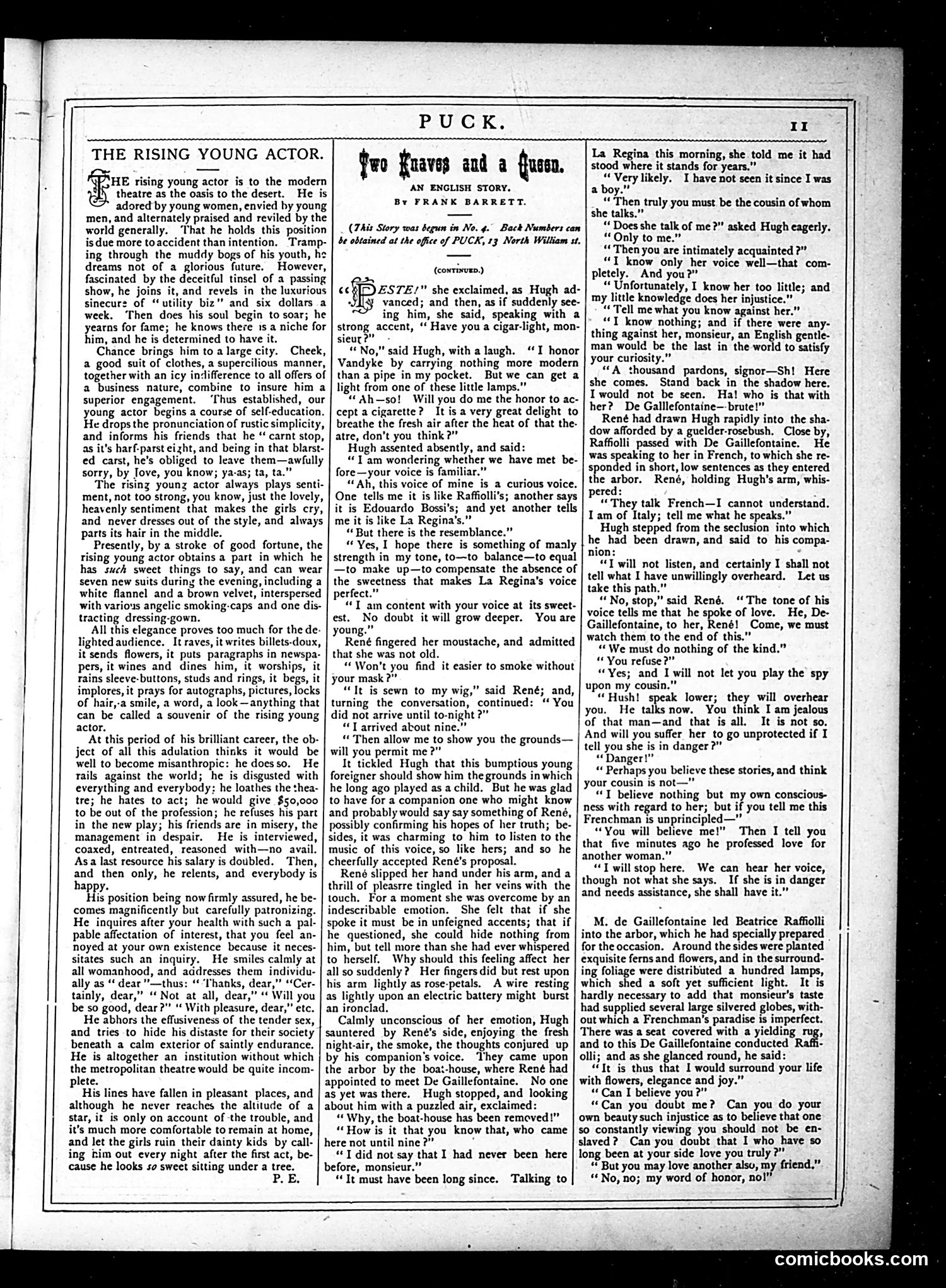
This page contains a serialized story by Frank Barrett rather than political satire. The narrative follows Hugh, a young man, and his interaction with a woman named Renée and another character, De Gaillefontaine. The story involves romantic tension—Hugh believes Renée loves him, but she may be deceiving him regarding her true feelings and loyalties to De Gaillefontaine. The opening article, "The Rising Young Actor," discusses theatrical life—a young actor's ascent through charm and ambition in metropolitan theater, with commentary on his sentimental nature and relationships. This page is primarily **literary content** rather than political cartoon or social satire, featuring serialized fiction typical of Puck's entertainment offerings.
📄 Transcribed text from this page (OCR, searchable)
Machine-transcribed from the original scan — historical spelling and the odd misread are preserved.
PUCK. THE RISING YOUNG ACTOR. y HE rising young actor is to the modern theatre as the oasis to the desert. He is adored by young women, envied by young men, and alternately praised and reviled by the world generally, ‘That he holds this position is due more toaccident than intention. Tramp- ing through the muddy bogs of his youth, he dreams not of a glorious future. However, fascinated by the deceitful tinsel of a passing show, he joins it, and revels in the luxurious sinecure of “utility biz’ and six dollars a week. ‘Then does his soul begin to soar; he yearns for fame; he knows there 1s a niche for him, and he is determined to have it. Chance brings him to a large city. Cheek, a good suit of clothes, a supercilious manner, together with an icy indifference to all offers of a business nature, combine to insure him a superior engagement. ‘Thus established, our young actor begins a course of self-education. He drops the pronunciation of rustic simplicity, and informs his friends that he “ carnt stop, as it’s harf-parst eizht, and being in that blarst- ed carst, he’s obliged to leave them—awfully sorry, by Jove, you know; ya-as; ta, ta.” The rising young actor always plays senti- ment, not too strong, you know, just the lovely, heavenly sentiment that makes the girls cry, and never dresses out of the style, and always parts its hair in the middle. Presently, by a stroke of good fortune, the rising young actor obtains a part in which he has such sweet things to say, and can wear seven new suits during the evening, including a white flannel and a brown velvet, interspersed with various angelic smoking-caps and one dis- tracting dressing-gown. All this elegance proves too much for the de- lighted audience. It raves, it writes billets-doux, it sends flowers, it puts paragraphs in newspa- pers, it wines and dines him, it worships, it rains sleeve-buttons, studs and rings, it begs, it implores, it prays for autographs, pictures, locks of hair,-a smile, a word, a look—anything that can be called a souvenir of the rising young actor. At this period of his brilliant career, the ob- ject of all this adulation thinks it would be well to become misanthropic: he doesso. He rails against the world; he is disgusted with everything and everybody: he loathes the thea- tre; he hates to act; he would give $50,000 to be out of the profession; he refuses his part in the new play; his friends are in misery, the management in despair. He is interviewed, coaxed, entreated, reasoned with—no avail. Asa last resource his salary is doubled. Then, and then only, he relents, and everybody is happy. is position being now firmly assured, he be- comes magnificently but carefully patronizing. He inquires after your health with such a pal- pable affectation of interest, that you feel an- noyed at your own existence because it neces- sitates such an inquiry. He smiles calmly at all womanhood, and addresses them individu- ally as “dear "—thus: ‘ ‘Thanks, dear,” ‘‘Cer- tainly, dear,” “Not at all, dear,” “ Will you be so good, dear?” ‘* With pleasure, dear,” etc. He abhors the effusiveness of the tender sex, and tries to hide his distaste for their society beneath a calm exterior of saintly endurance. He is altogether an institution without which the metropolitan theatre would be quite incom- plete. His lines have fallen in pleasant places, and although he never reaches the altitude of a star, it is only on account of -the trouble, and it’s much more comfortable to remain at home, and let the girls ruin their dainty kids by call- ing him out every night after the first act, be- cause he looks so sweet sitting under a tree. PEL Jeo fuaves and a {uecn, AN ENGLISH STORY. By FRANK BARRETT. (This Story was begun in No. 4. Back Numbers can be obtained at the office of PUCK, 13 North William st, (conraven.) 3 «ff ESTE!" she exclaimed, as Hugh ad- “ vanced; and then, as if suddenly see- ing him, she said, speaking with a strong accent, ‘‘ Have you a cigar-light, mon- sieut?”- "No," said Hugh, with a laugh. ‘I honor Vandyke by carrying nothing more modern than a pipe in my pocket. But we can get a light from one of these little lamps.” “ Ah—so! Will you do me the honor to ac- cept a cigarette? It is a very great delight to breathe the fresh air after the heat of that the- atre, don’t you think ?” Hugh assented absently, and said: “ Tam wondering whether we have met be- fore—your voice is familiar.” “Ah, this voice of mine is a curious voice. One tells me it is like Raffiolli’s; another says it is Edouardo Bossi and yet another tells me it is like La Regina's.” “But there is the resemblance.” “Yes, I hope there is something of manly strength in my tone, to—to balance—to equal —to make up—to compensate the absence of the sweetness that makes La Regina’s voice perfect.” “T am content with your voice at its sweet- est. No doubt it will grow deeper. You are young.” René fingered her moustache, and admitted that she was not old. “Won't you find it easier to smoke without your mask ?”” “It is sewn to my wig,” said René; and, turning the conversation, continued: ‘“ You did not arrive until to-night ?” “T arrived about nine.” “ Then allow me to show you the grounds— will you permit me?” It tickled Hugh that this bumptious young foreigner should show him the grounds in which he long ago played as a child. But he was glad to have for a companion one who might know and probably would say say something of René, possibly confirming his hopes of her truth; be- sides, it was charming to him to listen to the music of this voice, so like hers; and so he cheerfully accepted René’s proposal. René slipped her hand under his arm, and a thrill of pleasrre tingled in her veins with the touch. For a moment she was overcome by an indescribable emotion, She felt that if she spoke it must be in unfeigned accents; that if he questioned, she could hide nothing from him, but tell more than she had ever whispered to herself, Why should this feeling affect her all so suddenly? Her fingers did but rest upon his arm lightly as rose-petals. A wire resting as lightly upon an electric battery might burst an ironclad. Calmly unconscious of her emotion, Hugh sauntered by Rene’s side, enjoying the fresh night-air, the smoke, the thoughts conjured up by his companion’s voice. ‘They came upon the arbor by the boa:-house, where René had appointed to meet De Gaillefontaine. No one as yet was there. Hugh stopped, and looking about him with a puzzled air, exclaimed: “Why, the boat-house has been removed!” “How is it that you know that, who came here not until nine ?” “ “T did not say that I had never been here before, monsieur.” La Regina this morning, she told me it had stood where it stands for years.”” “Very likely. I have not seen it since I was a boy.” “Then truly you must be the cousin of whom she talks.” “ Does she talk of me?” asked Hugh eagerly. “Only to me.” “Then you are intimately acquainted ?” “I know only her voice well—that com- pletely. And you?” “ Unfortunately, I know her too little; and my little knowledge does her injustice.” “Tell me what you know against her.” “I know nothing; and if there were any- thing against her, monsieur, an English gentle- man would be the last in the world to satisfy your curiosity.” “(A thousand pardons, signor—Sh! Here she comes. Stand back in the shadow here. I would not be seen. Ha! who is that with her? De Galllefontaine—-brute!” René had drawn Hugh rapidly into the sha- dow afforded by a guelder-rosebush. Close by, Raffiolli passed with De Gaillefontaine. He was speaking to her in French, to which she re- sponded in short, low sentences as they entered the arbor. René, holding Hugh's arm, whis- pered: c “They talk French—I cannot understand. Iam of Italy; tell me what he speaks.” Hugh stepped from the seclusion into which he had been drawn, and said to his compa- nion: “T will not listen, and certainly I shall not tell what I have unwillingly overheard. Let us take this path.” “No, stop,” said René. “The tone of his voice tells me that he spoke of love. He, De- Gaillefontaine, to her, René! Come, we must watch them to the end of this.” «We must do nothing of the kind.” “You refuse?” “Yes; and I will not let you play the’ spy upon my cousin,” “Hush! speak lower; they will overhear you. He talks now. You think I am jealous of that man—and that is all. It is not so. And will you suffer her to go unprotected if I tell you she is in danger?” “Danger!” “ Perhaps you believe these stories, and think your cousin is not—” “T believe nothing but my own conscious- ness with regard to her; but if you tell me this Frenchman is unprincipled—” “You will believe me!” Then I tell you that five minutes ago he professed love for another woman.” “Twill stop here. We can hear her voice, though not what she says. If she is in danger and needs assistance, she shall have it.” M. de Gaillefontaine led Beatrice Raffiolli into the arbor, which he had specially prepared _ for the occasion. Around the sides were planted exquisite ferns and flowers, and in the surround- ing foliage were distributed _a hundred lamps, which shed a soft yet sufficient light. It is hardly necessary to add that monsieur’s taste had supplied several large silvered globes, with- out which a Frenchman's paradise is imperfect. There was a seat covered with a yielding rug, and to this De Gaillefontaine conducted - olli; and as she glanced round, he said: “It is thus that I would surround your life with flowers, elegance and joy.” “Can I believe you?” “Can you doubt me? Can you do your own beauty such injustice as to believe that one so constantly viewing you should not be en- slaved? Can you doubt that I who have so long been at your side love you truly ?”” “ But you may love another also, my friend.” “Tt must have been long since. Talking to **No, no; my word of honor, no!” comicbooks.com