
Puck, 1877-12-05 · page 7 of 16
Puck — December 5, 1877 — page 7: what you’re looking at
What you’re looking at
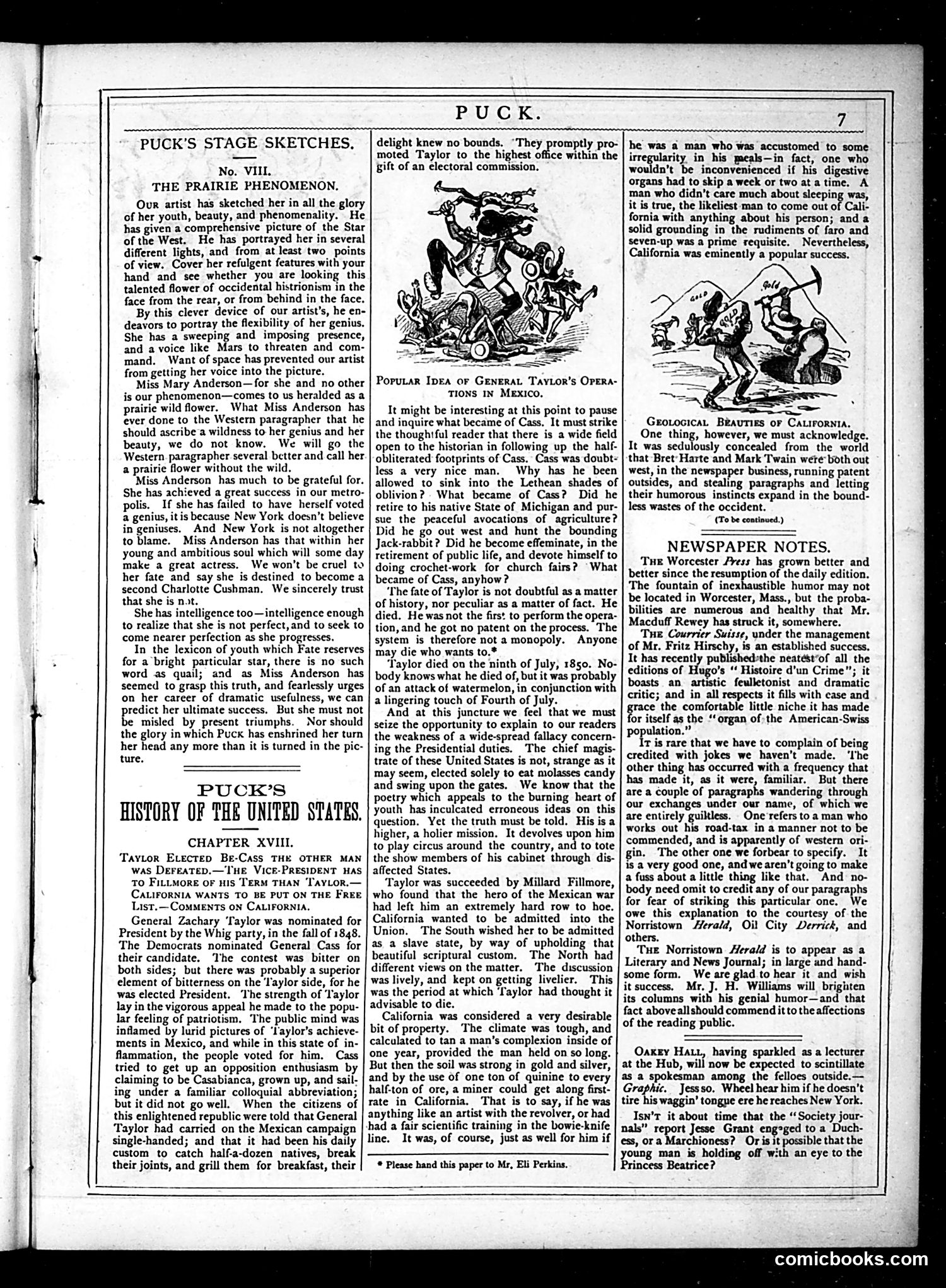
This page contains stage sketches and historical commentary rather than political cartoons. The main illustrated content includes: **"The Prairie Phenomenon"** sketch depicts Miss Mary Anderson, a Western actress praised for her talent and beauty. The accompanying text praises her ability to portray dramatic roles despite her youth. **"General Taylor's Operations in Mexico"** and **"Geological Beauties of California"** appear to be humorous illustrations related to Western expansion themes. The bulk of the page features **"Puck's History of the United States, Chapter XVIII,"** discussing President Taylor's 1848 election and California's admission to the Union. The satirical commentary critiques political debates over slavery expansion and California statehood, mocking politicians' hypocrisy regarding these contentious issues. The tone is characteristic of Puck's blend of theatrical gossip and political satire.
📄 Transcribed text from this page (OCR, searchable)
Machine-transcribed from the original scan — historical spelling and the odd misread are preserved.
PUCK. 7 PUCK’S STAGE SKETCHES, No. VIII. THE PRAIRIE PHENOMENON, Our artist has sketched her in all the glory of her youth, beauty, and phenomenality. He has given a comprehensive picture of the Star of the West. He has portrayed her in several different lights, and from at least two points of view. Cover her refulgent features with your hand and see whether you are looking this talented flower of occidental histrionism in the face from the rear, or from behind in the face. By this clever device of our artist’s, he en- deavors to portray the flexibility of her genius. She has a sweeping and imposing presence, and a voice like Mars to threaten and com- mand. Want of space has prevented our artist from getting her voice into the picture. Miss Mary Anderson—for she and no other is our phenomenon—comes to us heralded as a prairie wild flower. What Miss Anderson has ever done to the Western paragrapher that he should ascribe a wildness to her genius and her beauty, we do not know. We will go the Western. paragrapher several better and call her a prairie flower without the wild. Miss Anderson has much to be grateful for. She has achieved a great success in our metro- polis. If she has failed to have herself voted a genius, it is because New York doesn’t believe in geniuses. And New York is not altogether to blame. Miss Anderson has that within her young and ambitious soul which will some day make a great actress. We won't be cruel to her fate and say she is destined to become a second Charlotte Cushman. We sincerely trust that she is not. She has intelligence too— intelligence enough to realize that she is not perfect, and to seek to come nearer perfection as she progresses. In the lexicon of youth which Fate reserves for a bright particular star, there is no such word as quail; and as Miss Anderson has seemed to grasp this truth, and fearlessly urges on her career of dramatic usefulness, we can redict her ultimate success. But she must not be misled by Present triumphs. Nor should the glory in which Puck has enshrined her turn her head any more than it is turned in the pic- ture, PUCK’S HISTORY OF THE UNITED STATES. CHAPTER XVIII. Taytor Etectep Be-Cass THE OTHER MAN was DEFEATED.— THE VICE-PRESIDENT HAS To FittMore oF HIS TERM THAN ‘TAYLOR.— CALIFORNIA WANTS TO BE PUT ON THE FREE List.—ComMents oN CALIFORNIA, General Zachary ‘Taylor was nominated for President by the Whig party, in the fall of 1848. The Democrats nominated General Cass for their candidate. The contest was bitter on both sides; but there was probably a superior element of bitterness on the ‘l'aylor side, for he was elected President. ‘The strength of ‘Taylor lay in the vigorous appeal he made to the popu- lar feeling of patriotism. The public mind was inflamed by lurid pictures of ‘Iaylor’s achieve- ments in Mexico, and while in this state of in- flammation, the people voted for him. Cass tried to get up an opposition enthusiasm by claiming to be Casabianca, grown up, and sail- ing under a familiar colloquial abbreviation; but it did not go well. When the citizens of this enlightened republic were told that General ‘Taylor had carried on the Mexican campaign single-handed; and that it had been his daily custom to catch half-a-dozen natives, break their joints, and grill them for breakfast, their delight knew no bounds. “They promptly pro- moted Taylor to the highest office within the gift of an electoral commission. Popunar IDEA or GENERAL TayLor’s OPERA- TIONS IN MEXICO. It might be interesting at this point to pause and inquire what became of Cass. It must strike the thoughtful reader that there is a wide field open to the historian in following up the half- obliterated footprints of Cass. Cass was doubt- less a very nice man. Why has he been allowed to sink into the Lethean shades of oblivion? What became of Cass? Did he retire to his native State of Michigan and pur- sue the peaceful avocations of agriculture? Did he go out west and hunt the bounding Jack-rabbit? Did he become effeminate, in the retirement of public life, and devote himself to doing crochet-work for church fairs? “What became of Cass, anyhow? ‘The fate of Taylor is not doubtful as a matter of history, nor peculiar as a matter of fact. He died. He was not the first to perform the opera- tion, and he got no patent on the process. The system is therefore not a monopoly. Anyone may die who wants to.* ‘Taylor died on the ninth of July, 1850. No- body knows what he died of, but it was probably of an attack of watermelon, in conjunction with a lingering touch of Fourth of July. And at this juncture we feel that we must seize the opportunity to explain to our readers the weakness of a wide-spread fallacy concern- ing the Presidential duties. The chief magis- trate of these United States is not, strange as it may seem, elected solely to eat molasses candy and swing upon the gates. We know that the poetry which appeals to the burning heart of youth has inculcated erroneous ideas on this question. Yet the truth must be told. His is a higher, a holier mission. It devolves upon him to play circus around the country, and to tote the show members of his cabinet through dis- affected States. Taylor was succeeded by Millard Fillmore, who found that the hero of the Mexican war had left him an extremely hard row to hoe. California wanted to be admitted into the Union. The South wished her to be admitted as a slave state, by way of upholding that beautiful scriptural custom. The North had different views on the matter. The discussion was lively, and kept on getting livelier. This was the period at which ‘Taylor had thought it advisable to die. California was considered a very desirable bit of property. The climate was tough, and calculated to tan a man’s complexion inside of one year, provided the man held on so long. But then the soil was strong in gold and silver, and by the use of one ton of quinine to every half-ton of ore, a miner could get along first- rate in California. That is to say, if he was anything like an artist with the revolver, or had had a fair scientific training in the bowie-knife line. It was, of course, just as well for him if he was a man who was accustomed to some irre ‘ity in his meals—in fact, one who wouldn’t be inconvenienced if his digestive organs had to skip a week or two ata time. A man who didn’t care much about sleeping was, it is true, the likeliest man to come out of Cali- fornia with anything about his person; and a solid grounding in the rudiments of faro and seven-up was a prime requisite. Nevertheless, California was eminently a popular success. ‘ a > GrovocicaL B&autigs oF CALIFORNIA. One thing, however, we must acknowledge. It was sedulously concealed from the world that Bret’Harte and Mark Twain were both out west, in the newspaper business, running patent outsides, and stealing paragraphs and letting their humorous instincts expand in the bound- less wastes of the occident. (To be continued.) NEWSPAPER NOTES. ‘Tue Worcester Press has grown better and better since the resumption of the daily edition. The fountain of inexhaustible humor may not be located in Worcester, Mass., but the proba- bilities are numerous and healthy that Mr. Macduff Rewey has struck it, somewhere. Tue Courrier Suisse, under the management of Mr. Fritz Hirschy, is an established success. It has recently published-the neatest’of all the editions of Hugo’s “ Histoire d'un Crime”; it boasts an_ artistic feulletonist and dramatic critic; and in all respects it fills with case and race the comfortable little niche it has made for itself as the ‘‘organ of; the American-Swiss population.” 'T is rare that we have to complain of being credited with jokes we haven’t made. ‘I'he other thing has occurred with a frequency that has made it, as it were, familiar. But there are a couple of paragraphs wandering through our exchanges under our name, of which we are entirely guiltless. One'refers to a man who works out his road-tax in a manner not to be commended, and is apparently of western ori- gin. The other one we forbear to specify. It is a very good one, and we aren't going to make a fuss about a little thing like that. And no- body need omit to credit any of our paragraphs for fear of striking this particular one. We owe this explanation to the courtesy of the Norristown Herald, Oil City Derrick, and others. THE Norristown Herald is to appear as a Literary and News Journal; in large and hand- some form. We are glad to hear it and wish it success. Mr. J. H. Williams will brighten its columns with his genial humor—and that fact aboveallshould commenditto the affections of the reading public. Oakey Hatt, having sparkled as a lecturer at the Hub, will now be expected to scintillate as a spokesman among the felloes outside.— Graphic. Jessso. Wheel hear him if he doesn’t tire his waggin’ tongue ere he reaches New York. Isn’r it about time that the “Society jour- nals” report Jesse Grant eng2ged to a Duch- ess, ora Marchioness? Or is it possible that the Please hand this paper to Mr, Eli Perkins. pos, man is holding off w:th an eye to the incess Beatrice? comicbooks.com