
Puck, 1877-12-05 · page 5 of 16
Puck — December 5, 1877 — page 5: what you’re looking at
What you’re looking at
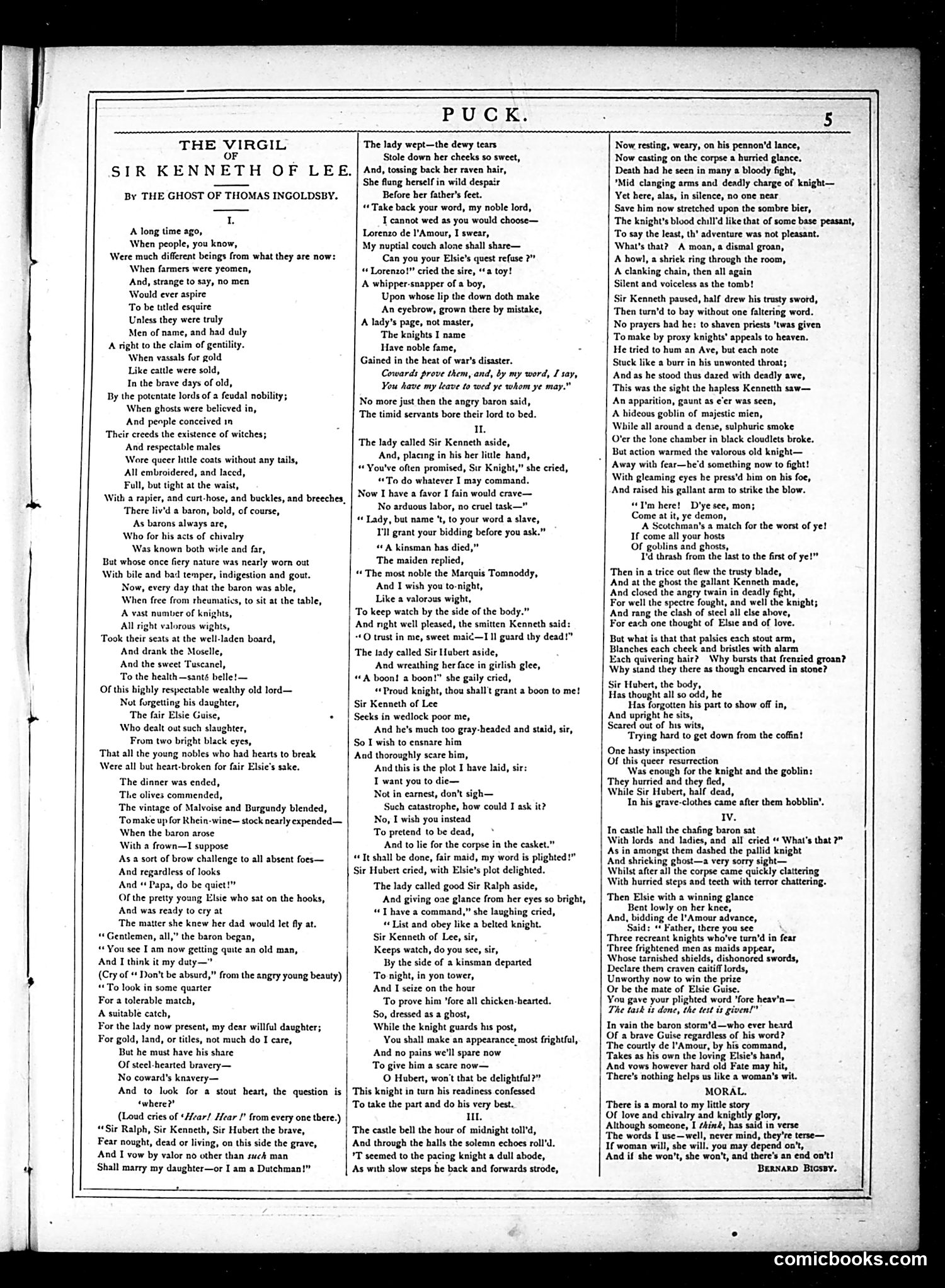
This page from *Puck* contains a lengthy narrative poem titled "The Virgil of Sir Kenneth of Lee," credited to "The Ghost of Thomas Ingoldsby." The poem is a mock-heroic, medieval-styled narrative featuring characters named Sir Kenneth, Sir Ralph, Sir Herbert, and Sir Hubert engaged in dramatic sword combat and courtly intrigue involving a maiden and matters of honor. The work appears to be literary satire rather than political commentary—it parodies romantic medieval literature and chivalric conventions through absurdist scenarios (a duel triggered by a servant's insult, a corpse used as a plot device). Without additional historical context or knowing the specific individuals being mocked, the precise targets remain unclear, though the piece clearly ridicules pretentious literary conventions and artificial notions of honor.
📄 Transcribed text from this page (OCR, searchable)
Machine-transcribed from the original scan — historical spelling and the odd misread are preserved.
= PUCK. TEE WARGILS SIR KENNETH OF LEE. By THE GHOST OF THOMAS INGOLDSBY. L A long time ago, When people, you know, Were much different beings from what they sre now: When farmers were yeomen, And, strange to say, no men Would ever aspire To be titled esquire Unless they were truly Men of name, and had duly A right to the claim of gentility. ‘When vassals fur gold Like cattle were sold, In the brave days of old, By the potentate lords of a feudal nobility; When ghosts were belicved in, And peaple conceived in Their creeds the existence of witches; And respectable males Wore queer litle coats without any tails, All embroidered, and laced, Full, but tight at the waist, With a rapier, and curt-hose, and buckles, and breeches, There liv'd a baron, bold, of course, As barons always are, Who for his acts of chivalry Was known both wide and far, But whose once fiery nature was nearly worn out With bile and bad temper, indigestion and gout. Now, every day that the baron was able, When free from rheumatics, to sit at the table, A vast number of knights, All right valorous wights, Took their seats at the well-laden board, And drank the Moselle, And the sweet Tuscanel, To the health—santé belle!— Of this highly respectable wealthy old lord— Not forgetting his daughter, The fair Elsie Guise, ~ | Who dealt out such slaughter, From two bright black eyes, That all the young nobles who had hearts to break Were all but heart-broken for fair Else's sake. The dinner was ended, The olives commended, The vintage of Malvoise and Burgundy blended, Tomake up for Rhein-wine— stock nearly expended— When the baron arose With a frown—I suppose As a sort of brow challenge to all absent foes— And regardless of looks And “Papa, do be quiet!” Of the pretty young Elsie who sat on the hooks, And was ready to cry at The matter she knew her dad would let fly at. “Gentlemen, all,” the baron began, “You see am now getting quite an old man, And I think it my duty— (Cry of «Don't be absurd,” from the angry young beauty) “To look in some quarter For a tolerable match, A suitable catch, For the lady now present, my dear willful daughter; For gold, land, or titles, not much do I care, But he must have his share Of steel-hearted bravery— No coward’s knavery— And to luok for a stout heart, the question is where?” (Loud cries of «Hear! Hear I” from every one there.) | “«Sir Ralph, Sir Kenneth, Sir Hubert the brave, | Fear nought, dead of living, on this side the grave, And I vow by valor no other than such man The lady wept—the dewy tears Stole down her checks so sweet, And, tossing back her raven hair, She flung herself in wild despair Before her father's feet. «Take back your word, my noble lord, T cannot wed as you would choose— Lorenzo de I"Amour, I swear, My nuptial couch alone shall share— Can you your Elsie’s quest refuse ?"” « Lorenzo!” cried the sire, ‘a toy! A whipper-snapper of a boy, Upon whose lip the down doth make An eyebrow, grown there by mistake, A lady's page, not master, The knights I name Have noble fame, Gained in the heat of war's disaster. Cowards prove them, and, by my word, I say, You have my leave to wed ye whom ye may.” No more just then the angry baron said, The timid servants bore their lord to bed. I. ‘The lady called Sir Kenneth aside, And, placing in his her little hand, “You've often promised, Sir Knight,” she cried, “To do whatever I may command. Now I have a favor I fain would crave— No arduous labor, no cruel task— « Lady, but name ‘t, to your word a slave, T'll grant your bidding before you ask.” “A kinsman has died,” The maiden replied, “The most noble the Marquis Tomnoddy, And I wish you to-night, Like a valorous wight, To keep watch by the side of the body.” And nght well pleased, the smitten Kenneth said: “+O trust in me, sweet mai¢—I Il guard thy dead! The lady called Sir Hubert aside, And wreathing her face in girlish glee, “A boon! a boon!” she gaily cried, “Proud knight, thou shall't grant a boon to me! Sir Kenneth of Lee Seeks in wedlock poor me, ‘And he’s much too gray-headed and staid, sir, So I wish to ensnare him And thoroughly scare him, And this is the plot I have laid, sir: I want you to die— Not in earnest, don’t sigh— Such catastrophe, how could I ask it? No, I wish you instead To pretend to be dead, And to lie for the corpse in the casket.” «Tt shall be done, fair maid, my word is plighted!” Sir Hubert cried, with Elsie’s plot delighted. ‘The lady called good Sir Ralph aside, And giving one glance from her eyes so bright, the laughing cried, «« List and obey like a belted knight. Sir Kenneth of Lee, sir, Keeps watch, do you see, sir, By the side of a kinsman departed To night, in yon tower, And I seize on the hour To prove him ‘fore all chicken-hearted. So, dressed as a ghost, While the knight guards his post, You shall make an appearance most frightful, ‘And no pains we'll spare now To give him a scare now— O Hubert, won't that be delightful?” This knight in turn his readiness confessed To take the part and do his very best. ita The castle bell the hour of midnight toll'd, And through the halls the solemn echoes roll'd. 'T seemed to the pacing knight a dull abode, Shall marry my daughter—or I am a Dutchman!” As with slow steps he back and forwards strode, Now resting, weary, on his pennon’d lance, Now casting on the corpse a hurried glance. Death had he seen in many a bloody fight, ’Mid clanging arms and deadly charge of knight— Yet here, alas, in silence, no one near Save him now stretched upon the sombre bier, The knight's blood chill'd like that of some base peasant, To say the least, th’ adventure was not pleasant. What's that? A moan, a dismal groan, A howl, a shriek ring through the room, A clanking chain, then all again Silent and voiceless as the tomb! Sir Kenneth paused, half drew his trusty sword, Then turn’d to bay without one faltering word. No prayers had he: to shaven priests ‘twas given To make by proxy knights’ appeals to heaven. He tried to hum an Ave, but each note Stuck like a burr in his unwonted throat And as he stood thus dazed with deadly awe, This was the sight the hapless Kennetth saw— An apparition, gaunt as e'er was seen, A hideous goblin of majestic mien, While all around a dense, sulphuric smoke O’er the lone chamber in black cloudlets broke. But action warmed the valorous old knight— Away with fear—he'd something now to fight! With gleaming eyes he press'd him on his foe, ‘And raised his gallant arm to strike the blow. “T'm here! D'ye see, mon; Come at it, ye demon, ‘A Scotchman’s a match for the worst of ye! If come all your hosts Of goblins and ghosts, T’d thrash from the last to the first of ye!” Then in a trice out flew the trusty blade And at the ghost the gallant Kenneth made, And closed the angry twain in deadly fight, For well the spectre fought, and well the knights And rang the clash of steel all else above, For each one thought of Elsie and of love. But what is that that palsies each stout arm, Blanches each cheek and bristles with alarm Each quivering hair? Why bursts that frenzied groan? ‘Why stand they there as though encarved in stone? Sir Hubert, the body, Has thought all so odd, he Has forgotten his part to show off And upright he sits, Scared out of his wits, Trying hard to get down from the coffin! One hasty inspection Of this queer resurrection ‘Was enough for the knight and the goblin: ‘They hurried and they fled, While Sir Hubert, half dea In his grave-clothes came after them hobblin’, Vv. In castle hall the chafing baron sat With lords and ladies, and all cried “¢ What's that ?” As in amongst them dashed the pallid knight ‘And shrieking ghost—a very sorry sight— Whilst after ail the corpse came quickly clattering With hurried steps and teeth with terror chattering. Then Elsie with a winning glance Bent lowly on her knee, And, bidding de l"Amour advance, ‘Said: « Father, there you see Three recreant knights who've turn'd in fear Three frightened men as maids appear, Whose tarnished shields, dishonored swords, Declare them craven caitiff lords, Unworthy now to win the prize Or be the mate of Elsie Guise. You gave your plighted word ‘fore heav'n— The task is done, the test is given!" In vain the baron storm'd—who ever heard OF a brave Guise regardless of his word? The courtly de I'Amour, by his command, Takes as his own the loving Elsie’s hand, And vows however hard old Fate may hit, There's nothing helps us like a woman's wit. MORAL. There is a moral to my little soy Of love and chivalry and knightly glory, Although someone, I ¢hind, has said in verse ‘The words I use—well, never mind, they're terse— If woman will, she will. you may depend on’t, And if she won't, she won't, and there's an end on’t! BERNaxp Bicssy. comicbooks.com