
Puck, 1877-12-05 · page 10 of 16
Puck — December 5, 1877 — page 10: what you’re looking at
What you’re looking at
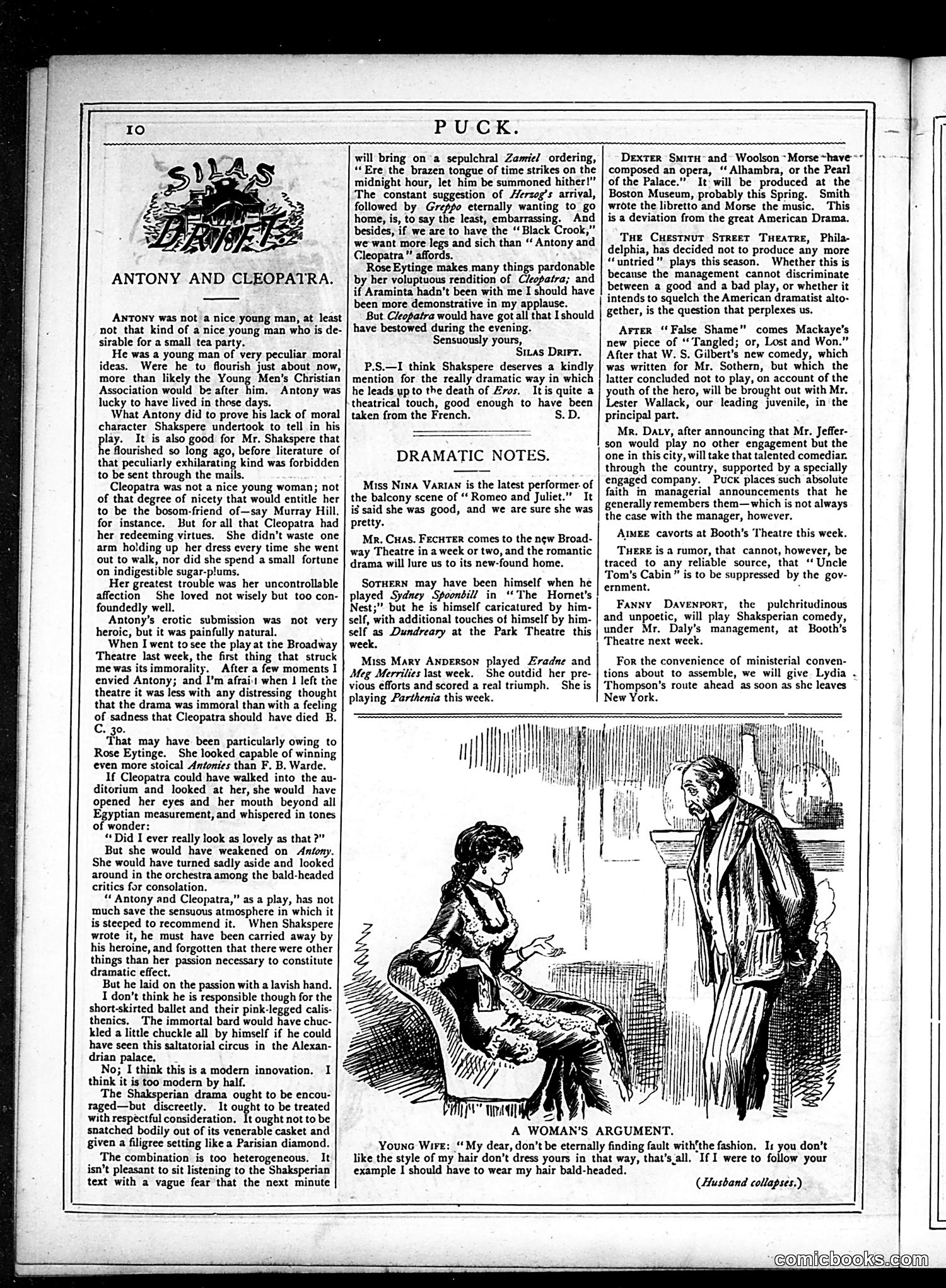
This page contains theatrical criticism rather than political satire. The main content discusses Shakespeare's *Antony and Cleopatra*, critiquing both the play itself and its performance standards of the era. The single illustration, captioned "A Woman's Argument," depicts a domestic dispute about hairstyling—a husband and wife debating fashion choices. The caption's joke relies on the husband's collapsing logic: he complains his wife's elaborate hairstyle doesn't suit her, then admits he'd wear his own hair identically if following her example, exposing the absurdity of his criticism. The "Dramatic Notes" section reviews contemporary theater performances, including mentions of Nina Varian and other performers. The satire here targets theatrical conventions rather than politics—poking fun at overwrought dramatic interpretations of Shakespeare.
📄 Transcribed text from this page (OCR, searchable)
Machine-transcribed from the original scan — historical spelling and the odd misread are preserved.
PUCK. ANTONY AND CLEOPATRA. ANTONY was not a nice young man, at least not that kind of a nice young man who is de- sirable for a small tea party. He was a young man of very peculiar moral ideas. Were he tu flourish just about now, more than likely the Young Men’s Christian Association would be after him. Antony was lucky to have lived in those days. What Antony did to prove his lack of moral character Shakspere undertook to tell in his play. It is also good for Mr. Shakspere that ¢ flourished so long ago, before literature of that peculiarly exhilarating kind was forbidden to be sent through the mails. Cleopatra was not a nice young woman; not of that degree of nicety that would entitle her to be the bosom-friend of—say Murray Hill. for instance. But for all that Cleopatra had her redeeming virtues. She didn’t waste one arm holding up her dress every time she went out to walk, nor did she spend a small fortune on indigestible sugar-p!ums. Her greatest trouble was her uncontrollable affection She loved not wisely but too con- foundedly well. Antony's erotic submission was not very heroic, but it was painfully natural. When I went to see the play at the Broadway Theatre last week, the first thing that struck me was its immorality. After a few moments I envied Antony; and I’m afrait when | left the theatre it was less with any distressing thought that the drama was immoral than with a feeling of sadness that Cleopatra should have died B. 30. That may have been particularly owing to Rose Eytinge. She looked capable of winning even more stoical Anfonies than F. B. Warde. If Cleopatra could have walked into the au- ditorium and looked at her, she would have opened her eyes and her mouth beyond all Egyptian measurement, and whispered in tones of wonder: “Did I ever really look as lovely as that ?”” But she would have weakened on Antony. She would have turned sadly aside and looked around in the orchestra among the bald-headed critics for consolation. “ Antony and Cleopatra,” as a play, has not much save the sensuous atmosphere in which it is steeped to recommend it. When Shakspere wrote it, he must have been carried away by his heroine, and forgotten that there were other things than her passion necessary to constitute dramatic effect. But he laid on the passion with a lavish hand. I don’t think he is responsible though for the short-skirted ballet and their pink-legged calis- thenics. The immortal bard would have chuc- kled a little chuckle all by himself if he could have seen this saltatorial circus in the Alexan- drian palace, No; I think this is a modern innovation. I think it is too modern by half. The Shaksperian drama ought to be encou- raged—but discreetly. It ought to be treated with respectful consideration. It ought not to be snatched bodily out of its venerable casket and given a filigree setting like a Parisian diamond. The combination is too heterogencous. It isn’t pleasant to sit listening to the Shaksperian will bring ona sepulchral Zazrie/ ordering, “Ere the brazen tongue of time strikes on the midnight hour, let him be summoned hither!” The constant suggestion of Herzog’s arrival, followed by Greppo eternally wanting to go home, is, to say the least, embarrassing. And besides, if. we are to have the ‘‘ Black Crook,” we want more legs and sich than “ Antony and Cleopatra” affords. Rose Eytinge makes many things pardonable by her voluptuous rendition of C/eopatra; and if Araminta hadn’t been with me I should have been more demonstrative in my applause. But Cleopatra would have got all that Ishould have bestowed during the evening. Sensuously yours, Sttas Drier. P.S.—I think Shakspere deserves a kindly mention for the really dramatic way in which he leads yp to the death of Eros, Itis quite a theatrical touch, good enough to have been taken from the French. S.D. DRAMATIC NOTES. Miss Nina Varian is the latest performer: of the balcony scene of ‘‘ Romeo and Juliet.” It ig said she was good, and we are sure she was pretty. Mr. Cuas. FECHTER comes to the n¢w Broad- way Theatre in a week or two, and the romantic drama will Jure us to its new-found home. SoTHERN may have been himself when he played Sydney Spoonbill in “The Hornet's Nest;” but he is himself caricatured by him- self, with additional touches of himself by him- self as Dundreary at the Park Theatre this week, Miss Mary ANDERSON played Eradne and Meg Merrilies last week. She outdid her pre- vious efforts and scored a real triumph. She is playing Parthenia this week. Dexter SmitH~and Woolson ~ Morse ~have ~~ composed an opera, ‘“ Alhambra, or the Pearl of the Palace.” It: will be produced at the Boston Museum, probably this Spring. Smith wrote the libretto and Morse the music. This is a deviation from the great American Drama. Tue Cuestnut STREET THEATRE, Phila- delphia, has decided not to produce any more “untried” plays this season. Whether this is because the management cannot discriminate between a good and a bad play, or whether it intends to squelch the American dramatist alto- gether, is the question that perplexes us. Arter ‘False Shame” comes Mackaye’s new piece of “Tangled; or, Lost and Won.” After that W. S. Gilbert’s new comedy, which was written for Mr. Sothern, but which the latter concluded not to play, on account of the youth of the hero, will be brought out with Mr. Lester Wallack, our leading juvenile, in the principal part. Mr. Daty, after announcing that Mr. Jeffer- son would play no other engagement but the one in this city, will take that talented comediar. through the country, supported by a specially engaged company. Puck places such absolute faith im managerial announcements that he generally remembers them—which is not always the case with the manager, however. AmEE cavorts at Booth's Theatre this week. ‘Tuere is a rumor, that cannot, however, be traced to any reliable source, that ‘‘ Uncle Tom's Cabin” is to be suppressed by the gov- ernment. : Fanny Davenport, the pulchritudinous and unpoetic, will play Shaksperian comedy, under Mr. Daly's management, at Booth’s Theatre next week. For the convenience of ministerial conven- tions about to assemble, we will give Lydia Thompson's route ahead as soon as she leaves New York. text with a vague fear that the next minute A WOMAN'S ARGUMENT. Younc Wire: “My dear, don’t be eternally finding fault with'the fashion. Is you don’t like the style of my hair don’t dress yours in that way, that’s all. If I were to follow your example I should have to wear my hair bald-headed. (Husband collapses.) comichooks.