
A complete issue · 16 pages · 1877
Puck — November 7, 1877
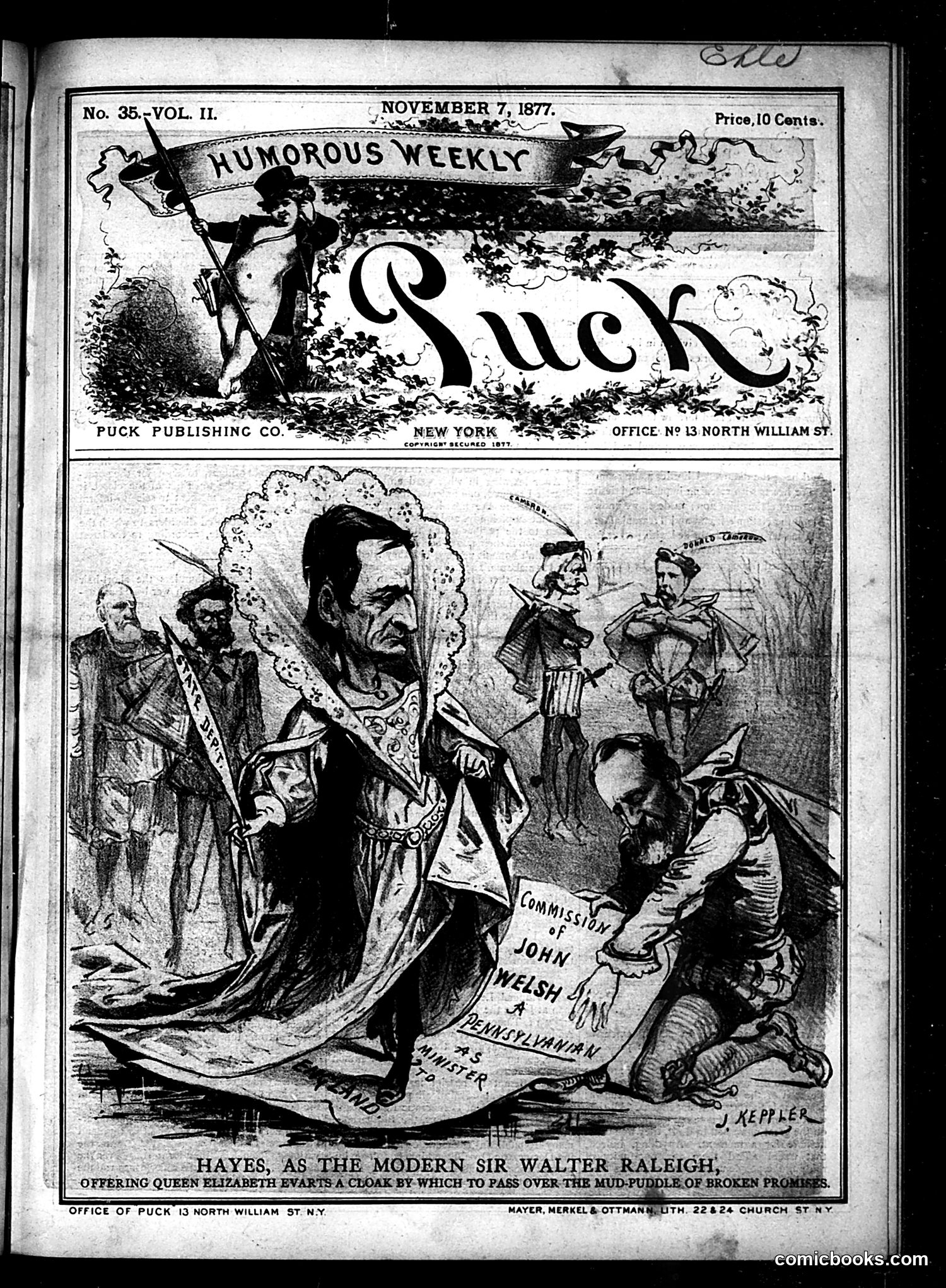
This November 1877 *Puck* cartoon mocks President Rutherford B. Hayes as "the modern Sir Walter Raleigh." The central figure, Hayes, wears an elaborate cloak labeled "Commission of John Welsh—A Pennsylvanian Blister," which he offers to Queen Elizabeth Evans (a female figure, likely representing something Hayes is trying to conciliate). The satire targets Hayes's appointment of John Welsh as a Pennsylvania commissioner following broken political promises. By comparing Hayes to Raleigh (who allegedly laid his cloak for Queen Elizabeth), the cartoon suggests Hayes is making grand, hollow gestures to cover up political failures—offering pageantry instead of substance to smooth over broken commitments ("mud-puddle of broken promises").
This page is primarily **text-based editorial content** rather than illustrated cartoons. The main pieces include: 1. **"The Man Who Doesn't Vote"** — A first-person narrative about voting rights and citizenship, discussing the author's experience registering to vote and the importance of political participation. 2. **"The English Mission"** and **"The Tammany Show"** — Political commentary pieces. The Tammany section critiques Tammany Hall (New York's Democratic political machine), discussing electoral manipulation and questioning the integrity of candidates like Augustus Schell and John Morrissey. The content reflects late-19th-century American political concerns: voting eligibility, machine politics, and electoral corruption. The satirical tone targets political establishments and encourages civic engagement. Without visible illustrations, the humor relies on rhetorical argument rather than visual caricature.
This page contains two satirical pieces about New York politics and law: **"Home Again! The Ex-Mayor Returns"** presents a dialogue between a reporter and Oakey Hall, the former New York City mayor. The satire mocks Hall's evasiveness about his activities and sudden reappearance. The reporter's persistent questioning—about Hall's travels, business dealings, and reasons for leaving—suggests Hall faced scandal or legal troubles that forced his departure. Hall's deflective, noncommittal responses ("I'd rather not mention it") imply guilt or embarrassment. **"Staten Island Law: A Sad but True Story"** is a poem satirizing judicial corruption, describing a judge who helps a man avoid paying debts by providing legal loopholes. The tale mocks both dishonest judges and those exploiting the legal system, suggesting widespread corruption in local courts. Both pieces critique New York's political and legal institutions through humor.
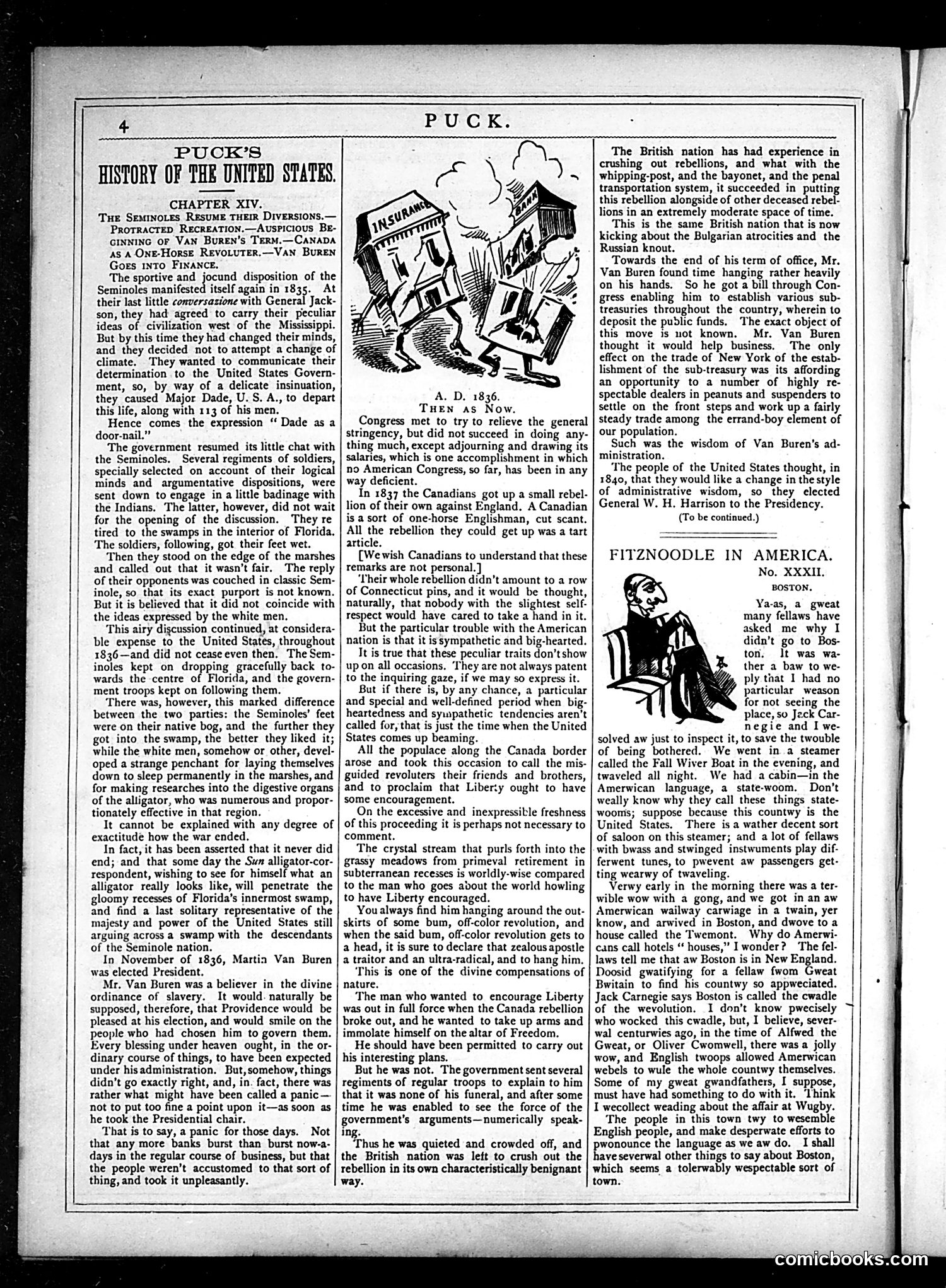
The main cartoon depicts a building labeled "INSURANCE" collapsing or exploding, with debris flying. This illustrates the text's discussion of financial instability during Van Buren's presidency (1836 onward). The visual metaphor suggests the collapse of banking and insurance systems, likely referencing the economic panic of 1837. The "Fitznoodle in America" section appears to be satirical humor about American customs and peculiarities (wooded areas named "state-woods," Boston called "the cradle of the revolution"). This ongoing feature uses a foreign observer character to mock American practices and regional pride. The history text discusses Seminole resistance and Van Buren's administration's financial troubles, contextualizing why contemporary readers would recognize the insurance collapse as commentary on the era's economic crisis.
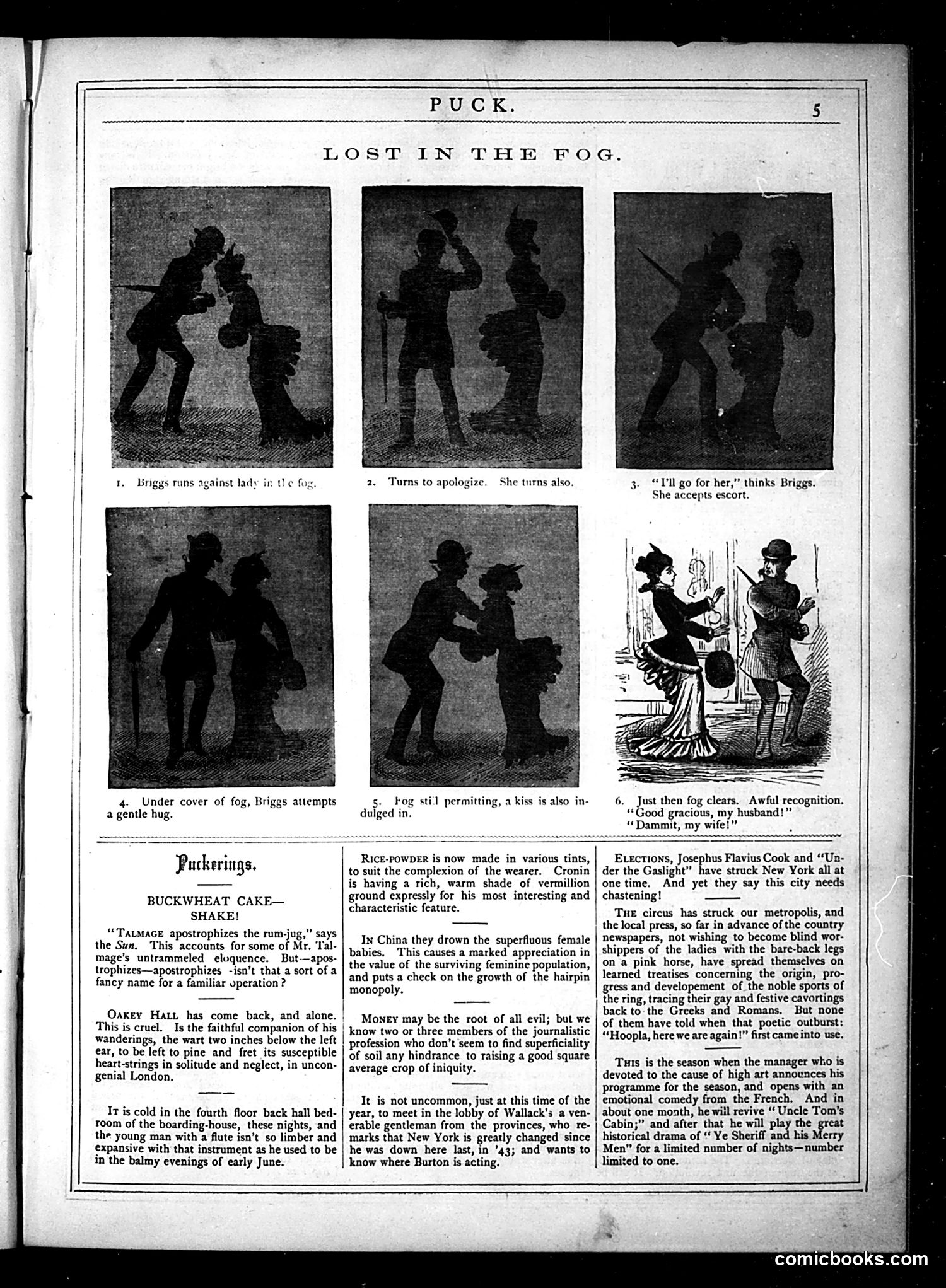
This six-panel comic strip depicts a romantic comedy scenario typical of Puck's humor. A man named Briggs encounters a lady in dense fog, creating confusion and opportunity for misadventure. The sequence shows: Briggs bumping into her (panel 1), apologizing while she rebuffs him (panel 2), offering escort (panel 3), attempting a "gentle hug" under cover of fog (panel 4), stealing a kiss (panel 5), and finally being recognized by her husband, who exclaims with apparent approval (panel 6). The satire plays on Victorian-era social anxieties about public propriety and the fog as cover for impropriety. The husband's seeming acceptance of the kiss suggests commentary on loose moral standards or marital dynamics of the era. The humor relies on the fog enabling behavior that wouldn't be socially acceptable in clear daylight.
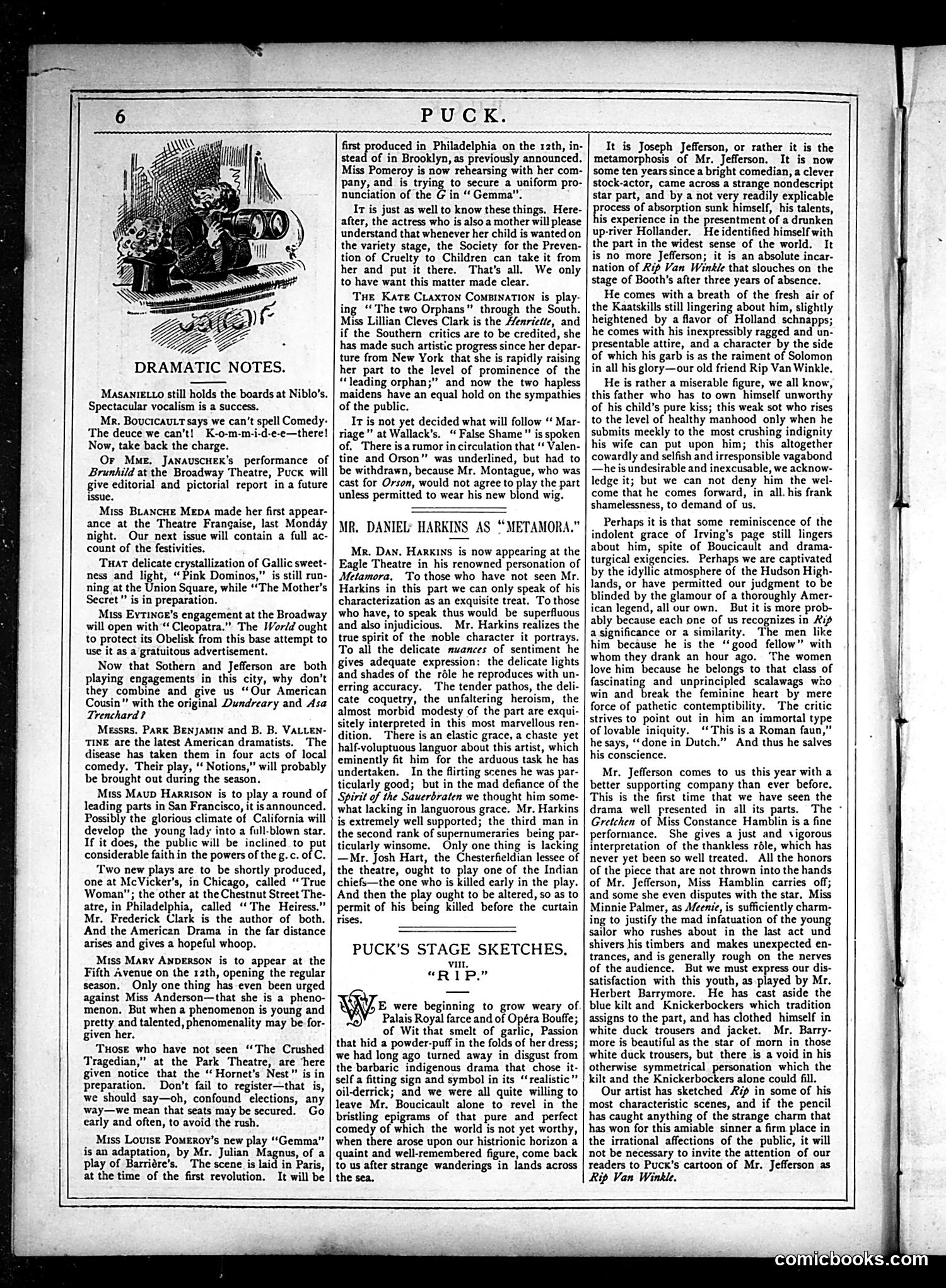
This page contains **theatrical reviews and drama criticism** rather than political satire. The main illustration shows a comedic theatrical scene, but the bulk of the content consists of "Dramatic Notes" discussing contemporary stage productions. The text references various actors and plays of the era, including Miss Pomeroy's new play "Gemma," performances by Dan Harkins, and discussions of productions like "The Two Orphans" and "Rip Van Winkle." At the bottom, "Puck's Stage Sketches" begins a section on theatrical performance, discussing an actor's portrayal of the character "Rip" in what appears to be a stage adaptation. This is primarily **entertainment/arts journalism** rather than political commentary—typical of Puck's coverage beyond its famous satirical cartoons.
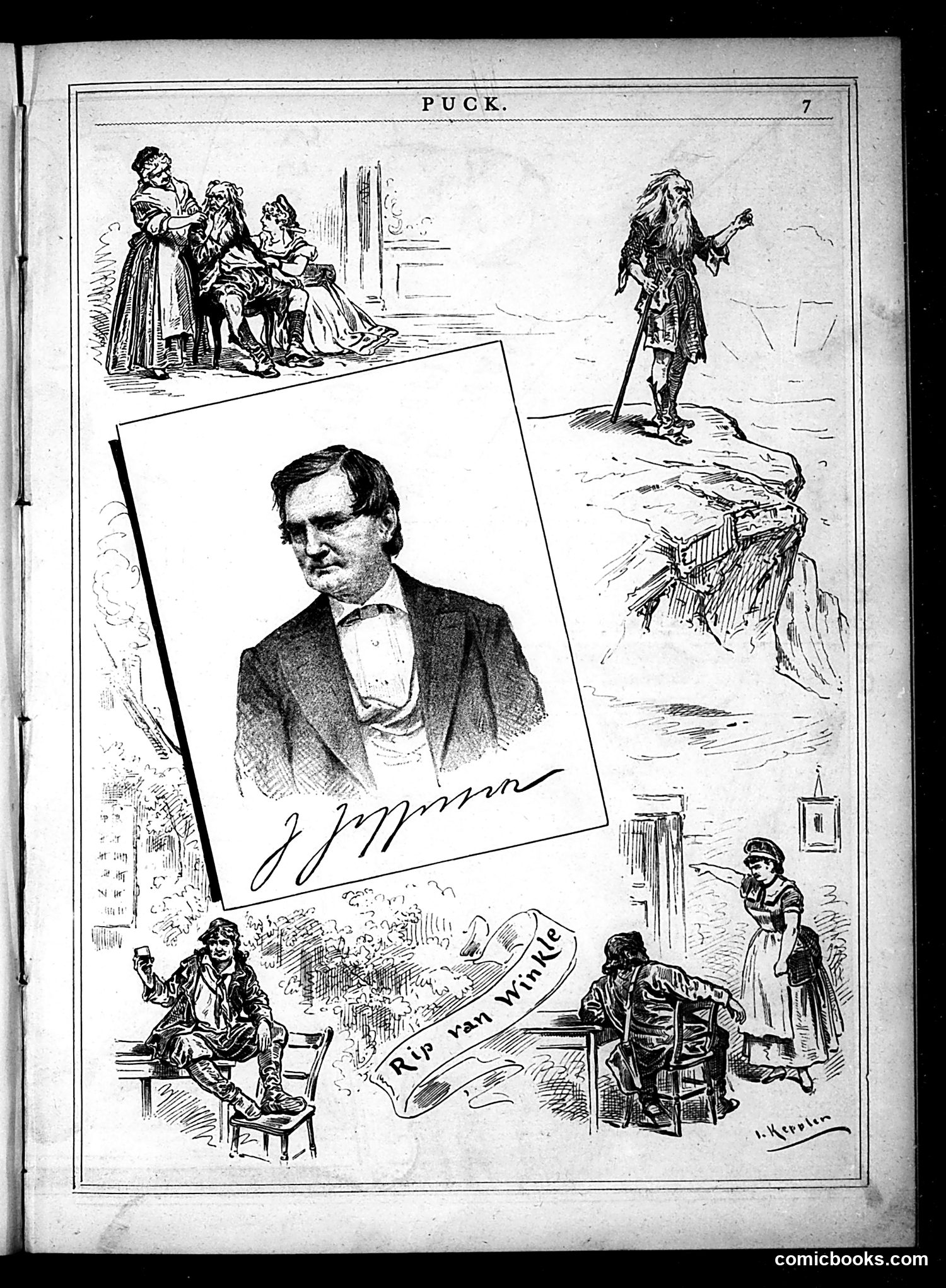
This page features a portrait of a man in formal 19th-century dress (signed "J. Nygrim") surrounded by illustrated vignettes. The central portrait appears to be the subject of satire, though the specific identity is unclear from visible text alone. The surrounding scenes depict various characters in distress or poverty—including what appears to be vagrants, beggars, and destitute figures. A banner reading "R.I.P. van Winkle" suggests the cartoon comments on someone who has "slept" through important social changes or who is disconnected from contemporary suffering. The overall composition satirizes either a political figure or wealthy individual accused of indifference to poverty and hardship. The "van Winkle" reference implies criticism of negligence or obliviousness to societal problems.
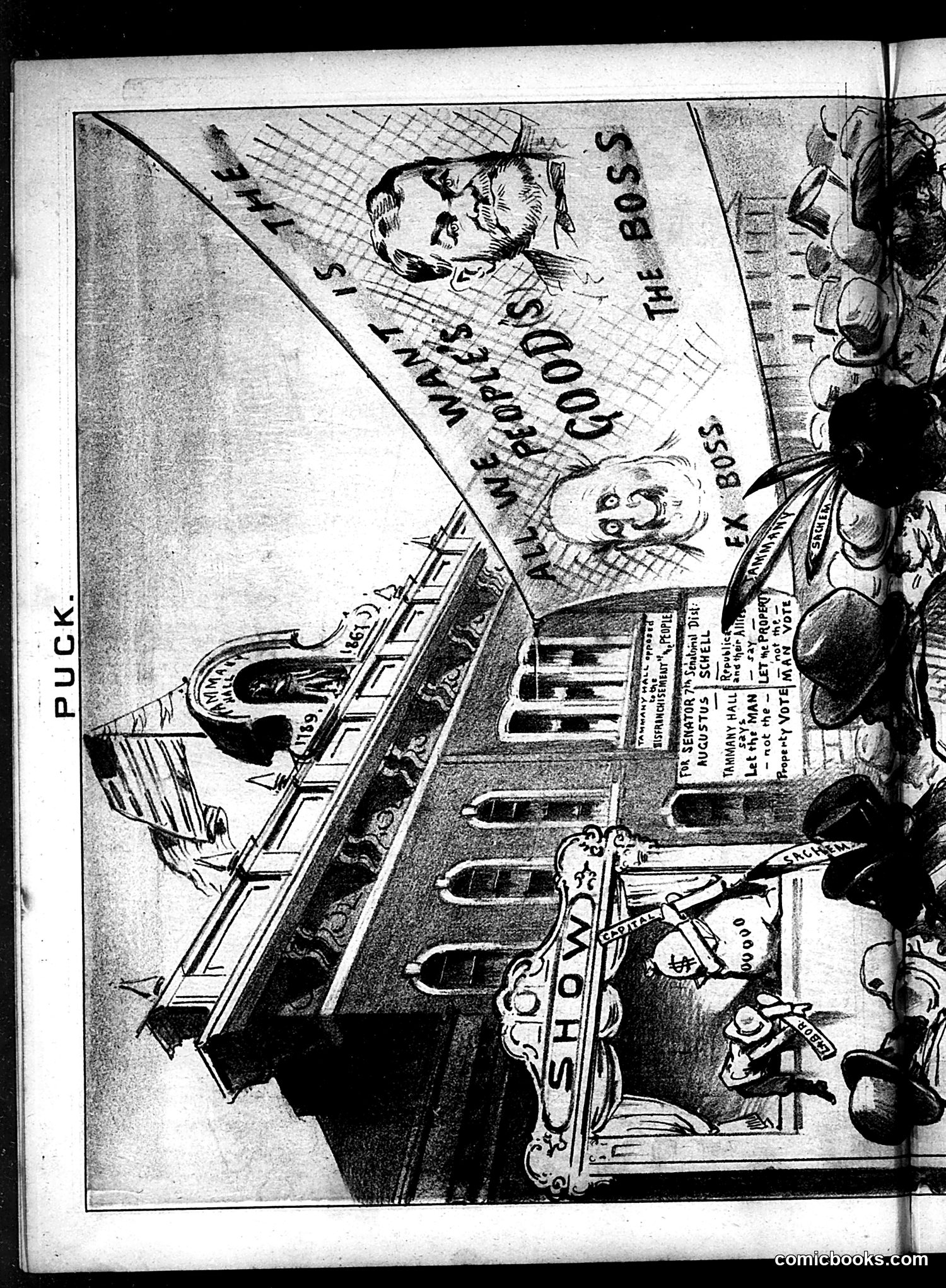
This page appears to be primarily **advertising** rather than editorial content. The main visible element is a large advertisement for what looks like a commercial product or service, with an ornate storefront or shop illustration labeled "SHOP" prominently displayed. The text is largely illegible in this reproduction quality, making it difficult to identify specific political references or satirical targets. There are some illustrated figures, but without clearer text or context, I cannot reliably identify who they represent or what contemporary issues are being addressed. **To properly analyze this page's satirical content, a higher-resolution image or clearer OCR text would be necessary.** If you have additional context about the publication date or issue, that would help significantly.
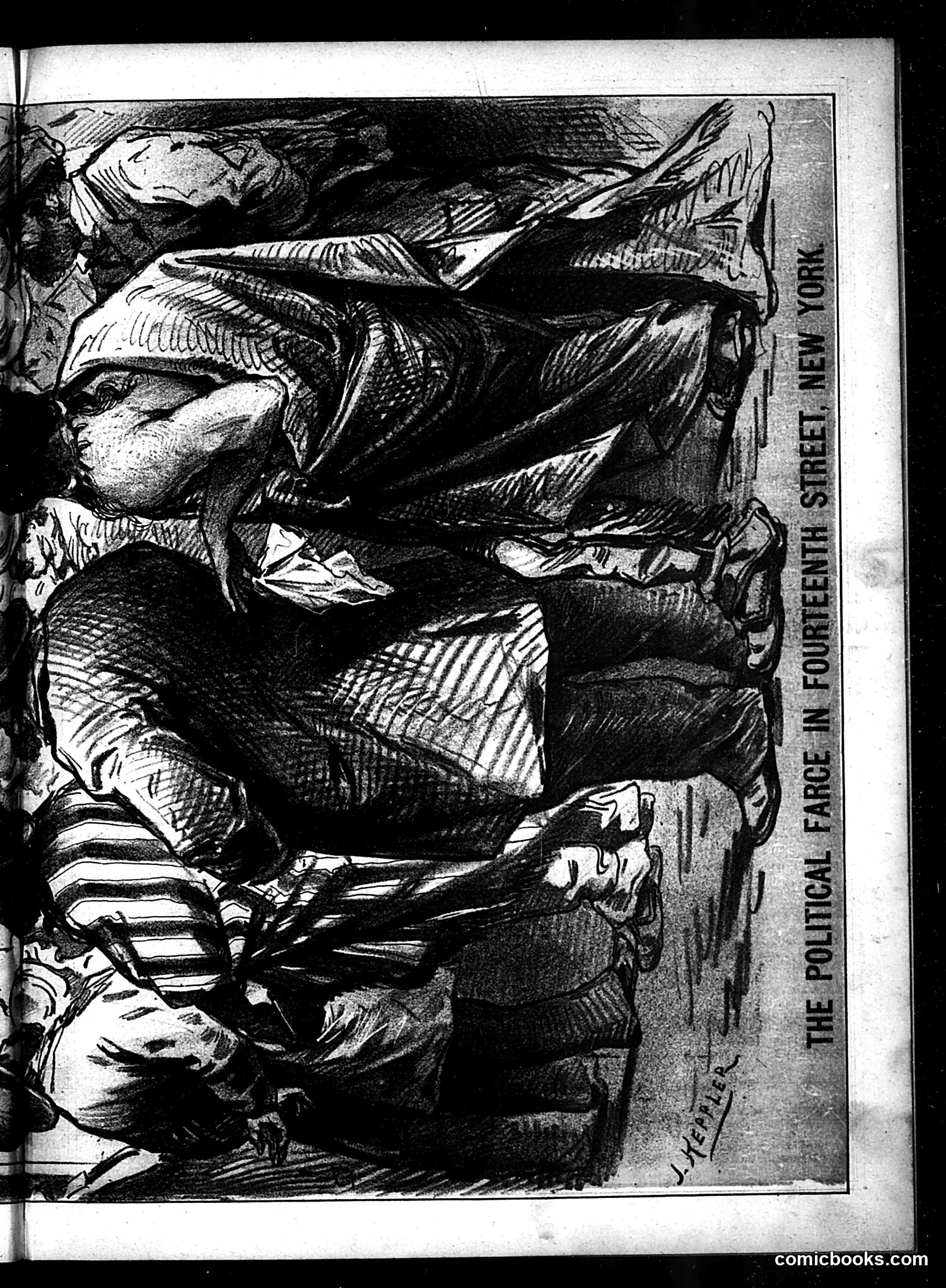
This appears to be a satirical illustration depicting a chaotic street scene, likely referencing political turmoil in New York City during the late 19th century. The image shows multiple figures in dramatic poses—some appearing distressed or engaged in conflict—with exaggerated facial expressions characteristic of Puck's style. The title references Fourteenth Street, a significant Manhattan location. The artistic style and composition suggest this comments on specific political corruption, street-level disorder, or civic mismanagement affecting that area. However, without additional context about the publication date or more legible text, I cannot identify the specific politicians or events being satirized. The satirical tone is clear, but the precise "farce" being mocked remains unclear from the image alone.
This is **not a political cartoon page**. Instead, it's page 10 of Puck magazine featuring the fourth installment of a serialized novel titled **"Mashed and Matched"** by an uncredited author. The page contains: - **Five chapters** of this romance novel (Chapters I-V), describing a love story involving characters named Angelina and Horatio - A **"Answers for the Anxious"** advice column addressing readers' questions about relationships, winter clothing, and literary matters - Standard magazine fiction content with no political satire or social commentary visible The novel appears to be a period romance set in New York (Harlem is mentioned), but this particular page contains serialized fiction rather than satirical cartoons, which were Puck's primary focus.
This page contains a satirical short story rather than a cartoon. The narrative mocks American fascination with Egyptian antiquities and colonial-era power dynamics. The story centers on **Ismail Pasha** (a historical Egyptian leader) and a journalist named **Dihemetri**. The satire targets Americans' obsession with acquiring Egyptian artifacts—specifically an obelisk—while also ridiculing American pretensions to cultural sophistication. The piece satirizes how wealthy Americans and newspapers pursued Egyptian treasures, and critiques the journalist's attempt to secure an audience with Ismail Pasha by flattering American "civilization" and progress. The humor derives from the obsequious behavior of the characters and the absurdity of American cultural imperialism dressed in diplomatic language. The "trousers" reference in the title remains unclear from this excerpt.
This page contains **Chapter XXXI of a serialized English story** titled "Two Knaves and a Queen," not a political cartoon. The narrative focuses on social drama among artists and society figures in what appears to be Victorian-era London. The story discusses a portrait of a woman named Rene that has caused scandal and jealousy among male acquaintances. Characters debate whether the subject is morally virtuous or has questionable character. References include the Academy (art exhibition), painting studios, and social gatherings of the artistic elite. The dialogue explores themes of artistic patronage, feminine virtue, romantic rivalry, and class distinctions—typical concerns of serialized fiction for Puck's middle and upper-class readership. **No political satire or identifiable historical figures appear on this page.**
This page consists primarily of brief satirical commentary snippets rather than a major cartoon. The main illustration shows cherubic figures, likely representing Puck magazine's mascot. The "Brevities" section contains short jokes and observations on contemporary social issues: banking failures, Mexican politics, Democratic politics in Ohio, literary piracy, hair care, European war commentary, and various minor domestic topics. Key themes include criticism of financial mismanagement, political incompetence, and social pretension. References to "the Democratic majority in Ohio" and allusions to European war suggest early 20th-century American context. The tone is consistently mocking of authority figures and current events, typical of Puck's satirical approach. Without specific dates or figures clearly named, the exact historical references remain somewhat unclear to modern readers.
This page is primarily **advertising and announcements** rather than satirical content. The main feature is a "Special Announcement" from Puck's publishers regarding their new **General Designing Office**, highlighting services provided by artist **Joseph Keppler** (likely a family member of Puck's founder). The office offers commercial illustration services including lithographic portraits for theatrical professionals, positioned as advantageous for the theatrical profession. The left column contains brief humor items and anecdotes typical of Puck's filler content—short jokes about social situations, regional peculiarities, and domestic scenarios. These lack specific political targets and serve as light entertainment. **No significant political cartoons or satirical commentary appear on this page.** It functions primarily as a business promotion within the magazine's pages.
This page is primarily **advertising and announcements** rather than editorial cartoon content. It contains: - Theater advertisements (Volks-Garden-Theatre, Aberle's Tivoli Theatre) - Business advertisements (portrait studios, hat makers, printing ink manufacturer, carpet warerooms) - A **memorial notice for Brigham Young**, the deceased Mormon leader, explaining that Puck magazine published a cartoon depicting "the 'Mormon's Empty Pillows'" in response to demand, now available as a single sheet from newsdealers - Patent cover offers for filing Puck magazine - Back issue availability notices - Clothing store advertisements The only substantive editorial content is the reference to a Brigham Young cartoon (not visible here), satirizing Mormon polygamy through the metaphor of empty pillows—a common 19th-century American criticism of the practice.
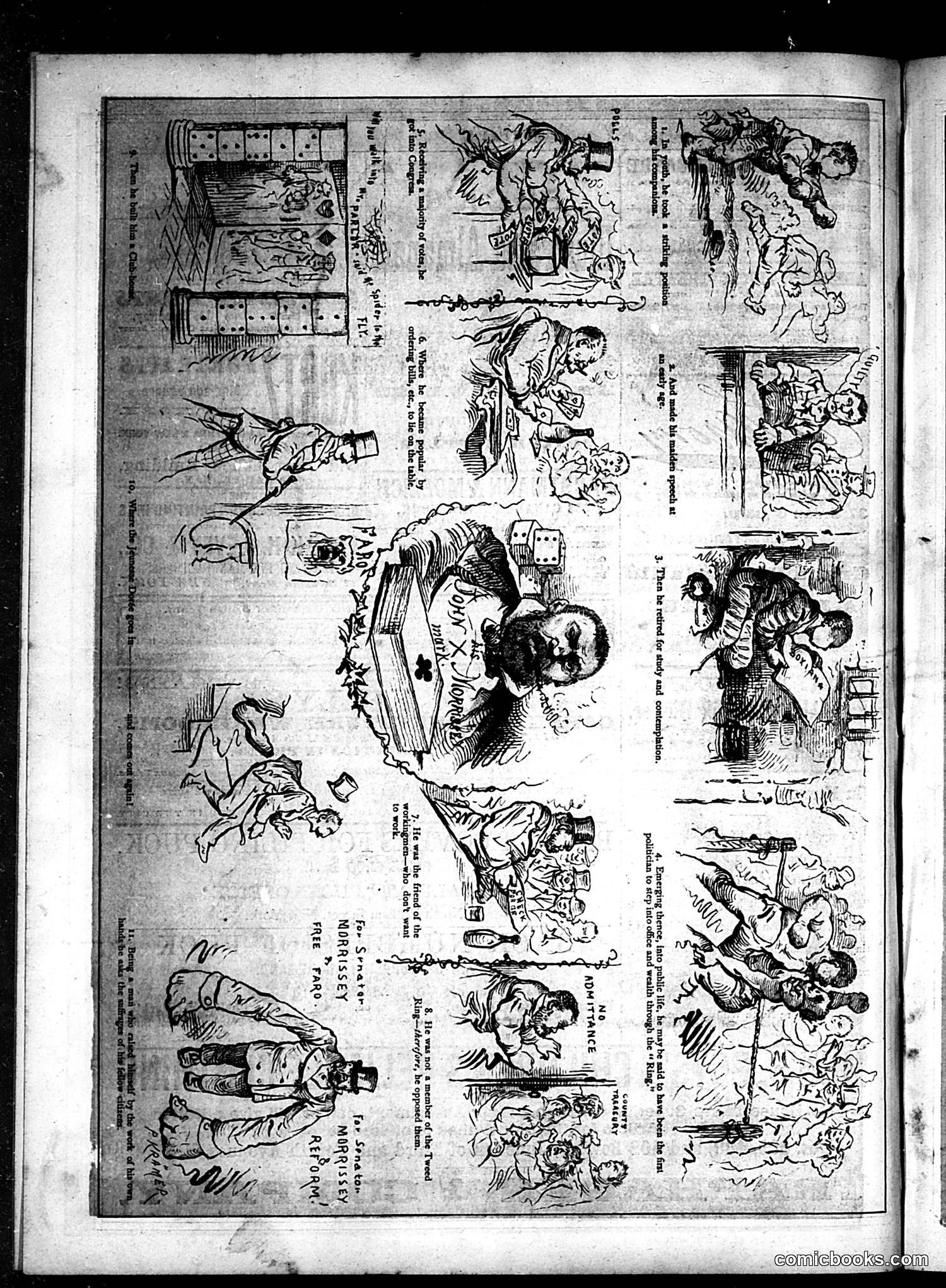
I can see this is a page from Puck magazine containing multiple satirical illustrations and some text, but the OCR text provided is largely illegible or incomplete—it appears to be mostly formatting artifacts rather than readable content. From the IMAGE alone, I can identify several cartoon panels with exaggerated character caricatures typical of late 19th/early 20th-century political satire. The drawings show various figures in different scenarios, some appearing to depict social or political commentary through dramatic poses and expressions. However, without legible text identifying the specific figures, events, or political references being satirized, I cannot reliably explain what these cartoons mean to a modern reader. To provide accurate historical context, I would need either clearer OCR text or additional identifying information about the publication date and specific topics covered.