
Puck, 1877-11-07 · page 4 of 16
Puck — November 7, 1877 — page 4: what you’re looking at
What you’re looking at
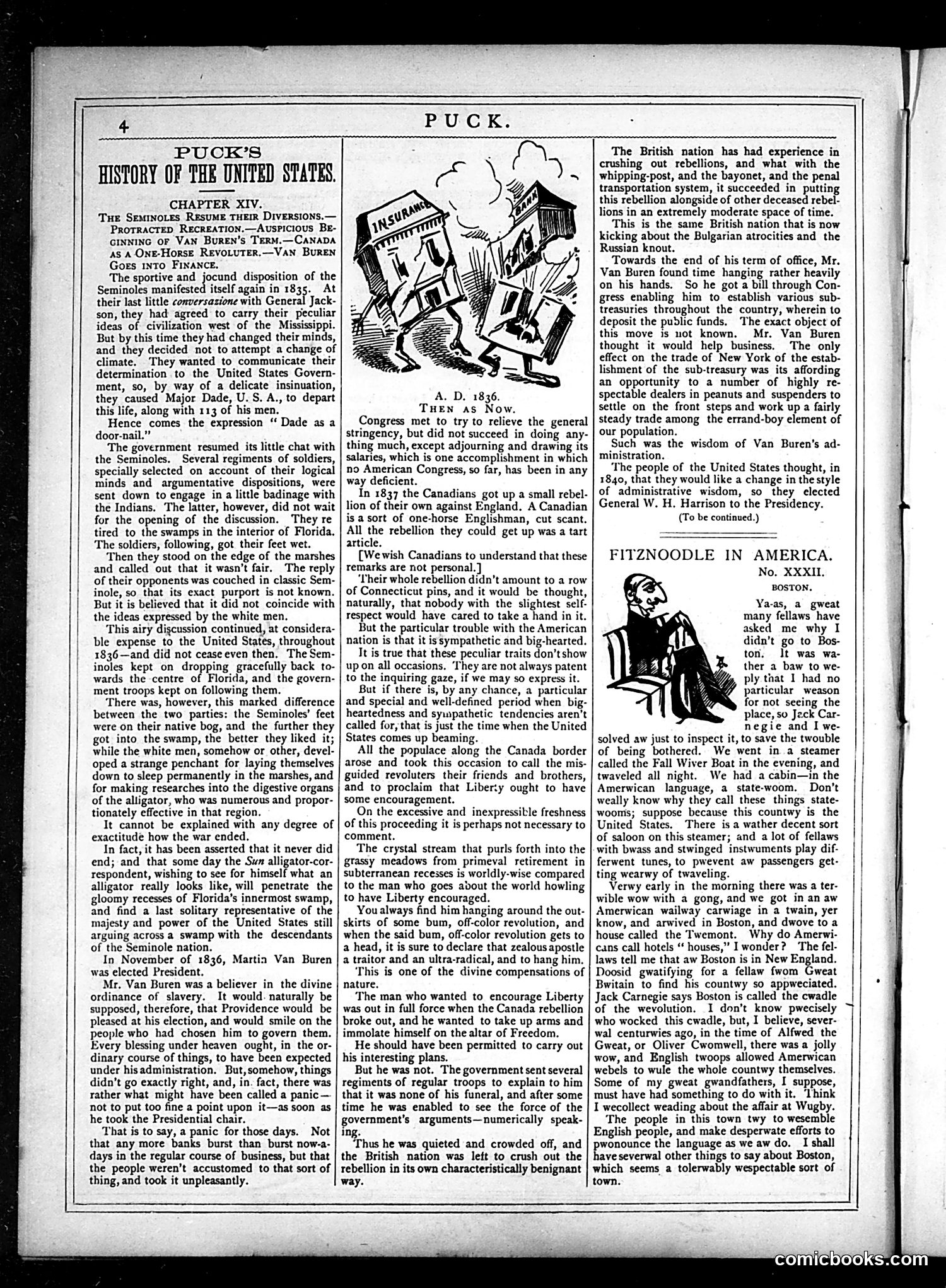
The main cartoon depicts a building labeled "INSURANCE" collapsing or exploding, with debris flying. This illustrates the text's discussion of financial instability during Van Buren's presidency (1836 onward). The visual metaphor suggests the collapse of banking and insurance systems, likely referencing the economic panic of 1837. The "Fitznoodle in America" section appears to be satirical humor about American customs and peculiarities (wooded areas named "state-woods," Boston called "the cradle of the revolution"). This ongoing feature uses a foreign observer character to mock American practices and regional pride. The history text discusses Seminole resistance and Van Buren's administration's financial troubles, contextualizing why contemporary readers would recognize the insurance collapse as commentary on the era's economic crisis.
📄 Transcribed text from this page (OCR, searchable)
Machine-transcribed from the original scan — historical spelling and the odd misread are preserved.
4 PUCK’S HISTORY OF THE UNITED STATES. CHAPTER XIV. Tue Semtnotes RESUME THEIR DIVERSIONS.— ProtracTep RecreaTion.—Auvspicious BE- GINNING OF VAN Buren’s TERM.—CANADA AS A ONE-Horse REVOLUTER.—VAN BUREN Goes INTO FINANCE. The sportive and jocund disposition of the Seminoles manifested itself again in 1835. At their last little conversazione with General Jack- son, they had agreed to carry their peculiar ideas of civilization west of the Mississippi. But by this time they had changed their minds, and they decided not to attempt a change of climate. They wanted to communicate their determination to the United States Govern- ment, so, by way of a delicate insinuation, they ‘caused Major Dade, U.S. A., to depart this life, along with 113 of his men. Hence comes the expression ‘‘ Dade as a door-nail.” The government resumed its little chat with the Seminoles. Several regiments of soldiers, specially selected on account of their logical minds and argumentative dispositions, were sent down to engage in a little badinage with the Indians, The latter, however, did not wait for the opening of the discussion. They re tired to the swamps in the interior of Florida. The soldiers, following, got their feet wet. Then they stood on the edge of the marshes and called out that it wasn’t fair, The reply of their opponents was couched in classic Sem- inole, so that its exact purport is not known. But it is believed that it did not coincide with the ideas expressed by the white men, This airy digcussion continued, at considera- ble expense to the United States, throughout 1836—and did not cease even then. The Sem- inoles kept on dropping gracefully back to- wards the centre of Florida, and the govern- ment troops kept on following them. There was, however, this marked difference between the two parties: the Seminoles’ feet were on their native bog, and the further they got into the swamp, the better they liked it; while the white men, somehow or other, devel- oped a strange penchant for laying themselves down to sleep permanently in the marshes, and for making researches into the digestive organs of the alligator, who was numerous and propor- tionately effective in that region. It cannot be explained with any degree of exactitude how the war ended. In fact, it has been asserted that it never did end; and that some day the Sua alligator-cor- respondent, wishing to see for himself what an alligator really looks like, will penetrate the gloomy recesses of Florida’s innermost swamp, and find a last solitary representative of the majesty and power of the United States still arguing across a swamp with the descendants of the Seminole nation. In November of 1836, Martin Van Buren was elected President. Mr. Van Buren was a believer in the divine ordinance of slavery. It would. naturally be supposed, therefore, that Providence would be pleased at his election, and would smile on the people who had chosen him to govern them. Every blessing under heaven ought, in the or- dinary course of things, to have been expected under his administration. But, somehow, things didn’t go exactly right, and, in. fact, there was rather what might have been called a panic— not to put too fine a point upon it—as soon as he took the Presidential chair. That is to say, a panic for those days. Not that any more banks burst than burst now-a- days in the regular course of business, but that the people weren’t accustomed to that sort of thing, and took it unpleasantly. A. D. 1836. Tuen as Now. Congress met to try to relieve the general stringency, but did not succeed in doing any- thing much, except adjourning and drawing its salaries, which is one accomplishment in which no American Congress, so far, has been in any way deficient. In 1837 the Canadians got up a small rebel- lion of their own against England. A Canadian is a sort of one-horse Englishman, cut scant. All the rebellion they could get up was a tart article. (Wewish Canadians to understand that these remarks are not personal] ‘Their whole rebellion didn’t amount to a row of Connecticut pins, and it would be thought, naturally, that nobody with the slightest self- respect would have cared to take a hand in it. But the particular trouble with the American nation is that it issympathetic and big-hearted. It is true that these peculiar traits don’t show upon all occasions. They are not always patent to the inquiring gaze, if we may so express it. But if there is, by any chance, a particular and special and well-defined period when big- heartedness and synpathetic tendencies aren’t called for, that is just the time when the United States comes up beaming. All the populace along the Canada border arose and took this occasion to call the mis- guided revoluters their friends and brothers, and to proclaim that Liberty ought to have some encouragement. On the excessive and inexpressible freshness of this proceeding it is perhaps not necessary to comment. The crystal stream that purls forth into the Grassy meadows from primeval retirement in subterranean recesses is worldly-wise compared to the man who goes about the world howling to have Liberty encouraged. You always find him hanging around the out- skirts of some bum, off-color revolution, and when the said bum, off-color revolution gets to a head, it is sure to declare that zealous apostle a traitor and an ultra-radical, and to hang him. This is one of the divine compensations of nature. The man who wanted to encourage Liberty was out in full force when the Canada rebellion broke out, and he wanted to take up arms and immolate himself on the altar of Freedom. He should have been permitted to carry out his interesting plans. But he was not. The government sent several regiments of regular troops to explain to him that it was none of his funeral, and after some time he was enabled to see the force of the government's arguments—numerically speak- ing. Thus he was quieted and crowded off, and the British nation was left to crush out the rebellion in its own characteristically benignant way. The British nation has had experience in crushing out rebellions, and what with the whipping-post, and the bayonet, and the penal transportation system, it succeeded in putting this rebellion alongside of other deceased rebel- lions in an extremely moderate space of time. This is the same British nation that is now kicking about the Bulgarian atrocities and the Russian knout. Towards the end of his term of office, Mr. Van Buren found time hanging rather heavily on his hands. So he got a bill through Con- gress enabling him to establish various sub- treasuries throughout the country, wherein to deposit the public funds. The exact object of this move is uot known. Mr. Van Buren thought it would help business. The only effect on the trade of New York of the estab- lishment of the sub-treasury was its affording an opportunity to a number of highly re- spectable dealers in peanuts and suspenders to settle on the front steps and work up a fairly steady trade among the errand-boy element of our population. Such was the wisdom of Van Buren’s ad- ministration, The people of the United States thought, in 1840, that they would like a change in the style of administrative wisdom, so they elected General W. H. Harrison to the Presidency. (To be continued.) FITZNOODLE IN AMERICA. No. XXXII. BOSTON. Ya-as, a gweat many fellaws have asked me why I didn’t go to Bos- ton, It was wa- ther a baw to we- ply that 1 had no particular weason for not seeing the place, so Jack Car- negie and I we- solved aw just to inspect it, to save the twouble of being bothered. We went in a steamer called the Fall Wiver Boat in the evening, and twaveled all night. We had a cabin—in the Amerwican language, a state-woom. Don’t weally know why they call these things state- wooms; suppose because this countwy is the United States. There is a wather decent sort of saloon on this steamer; and a lot of fellaws with bwass and stwinged instwuments play dif- ferwent tunes, to pwevent aw passengers get- ting wearwy of twaveling. Verwy early in the morning there was a ter- wible wow with a gong, and we got in an aw Amerwican wailway carwiage in a twain, yer know, and arwived in Boston, and dwove to a house called the Twemont. Why do Amerwi- cans call hotels “ houses,” I wonder? The fel- laws tell me that aw Boston is in New England. Doosid gwatifying for a fellaw fwom Gweat Bwitain to find his countwy so appweciated. Jack Carnegie says Boston is called the cwadle of the wevolution. I don’t know pwecisely who wocked this cwadle, but, I believe, sever- wal centurwies ago, in the time of Alfwed the Gweat, or Oliver Cwomwell, there was a jolly wow, and English twoops allowed Amerwican webels to wule the whole countwy themselves. Some of my gweat gwandfathers, I suppose, must have had something to do with it. ‘Think I wecollect weading about the affair at Wugby. The people in this town twy to wesemble English people, and make desperwate efforts to pwonounce the language as we aw do. _I shall have severwal other things to say about Boston, which seems a tolerwably wespectable sort of town.