
Puck, 1877-11-07 · page 11 of 16
Puck — November 7, 1877 — page 11: what you’re looking at
What you’re looking at
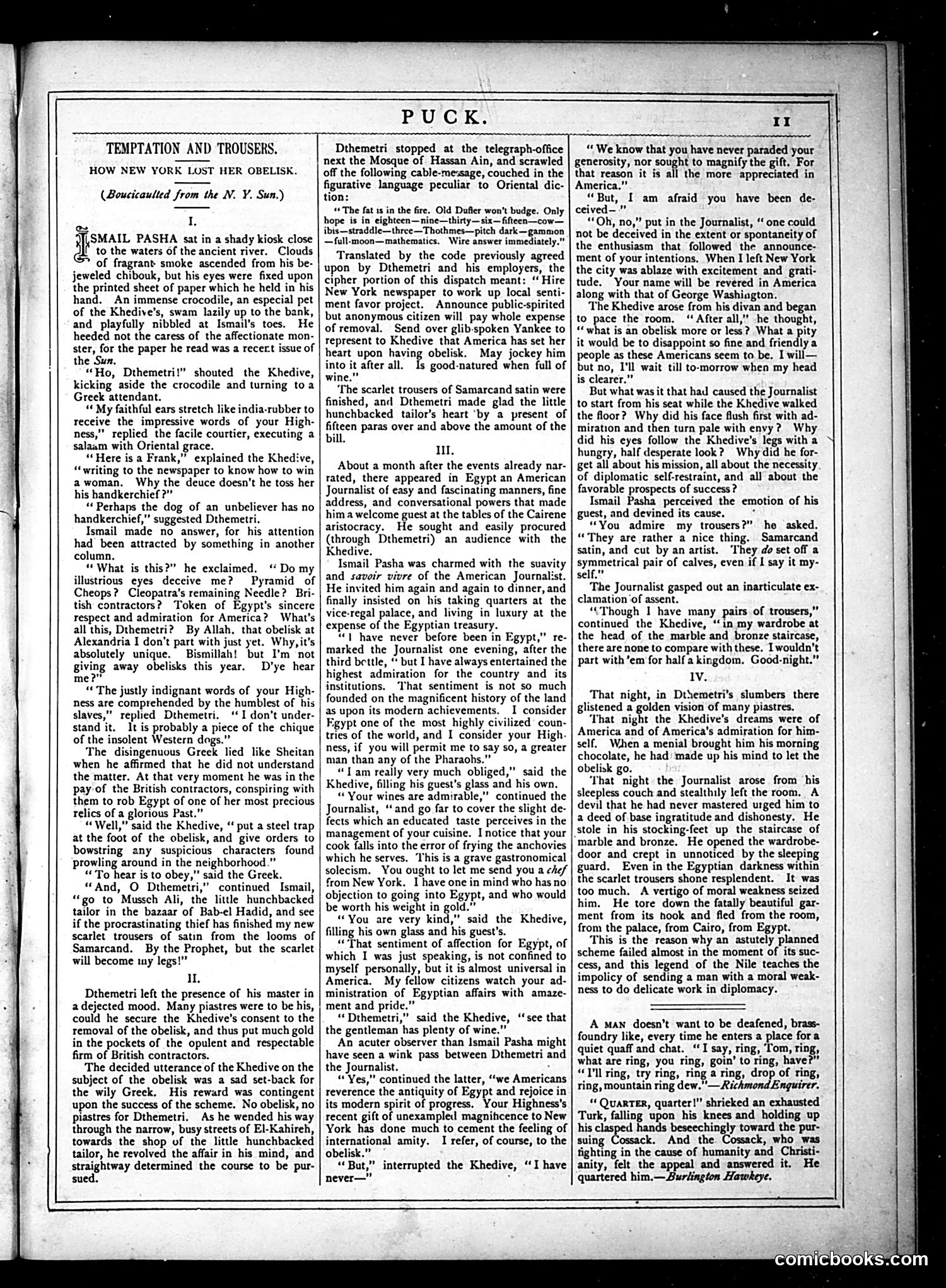
This page contains a satirical short story rather than a cartoon. The narrative mocks American fascination with Egyptian antiquities and colonial-era power dynamics. The story centers on **Ismail Pasha** (a historical Egyptian leader) and a journalist named **Dihemetri**. The satire targets Americans' obsession with acquiring Egyptian artifacts—specifically an obelisk—while also ridiculing American pretensions to cultural sophistication. The piece satirizes how wealthy Americans and newspapers pursued Egyptian treasures, and critiques the journalist's attempt to secure an audience with Ismail Pasha by flattering American "civilization" and progress. The humor derives from the obsequious behavior of the characters and the absurdity of American cultural imperialism dressed in diplomatic language. The "trousers" reference in the title remains unclear from this excerpt.
📄 Transcribed text from this page (OCR, searchable)
Machine-transcribed from the original scan — historical spelling and the odd misread are preserved.
PUCK. Ir TEMPTATION AND TROUSERS. HOW NEW YORK LUST HER OBELISK. (Boucicaulted from the N. Y. Sun.) I joan PASHA sat in a shady kiosk close to the waters of the ancient river. Clouds of fragrant smoke ascended from his be- jeweled chibouk, but his eyes were fixed upon the printed sheet of paper which he held in his hand. An immense crocodile, an especial pet of the Khedive’s, swam lazily up to the bank, and playfully nibbled at Ismail’s toes. He heeded not the caress of the affectionate mon- ster, for the paper he read was a recert issue of the Sun, “Ho, Dthemetri!” shouted the Khedive, kicking’ aside the crocodile and turning toa Greek attendant. “« My faithful ears stretch like india-rubber to receive the impressive words of your High- ness,” replied the facile courtier, executing a salaam with Oriental grace. ‘Here is a Frank,” explained the Khedive, “‘writing to the newspaper to know how to win awoman, Why the deuce doesn’t he toss her his handkerchief ?”” “Perhaps the dog of an unbeliever has no handkerchief,” suggested Dthemetri. Ismail made no answer, for his attention had been attracted by something in another column, “What is this?” he exclaimed. ‘ Do my illustrious eyes deceive me? Pyramid of Cheops? Cleopatra's remaining Needle? Bri- tish contractors? Token of Egypt's sincere respect and admiration for America? What's all this, Dthemetri? By Allah, that obelisk at Alexandria I don’t part with just yet. Why, it’s absolutely unique. Bismillah! but I'm ‘not giving away obelisks this year. D'ye hear me?” “The justly indignant words of your High- ness are comprehended by the humblest of his slaves,” replied Dthemetri. ‘I don’t under- stand it. It is probably a piece of the chique of the insolent Western dogs.” The disingenuous Greck lied like Sheitan when he affirmed that he did not understand the matter. At that very moment he was in the pay-of the British contractors, conspiring with them to rob Egypt of one of her most precious Telics of a glorious Past.” “Well,” said the Khedive, ‘ put a steel trap at the foot of the obelisk, and give orders to bowstring any suspicious characters found prowling around in the neighborhood.” “To hear is to obey,” said the Greek. “And, O Dthemetri,” continued Ismail, “go to Mussch Ali, the little hunchbacked tailor in the bazaar of Bab-el Hadid, and see if the procrastinating thief has finished my new scarlet trousers of satin from the looms of Samarcand. By the Prophet, but the scarlet will become ty legs!” IL, Dthemetri left the presence of his master in adejected mood. Many piastres were to be his, could he secure the Khedive's consent to the removal of the obelisk, and thus put much gold in the pockets of the opulent and respectable firm of British contractors. The decided utterance of the Khedive on the subject of the obelisk was a sad set-back for the wily Greek. His reward was contingent upon the success of the scheme. No obelisk, no piastres for Dthemetri. As he wended his way through the narrow, busy streets of El-Kahireh, towards the shop of the little hunchbacked tailor, he revolved the affair in his mind, and straightway determined the course to be pur- Dthemetri stopped at the telegraph-office | ‘We know that you have never paraded your next the Mosque of Hassan Ain, and scrawled off the following cable-message, couched in the figurative language peculiar to Oriental dic- tion: «The fat is in the fire. Old Dufler won't budge. Only hope is in eighteen—nine—thirty—six—fifteen—cow— ibis—straddle—three—Thothmes—pitch dark—gammon —full-moon—mathematics. Wire answer immediately.” Translated by the code previously agreed upon by Dthemetri and his employers, the cipher portion of this dispatch meant: ‘Hire New York newspaper to work up local senti- ment favor project. Announce public-spirited but anonymous citizen will pay whole expense of removal. Send over glib-spoken Yankee to represent to Khedive that America has set her heart upon having obelisk. May jockey him into it after all. Is good-natured when full of wine.” ‘The scarlet trousers of Samarcand satin were finished, and Dthemetri made glad the little hunchbacked tailor’s heart ‘by a present of fifteen paras over and above the amount of the bill. il. About a month after the events already nar- rated, there appeared in Egypt an American Journalist of easy and fascinating manners, fine address, and conversational powers that made hima welcome guest at the tables of the Cairene aristocracy. He sought and easily procured (through Dthemetri) an audience with the Khedive. Ismail Pasha was charmed with the suavity and savoir vivre of the American Journalist. He invited him again and again to dinner, and finally insisted on his taking quarters at the vice-regal palace, and living in luxury at the expense of the Egyptian treasury. “| have never before been in Egypt,” re- marked the Journalist one evening, after the third bettle, “ but I have always entertained the highest admiration for the country and its institutions. That sentiment is not so much founded on the magnificent history of the land as upon its modern achievements. I consider Fgypt one of the most highly civilized’ coun- tries of the world, and I consider your High- ness, if you will permit me to say so, a greater man than any of the Pharaohs.” “am really very much obliged,” said the Khedive, filling his guest's glass and his own. “Your wines are admirable,” continued the Journalist, “and go far to cover the slight de- fects which an educated taste perceives in the management of your cuisine. I notice that your cook falls into the error of frying the anchovies which he serves. ‘This is a grave gastronomical solecism. You ought to let me send you a chef from New York. I have one in mind who has no objection to going into Egypt, and who would be worth his weight in gold.” “You are very kind,” said the Khedive, filling his own glass and his guest's. “That sentiment of affection for Egypt, of which I was just speaking, is not confined to myself personally, but it is almost universal in America. My fellow citizens watch your ad- ministration of Egyptian affairs with amaze- ment and pride.” “‘Dthemetri,” said the Khedive, ‘see that the gentleman has plenty of wine.” An acuter observer than Ismail Pasha might have seen a wink pass between Dthemetri and the Journalist. : “Yes,” continued the latter, “‘we Americans reverence the antiquity of Egypt and rejoice in its modern spirit of progress. Your Highness's recent gift of unexampled magnitcence to New York has done much to cement the feeling of international amity. I refer, of course, to the obelisk.” “But,” interrupted the Khedive, ‘I have generosity, nor sought to magnify the gift. For that reason it is all the more appreciated in America.” “But, I am afraid you have been de- ceived—” “Oh, no,” put in the Journalist, “one could not be deceived in the extent or spontaneity of the enthusiasm that followed the announce- ment of your intentions. When I left New York the city was ablaze with excitement and grati- tude. Your name will be revered in America along with that of George Washiagton. The Khedive arose from his divan and began to pace the room. “After all,” -he thought, “‘what is an obelisk more or less? What a pity it would be to disappoint so fine and friendly a people as these Americans seem to. be. I will— but no, I'll wait till to-morrow when my head is clearer.” But what was it that had caused the Journalist to start from his seat while the Khedive walked the floor? Why did his face flush first with ad- miration and then turn pale with envy? Why did his eyes follow the Khedive’s legs with a hungry, half desperate look? Why did he for- get all about his mission, all about the necessity of diplomatic self-restraint, and all about the favorable prospects of success? Ismail Pasha perceived the emotion of his guest, and devined its cause. * “You admire my trousers?” he asked. “They are rather a nice thing. Samarcand satin, and cut by an artist. hey do set off a symmetrical pair of calves, even if I say it my- self.” The Journalist gasped out an inarticulate ex- clamation ‘of assent. “Though I have many pairs of trousers,” continued the Khedive, ‘in my wardrobe at the head of the marble and bronze staircase, there are none to compare with these. I wouldn't part with ’em for halfa kingdom. Good-night.” Iv. That night, in Dthemetri’s slumbers there glistened a golden vision of many piastres. ‘That night the Khedive’s dreams were of America and of America’s admiration for him- self. When a menial brought him his morning chocolate, he had’ made up his mind to let the obelisk go. ‘That night the Journalist arose from his sleepless couch and stealthily left the room, A devil that he had never mastered urged him to a deed of base ingratitude and dishonesty. He stole in his stocking-feet up the staircase of marble and bronze. He opened the wardrobe- door and crept in unnoticed by the sleeping guard. Even in the Egyptian darkness within the scarlet trousers shone resplendent. It was too much. A vertigo of moral weakness seized him. He tore down the fatally beautiful gar- ment from its hook and fled from the room, from the palace, from Cairo, from Egypt. This is the reason why an astutely planned scheme failed almost in the moment of its suc- cess, and this legend of the Nile teaches the impolicy of sending a man with a moral weak- ness to do delicate work in diplomacy. A Man doesn’t want to be deafened, brass- foundry like, every time he enters a place fora quiet quaff and chat. “I say, ring, Tom, ring, what are ring, you ring, goin’ to ring, have?” “Vl ring, try ring, ring a ring, drop of ring, ring, mountain ring dew.” —Richmond Enquirer. “ QuaRTER, quarter!” shrieked an exhausted Turk, falling upon his knees and holding up his clasped hands beseechingly toward the pur- suing Caeeaes And the. Cossack, who was fighting in the cause of humanity and Christi- anity, felt the appeal and answered it, He sur never- quartered him.— Burlington Hawkeye,