
Puck, 1877-11-07 · page 13 of 16
Puck — November 7, 1877 — page 13: what you’re looking at
What you’re looking at
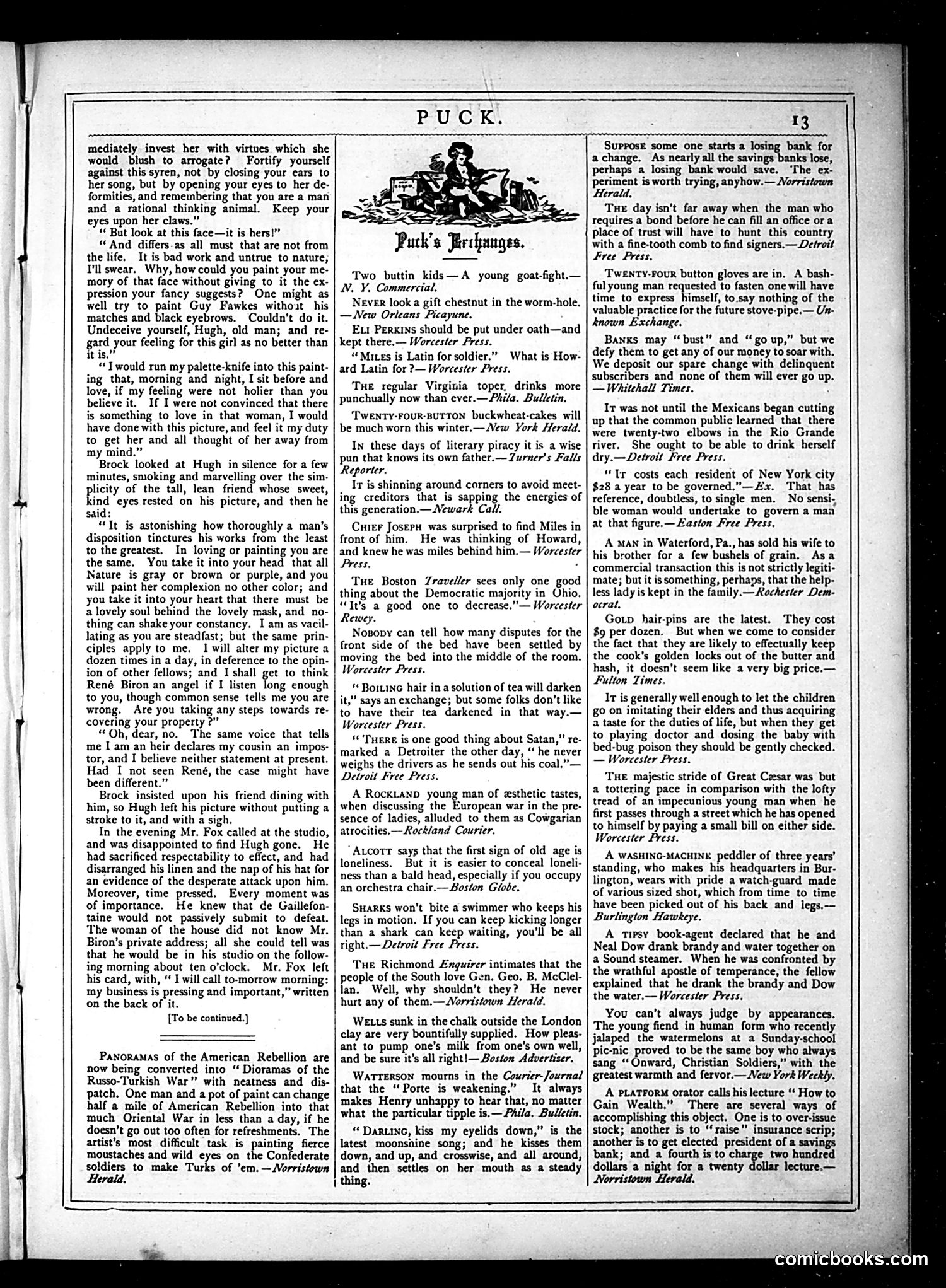
This page consists primarily of brief satirical commentary snippets rather than a major cartoon. The main illustration shows cherubic figures, likely representing Puck magazine's mascot. The "Brevities" section contains short jokes and observations on contemporary social issues: banking failures, Mexican politics, Democratic politics in Ohio, literary piracy, hair care, European war commentary, and various minor domestic topics. Key themes include criticism of financial mismanagement, political incompetence, and social pretension. References to "the Democratic majority in Ohio" and allusions to European war suggest early 20th-century American context. The tone is consistently mocking of authority figures and current events, typical of Puck's satirical approach. Without specific dates or figures clearly named, the exact historical references remain somewhat unclear to modern readers.
📄 Transcribed text from this page (OCR, searchable)
Machine-transcribed from the original scan — historical spelling and the odd misread are preserved.
13 mediately invest her with virtues which she would blush to arrogate? Fortify yourself against this syren, not by closing your ears to her song, but by opening your eyes to her de- formities, and remembering that you are a man and a rational thinking animal. Keep your eyes upon her claws.”” “ But look at this face—it is hers!” “And differs-as all must that are not from the life. It is bad work and untrue to nature, I'll swear. Why, how could you paint your me- mory of that face without giving to it the ex- pression your fancy suggests? One might as well try to paint Guy Fawkes without his matches and black eyebrows. Couldn't do it. Undeceive yourself, Hugh, old man; and re- gard your feeling for this girl as no better than “I would run my palette-knife into this paint- ing that, morning and night, I sit before and love, if my feeling were not holier than you believe it. If I were not convinced that there is something to love in that woman, I would have done with this picture, and feel it my duty to get her and all thought of her away from my mind.” Brock looked at Hugh in silence for a few minutes, smoking and marvelling over the sim- plicity of the tall, lean friend whose sweet, kind eyes rested on his picture, and then he said: “Tt is astonishing how thoroughly a man’s disposition tinctures his works from the least to the greatest. In loving or painting you are the same. You take it into your head that all Nature is gray or brown or purple, and you will paint her complexion no other color; and you take it into your heart that there must be a lovely soul behind the lovely mask, and no- thing can shake your constancy. I am as vacil- lating as you are steadfast; but the same prin- ciples apply to me. 1 will alter my picture a dozen times in a day, in deference to the opin- ion of other fellows; and I shall get to think René Biron an angel if I listen long enough to you, though common sense tells me you are wrong. Are you taking any steps towards re- covering your property ?”” “Oh, dear, no. The same voice that tells me I am an heir declares my cousin an impos- tor, and I believe neither statement at present. Had I not seen René, the case might have been different.” Brock insisted upon his friend dining with him, so Hugh left his picture without putting a stroke to it, and with a sigh. In the evening Mr. Fox called at the studio, and was disappointed to find Hugh gone. He had sacrificed respectability to effect, and had disarranged his linen and the nap of his hat for an evidence of the desperate attack upon him. Moreover, time pressed. Every moment was of importance. He knew that de Gaillefon- taine would not passively submit to defeat. ‘The woman of the house did not know Mr. Biron’s private address; all she could tell was that he would be in his studio on the follow- ing morning about ten o'clock. Mr. Fox left his card, with, “ I will call to-morrow morning: my business is pressing and important,” written on the back of it. {To be continued.) Panoramas of the American Rebellion are now being converted into ‘ Dioramas of the Russo-Turkish War" with neatness and dis- patch. One man and a pot of paint can change half a mile of American Rebellion into that much Oriental War in less than a day, if he doesn’t go out too often for refreshments. The artist's most difficult task is painting fierce moustaches and wild eyes on the Confederate solic to make Turks of 'em.—Norristown |e Two buttin kids —A young goat-fight.— N.Y. Commercial. Never look a gift chestnut in the worm-hole, —New Orleans Picayune. Ext Perkins should be put under oath—and kept there.— Worcester Press. “Mites is Latin for soldier.” ard Latin for ?— Worcester Press. Tue regular Virginia toper, drinks more punchually now than ever.— Phila, Bulletin. ‘TWENTY-FOUR-BUTTON buckwheat-cakes will be much worn this winter.—New York Herald. In these days of literary piracy it is a wise pun that knows its own father.— Zurner’s Falls Reporter. Ir is shinning around corners to avoid meet- ing creditors that is sapping the energies of this generation.—_Mewark Call, Cur JosepH was surprised to find Miles in front of him. He was thinking of Howard, and knew he was miles behind him.— Worceste Press. . Tue Boston Zraveller sees only one good thing about the Democratic majority in Ohio, “It’s a good one to decrease.”— Worcester Rewey. Nogopy can tell how many disputes for the front side of the bed have been settled by moving the bed into the middle of the room. Worcester Press. What is How- * Boitinc hair in a solution of tea will darken it,” says an exchange; but some folks don’t like to have their tea darkened in that way.— Worcester Press. “‘THere is one good thing about Satan,” re- marked a Detroiter the other day, “ he never weighs the drivers as he sends out his coal.”— Detroit Free Press. A RockLanp young man of esthetic tastes, when discussing the European war in the pre- sence of ladies, alluded to them as Cowgarian atrocities.—Rockland Courier. “Atcorr says that the first sign of old age is loneliness. But it is easier to conceal loneli- ness than a bald head, especially if you occupy an orchestra chair.— Boston Globe, SHARKS won't bite a swimmer who keeps his legs in motion. If you can keep kicking longer than a shark can keep waiting, you'll be all right.—Detroit Free Press. Tue Richmond £nguirer intimates that the people of the South love Gen. Geo. B. McClel- lan. Well, why shouldn't they? He never hurt any of them.—orristown Herald. Wexts sunk in the chalk outside the London clay are very bountifully supplied. How pleas- ant to pump one’s milk from one’s own well, and be sure it’s all right!—Boston Advertiser. Watrerson mourns in the Courier-Journal that the ‘Porte is weakening.” It always makes Henry unhappy to hear that, no matter what the particular tipple is.— Phila. Bulletin, “ Dartine, kiss my eyelids down,” is the latest moonsnine song; and he kisses them down, and up, and crosswise, and all around, and then settles on her mouth as a steady | thing. Suppose some one starts a losing bank for achange, As nearly all the savings banks lose, perhaps a losing bank would save. ‘The ex- periment is worth trying, anyhow.— Norristown Herald. Tue day isn't far away when the man who requires a bond before he can fill an office ora place of trust will have to hunt this country with a fine-tooth comb to find signers.— Detroit Free Press. ‘TWENTY-FOUR button gloves are in. A bash- ful young man requested to fasten one will have time to express himself, to.say nothing of the valuable practice for the future stove-pipe.— Un- known Exchange. Banks may “bust” and “go up,” but we defy them to get any of our money to soar with. We deposit our spare change with delinquent subscribers and none of them will ever go up. —Whitehall Times. Ir was not until the Mexicans began cutting up that the common public learned that there were twenty-two elbows in the Rio Grande river. She ought to be able to drink herself dry.—Detroit Free Press. “Tr costs each resident of New York city $28 a year to be governed,”—#x. That has reference, doubtless, to single men. No sensi-, ble woman would undertake to govern a maa at that figure.—Zaston Free Press. A aN in Waterford, Pa., has sold his wife to his brother for a few bushels of grain. Asa commercial transaction this is not strictly legiti- mate; but it is something, perhaps, that the help- less lady is kept in the family.— Rochester Dem- ocrat, Gotp hair-pins are the latest. They cost $9 per dozen. But when we come to consider the fact that they are likely to effectually keep the cook's golden locks out of the butter and hash, it doesn’t seem like a very big price.— Fulton Times. Ir is generally well enough to let the children go on imitating their elders and thus acquiring a taste for the duties of life, but when they get to playing doctor and dosing the baby with bed-bug poison they should be gently checked. — Worcester Press. THE majestic stride of Great Cesar was but a tottering pace in comparison with the lofty tread of an impecunious young man when he first passes through a street which he has opened to himself by paying a small bill on either side. Worcester Press. A WASHING-MACHINE peddler of three years’ standing, who makes his headquarters in Bur- lington, wears with pride a watch-guard made of various sized shot, which from time to time have been picked out of his back and legs.— Burlington Hawkeye. A tipsy book-agent declared that he and Neal Dow drank brandy and water together on a Sound steamer. When he was confronted by the wrathful apostle of temperance, the fellow explained that he drank the brandy and Dow the water.— Worcester Press. You can’t always judge by appearances. The young fiend in human form who recently jalaped the watermelons at a Sunday-school pic-nic proved to be the same boy who always sang ‘‘Onward, Christian Soldiers,” with the greatest warmth and fervor.— Mew York Weekly. A PLATFORM orator calls his lecture ‘‘ How to Gain Wealth.” There are several ways of accomplishing this object. One is to over-issue stock; another is to ‘“‘raise” insurance scrip; another is to get elected president of a savings bank; and a fourth is to charge two hundred dollars a night for a twenty dollar lecture.— Norristown Herald.