
Puck, 1877-11-07 · page 12 of 16
Puck — November 7, 1877 — page 12: what you’re looking at
What you’re looking at
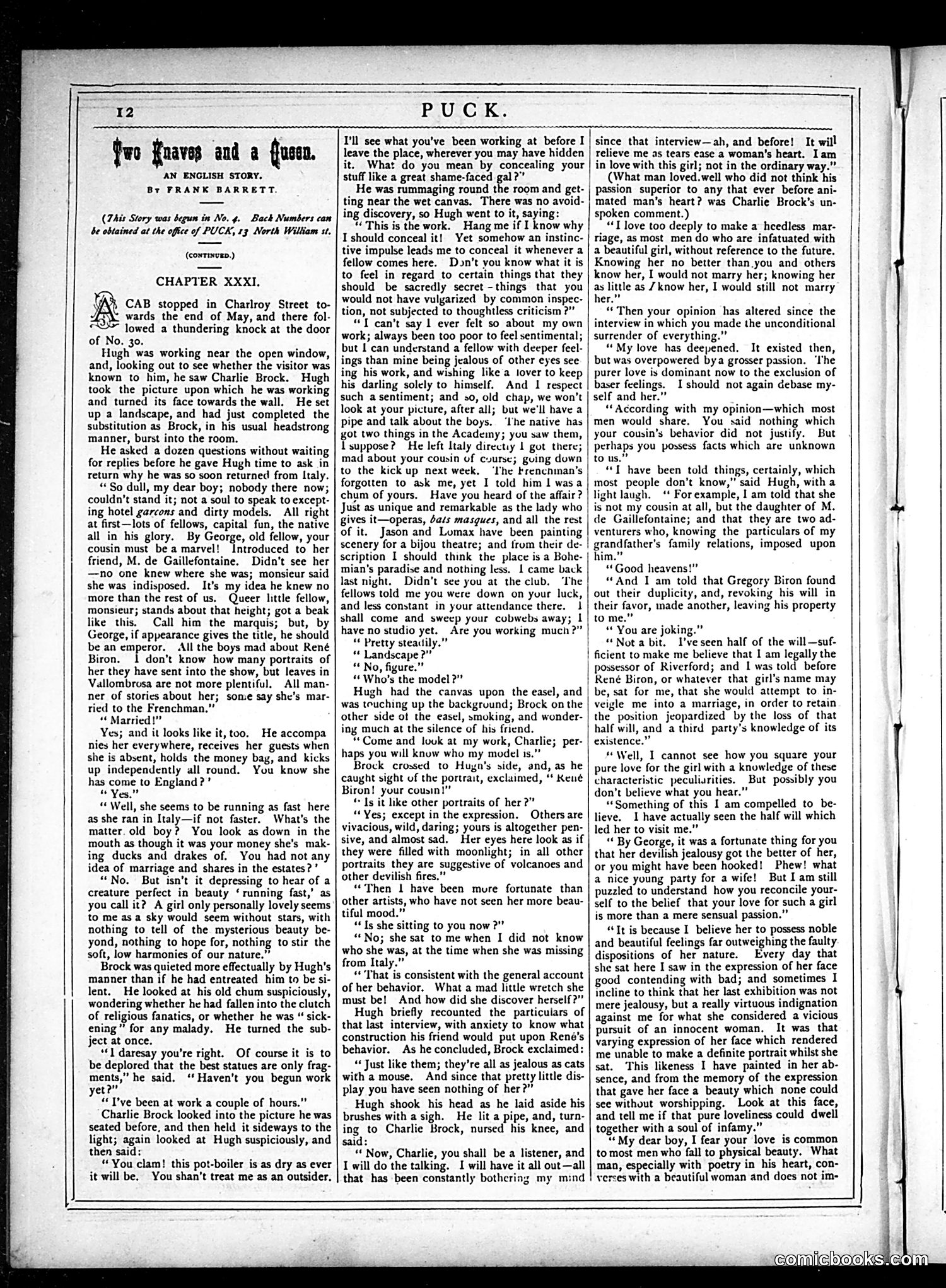
This page contains **Chapter XXXI of a serialized English story** titled "Two Knaves and a Queen," not a political cartoon. The narrative focuses on social drama among artists and society figures in what appears to be Victorian-era London. The story discusses a portrait of a woman named Rene that has caused scandal and jealousy among male acquaintances. Characters debate whether the subject is morally virtuous or has questionable character. References include the Academy (art exhibition), painting studios, and social gatherings of the artistic elite. The dialogue explores themes of artistic patronage, feminine virtue, romantic rivalry, and class distinctions—typical concerns of serialized fiction for Puck's middle and upper-class readership. **No political satire or identifiable historical figures appear on this page.**
📄 Transcribed text from this page (OCR, searchable)
Machine-transcribed from the original scan — historical spelling and the odd misread are preserved.
12 PUCK. Guo fuaves and a {usso. AN ENGLISH STORY. Br FRANK BARRETT. (This Story was begun in No. 4. Back Numbers can be obtained at the office of PUCK, 13. North William st, (cowrmven.) CHAPTER XXXI. CAB stopped in Charlroy Street to- St wards the end of May, and there fol- «© lowed a thundering knock at the door of No. 30. Hugh was working near the open window, and, looking out to see whether the visitor was known to him, he saw Charlie Brock. Hugh took the picture upon which he was working and turned its face towards the wall. He set up a landscape, and had just completed the substitution as Brock, in his usual headstrong manner, burst into the room. He asked a dozen questions without waiting for replies before he gave Hugh time to ask in return why he was so soon returned from Italy, “ So dull, my dear boy; nobody there now; couldn't stand it; not a soul to speak to except- ing hotel garcons and dirty models, All right at first—lots of fellows, capital fun, the native all in his glory. By George, old fellow, your cousin must be a marvel! Introduced to her friend, M. de Gaillefontaine. Didn't see her —no one knew where she was; monsieur said she was indisposed. It’s my idea he knew no more than the rest of us. Queer little fellow, monsieur; stands about that height; got a beak like this. Call him the marquis; but, by George, if appearance gives the title, he should be an emperor. All the boys mad about René Biron. 1 don’t know how many portraits of her they have sent into the show, but leaves in Vallombrosa are not more plentiful. All man- ner of stories about her; some say she’s mar- ried to the Frenchman.” “* Married!” Yes; and it looks like it, too. He accompa nies her everywhere, receives her guests when she is absent, holds the money bag, and kicks up independently all round. You know she has come to England?’ Yes,"" “ Well, she seems to be running as fast here as she ran in Italy—if not faster. What's the matter. old boy? You look as down in the mouth as though it was your money she’s mak- ing ducks and drakes of. You had not any idea of marriage and shares in the estates?’ “No. But isn't it depressing to hear of a creature perfect in beauty ‘running fast,’ as you call it? A girl only personally lovely seems to me as a sky would seem without stars, with nothing to tell of the mysterious beauty be- yond, nothing to hope for, nothing to stir the soft, low harmonies of our nature.” Brock was quieted more effectually by Hugh's manner than if he had entreated him to be si- lent. He looked at his old chum suspiciously, wondering whether he had fallen into the clutch of religious fanatics, or whether he was “ sick- ening” for any malady. He turned the sub- ject at once, ‘1 daresay you're right. Of course it is to be deplored that the best statues are only frag- meaty he said. ‘Haven't you begun work yet?” “I’ve been at work a couple of hours.” Charlie Brock looked into the picture he was seated before, and then held it sideways to the light; again looked at Hugh suspiciously, and then said: “You clam! this pot-boiler is as dry as ever it will be. You shan’t treat me as an outsider. I'll see what you've been working at before I leave the place, wherever you may have hidden it. What do you mean by concealing your stuff like a great shame-faced gal?” He was rummaging round the room and get- | ting near the wet canvas. There was no avoid- ing discovery, so Hugh went to it, saying: “This is the work. Hang me if I know why I should conceal it! Yet somehow an instinc- tive impulse leads me to conceal it whenever a fellow comes here. Don't you know what it is to feel in regard to certain things that they should be sacredly secret -things that you would not have vulgarized by common inspec- tion, not subjected to thoughtless criticism ?” “T can't say 1 ever felt so about my own work; always been too poor to feel sentimental; but 1 can understand a fellow with deeper feel- ings than mine being jealous of other eyes see ing his work, and wishing like a lover to keep his darling solely to himself. And I respect such a sentiment; and s0, old chap, we won't look at your picture, after all; but we'll have a pipe and talk about the boys. ‘I'he native has got two things in the Academy; you saw them, I suppose? He left Italy directry 1 got there; mad about your cousin of curse; guing down to the kick up next week. ‘I'he Frenchman's forgotten to ask me, yet I told him 1 wasa chum of yours. Have you heard of the affair? Just as unique and remarkable as the lady who gives it—operas, ba/s masgues, and all the rest of it. Jason and Lomax have been painting scenery for a bijou theatre; and from their de- scription I should think the place is a Bohe- mian’s paradise and nothing less. 1 came back last night. Didn't see you at the club, ‘The fellows told me you were down on your luck, and less constant in your attendance there. 1 shall come and sweep your cobwebs away; 1 Are you working much?” | have no studio yet. “ Pretty steadily.” * Landscape ?” “ No, figure.” ‘Who's the model ?” Hugh had the canvas upon the easel, and was touching up the background; Brock on the other side of the easel, smoking, and wonder- ing much at the silence of his friend. * Come and look at my work, Charlie; per- | haps you will know who my model is.” Brock crossed to Hugn’s side, and, as he caught sight of the portrait, exclaimed, “ Kené Biron! your cousin!” “Is it like other portraits of her?” “Yes; except in the expression. Others are vivacious, wild, daring; yours is altogether pen- sive, and almost sad. Her eyes here look as if they were filled with moonlight; in all other portraits they are suggestive of volcanoes and other devilish fires,” “Then 1 have been mure fortunate than other artists, who have not seen her more beau- tiful mood.” “Is she sitting to you now ?”” “No; she sat to me when I did not know who she was, at the time when she was missing from Italy.” “That is consistent with the general account of her behavior. What a mad little wretch she must be! And how did she discover herself?” Hugh briefly recounted the particulars of that last interview, with anxiety to know what construction his friend would put upon René’s behavior. As he concluded, Brock exclaimed: “Just like them; they’re all as jealous as cats with a mouse. And since that pretty little dis- play you have seen nothing of her?” Hugh shook his head as he laid aside his brushes with a sigh. He lit a pipe, and, turn- ing to Charlie Brock, nursed his knee, and said: “« Now, Charlie, you shall be a listener, and I will do the talking. 1 will have it all out—all that has been constantly bothering my mind since that interview—ah, and before! It will relieve me as tears ease a woman's heart. Iam in love with this girl; not in the ordinary way.” (What man loved.well who did not think his passion superior to any that ever before ani- mated man’s heart? was Charlie Brock’s un- spoken comment.) “T love too deeply to make a heedless_ mar- riage, as most_men do who are infatuated with a beautiful girl, without reference to the future. Knowing her no better than.you and others know her, I would not marry her; knowing her as little as / know her, I would still not marry her.” “Then your opinion has altered since the interview in which you made the unconditional surrender of everything.” “My love has deepened. It existed then, but was overpowered bya grosser passion. ‘he purer love is dominant now to the exclusion of baser feelings. I should not again debase my- self and her.” “According with my opinion—which most men would share. You said nothing which your cousin's behavior did not justify. But perhaps you possess facts which are unknown to us.”” “I have been told things, certainly, which most people don’t know,” said Hugh, with a light laugh.‘ For example, 1 am told that she is not my cousin at all, but the daughter of M. de Gaillefontaine; and that they are two ad- venturers who, knowing the particulars of my grandfather's family relations, imposed upon him.” “Good heavens!” “And I am told that Gregory Biron found out their duplicity, and, revoking his will in their favor, made another, leaving his property to me.” “ You are joking.” “Nota bit. I’ve seen half of the will—suf- ficient to make me believe that 1 am legally the | possessor of Riverford; and I was told before | René Biron, or whatever that girl’s name may be, sat for me, that she would attempt to in- veigle me into a marriage, in order to retain the position jeopardized by the loss of that half will, and a third party's knowledge of its existence.” “Well, I cannot see how you square your pure love for the girl with a knowledge of these characteristic peculiarities. But possibly you don’t believe what you hear.”” “Something of this I am compelled to be- lieve. I have actually seen the half will which led her to visit me.” “« By George, it was a fortunate thing for you that her devilish jealousy got the better of her, or you might have been hooked! Phew! what a nice young party for a wife! But I am still puzzled to understand how you reconcile your- self to the belief that your love for such a girl is more than a mere sensual passion.” “Tt is because I believe her to possess noble and beautiful feelings far outweighing the faulty: dispositions of her nature. Every day that she sat here I saw in the expression of her face good contending with bad; and sometimes I incline to think that her last exhibition was not mere jealousy, but a really virtuous indignation against me for what she considered a vicious pursuit of an innocent woman. It was that varying expression of her face which rendered me unable to make a definite portrait whilst she sat. This likeness I have painted in her ab- sence, and from the memory of the expression that gave her face a beauty which none could see without worshipping. Look at this face, and tell me if that pure loveliness could dwell together with a soul of infamy.” “ My dear boy, I fear your love is common to most men who fall to physical beauty. What man, especially with poetry in his heart, con- verses with a beautiful woman and does not im-