
Puck, 1877-11-07 · page 2 of 16
Puck — November 7, 1877 — page 2: what you’re looking at
What you’re looking at
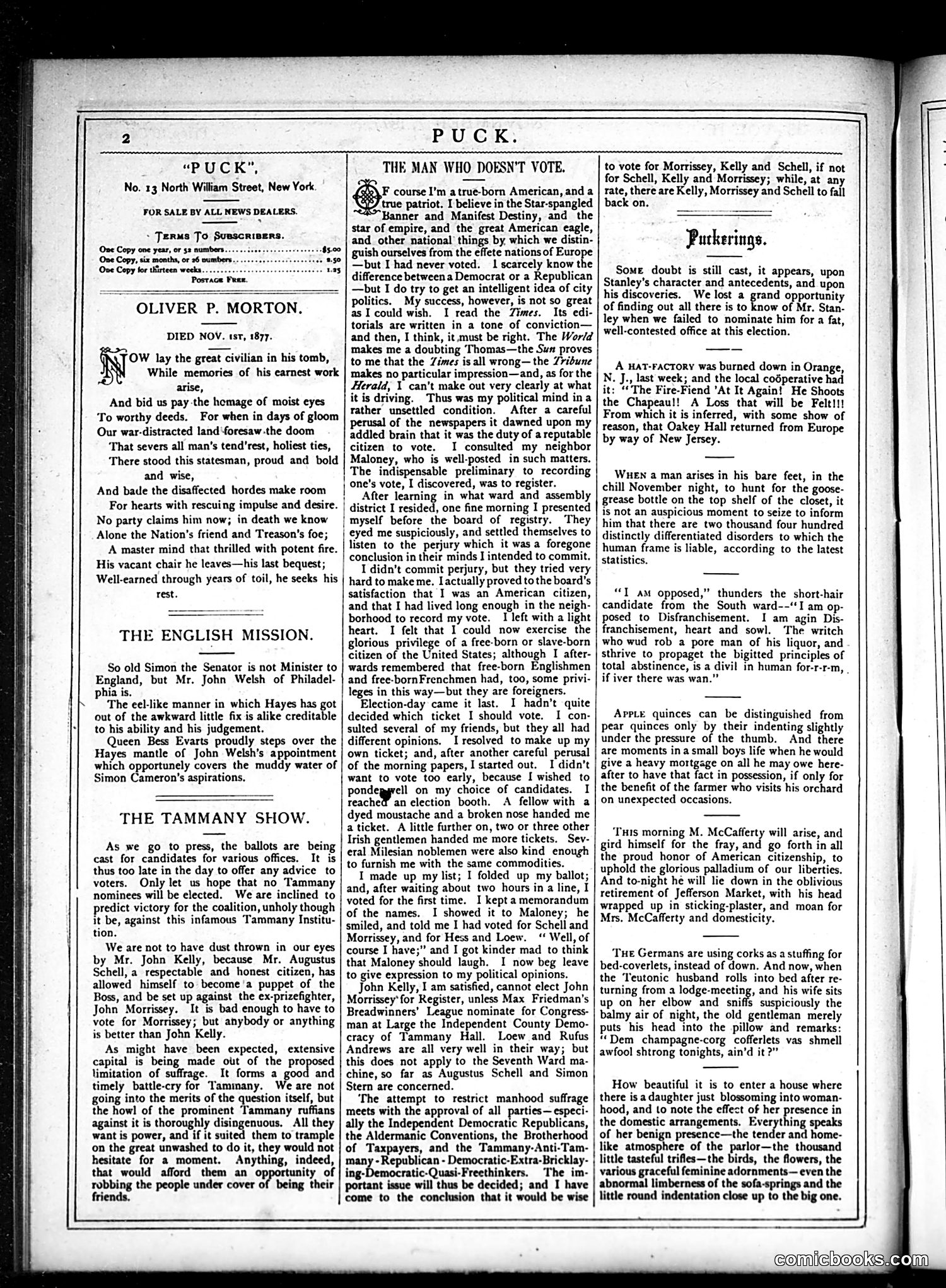
This page is primarily **text-based editorial content** rather than illustrated cartoons. The main pieces include: 1. **"The Man Who Doesn't Vote"** — A first-person narrative about voting rights and citizenship, discussing the author's experience registering to vote and the importance of political participation. 2. **"The English Mission"** and **"The Tammany Show"** — Political commentary pieces. The Tammany section critiques Tammany Hall (New York's Democratic political machine), discussing electoral manipulation and questioning the integrity of candidates like Augustus Schell and John Morrissey. The content reflects late-19th-century American political concerns: voting eligibility, machine politics, and electoral corruption. The satirical tone targets political establishments and encourages civic engagement. Without visible illustrations, the humor relies on rhetorical argument rather than visual caricature.
📄 Transcribed text from this page (OCR, searchable)
Machine-transcribed from the original scan — historical spelling and the odd misread are preserved.
PUCK. “PUCK", No. 13 North William Street, New York FOR SALE BY ALL NEWS DEALERS. + Teras To Sunscrisers. One Copy one year, or 52 numbers. Ove Copy, six months, or 26 oumbers.. Ove Copy for tBizteen weeks... Postace OLIVER P. MORTON. | DIED NOV. «sr, 1877. ‘OW lay the great civilian in his tomb, While memories of his earnest work arise, And bid us pay-the homage of moist eyes To worthy deeds. For when in days of gloom Our war-distracted land ‘foresaw.the doom ‘That severs all man's tend'rest, holiest ties, There stood this statesman, proud and bold and wise, And bade the disaffected hordes make room For hearts with rescuing impulse and desire. No party claims him now; in death we know Alone the Nation's friend and Treason's foe; A master mind that thrilled with potent fire. His vacant chair he leaves—his last bequest; Well-earned through years of toil, he seeks his THE ENGLISH MISSION. So old Simon the Senator is not Minister to England, but Mr. John Welsh of Philadel- phia is. ‘The eel-like manner in which Hayes has got out of the awkward little fix is alike creditable to his ability and his judgement. Queen Bess Evarts proudly steps over the Hayes mantle of John Welsh’s appointment which opportunely covers the muddy water of Simon Cameron's aspirations. THE TAMMANY SHOW. ‘As we go to press, the ballots are being cast for candidates for various offices. It is thus too late in the day to offer any advice to voters. Only let us hope that no Tammany nominees will be elected. We are inclined to predict victory for the coalition, unholy though it be, against this infamous Tammany Institu- tion. We are not to have dust thrown in our eyes by Mr. John Kelly, because Mr. Augustus Schell, a respectable and honest citizen, has allowed himself to become 'a puppet of the Boss, and be set up against the ex-prizefighter, John Morrissey. It is bad enough to have to vote for Morrissey; but anybody or anything is better than John Kelly. As might have been expected, extensive capital is being made out of the proposed limitation of suffrage. It forms a good and timely battle-cry for Tammany. We are not going into the merits of the question itself, but the howl of the prominent Tammany ruffians against it is thoroughly disingenuous. All they want is power, and if it suited them to trample on the great unwashed to do it, they would not hesitate for a moment. Anything, indeed, that would afford them an opportunity of robbing the people under cover of being their friends, THE MAN WHO DOESN'T VOTE. F course I’m atrue-born American, and a true patriot. I believe in the Star-spangled Banner and Manifest Destiny, and the star of empire, and the great American eagle, and other national’ things by, which we distin- guish ourselves from the effete nations of Euro) —but I had never voted. 1 scarcely know the difference between a Democrat or a Republican —but I do try to get an intelligent idea of city politics. My success, however, is not so great as I could wish. I read the Zimes. Its edi- torials are written in a tone of conviction— and then, I think, it must be right. The Wor/d makes me a doubting ‘Thomas—the Sun proves to me that the Zimes is all wrong—the 7ridune makes no particular impression—and, as for the Herald, 1 can't make out very clearly at what it is driving. Thus was my political mind ina rather unsettled condition. After a careful perusal of the newspapers it dawned upon my addled brain that it was the duty of a reputable citizen to vote. I consulted my neighbor Maloney, who is well-posted in such matters. The indispensable preliminary to recording one's vote, I discovered, was to register. ‘After learning in what ward and assembly district I resided, one fine morning I presented myself before the board of registry. They eyed me suspiciously, and settled themselves to listen to the perjury which it was a foregone conclusion in their minds J intended to commit. I didn't commit perjury, but they tried very hard to make me. actually proved to the board's satisfaction that I was an American citizen, and that I had lived long enough in the neigh- borhood to record my vote. I left with a light heart. I felt that 1 could now exercise the glorious privilege of a free-born or slave-born citizen of the United States; although I after- wards remembered that free-born Englishmen and free-bornFrenchmen had, too, some privi- leges in this way—but they are foreigners. Election-day came it last. I hadn't quite decided which ticket I should vote. I con- sulted several of my friends, but they all had different opinions. I resolved to make up my own ticket; and, after another careful perusal of the morning papers, I started out. I didn’t want to vote too early, because I wished to pondeggrell on my choice of candidates. I reached an election booth. A fellow with a dyed moustache and a broken nose handed me a ticket. A little further on, two or three other Irish gentlemen handed me more tickets. Sev- eral Milesian noblemen were also kind enough to furnish me with the same commodities. I made up my list; I folded up my ballot; and, after waiting about two hours in a line, I voted for the first time. I kept a memorandum of the names. I showed it to Maloney; he smiled, and told me I had voted for Schell and Morrissey, and for Hess and Loew. ‘ Well, of course I have;” and J got kinder mad to think that Maloney should laugh. I now beg leave to give expression to my political opinions. John Kelly, I am satisfied, cannot elect John Morrissey‘ for Register, unless Max Friedman's Breadwinners’ League nominate for Congress- man at Large the Independent County Demo- cracy of Tammany Hall. Loew and Rufus Andrews are all very well in their way; but this does not apply to the Seventh Ward ma- chine, so far as Augustus Schell and Simon Stern are concerned. ‘The attempt to restrict manhood suffrage meets with the approval of all parties—especi- ally the Independent Democratic Republicans, the Aldermanic Conventions, the Brotherhood of Taxpayers, and the Tammany-Anti-Tam- many -Republican - Democratic-Extra-Bricklay- ing- ratic-Quasi-Freethinkers. The im- portant issue will thus be decided; and I have come to the conclusion that it would be wise to vote for Morrissey, Kelly and Schell, if not for Schell, Kelly and Morrissey; while, at any tate, there are Kelly, Morrissey and Schell to fall ick on. Puckerings. Some doubt is still cast, it appears, upon Stanley's character and antecedents, and upon his discoveries. We lost a grand opportunity of finding out all there is to Eeow of Mr. Stan- ley when we failed to nominate him for a fat, well-contested office at this election. A HAT-FACToRY was burned down in Orange, N, J., last week; and the local coéperative had it: “The Fire-Fiend 'At It Again! He Shoots the Chapeau!! A Loss that will be Felt!!! From which it is inferred, with some show of reason, that Oakey Hall returned from Europe by way of New Jersey. WHEN a man arises in his bare feet, in the chill November night, to hunt for the goose- grease bottle on the top shelf of the closet, it is not an auspicious moment to seize to inform him that there are two thousand four hundred distinctly differentiated disorders to which the human frame is liable, according to the latest statistics. “I am opposed,” thunders the short-hair candidate from the South ward--‘I am op- posed to Disfranchisement. I am agin Dis- franchisement, heart and sowl. The writch who wud rob a pore man of his liquor, and sthrive to propaget the bigitted principles of total abstinence, is a divil in human for-r-r-m, if iver there was wan.” AppLe quinces can be distinguished from pear quinces only by their indenting slightly under the pressure of the thumb. And there are moments ina small boys life when he would give a heavy mortgage on all he may owe here- after to have that fact in possession, if only for the benefit of the farmer who visits his orchard on unexpected occasions. ‘THis morning M. McCafferty will arise, and gird himself for the fray, and go forth in all the proud honor of American citizenship, to uphold the glorious palladium of our liberties. And to-night he will lie down in the oblivious retirement of Jefferson Market, with his head wrapped up in sticking-plaster, and moan for Mrs. McCafferty and domesticity. ‘Tue Germans are using corks as a stuffing for bed-coverlets, instead of down. And now, when the ‘Teutonic husband rolls into bed after re- turning from a lodge-meeting, and his wife sits up on her elbow and sniffs suspiciously the balmy air of night, the old gentleman merely puts his head into the pillow and remarks: ‘Dem champagne-corg cofferlets vas shmell awfool shtrong tonights, ain’d it ?” How beautiful it is to enter a house where there is adaughter just blossoming into woman- hood, and to note the effect of her presence in the domestic arrangements. Everything speaks of her benign presence—the tender and home- like atmosphere of the parlor—the thousand | little tasteful trifles—the birds, the flowers, the various graceful feminine adornments—even the abnormal limberness of the sofa-springs and the little round indentation close up to the big one. comichooks, com