
Puck, 1877-11-07 · page 6 of 16
Puck — November 7, 1877 — page 6: what you’re looking at
What you’re looking at
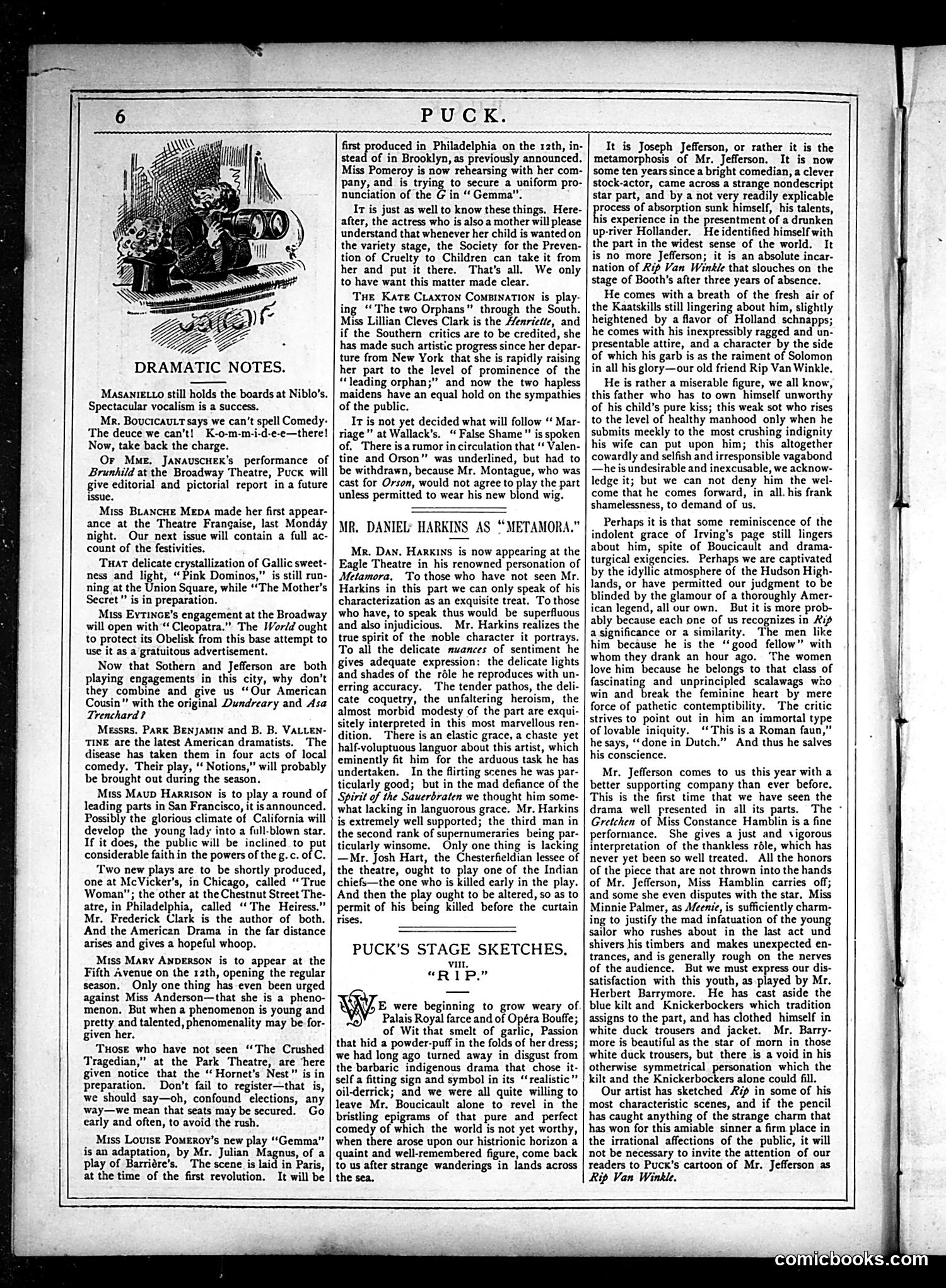
This page contains **theatrical reviews and drama criticism** rather than political satire. The main illustration shows a comedic theatrical scene, but the bulk of the content consists of "Dramatic Notes" discussing contemporary stage productions. The text references various actors and plays of the era, including Miss Pomeroy's new play "Gemma," performances by Dan Harkins, and discussions of productions like "The Two Orphans" and "Rip Van Winkle." At the bottom, "Puck's Stage Sketches" begins a section on theatrical performance, discussing an actor's portrayal of the character "Rip" in what appears to be a stage adaptation. This is primarily **entertainment/arts journalism** rather than political commentary—typical of Puck's coverage beyond its famous satirical cartoons.
📄 Transcribed text from this page (OCR, searchable)
Machine-transcribed from the original scan — historical spelling and the odd misread are preserved.
PUCK. DRAMATIC NOTES. Masanie to still holds the boards at Niblo’s. Spectacular vocalism is a success. Mr. BoucicauLt says we can’t spell Comedy: ‘The deuce we can’t! K-o-m-m-i-d-e-e—there! Now, take back the charge. Or Mme, Janauscuek’s performance of Brunhild at the Broadway Theatre, Puck will give editorial and pictorial report in a future issue. Miss BLaNcHE Mepa made her first appear- ance at the Theatre Frangaise, last Monday night. Our next issue will contain a full ac- count of the festivities. Tuat delicate crystallization of Gallic sweet- ness and light, ‘Pink Dominos,” is still run- ning at the Union Square, while “The Mother’s Secret” is in preparation. Miss Eytince’s engagement at the Broadway will open with“ Cleopatra.” The IMorld ought to protect its Obelisk from this base attempt to use it as a gratuitous advertisement. Now that Sothern and Jefferson are both playing engagements in this city, why don’t they combine and give us “Our American Cousin” with the original Dundreary and Asa Trenchard? Messrs. PARK BENJAMIN and B. B, VALLEN- TINE are the latest American dramatists. The disease has taken them in four acts of local comedy. Their play, ‘ Notions,” will probably be brought out during the season. Miss Maup Harrison is to play a round of leading parts in San Francisco, it is announced. Possibly the glorious climate of California will develop the young lady into a full-blown star. If it does, the public will be inclined to put considerable faith in the powers of the g.c. of C. ‘Two new plays are to be shortly produced, one at McVicker’s, in Chicago, called “True Woman”; the other at the Chestnut Street The- atre, in Philadelphia, called “The Heiress.” Mr. Frederick Clark is the author of both. And the American Drama in the far distance arises and gives a hopeful whoop. Miss Mary ANDERSON is to appear at the Fifth Avenue on the 12th, opening the regular season. Only one thing has even been urged against Miss Anderson—that she is a pheno- menon. But when a phenomenon is young and pretty and talented, phenomenality may be for- given her. Tuose who have not seen ‘The Crushed Tragedian,” at the Park Theatre, are ‘here given notice that the ‘Hornet's Nest” is in preparation. Don’t fail to register—that is, we should say—oh, confound elections, any way—we mean that seats may be secured. Go early and often, to avoid the rush. Miss Louise Pomeroy’s new play “Gemma” is an adaptation, by Mr. Julian Magnus, of a play of Barridre’s, The scene is laid in Paris, at the time of the first revolution. It will be first produced in Philadelphia on the rath, in- stead of in Brooklyn, as previously announced. Miss Pomeroy is now rehearsing with her com- pany, and is trying to secure a uniform pro- nunciation of the G in “‘ Gemma”. Ir is just as well to know these things. Here- after, the actress who is also a mother will please understand that whenever her child is wanted on the variety stage, the Society for the Preven- tion of Cruelty to Children can take it from her and put it there. That’s all. We only to have want this matter made clear. Tue Kate Craxton ComBination is play- ing ‘The two Orphans” through the South. Miss Lillian Cleves Clark is the Henriette, and if the Southern critics are to be credited, she has made such artistic progress since her depar- ture from New York that she is rapidly raising her part to the level of prominence of the “leading orphan;” and now the two hapless maidens have an equal hold on the sympathies of the public. Ir is not yet decided what will follow “ Mar- riage” at Wallack’s. ‘“ False Shame” is spoken of. There isa rumor in circulation that “ Valen- tine and Orson” was underlined, but had to be withdrawn, because Mr. Montague, who was cast for Orson, would not agree to play the part unless permitted to wear his new blond wig. MR. DANIEL HARKINS AS “METAMORA.” Mr. Day, Harkins is now appearing at the Eagle Theatre in his renowned personation of Metamora, To those who have not seen Mr. Harkins in this part we can only speak of his characterization as an exquisite treat. To those who have, to speak thus would be superfluous and also injudicious. Mr. Harkins realizes the true spirit of the noble character it portrays. To all the delicate nuances of sentiment he gives adequate expression: the delicate lights and shades of the réle he reproduces with un- erring accuracy. ‘he tender pathos, the deli- cate coquetry, the unfaltering heroism, the almost morbid modesty of the part are exqui- sitely interpreted in this most marvellous ren- dition. There is an elastic grace, a chaste yet half-voluptuous languor about this artist, which eminently fit him for the arduous task he has undertaken. In the flirting scenes he was par- ticularly good; but in the mad defiance of the Spirit of the Sauerbraten we thought him some- what lacking in languorous grace. Mr. Harkins is extremely well supported; the third man in the second rank of supernumeraries being par- ticularly winsome. Only one thing is lacking —Mr. Josh Hart, the Chesterfieldian lessee of the theatre, ought to play one of the Indian chiefs—the one who is killed early in the play. And then the pay ought to be altered, so as to permit of his being killed before the curtain rises. PUCK’S STAGE SKETCHES, VIII. “RIP.” E were beginning to grow weary of. Palais Royal farce and of Opéra Bouffe; of Wit that smelt of garlic, Passion that hid a powder-puff in the folds of her dress; we had long ago turned away in disgust from the barbaric indigenous drama that chose it- self a fitting sign and symbol in its “realistic” oil-derrick; and we were all quite willing to leave Mr. Boucicault alone to revel in the bristling epigrams of that pure and perfect comedy of which the world is not yet worthy, when there arose upon our histrionic horizon a quaint and well-remembered figure, come back to us after strange wanderings in lands across the sea, It is Joseph Jefferson, or rather it is the metamorphosis of Mr. Jefferson. It is now some ten years since a bright comedian, a clever stock-actor, came across a strange nondescript star part, and by a not very readily explicable proces of absorption sunk himself, his talents, is experience in the presentment of a drunken up-river Hollander. He identified himself with the part in the widest sense of the world. It is no more Jefferson; it is an absolute incar- nation of Rip Van Winkie that slouches on the stage of Booth’s after three years of absence. He comes with a breath of the fresh air of the Kaatskills still lingering about him, slightly heightened by a flavor of Holland schnapps; he comes with his inexpressibly ragged and un- presentable attire, and a character by the side of which his garb is as the raiment of Solomon in all his glory—our old friend Rip Van Winkle. He is rather a miserable figure, we all know, this father who has to own himself unworthy of his child’s pure kiss; this weak sot who rises to the level of healthy manhood only when he submits meekly to the most crushing indignity his wife can put upon him; this altogether cowardly and selfish and irresponsible vagabond —he is undesirable and inexcusable, we acknow- ledge it; but we can not deny him the wel- come that he comes forward, in all. his frank shamelessness, to demand of us. Perhaps it is that some reminiscence of the indolent grace of Irving's page still lingers about him, spite of Boucicault and drama- turgical exigencies. Perhaps we are captivated by the idyllic atmosphere of the Hudson High- lands, or have permitted our judgment to be blinded by the glamour of a thoroughly Amer- ican legend, all our own. But it is more prob- ably because each one of us recognizes in Kip a significance or a similarity. The men like him because he is the ‘good fellow” with whom they drank an hour ago. ‘The women love him because he belongs to that class of fascinating and unprincipled scalawags who win and ‘break the feminine heart by mere force of pathetic contemptibility. The critic strives to point out in him an immortal type of lovable iniquity. ‘This is a Roman faun,” he says, ‘‘done in Dutch.” And thus he salves his conscience. Mr. Jefferson comes to us this year with a better supporting company than ever before. This is the first time that we have seen the drama well presented in all its parts. The ~ Gretchen of Miss Constance Hamblin is a fine performance. She gives a just and vigorous interpretation of the thankless réle, which has never yet been so well treated. All the honors of the piece that are not thrown into the hands of Mr. Jefferson, Miss Hamblin carries off; and some she even disputes with the star, Miss Minnie Palmer, as Meenie, is sufficiently charm- ing to justify the mad infatuation of the young sailor who rushes about in the last act und shivers his timbers and makes unexpected en- trances, and is generally rough on the nerves of the audience. But we must express our dis- satisfaction with this youth, as played by Mr. Herbert Barrymore. He has cast aside the blue kilt and Knickerbockers which tradition assigns to the part, and has clothed himself in white duck trousers and jacket. Mr. Barry- more is beautiful as the star of morn in those white duck trousers, but there is a void in his otherwise symmetrical personation which the kilt and the Knickerbockers alone could fill. Our artist has sketched ip in some of his most characteristic scenes, and if the pencil has caught anything of the strange charm that has won for this amiable sinner a firm place in the irrational affections of the public, it will not be necessary to invite the attention of our readers to Puck’s cartoon of Mr. Jefferson as Rip Van Winkle. Comicbooks.com