
Puck, 1877-11-07 · page 10 of 16
Puck — November 7, 1877 — page 10: what you’re looking at
What you’re looking at
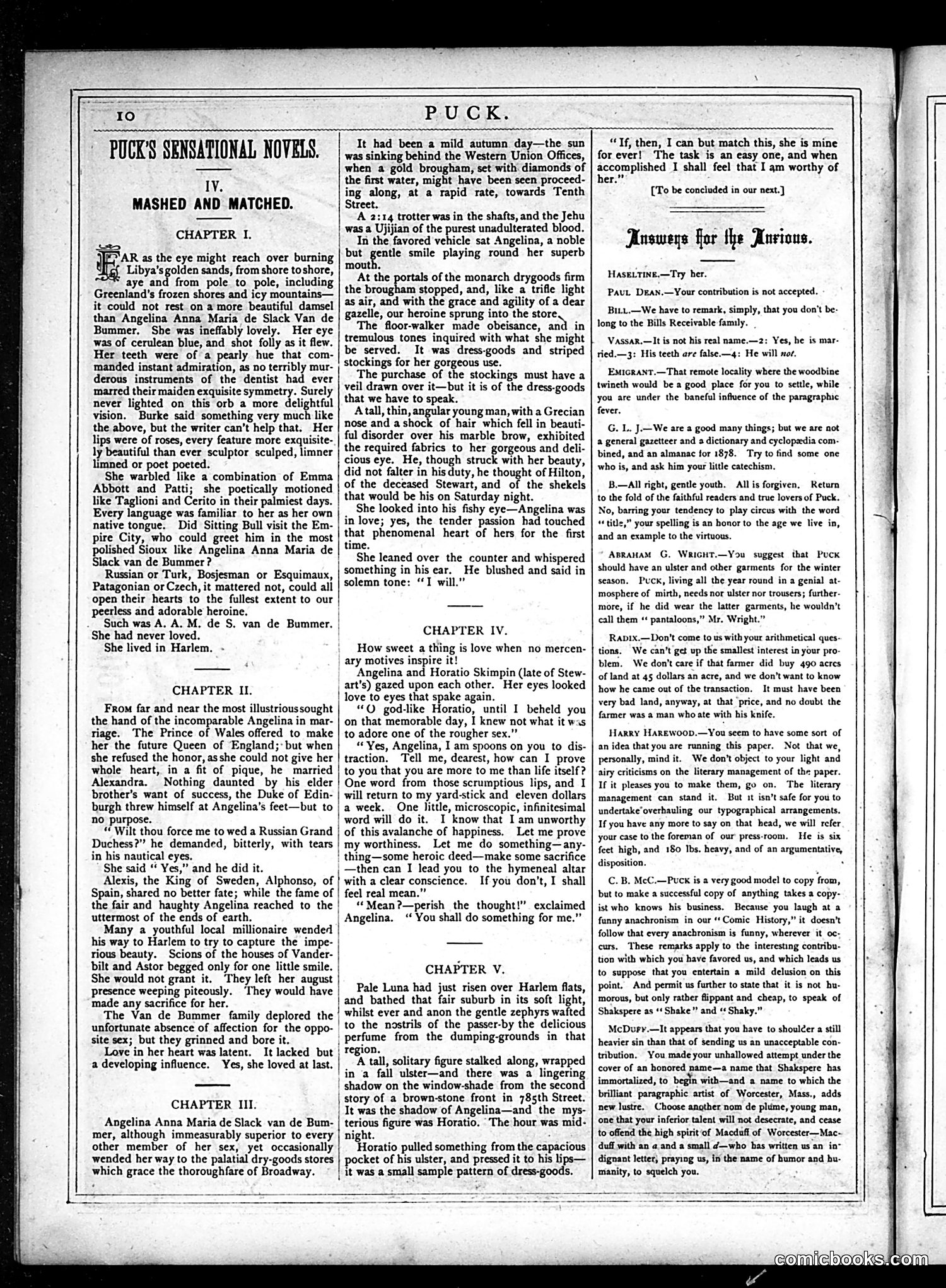
This is **not a political cartoon page**. Instead, it's page 10 of Puck magazine featuring the fourth installment of a serialized novel titled **"Mashed and Matched"** by an uncredited author. The page contains: - **Five chapters** of this romance novel (Chapters I-V), describing a love story involving characters named Angelina and Horatio - A **"Answers for the Anxious"** advice column addressing readers' questions about relationships, winter clothing, and literary matters - Standard magazine fiction content with no political satire or social commentary visible The novel appears to be a period romance set in New York (Harlem is mentioned), but this particular page contains serialized fiction rather than satirical cartoons, which were Puck's primary focus.
📄 Transcribed text from this page (OCR, searchable)
Machine-transcribed from the original scan — historical spelling and the odd misread are preserved.
PUCK. POCK'S SENSATIONAL NOVELS. Iv. MASHED AND MATCHED. CHAPTER I. q AR as the eye might reach over burning Libya's golden sands, from shore toshore, aye and from pole to pole, including Greenland’s frozen shores and icy mountains— it could not rest on a more beautiful damsel than Angelina Anna Maria de Slack Van de Bummer, She was ineffably lovely. Her eye was of cerulean blue, and shot folly as it flew. Her teeth were of a pearly hue that com- manded instant admiration, as no terribly mur- derous instruments of the dentist had ever marred their maiden exquisite symmetry. Surely never lighted on this orb a more delightful vision. Burke said something very much like the above, but the writer can’t help that. Her lips were of roses, every feature more exquisite- ly beautiful than ever sculptor sculped, limner limned or poet poeted. She warbled like a combination of Emma Abbott and Patti; she poetically motioned like Taglioni and Cerito in their palmiest days. Every language was familiar to her as her own native tongue. Did Sitting Bull visit the Em- pire City, who could greet him in the most polished Sioux like Angelina Anna Maria de lack van de Bummer? Russian or Turk, Bosjesman or Esquimaux, Patagonian or Czech, it mattered not, could all open their hearts to the fullest extent to our peerless and adorable heroine. Such was A. A. M. She had never loved. She lived in Harlem. - CHAPTER II. From far and near the most illustrioussought the hand of the incomparable Angelina in mar- riage. The Prince of Wales offered to make her the future Queen of England;: but when she refused the honor, asshe could not give her whole heart, in a fit of pique, he married Alexandra. Nothing daunted by his elder brother’s want of success, the Duke of Edin- burgh threw himself at Angelina's feet—but to | no purpose. «Wilt thou force me to wed a Russian Grand | Duchess?” he demanded, bitterly, with tears | in his nautical eyes. She said ‘ Yes,” and he did it. Alexis, the King of Sweden, Alphonso, of Spain, shared no better fate; while the fame of the fair and haughty Angelina reached to the uttermost of the ends of earth. Many a youthful local millionaire wended his way to Harlem to try to capture the impe- rious beauty. Scions of the houses of Vander- bilt and Astor begged only for one little smile. presence weeping piteously. made any sacrifice for her. The Van de Bummer family deplored the unfortunate absence of affection for the oppo- site sex; but they grinned and bore it. Love in her heart was latent. It lacked but a developing influence. Yes, she loved at last. ‘They would have CHAPTER III. Angelina Anna Maria de Slack van de Bum- mer, although immeasurably superior to every other member of her sex, yet occasionally wended her way to the palatial dry-goods stores which grace the thoroughfare of Broadway. It had been a mild autumn day—the sun was sinking behind the Western Union Offices, when a gold brougham, set with diamonds of the first water, might have been seen proceed- ing along, at a rapid rate, towards Tenth Street. A 2:14 trotter was in the shafts, and the Jehu was a Ujijian of the purest unadulterated blood. In the favored vehicle sat Angelina, a noble but gentle smile playing round her superb mouth: At the portals of the monarch drygoods firm the brougi stopped, and, like a trifle light as air, and with the grace and agility of a dear gazelle, our heroine sprung into the store. The floor-walker made obeisance, and in tremulous tones inquired with what she might be served. It was dress-goods and striped stockings for her gorgeous use. The purchase of the stockings must have a veil drawn over it—but it is of the dress-goods that we have to speak. Atall, thin, angular young man, with a Grecian nose and a shock of hair which fell in beauti- ful disorder over his marble brow, exhibited the required fabrics to her gorgeous and deli- cious eye. He, though struck with her beauty, did not falter in his duty, he thought of Hilton, of the deceased Stewart, and of the shekels that would be his on Saturday night. She looked into his fishy eye—Angelina was in love; yes, the tender passion had touched that phenomenal heart of hers for the first time. She leaned over the counter and whispered something in his ear. He blushed and said in solemn tone: ‘I will.” . de S, van de Bummer. | CHAPTER IV. How sweet a thing is love when no mercen- ary motives inspire it! ‘Angelina and Horatio Skimpin (late of Stew- art's) gazed upon each other. Her eyes looked | love to eyes that spake again. “QO god-like Horatio, until I beheld you on that memorable day, I knew not what it was to adore one of the rougher sex.” “Yes, Angelina, I am spoons on you to dis- traction, Tell me, dearest, how can I prove to you that you are more to me than life itself? | One word from those scrumptious lips, and I will return to my yard-stick and eleven dollars a week. One litile, microscopic, infinitesimal | word will do it. I know that I am unworthy of this avalanche of happiness. Let me prove my worthiness. Let me do something—any- | thing—some heroic deed—make some sacrifice —then can I lead you to the hymeneal altar with a clear conscience. If you don’t, I shall feel real mean.” “Mean?—perish the thought!” exclaimed Angelina. “ You shall do something for me.” | | | | PTER V. She would not grant it. They left her august | CARTE | Pale Luna had just risen over Harlem flats, | and bathed that fair suburb in its soft light, | whilst ever and anon the gentle zephyr wafted | to the nostrils of the passer-by the delicious perfume from the dumping-grounds in that | region. ‘A tall, solitary figure stalked along, wrapped in ‘a fall ulster—and there was a. lingering | shadow on the window-shade from the second | story of a brown-stone front in 785th Street. | It was the shadow of Angelina—and the mys- | terious figure was Horatio. “The hour was mid- night. : ratio pulled something from the capacious pocket of his ulster, and pressed it to his lips— | it was a small sample pattern of dress-goods. “Tf, then, I can but match this, she is mine for ever! The task is an easy one, and when accomplished I shall feel that I am worthy of her.” [To be concluded in our next.] Answeys for the Anvious. Haseutine.—Try her. PAUL DeaN.—Your contribution is not accepted. Bu.—We have to remark, simply, that you don’t be- long to the Bills Receivable family. VAssak.—It is not his real name.—2: Yes, he is mar- ried.—3: His teeth are false.—4: He will nor. EsicRANT.—That remote locality where the woodbine twineth would be a good place for you to settle, while you are under the baneful influence of the paragraphic fever. G. L. J.—We are a good many things; but we are not a general gazetteer and a dictionary and cyclopxedia com- bined, and an almanac for 1878. Try to find some one who is, and ask him your little catechism. B.—All right, gentle youth. All is forgiven, Return to the fold of the faithful readers and true lovers of Puck. No, barring your tendency to play circus with the word title,” your spelling is an honor to the age we live in, and an example to the virtuous. Apranam G. WaichT.—You suggest that Puck should have an ulster and other garments for the winter season. Puck, living all the year round in a genial at- mosphere of mirth, needs nor ulster nor trousers; further- more, if he did wear the latter garments, he wouldn't call them “ pantaloons,” Mr. Wright.” Rab1x.—Don't come to us with your arithmetical ques- tions, We can't get up the smallest interest in your pro- blem. We don’t care if that farmer did buy 490 acres of land at 45 dollars an acre, and we don't want to know how he came out of the transaction. It must have been very bad land, anyway, at that ‘price, and no doubt the farmer was a man who ate with his knife. Harry Harewoop.—You seem to have some sort of an idea that you are running this paper. Not that we, personally, mind it. We don’t object to your light and airy criticisms on the literary management of the paper. If it pleases you to make them, go on. The literary management can stand it. But it isn’t safe for you to undertake’overhauling our typographical arrangements. If you have any more to say on that head, we will refer your case to the foreman of our press-room. He is six feet high, and 180 Ibs. heavy, and of an argumentative, disposition. C.B, McC.—Puck is a very good model to copy from, but to make a successful copy of anything takes a copy- ist who knows his business. Because you laugh at a funny anachronism in our “Comic History,” it doesn’t follow that every anachronism is funny, wherever it oc- curs, These remarks apply to the interesting contribu- tion with which you have favored us, and which leads us to suppose that you entertain a mild delusion on this point. And permit us further to state that it is not hu- morous, but only rather fippant and cheap, to speak of Shakspere as Shake” and « Shaky.” McDury.—It appears that you have to shoulder a still heavier sin than that of sending us an unacceptable con- tribution. You made your unhallowed attempt under the cover of an honored name—a name that Shakspere has immortalized, to begin with—and a name to which the brilliant paragraphic artist of Worcester, Mass., adds new lustre. Choose another nom de plime, young man, one that your inferior talent will not desecrate, and cease to offend the high spirit of Macduff of Worcester—Mac- duff with an a.and a small d—who bas written us an in” dignant letter, praying us, in the name of humor and bu- manity, to squelch you.