
A complete issue · 16 pages · 1877
Puck — September 26, 1877
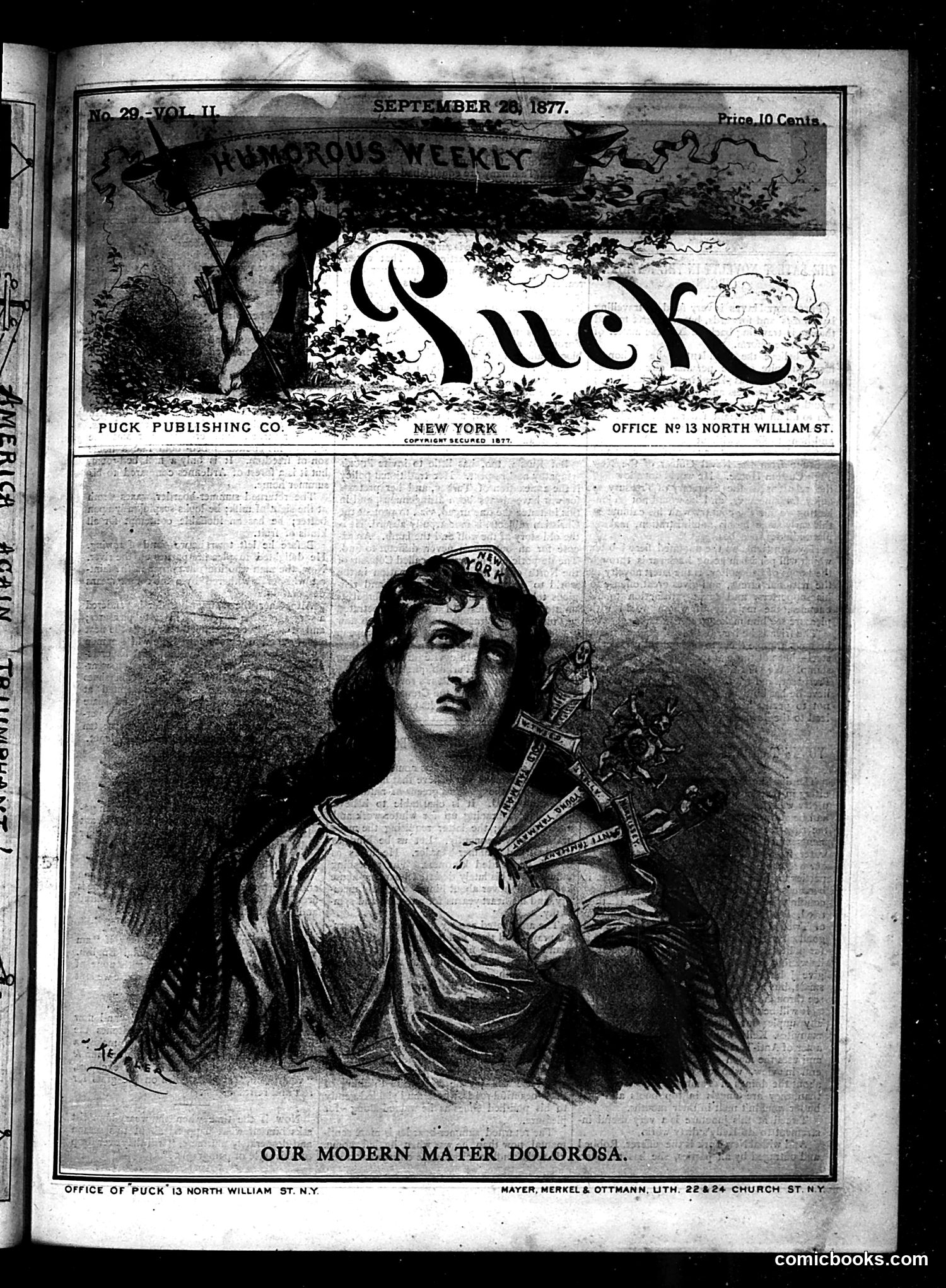
This cover illustration, titled "Our Modern Mater Dolorosa," depicts a woman in classical dress holding a dagger or sword, presented in a style reminiscent of religious imagery of the Virgin Mary mourning Christ's death ("Mater Dolorosa"). The satire appears to comment on contemporary American suffering or national grief, though without additional context from the magazine's interior content, the specific political event being referenced—whether related to Reconstruction politics, economic crisis, or another 1877 crisis—cannot be determined with certainty. The classical artistic treatment combined with the sorrowful female figure suggests commentary on the nation's distress during this turbulent period in American history.
This page contains three satirical articles rather than illustrated cartoons: 1. **"The Latest Novelty in the National Circus"** critiques President Hayes's travel habits and his administration's policies, particularly regarding the Turkish-Russian conflict and treatment of the Turks. The satire suggests Hayes lacks the judgment needed for office. 2. **"Young Tammany and Old Tammany"** attacks Tammany Hall (New York's Democratic political machine), comparing its corrupt practices unfavorably to rival factions. It defends Hayes's honest character while mocking Tammany's dishonesty. 3. **"The Returned Summer Boarder"** humorously depicts a city dweller returning from rural vacation, contrasting his idealization of country life with the harsh realities of farm labor and poverty. The page emphasizes Puck's Republican editorial stance and preference for attacking Democratic urban corruption.
This page contains three distinct sections: a humorous poem "Gone" about romantic loss; "Uncle Peter and His Louisa," a comic song retelling an old folk tale about a jealous rooster opposing a young woman's marriage; and "Blank Florida," a poem about a man from Maine relocating to Florida for oranges and warmth. The page also includes "Puck's Personal Intelligence" — a gossip column featuring brief satirical items about public figures and social scandals, including references to fashions, a bachelor's lifestyle choices, and various social commentary. "Dramatic Notes" covers theater news, including upcoming performances and cast changes in Broadway productions. The content is primarily literary and theatrical rather than political cartooning, reflecting Puck's role as a general satirical magazine beyond just visual humor.
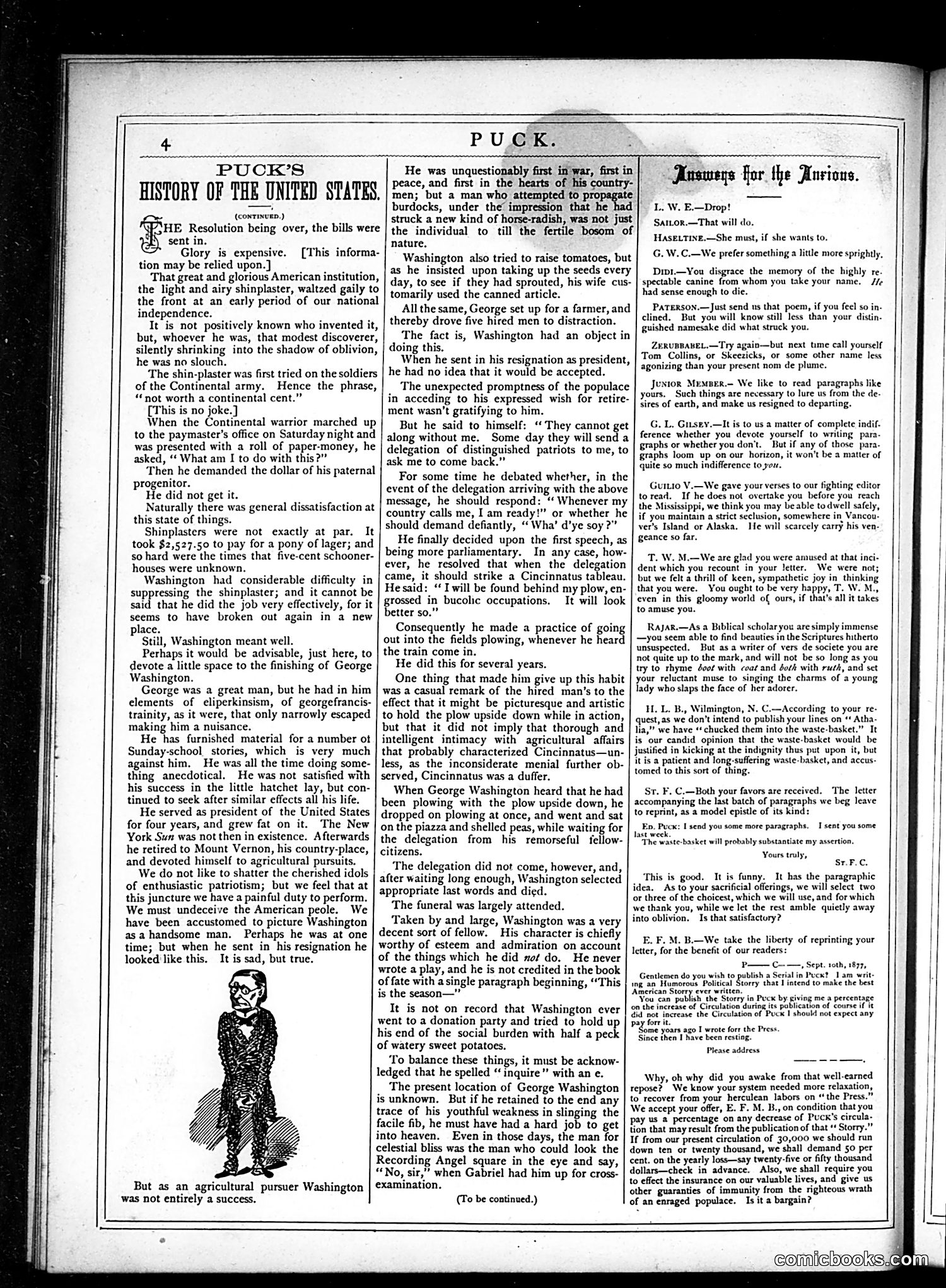
This page contains **"Puck's History of the United States (Continued)"** — a satirical historical article about George Washington's agricultural experiments, particularly his failures as a farmer. The main text mocks Washington's attempt to become a successful farmer after his presidency, describing his unsuccessful efforts growing tomatoes and his comical struggle with plowing (supposedly holding the plow "upside down"). The satire suggests that despite Washington's military and political success, he lacked practical farming knowledge. The right column contains reader responses ("Answers for the Aurious"), addressing various submitted questions on unrelated topics. **The small illustration** (bottom left) appears to be a generic decorative element rather than a specific caricature. The humor relies on textual satire rather than visual commentary.
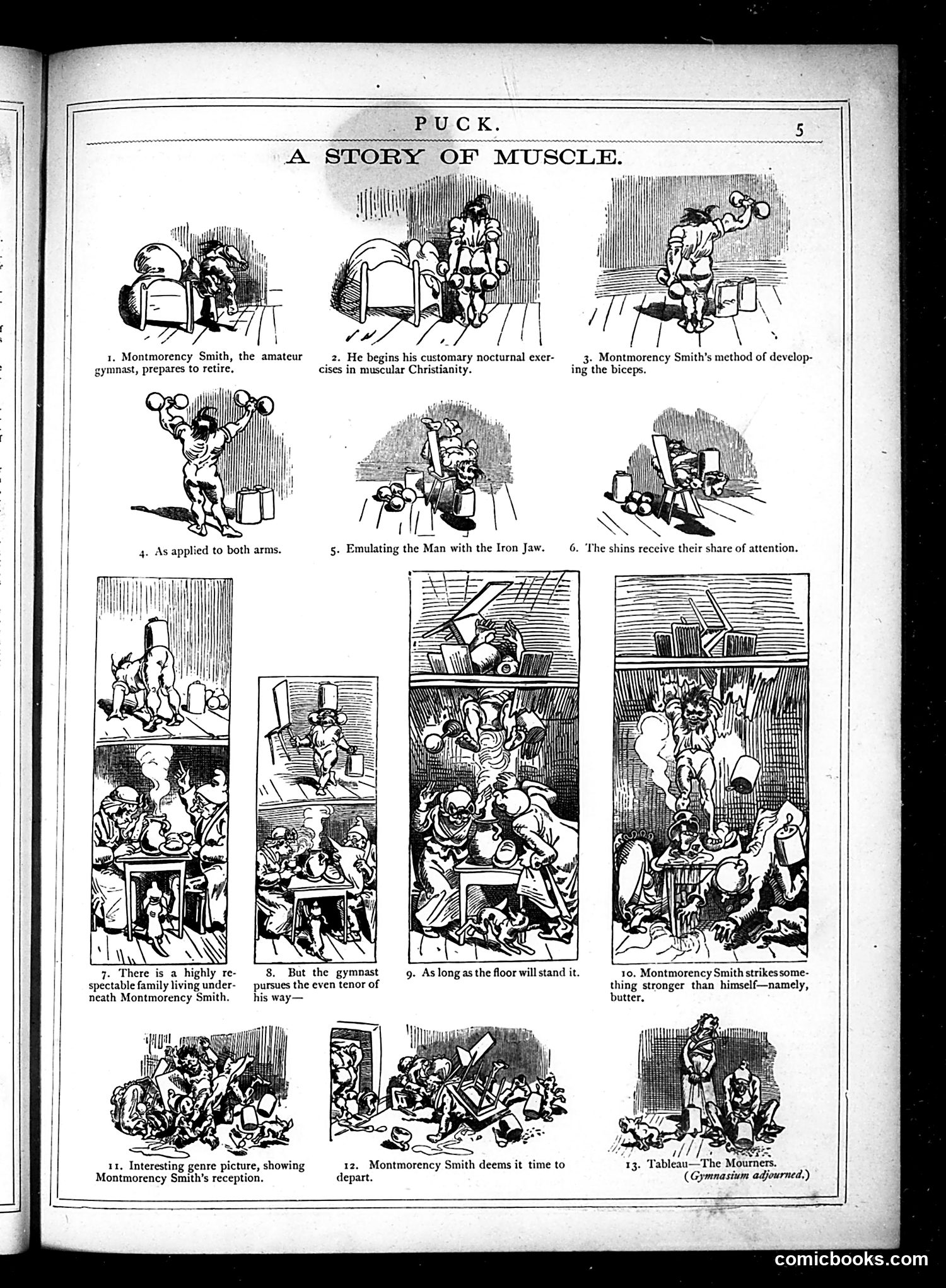
This is a satirical 13-panel narrative about "Montmorency Smith," an amateur gymnast who obsessively pursues muscular development through increasingly extreme training methods. The joke mocks the turn-of-the-century fitness craze and bodybuilding culture. Smith progresses from basic exercises to absurd extremes—lifting dumbbells, striking poses, eventually supporting his entire household on his shoulders. The satire peaks when he discovers butter "stronger than himself" (panel 10), suggesting that dietary substance matters more than muscle alone. The final panels show his muscular development attracts unwanted consequences: crowds, chaos, and financial burden. The Latin caption "Gymnasium adornatum" (adorned gymnasium) suggests the hollow vanity underlying obsessive bodybuilding. The satire critiques both the fitness obsession and its social disruptions.
This page contains primarily **household advice columns** rather than political satire. "Lumps of Wisdom" offers practical domestic tips (using silver spoons to scrape kettles, proper clothesline etiquette, food storage methods). The only cartoon visible depicts a figure labeled "Fitznoodle in America" - a small illustration of what appears to be a poorly dressed man or vagrant. The accompanying text suggests this is a **humorous serial character**, describing Fitznoodle's wanderings and complaints about American society, particularly regarding invitations to social events like weddings that prove "too much trouble to go." The satire targets **social pretension and American hospitality norms** rather than specific political figures. This appears to be general entertainment and domestic humor rather than pointed political commentary.
This page from *Puck* magazine contains serialized fiction rather than political cartoons. The featured story is titled "Edwin, Wah-Wa-We-Ne-Ma and Arabella; or, The Baby and the Pocket-Stove," described as "A Story of Murder and Mucilage in Seven Chapters." The narrative appears to be comedic melodrama—typical *Puck* fare mixing absurdist humor with Gothic plot elements (murder, arsenic poisoning, a wounded mother-in-law). Chapter titles reference dramatic situations: "The Baby and the Pocket-Stove," ophthalmia as a disease metaphor, and social commentary about pocket-stoves. A separate article, "Policemen at the Club," discusses police statistics and crime reports from New York precincts, offering satirical social observation rather than explicit political critique. This represents *Puck's* blend of entertainment, serialized fiction, and light social satire rather than hard-hitting political cartooning.
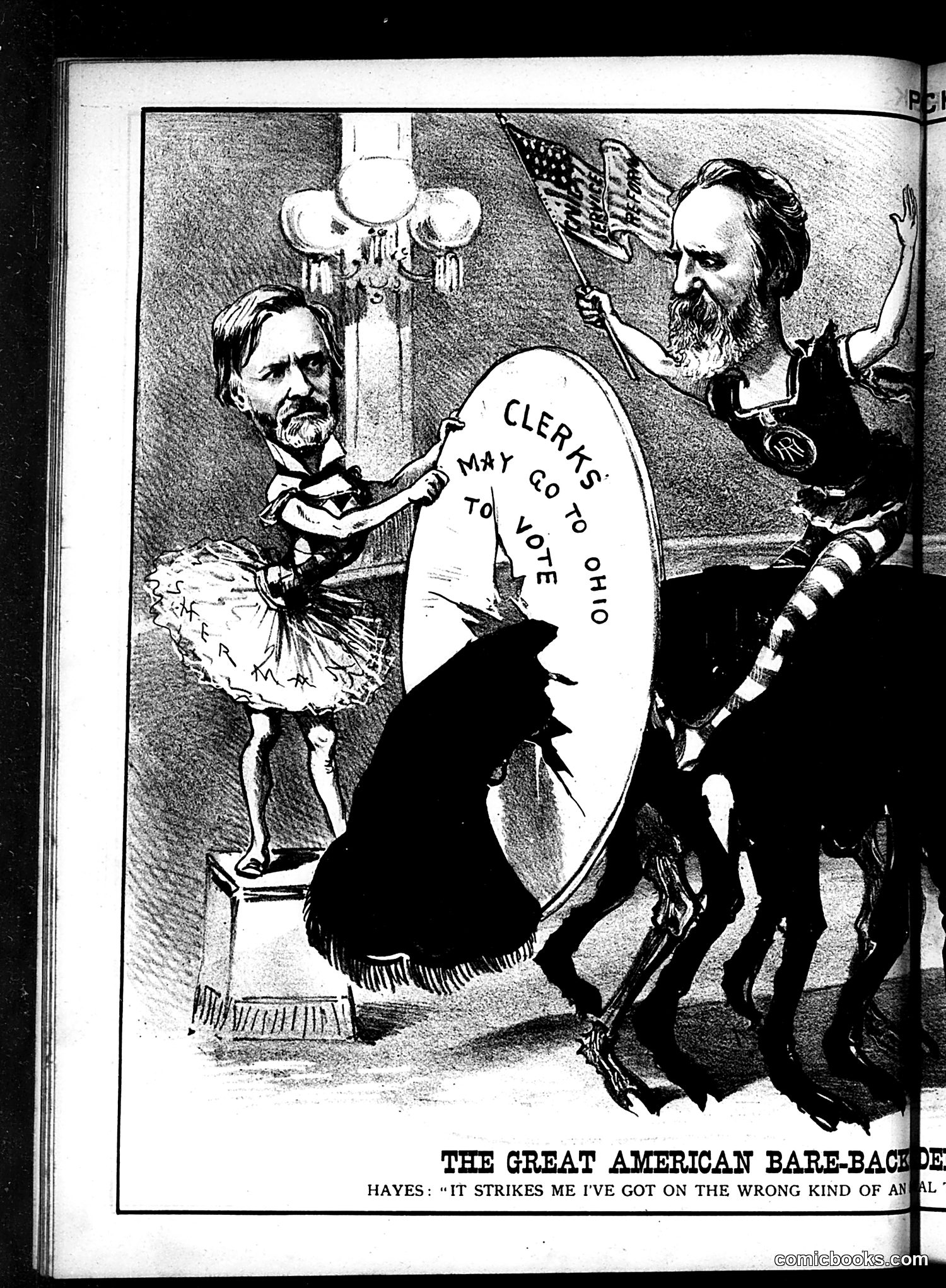
This political cartoon satirizes what appears to be a heated disagreement between two bearded men in 19th-century dress. The figure on the left holds a large paddle or fan labeled "CLERKS MAY GO TO OHIO," while the right figure waves an American flag. A dark silhouette in the foreground appears puzzled or concerned. The caption quotes Hayes: "It strikes me I've got on the wrong kind of an [animal]" — likely "ass," making a self-deprecating joke about his position. The cartoon likely references a political controversy during or after Rutherford B. Hayes's presidency, possibly concerning Ohio politics or a specific policy debate. Without knowing the exact date and context, the specific satirical target remains unclear, though the "bare-back" title suggests riding or instability as metaphors for political difficulty.
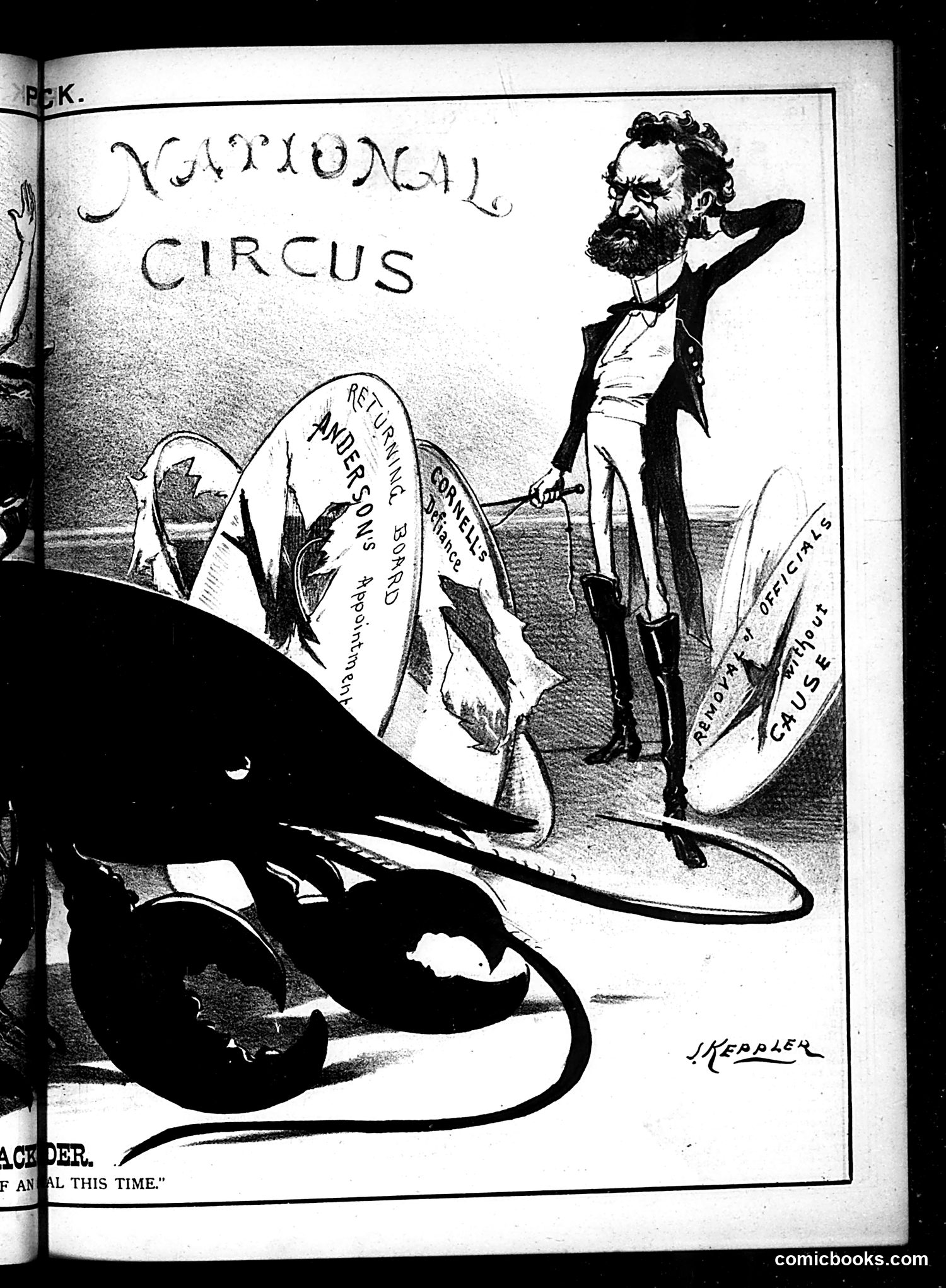
This Puck cartoon depicts a bearded ringmaster in formal attire standing beside circus wheels labeled with various political/administrative roles: "RETURNING OFFICER," "CHIEF CLERK," and "GAUSS BIRD OFFICIALS" (text partially unclear). The satire compares electoral administration to a circus performance, suggesting corruption or incompetence in the voting process. The elaborate wheels and the showman's theatrical pose mock those running elections as charlatans putting on an elaborate performance rather than conducting honest governance. The cartoon critiques what appears to be electoral fraud or malfeasance, portraying election officials as circus performers engaged in deception. The specific political context—which election or scandal this references—remains unclear without additional historical documentation.
This page contains theater criticism rather than political satire. The header illustration shows "Struck Oil," likely a theatrical production being reviewed. The main text is a letter to Puck's editor critiquing a play called "Struck Oil" performed at Wallack's Theatre. The reviewer praises the Williamson family's acting and dancing but criticizes the play's structure and dialogue. He notes the inclusion of German dialect and broken English spoken by characters, finding these comedic elements jarring. The secondary article "Aimee" reviews actress Aimee's performance, noting her youth and charm but criticizing her portrayal as somewhat inferior to previous performances. This represents Puck's theater criticism section, offering detailed commentary on contemporary New York stage productions for educated readers interested in the performing arts.
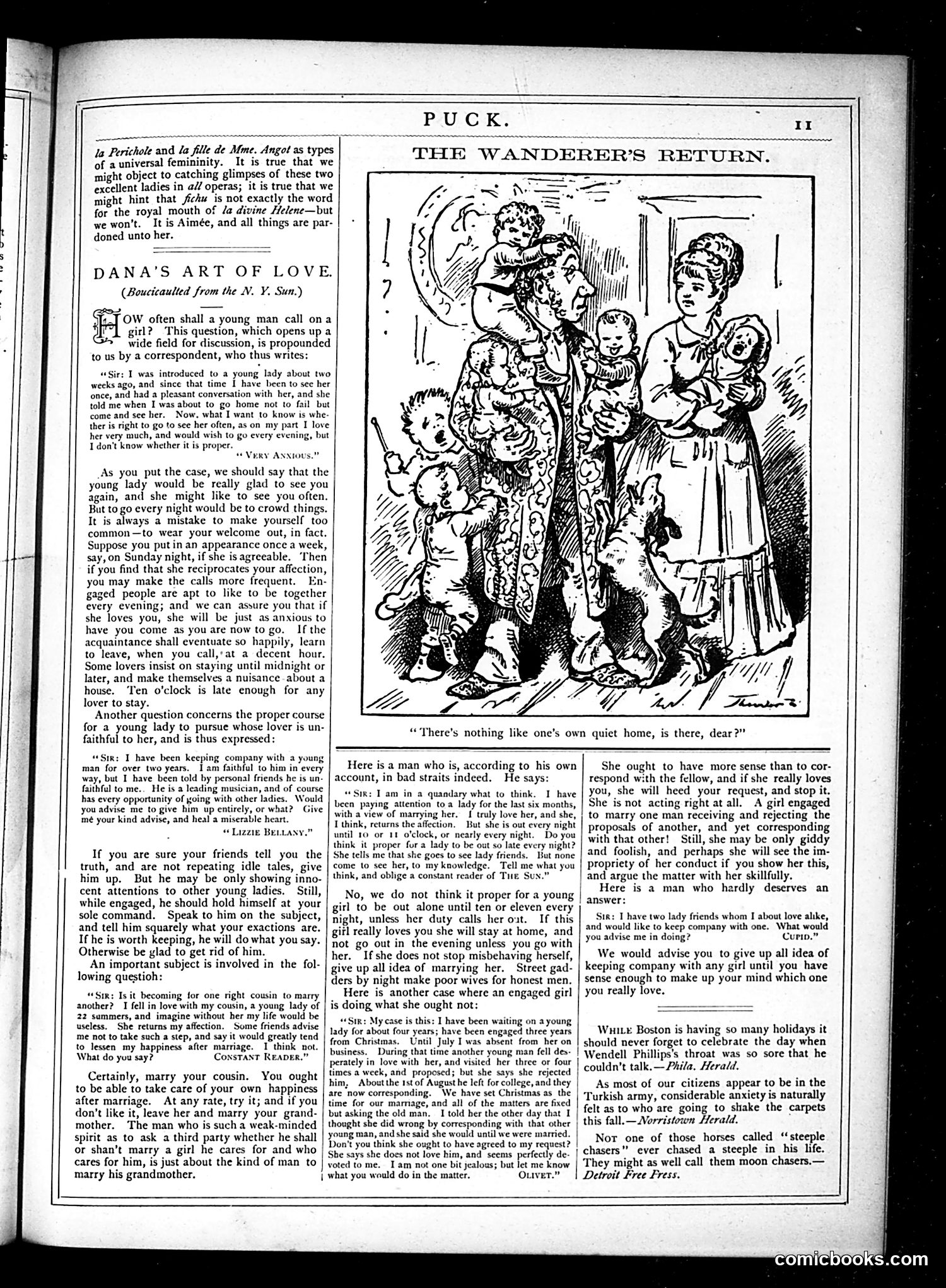
This cartoon depicts a woman (labeled "the wanderer") returning home with multiple small children clinging to her skirts and arms. The accompanying text discusses a man asking a young woman to marry him, noting his "wandering" habits—he frequently visits other ladies. The satire mocks the double standard of courtship and marriage: the man openly admits to regularly visiting other women, yet expects the woman to accept this behavior and remain faithful and domestic. The cartoon visualizes the absurd consequences—she's burdened with many children while he continues his infidelities. The piece critiques both the man's presumption that a woman would accept such unfaithful treatment and the social expectations pressuring women into marriages with unfaithful suitors.
This page contains **text only** — specifically Chapter XXV of "Two Knaves and a Queen," an English serialized short story by Frank R. Stockton. The heading indicates this installment appeared in Puck's North William Street office edition. The narrative excerpt shows dialogue between characters named Hugh and René, discussing fencing, swordplay, and romantic tension. There are **no political cartoons, caricatures, or satirical illustrations** visible on this page. This appears to be standard fiction content published by Puck magazine alongside its typical satirical humor. Without seeing accompanying illustrations or knowing the larger story context, I cannot identify specific political or social satire related to the narrative itself.
The main cartoon, titled "Puck's Bargaines: THE DEAD PROPHET - A NEW BRIDGE OF SIGHS," appears at the top center. The accompanying poem by James Penuckle satirizes a figure (unclear which specific person) through extended metaphor about family relationships and human suffering. The remainder of the page contains miscellaneous short satirical items and quips typical of Puck's format, addressing various social and political topics of the era. These brief pieces comment on topics ranging from women's fashion to urban transportation to religious practices. Without clearer visual detail of the main cartoon's figures or more specific historical context about contemporary events, the precise targets of the satire remain difficult to identify with certainty.
This page contains no political cartoons—it's primarily literary content. The main feature is "The Betrothal—A True Story," the opening chapter of a serialized narrative about two lovers. The story emphasizes their devotion and ends with the line "[THE END.]" The rest of the page consists of various short humorous anecdotes and satirical commentary excerpted from newspapers and publications. These snippets mock diverse targets: Hindu theology, Danish barbers, newspaper editors, fashion trends, and urban life. The humor relies on wordplay and absurdist scenarios rather than visual satire. This represents Puck's mixed editorial approach—combining serialized fiction with reprinted satirical commentary as filler content.
This page is primarily **advertising and announcements** for Puck magazine and related businesses, rather than satirical content. The visible elements include: - A memorial notice for **Brigham Young**, announcing a cartoon depicting the "Mormon's Empty Pillow" published as a single sheet - Multiple ads for gentlemen's hats, champagne, printing inks, and other products - An announcement for **Puck's Illustrated Almanac** (160 pages) - Ads for portrait photography services, cigarettes, and bitters - Notices about patent covers and back issues available for purchase The only clear satirical reference is the Brigham Young memorial, likely mocking the Mormon leader's polygamy. The rest of the page functions as period magazine filler and commercial promotion rather than editorial satire.
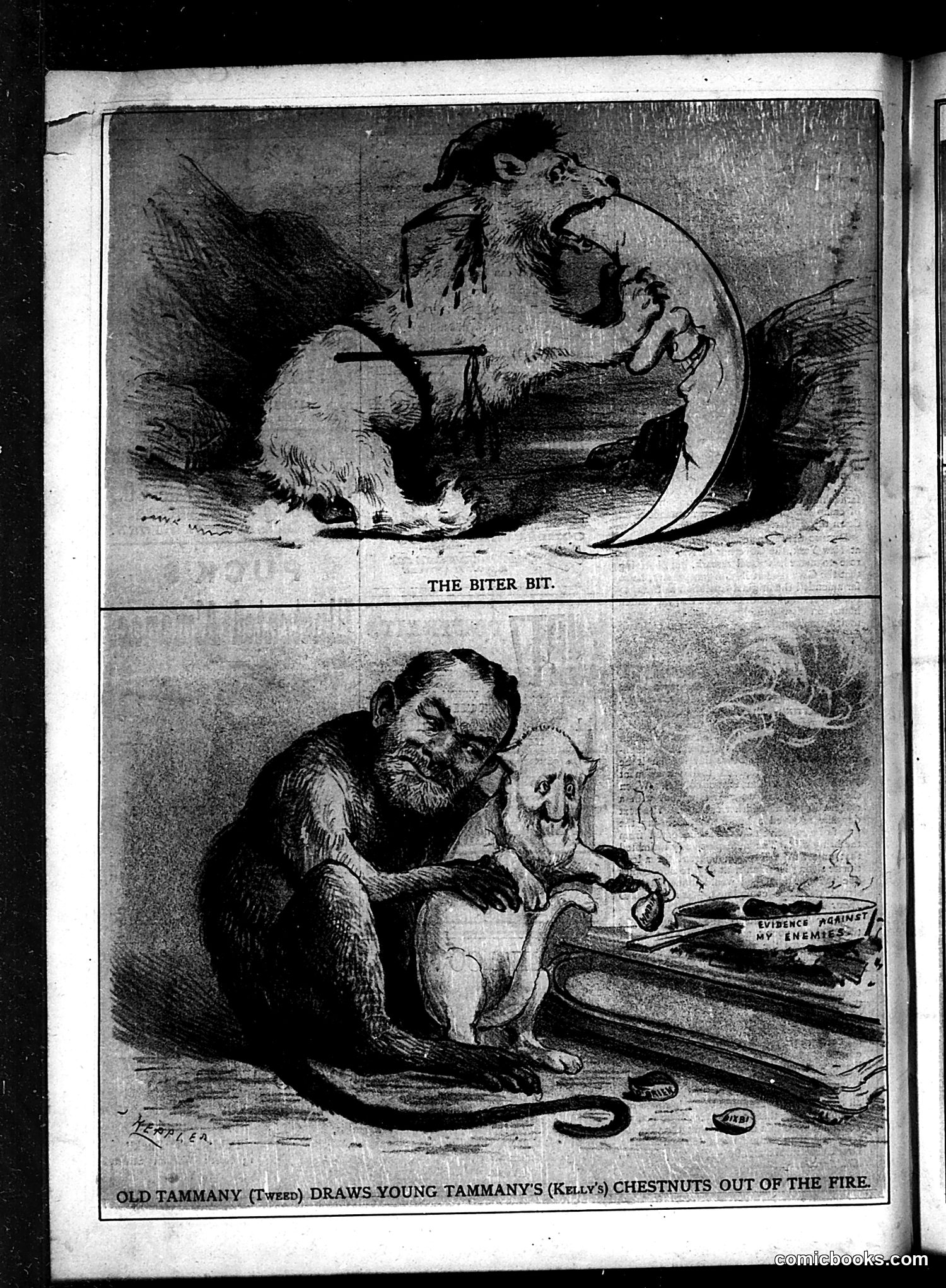
This two-panel satirical cartoon uses animal metaphors to mock political betrayal. The top panel, titled "THE BITTER BIT," shows a dog being bitten by a scorpion or serpent—illustrating the fable of mutual destruction through treachery. The bottom panel depicts an older monkey (identified as "Old Tammany"/Tweed) manipulating a younger monkey (Kelly) to retrieve chestnuts from a fire, while a document labeled "EVIDENCE AGAINST MY ENEMIES" sits nearby. The cartoon appears to reference **Tammany Hall corruption** in New York politics, likely depicting William "Boss" Tweed (the elder figure) cynically using younger associates to do dirty work while distancing himself from incriminating evidence. The "bitter bit" theme suggests the manipulator will ultimately suffer consequences from his own schemes.