
Puck, 1877-09-26 · page 13 of 16
Puck — September 26, 1877 — page 13: what you’re looking at
What you’re looking at
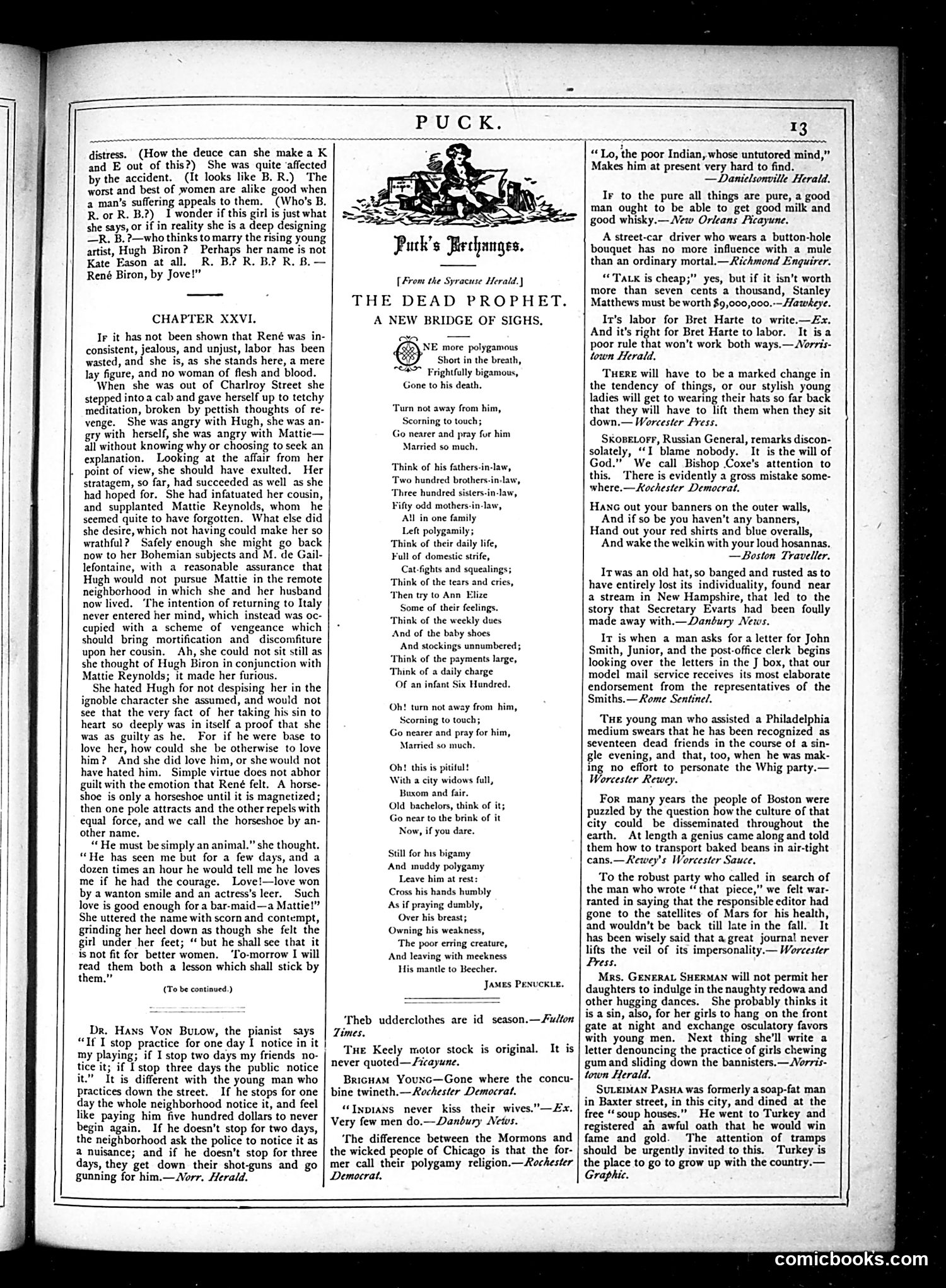
The main cartoon, titled "Puck's Bargaines: THE DEAD PROPHET - A NEW BRIDGE OF SIGHS," appears at the top center. The accompanying poem by James Penuckle satirizes a figure (unclear which specific person) through extended metaphor about family relationships and human suffering. The remainder of the page contains miscellaneous short satirical items and quips typical of Puck's format, addressing various social and political topics of the era. These brief pieces comment on topics ranging from women's fashion to urban transportation to religious practices. Without clearer visual detail of the main cartoon's figures or more specific historical context about contemporary events, the precise targets of the satire remain difficult to identify with certainty.
📄 Transcribed text from this page (OCR, searchable)
Machine-transcribed from the original scan — historical spelling and the odd misread are preserved.
distress. (How the deuce can she make a K and E out of this?) She was quite ‘affected by the accident. (It looks like B.R.) The worst and best of women are alike good when a man’s suffering appeals to them. (Who's B. R. or R. B.?)_ I wonder if this girl is just what she says, or if in reality she is a deep designing “R. B.?—who thinks to marry the rising young artist, Hugh Biron? Perhaps her name is not Kate Eason at all. R. B? R. B.? R. B.— René Biron, by Jove!” CHAPTER XXVI. Ir it has not been shown that René was in- consistent, jealous, and unjust, labor has been wasted, and she is, as she stands here, a mere lay figure, and no woman of flesh and blood. When she was out of Charlroy Street she stepped into a cab and gave herself up to tetchy meditation, broken by pettish thoughts of re- venge. She was angry with Hugh, she was an- gry with herself, she was angry with Mattie— all without knowing why or choosing to seek an explanation. Looking at the affair from her point of view, she should have exulted. Her stratagem, so far, had succeeded as well as she had hoped for. She had infatuated her cousin, and supplanted Mattie Reynolds, whom he seemed quite to have forgotten. What else did she desire, which not having could make her so wrathful? Safely enough she might go back now to her Bohemian subjects and M. de Gail- lefontaine, with a reasonable assurance that Hugh would not pursue Mattie in the remote neighborhood in which she and her husband now lived. ‘The intention of returning to Italy never entered her mind, which instead was oc- cupied with a scheme of vengeance which should bring mortification and discomfiture upon her cousin. Ah, she could not sit still as she thought of Hugh Biron in conjunction with Mattie Reynolds; it made her furious. She hated Hugh for not despising her in the ignoble character she assumed, and would not see that the very fact of her taking his sin to heart so deeply was in itself a proof that she was as guilty as he. For if he were base to love her, how could she be otherwise to love him? And she did love him, or she would not have hated him. Simple virtue does not abhor guilt with the emotion that René felt. A horse- shoe is only a horseshoe until it is magnetized; then one pole attracts and the other repels with equal force, and we call the horseshoe by an- other name. “He must be simply an animal.” she thought. “He has seen me but for a few days, and a dozen times an hour he would tell me he loves me if he had the courage. Love!—love won by a wanton smile and an actress's leer. Such love is good enough for a bar-maid—a Mattie!” She uttered the name with scorn and contempt, grinding her heel down as though she felt the girl under her feet; ‘ but he shall see that it is not fit for better women. ‘I'o-morrow I will read them both a lesson which shall stick by them.” (To be continued.) Dr. Hans Von Butow, the pianist says “If I stop practice for one day I notice in it my playing; if I stop two days my friends no- tice it; if I'stop three days the public notice it.” It is different with the young man who practices down the street. If he stops for one day the whole neighborhood notice it, and feel like paying him five hundred dollars to never in again. If he doesn’t stop for two days, the neighborhood ask the police to notice it as a nuisance; and if he doesn’t stop for three days, they get down their shot-guns and go gunning for him.—Norr. Herald. [From the Syracuse Herald.) THE DEAD PROPHET. A NEW BRIDGE OF SIGHS, of E more polygamous Short in the breath, Frightfully bigamous, Gone to his death. ‘Turn not away from him, Scorning to touch; Go nearer and pray for him Married so much, ‘Think of his fathers-in-law, Two hundred brothers-in-law, ‘Three hundred sisters-in-law, Fifty odd mothers-in-law, All in one family Left polygamily; Think of their daily life, Full of domestic strife, Cat-fights and squealings; ‘Think of the tears and cries, ‘Then try to Ann Elize Some of their feelings. Think of the weekly dues And of the baby shoes And stockings unnumbered} ‘Think of the payments large, Think of a daily charge Of an infant Six Hundred. Oh! turn not away from him, Scorning to touch; Go nearer and pray for him, Married so much. Ob! this is pitiful! With a city widows full, Buxom and fair. Old bachelors, think of it; Go near to the brink of it Now, if you dare. Still for his bigamy And muddy polygamy Leave him at rest: Cross his hands humbly As if praying dumbly, Over his breasts Owning his weakness, ‘The poor erring creature, And leaving with meekness His mantle to Beecher. Janes Penuck ie. ‘Theb udderclothes are id season.—Fulton Times. Tue Keely motor stock is original. never quoted—/icayune, Bricuam Younc—Gone where the concu- bine twineth.—Rochester Democrat. “Inpians never kiss their wives.”—Zx. Very few men do.—Danbury Nets. ‘The difference between the Mormons and the wicked people of Chicago is that the for- mer call their polygamy religion.—Xochester Democrat. It is 13 “Lo, the poor Indian, whose untutored mind,” Makes him at present very hard to find. —Danielsonville Herald. Ir to the pure all things are pure, a good man ought to be able to get good milk and good whisky.—New Orleans Picayune. A street-car driver who wears a button-hole bouquet has no more influence with a mule than an ordinary mortal.—Richmond Enquirer, “ Tatx is cheap;” yes, but if it isn’t worth more than seven cents a thousand, Stanley Matthews must be worth $9,000,000.-—Hawkeye. It’s labor for Bret Harte to write.—Ex. And it’s right for Bret Harte to labor. It isa poor rule that won’t work both ways.—Norris- town Herald. Tuere will have to be a marked change in the tendency of things, or our stylish young ladies will get to wearing their hats so far back that they will have to lift them when they sit down.— Worcester Press. Skosetorr, Russian General, remarks discon- solately, “I blame nobody. It is the will of God.” We call Bishop Coxe’s attention to this. There is evidently a gross mistake some- where.—Xochester Democrat. Hanc out your banners on the outer walls, And if so be you haven't any banners, Hand out your red shirts and blue overalls, And wake the welkin with your loud hosannas. —Boston Traveller. Ir was an old hat, so banged and rusted as to have entirely lost its individuality, found near a stream in New Hampshire, that led to the story that Secretary Evarts had been foully made away with.— Danbury News. It is when a man asks for a letter for John Smith, Junior, and the post-office clerk begins looking over the letters in the J box, that our model mail service receives its most elaborate endorsement from the representatives of the Smiths.— Rome Sentinel. ‘THE young man who assisted a Philadelphia medium swears that he has been recognized as seventeen dead friends in the course of a sin- gle evening, and that, too, when he was mak- ing no effort to personate the Whig party.— Worcester Rewey. For many years the people of Boston were puzzled by the question how the culture of that city could be disseminated throughout the earth. At length a genius came along and told them how to transport baked beans in air-tight cans.—Kewey’s Worcester Sauce, To the robust party who called in search of the man who wrote “that piece,” we felt war- ranted in saying that the responsible editor had gone to the satellites of Mars for his health, and wouldn't be back till late in the fall. It has been wisely said that a great journal never lifts the veil of its impersonality.— Worcester Press. Mrs. GENERAL SHERMAN will not permit her daughters to indulge in the naughty redowa and other hugging dances. She probably thinks it is a sin, also, for her girls to hang on the front gate at night and exchange osculatory favors with young men. Next thing she'll write a letter denouncing the practice of girls chewing gum and sliding down the bannisters.—Norris- town Herald. SuLEntan Pasua was formerly asoap-fat man in Baxter street, in this city, and dined at the free ‘soup houses." He went to Turkey and registered ah awful oath that he would win fame and gold. The attention of tramps should be urgently invited to this. Turkey is the place to go to grow up with the country.— Graphic. comicbooks.com