
Puck, 1877-09-26 · page 7 of 16
Puck — September 26, 1877 — page 7: what you’re looking at
What you’re looking at
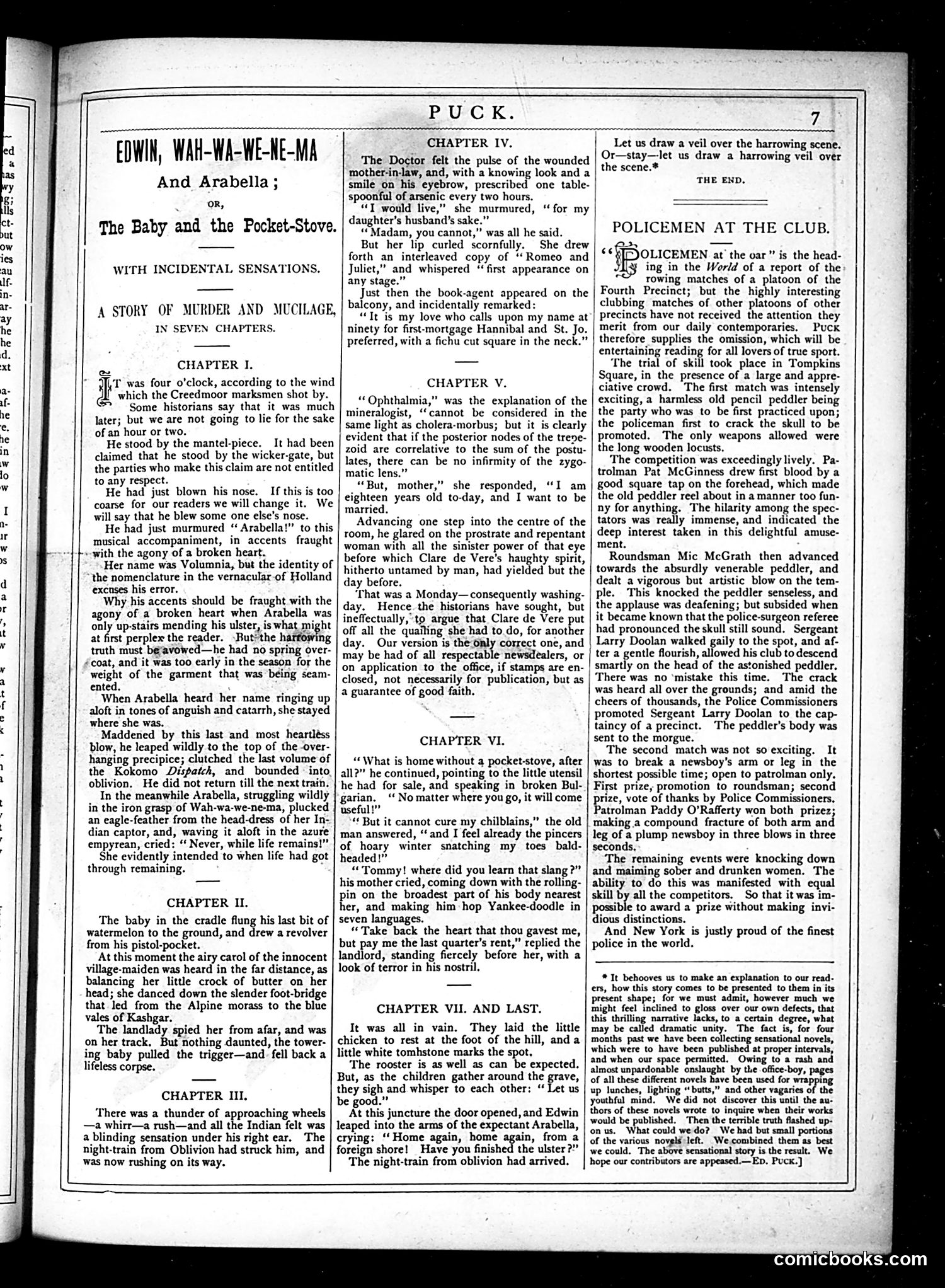
This page from *Puck* magazine contains serialized fiction rather than political cartoons. The featured story is titled "Edwin, Wah-Wa-We-Ne-Ma and Arabella; or, The Baby and the Pocket-Stove," described as "A Story of Murder and Mucilage in Seven Chapters." The narrative appears to be comedic melodrama—typical *Puck* fare mixing absurdist humor with Gothic plot elements (murder, arsenic poisoning, a wounded mother-in-law). Chapter titles reference dramatic situations: "The Baby and the Pocket-Stove," ophthalmia as a disease metaphor, and social commentary about pocket-stoves. A separate article, "Policemen at the Club," discusses police statistics and crime reports from New York precincts, offering satirical social observation rather than explicit political critique. This represents *Puck's* blend of entertainment, serialized fiction, and light social satire rather than hard-hitting political cartooning.
📄 Transcribed text from this page (OCR, searchable)
Machine-transcribed from the original scan — historical spelling and the odd misread are preserved.
PUCK. EDWIN, WAH-WA-WE-NE-MA And Arabella ; OR, The Baby and the Pocket-Stove. WITH INCIDENTAL SENSATIONS. A STORY OF MURDER AND MUCILAGE, IN SEVEN CHAPTERS. CHAPTER I. e re sh, was four o'clock, according to the wind J which the Creedmoor marksmen shot by. Some historians say that it was much later; but we are not going to lie for the sake of an hour or two. He stood by the mantel-piece. It had been claimed that he stood by the wicker-gate, but the parties who make this claim are not entitled to any respect. He had just blown his nose. If this is too coarse for our readers we will change it. We will say that he blew some one else’s nose. He had just murmured “ Arabella!” to this musical accompaniment, in accents fraught »-with the agony of a broken heart. Her name was Volumnia, but the identity of the nomenclature in the vernacular-of Holland excnses his error. Why his accents should be fraught with the agony of a broken heart when Arabella was only up-stairs mending his ulster, is what might at first perplex the reader. \But*the harfowing truth must be‘avowed—he had no spring over- écoat, and it was too early in the season for the weight of the garment that was béing seam- ented. When Arabella heard her name ringing up aloft in tones of anguish and catarrh, she stayed where she was. Maddened by this last and most heartléss blow, he leaped wildly to the top of the -over- hanging precipice; clutched the last volume of the Kokomo Dispatch, and bounded ° into. oblivion. He did not return till the next train. In the meanwhile Arabella, struggling wildly in the iron grasp of Wah-wa-we-ne-ma, plucked an eagle-feather from the head-dress of her In- dian captor, and, waving it aloft in the azure empyrean, cried: “ Never, while life remains!” She evidently intended to when life had got through remaining. CHAPTER II. The baby in the cradle flung his last bit of watermelon to the ground, and drew a revolver from his pistol-pocket. At this moment the airy carol of the innocent village-maiden was heard in the far distance, as balancing her little crock of butter on her head; she danced down the slender foot-bridge that led from the Alpine morass to the blue vales of Kashgar. The landlady spied her from afar, and was on her track. But nothing daunted, the tower- ing baby pulled the trigger—and. fell back a lifeless corpse. CHAPTER III. ‘There was a thunder of approaching wheels —a whirr—a rush—and all the Indian felt was a blinding sensation under his right ear. The night-train from Oblivion had struck him, and was now rushing on its way. CHAPTER IV. ‘The Doctor felt the pulse of the wounded mother-in-law, and, with a knowing look and a smile on his eyebrow, prescribed one table- spoonful of arsenic every two hours. “I would live,” she murmured, “for my daughter’s husband’s sake.”” “Madam, you cannot,” was all he said. But her lip curled scornfully. She drew forth an interleaved copy of ‘Romeo and Juliet,” and whispered “first appearance on | | Fourth Precinct; but the highly interesting any stage.” Just then the book-agent appeared on the balcony, and incidentally remarked: “Tt is my love who calls upon my name at ninety for first-mortgage Hannibal and St. Jo. preferred, with a fichu cut square in the neck.” CHAPTER V. “Ophthalmia,” was the explanation of the mineralogist, ‘‘cannot be considered in the same light as cholera-morbus; but it is clearly evident that if the posterior nodes of the trene- zoid are correlative to the sum of the postu- lates, there can be no infirmity of the zygo- matic lens.” “But, mother,” she responded, “I am eighteen years old to-day, and I want to be married. Advancing one step into the centre of the room, he glared on the prostrate and repentant woman with all the sinister power of that eye before which Clare de Vere’s haughty spirit, hitherto untamed by man, had yielded but the day before. ‘That was a Monday—consequently washing- day. Hence. the historians have sought, but ineffectually,"to argue that Clare de Vere put off all the quaiting she had to do, for another day. Our version is the-Only correct one, and may be had of all respectable newsdealers, or on application to the office, if stamps are en- closed, not necessarily for publication, but as a guarantee of good faith. CHAPTER VI. “What is home without a pocket-stove, after all?” he continued, pointing to the little utensil he had for sale, and speaking in broken Bul- garian. ‘‘ No matter where you go, it will come useful!” “* But it cannot cure my chilblains,” the old man answered, “and I feel already the pincers of hoary winter snatching my toes bald- headed!” “Tommy! where did you learn that slang ?”” his mother cried, coming down with the rolling- pin on the broadest part of his body nearest her, and making him hop Yankee-doodle in seven languages. “Take back the heart that thou gavest me, but pay me the last quarter’s rent,” replied the landlord, standing fiercely before her, with a look of terror in his nostril. CHAPTER VII. AND LAST. It was all in vain. They laid the little chicken to rest at the foot of the hill, anda little white tomhstone marks the spot, The rooster is as well as can be expected. But, as the children gather around the grave, they sigh and whisper to each other: “Let us be good.” At this juncture the door opened, and Edwin leaped into the arms of the expectant Arabella, crying: ‘‘Home again, home again, from a foreign shore! Have you finished the ulster?” The night-train from oblivion had arrived. | ple. Let us draw a veil over the harrowing scene. Or—stay—let us draw a harrowing veil over the scene.* THE END. POLICEMEN AT THE CLUB. =n a “ff OLICEMEN at the oar” is the head- ing in the World of a report of the is rowing matches of a platoon of the clubbing matches of other platoons of other precincts have not received the attention they merit from our daily contemporaries. Puck therefore supplies the omission, which will be entertaining reading for all lovers of true sport. ‘The trial of skill took place in Tompkins Square, in the presence of a large and appre- ciative crowd. The first_ match was intensely exciting, a harmless old pencil peddler being the party who was to be first practiced upon; the policeman first to crack the skull to be promoted. The only weapons allowed were the long wooden locusts. ‘The competition was exceedingly lively. Pa- trolman Pat McGinness drew first blood by a good square tap on the forehead, which made the old peddler reel about in a manner too fun- ny for anything. ‘The hilarity among the spec- tators was really immense, and indicated the deep interest taken in this delightful amuse- ment. Roundsman Mic McGrath then advanced towards the absurdly venerable peddler, and dealt a vigorous but artistic blow on the tem- This knocked the peddler senseless, and the applause was deafening; but subsided when it became known that the police-surgeon referee had pronounced the skull still sound. Sergeant Larry Doolan walked gaily to the spot, and af- ter a gentle flourish, allowed his club to descend smartly on the head of the astonished peddler. There was no ‘mistake this time. The crack was heard all over the grounds; and amid the | cheers of thousands, the Police Commissioners promoted Sergeant Larry Doolan to the cap- taincy of a precinct. The peddler’s body was sent to the morgue. The second match was not so exciting. It was to break a newsboy’s arm or leg in the shortest possible time; open to patrolman only, First prize, promotion to roundsman; second prize, vote of thanks by Police Commissioners, Patrolman Paddy O’Rafferty won both prizez; making a compound fracture of both arm and leg of a plump newsboy in three blows in three seconds, The remaining events were knocking down and maiming sober and drunken women. The ability to do this was manifested with equal skill by all the competitors. So that it was im- possible to award a prize without making invi- dious distinctions. ‘And New York is justly proud of the finest police in the world. * It behooves us to make an explanation to our read- ers, how this story comes to be presented to them in its present shape; for we must admit, however much we might feel inclined to gloss over our own defects, that this thrilling narrative lacks, to a certain degree, what may be called dramatic unity. The fact is, for four months past we have been collecting sensational novels, which were to have been published at proper intervals, and when our space permitted. Owing to a rash and almost unpardonable onslaught by the office-boy, pages of all these different novels have been used for wrapping up lunches, lighting ‘ butts,” and other vagaries of the youthful mind, We did not discover this until the au- thors of these novels wrote to inquire when their works would be published. ‘Then the terrible truth flashed up- onus. What could wedo? We had but small portions of the various novglé left. We.combined them as best we could. The above sensational story is the result. We hope our contributors are appeased. —ED. PUCK.] comicbooks.com