
Puck, 1877-09-26 · page 14 of 16
Puck — September 26, 1877 — page 14: what you’re looking at
What you’re looking at
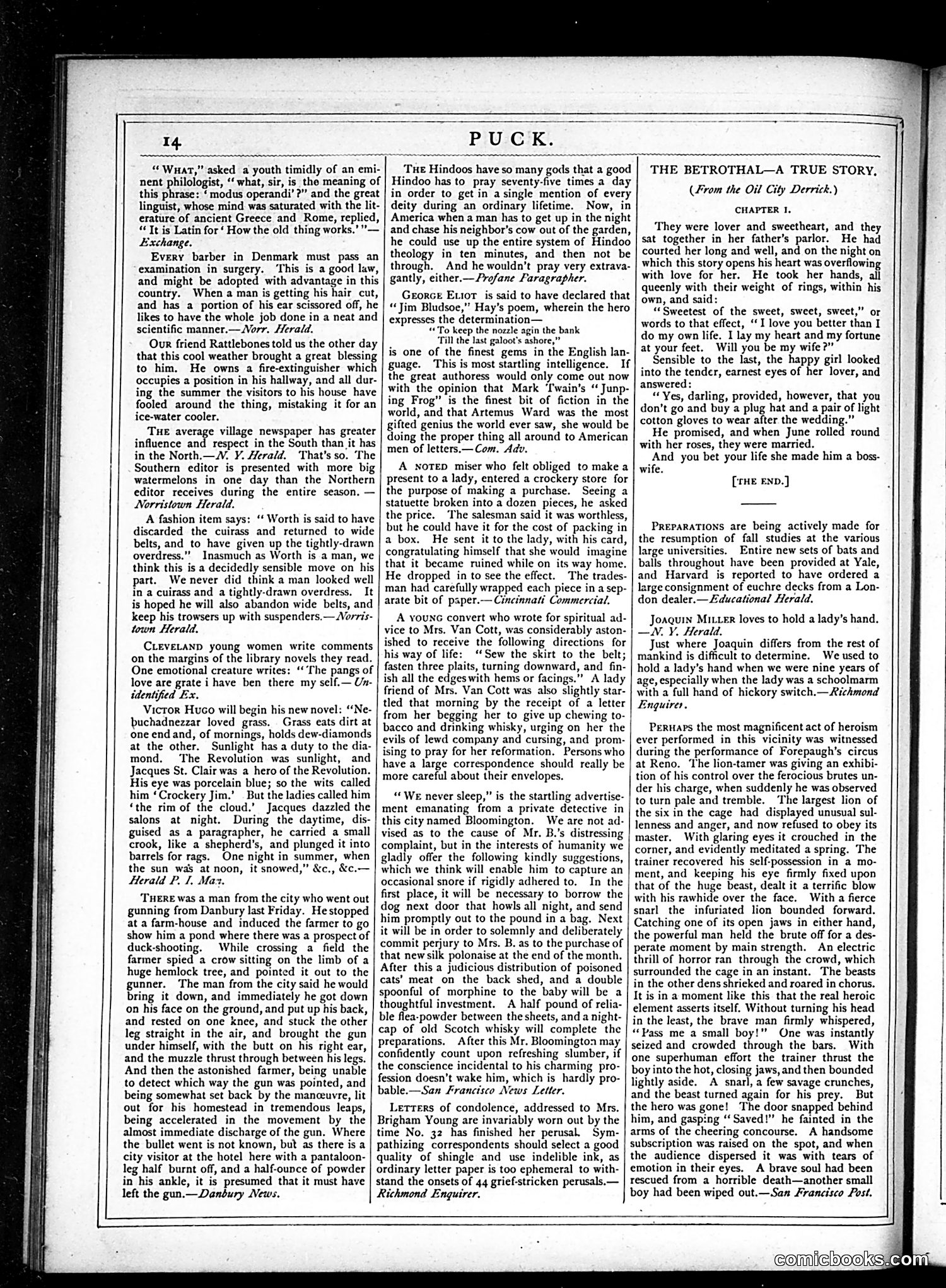
This page contains no political cartoons—it's primarily literary content. The main feature is "The Betrothal—A True Story," the opening chapter of a serialized narrative about two lovers. The story emphasizes their devotion and ends with the line "[THE END.]" The rest of the page consists of various short humorous anecdotes and satirical commentary excerpted from newspapers and publications. These snippets mock diverse targets: Hindu theology, Danish barbers, newspaper editors, fashion trends, and urban life. The humor relies on wordplay and absurdist scenarios rather than visual satire. This represents Puck's mixed editorial approach—combining serialized fiction with reprinted satirical commentary as filler content.
📄 Transcribed text from this page (OCR, searchable)
Machine-transcribed from the original scan — historical spelling and the odd misread are preserved.
“Wuat,” asked a youth timidly of an emi nent philologist, ‘ what, sir, is the meaning of this phrase: ‘ modus operandi’ ?” and the great linguist, whose mind was saturated with the lit- erature of ancient Greece and Rome, replied, “Tt is Latin for‘ How the old thing works.’ "— Exchange. Every barber in Denmark must pass an examination in surgery. ‘This is a good law, and might be adopted with advantage in this country. When a man is getting his hair cut, and has a portion of his ear scissored off, he likes to have the whole job done in a neat and scientific manner.—orr. Herald. Our friend Rattlebones told us the other day that this cool weather brought a great blessing to him. He owns a fire-extinguisher which occupies a position in his hallway, and all dur- ing the summer the visitors to his house have fooled around the thing, mistaking it for an ice-water cooler. Tue average village newspaper has greater influence and respect in the South than it has in the North.—. Y. Herald. That's so. The Southern editor is presented with more big watermelons in one day than the Northern editor receives during the entire season, — Norristown Herald. A fashion item says: ‘‘ Worth is said to have discarded the cuirass and returned to wide belts, and to have given up the tightly-drawn overdress.” Inasmuch as Worth is a man, we think this is a decidedly sensible move on his part. We never did think a man looked well in a cuirass and a tightly-drawn overdress. It is hoped he will also abandon wide belts, and keep his trowsers up with suspenders.—Norvis- town Herald. CLEVELAND young women write comments on the margins of the library novels they read. One emotional creature writes: ‘The pangs of love are grate i have ben there my self.— Un- identified Ex. Victor Huso will begin his new novel: “Ne- buchadnezzar loved grass. Grass eats dirt at one end and, of mornings, holds dew-diamonds at the other. Sunlight has a duty to the dia- mond. ‘The Revolution was sunlight, and Jacques St. Clair was a hero of the Revolution. His eye was porcelain blue; so the wits called him ‘Crockery Jim.’ But the ladies called him “the rim of the cloud.’ Jacques dazzled the salons at night. During the daytime, dis- guised as a paragrapher, he carried a small crook, like a shepherd's, and plunged it into barrels for rags. One night in summer, when the sun was at noon, it snowed,” &c., &c.— Herald P. I, Maz. ‘THERE was a man from the city who went out gunning from Danbury last Friday. He stopped at a farm-house and induced the farmer to go show him a pond where there was a prospect of duck-shooting. While crossing a field the farmer spied a crow sitting on the limb of a huge hemlock tree, and pointed it out to the gunner. The man from the city said he would bring it down, and immediately he got down on his face on the ground, and put up his back, and rested on one knee, and stuck the other leg straight in the air, and brought the gun under himself, with the butt on his right ear, and the muzzle thrust through between his legs. And then the astonished farmer, being unable to detect which way the gun was pointed, and being somewhat set back by the manceuvre, lit out for his homestead in tremendous leaps, being accelerated in the movement by the almost immediate discharge of the gun. Where the bullet went is not known, but as there is a city visitor at the hotel here with a pantaloon- leg half burnt off, and a half-ounce of powder in his ankle, it is presumed that it must have left the gun.— Danbury News. PUCK. ‘Tue Hindoos have so many gods that a good Hindoo has to pray seventy-five times a day in order to get in a single mention of every deity during an ordinary lifetime. Now, in America when a man has to get up in the night and chase his neighbor’s cow out of the garden, he could use up the entire system of Hindoo theology in ten minutes, and then not be through. And he wouldn't pray very extrava- gantly, either.— Profane Faragrapher. Georce Ettor is said to have declared that “Jim Bludsoe,” Hay’s poem, wherein the hero expresses the determination— “To keep the nozzle agin the bank Till the last galoot’s ashore,” is one of the finest gems in the English lan- guage. This is most startling intelligence. If the great authoress would only come out now with the opinion that Mark ‘[wain’s “ Junp- ing Frog” is the finest bit of fiction in the world, and that Artemus Ward was the most gifted genius the world ever saw, she would be doing the proper thing all around to American men of letters.—Com. Adv. A NoTED miser who felt obliged to make a present to a lady, entered a crockery store for the purpose of making a purchase. Seeing a statuette broken into a dozen pieces, he asked the price. ‘The salesman said it was worthless, but he could have it for the cost of packing in a box. He sent it to the lady, with his card, congratulating himself that she would imagine that it became ruined while on its way home. He dropped in to see the effect. The trades- man had carefully wrapped each piece in a sep- arate bit of paper.— Cincinnati Commercial. ‘A YouNG convert who wrote for spiritual ad- vice to Mrs. Van Cott, was considerably aston- ished to receive the following directions for his way of life: “Sew the skirt to the belt; fasten three plaits, turning downward, and fin- ish all the edges with hems or facings.” A lady friend of Mrs. Van Cott was also slightly star- tled that morning by the receipt of a letter from her begging her to give up chewing to- bacco and drinking whisky, urging on her the evils of lewd company and cursing, and prom- ising to pray for her reformation. Persons who have a large correspondence should really be more careful about their envelopes. “WE never sleep,” is the startling advertise- ment emanating from a private detective in this city named Bloomington. We are not ad- vised as to the cause of Mr. B.’s distressing complaint, but in the interests of humanity we gladly offer the following kindly suggestions, which we think will enable him to capture an occasional snore if rigidly adhered to. first place, it will be necessary to borrow the dog next door that howls all night, and send him promptly out to the pound in a bag. Next it will be in order to solemnly and deliberately commit perjury to Mrs. B. as to the purchase of that new silk polonaise at the end of the month, After this a judicious distribution of poisoned cats’ meat on the back shed, and a double spoonful of morphine to the baby will be a thoughtful investment. A half pound of relia- ble flea-powder between the sheets, and a night- cap of old Scotch whisky will complete the preparations. After this Mr. Bloomington may confidently count upon refreshing slumber, if the conscience incidental to his charming pro- fession doesn’t wake him, which is hardly pro- bable.—San Francisco News Letter. Letters of condolence, addressed to Mrs. Brigham Young are invariably worn out by the time No. 32 has finished her perusal, Sym- pathizing correspondents should select a good quality of shingle and use indelible ink, as ordinary letter paper is too ephemeral to with- stand the onsets of 44 grief-stricken perusals.— Richmond Engutrer. In the | THE BETROTHAL—A TRUE STORY, (From the Oil City Derrick.) CHAPTER 1. They were lover and sweetheart, and they sat together in her father’s parlor. He had courted her long and well, and on the night on which this story opens his heart was overflowing with love for her. He took her hands, all queenly with their weight of rings, within his own, and said: “Sweetest of the sweet, sweet, sweet,” or words to that effect, ‘I love you better than I do my own life. I lay my heart and my fortune at your feet. Will you be my wife?” Sensible to the last, the happy girl looked into the tender, earnest eyes of her lover, and answered: “Yes, darling, provided, however, that you don’t go and buy a plug hat and a pair of light cotton gloves to wear after the wedding.” He promised, and when June rolled round with her roses, they were married. And you bet your life she made him a boss- wife. [rue END.) Preparations are being actively made for the resumption of fall studies at the various large universities. Entire new sets of bats and balls throughout have been provided at Yale, and Harvard is reported to have ordered a large consignment of euchre decks from a Lon- don dealer.— Educational Herald. Joaquin Mitver loves to hold a lady’s hand. —wN. Y, Herald. Just where Joaquin differs from the rest of mankind is difficult to determine. We used to hold a lady’s hand when we were nine years of age, especially when the lady was a schoolmarm with a full hand of hickory switch.—Richmond Enquirer. Peruaps the most magnificent act of heroism ever performed in this vicinity was witnessed during the performance of Forepaugh’s circus at Reno. The lion-tamer was giving an exhibi- tion of his control over the ferocious brutes un- der his charge, when suddenly he was observed to turn pale and tremble. The largest lion of the six in the cage had displayed unusual sul- lenness and anger, and now refused to obey its master. With glaring eyes it crouched in the corner, and evidently meditated a spring. The trainer recovered his self-possession in a mo- ment, and keeping his eye firmly fixed upon that of the huge beast, dealt it a terrific blow with his rawhide over the face. With a fierce snarl the infuriated lion bounded forward. Catching one of its open jaws in either hand, the powerful man held the brute off for a des- perate moment by main strength. An electric thrill of horror ran through the crowd, which surrounded the cage in an instant. The beasts in the other dens shrieked and roared in chorus. It is in a moment like this that the real heroic element asserts itself. Without turning his head in the least, the brave man firmly whispered, “Pass me a small boy!” One was instantly seized and crowded through the bars, With one superhuman effort the trainer thrust the boy into the hot, closing jaws, and then bounded lightly aside. A snarl, a few savage crunches, and the beast turned again for his prey. But the hero was gone! The door snapped behind him, and gasping ‘Saved!’ he fainted in the arms of the cheering concourse. A handsome subscription was raised on the spot, and when the audience dispersed it was with tears of emotion in their eyes. A brave soul had been rescued from a horrible death—another small boy had been wiped out.—San Francisco Post. —————ae comiclbooks, com