
Puck, 1877-09-26 · page 10 of 16
Puck — September 26, 1877 — page 10: what you’re looking at
What you’re looking at
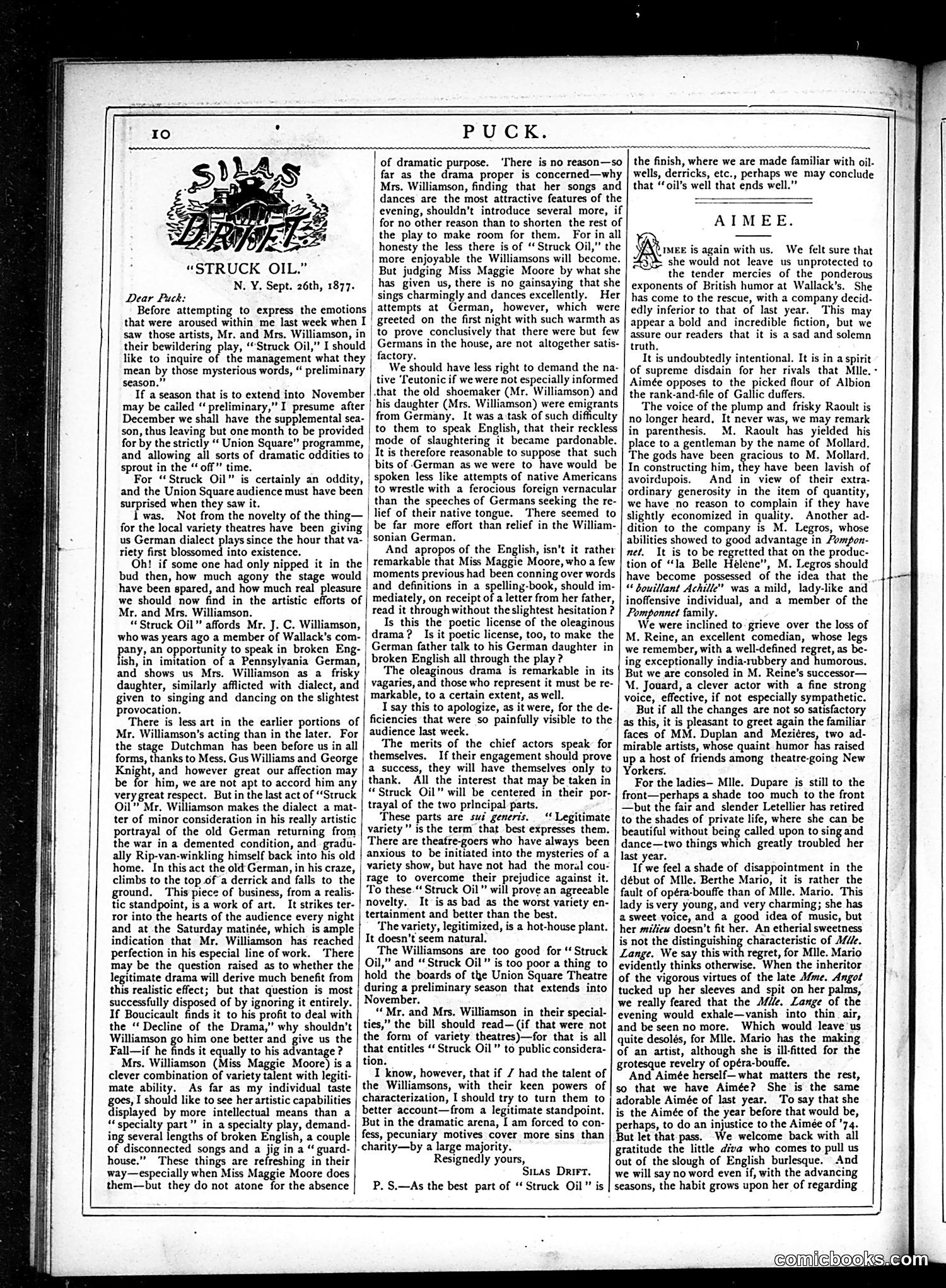
This page contains theater criticism rather than political satire. The header illustration shows "Struck Oil," likely a theatrical production being reviewed. The main text is a letter to Puck's editor critiquing a play called "Struck Oil" performed at Wallack's Theatre. The reviewer praises the Williamson family's acting and dancing but criticizes the play's structure and dialogue. He notes the inclusion of German dialect and broken English spoken by characters, finding these comedic elements jarring. The secondary article "Aimee" reviews actress Aimee's performance, noting her youth and charm but criticizing her portrayal as somewhat inferior to previous performances. This represents Puck's theater criticism section, offering detailed commentary on contemporary New York stage productions for educated readers interested in the performing arts.
📄 Transcribed text from this page (OCR, searchable)
Machine-transcribed from the original scan — historical spelling and the odd misread are preserved.
— PUCK. “STRUCK OIL.” N. Y. Sept. 26th, 1877. Dear Puck: Before attempting to express the emotions | that were aroused within me last week when I saw those artists, Mr. and Mrs. Williamson, in their bewildering play, ‘Struck Oil,” I should like to inquire of the management what they mean by those mysterious words, “ preliminary season.” If a season that is to extend into November may be called “ preliminary," I presume after December we shall have the supplemental sea- son, thus leaving but one month to be provided for by the strictly “ Union Square” programme, and allowing all sorts of dramatic oddities to sprout in the “off” time. For “Struck Oil” is certainly an oddity, and the Union Square audience must have been surprised when they saw it. i was. Not from the novelty of the thing— for the local variety theatres have been giving us German dialect plays since the hour that va- riety first blossomed into existence. Oh! if some one had only nipped it in the bud then, how much agony the stage would have been spared, and how much real pleasure we should now find in the artistic efforts of Mr. and Mrs. Williamson. “Struck Oil” affords Mr. J. C. Williamson, who was years ago a member of Wallack’s com- Bin, an opportunity to speak in broken Eng- ish, in imitation of a Pennsylvania German, and shows us Mrs. Williamson as a frisky daughter, similarly afflicted with dialect, and given to singing and dancing on the slightest provocation. There is less art in the earlier portions of Mr. Williamson's acting than in the later. For the stage Dutchman has been before us in all forms, thanks to Mess, Gus Williams and George Knight, and however great our affection may be for him, we are not apt to accord him any very great respect. But in the last act of “Struck Oil” Mr. Williamson makes the dialect a mat- ter of minor consideration in his really artistic portrayal of the old German returning from the war in a demented condition, and gradu- ally Rip-van-winkling himself back into his old home. In this act the old German, in his craze, climbs to the top of a derrick and falls to the ground. This piece of business, from a realis- tic standpoint, is a work of art. It strikes ter- ror into the hearts of the audience every night and at the Saturday matinée, which is ample indication that Mr. Williamson has reached perfection in his especial line of work. There may be the question raised as to whether the legitimate drama will derive much benefit from this realistic effect; but that question is most successfully disposed of by ignoring it entirely. If Boucicault finds it to his profit to deal with the ‘ Decline of the Drama,” why shouldn’t Williamson go him one better and give us the Fall—if he finds it equally to his advantage ? Mrs. Williamson (Miss Maggie Moore) is a clever combination of variety talent with legiti- mate ability. As far as my individual taste goes, I should like to see her artistic capabilities displayed by more intellectual means than a/ “ specialty part” in a specialty play, demand- ing several lengths of broken English, a couple of disconnected songs and a jig in a “ guard- house.” These things are refreshing in their way—especially when Miss Maggie Moore does them—but they do not atone for the absence of dramatic purpose. ‘There is no reason—so far as the drama proper is concerned—why | Mrs. Williamson, finding that her songs and | dances are the most attractive features of the | evening, shouldn’t introduce several more, if | for no other reason than to shorten the rest of the play to make room for them. For in all honesty the less there is of “Struck Oil,” the more enjoyable the Williamsons will become. But judging Miss Maggie Moore by what she has given us, there is no gainsaying that she sings charmingly and dances excellently. Her | attempts at German, however, which were greeted on the first night with such warmth as to prove conclusively that there were but few Germans in the house, are not altogether satis- factory. We should have less right to demand the na- tive ‘Teutonic if we were not especially informed that the old shoemaker (Mr. Williamson) and his daughter (Mrs. Williamson) were emigrants from Germany, It was a task of such difficulty to them to speak English, that their reckless | mode of slaughtering it became pardonable. It is therefore reasonable to suppose that such bits of German as we were to have would be | spoken less like attempts of native Americans to wrestle with a ferocious foreign vernacular than the speeches of Germans seeking the re- lief of their native tongue. There seemed to be far more effort than relief in the William- | sonian German. And apropos of the English, isn't it rather remarkable that Miss Maggie Moore, who a few moments previous had been conning over words and definitions in a spelling-book, should im- mediately, on receipt of a letter from her father, read it through without the slightest hesitation ? Is this the poetic license of the oleaginous drama? _Is it poetic license, too, to make the German father talk to his German daughter in broken English all through the play ? The oleaginous drama is remarkable in its vagaries, and those who represent it must be re- markable, to a certain extent, as well. I say this to apologize, as it were, for the de- ficiencies that were so painfully visible to the audience last week. The merits of the chief actors speak for themselves. If their engagement should prove a success, they will have themselves only to thank. All the interest that may be taken in “ Struck Oil” will be centered in their por- trayal of the two principal parts. ‘These parts are sui generis. ‘Legitimate variety” isthe term that best expresses them. There are theatre-goers who have always been anxious to be initiated into the mysteries of a variety show, but have not had the moral cou- rage to overcome their prejudice against it. ‘To these.‘ Struck Oil” will prove an agreeable novelty. It is as bad as the worst variety en- tertainment and better than the best. ‘The variety, legitimized, is a hot-house plant. It doesn’t seem natural. The Williamsons are too good for ‘‘ Struck Oil,” and “ Struck Oil” is too poor a thing to hold the boards of the Union Square Theatre during a preliminary season that extends into November. “Mr, and Mrs. Williamson in their special- ties,” the bill should read—(if that were not the form of variety theatres)—for that is all that entitles “ Struck Oil” to public considera- tion. I know, however, that if 7 had the talent of the Williamsons, with their keen powers of characterization, I should try to turn them to better account—from a legitimate standpoint. But in the dramatic arena, I am forced to con- fess, pecuniary motives cover more sins than charity—by a large majority. Resignedly yours, Sitas Drirt, P. S.—As the best part of “Struck Oil” is the finish, where we are made familiar with oil- wells, derricks, etc., perhaps we may conclude that “oil's well that ends well.” AIMEE. IMEE is again with us. We felt sure that Jy she would not leave us unprotected to the tender mercies of the ponderous exponents of British humor at Wallack’s. She has come to the rescue, with a company decid- edly inferior to that of last year. This may appear a bold and incredible fiction, but we assure our readers that it is a sad and solemn truth, It is undoubtedly intentional. It is in a spirit of supreme disdain for her rivals that Mlle. - Aimée opposes to the picked flour of Albion the rank-and-file of Gallic duffers. The voice of the plump and frisky Raoult is no longer heard, It never was, we may remark in parenthesis. M. Raoult has yielded his place to a gentleman by the name of Mollard. The gods have been gracious to M. Mollard. In constructing him, they have been lavish of avoirdupois. And in view of their extra- ordinary generosity in the item of quantity, we have no reason to complain if they have slightly economized in quality. Another ad- dition to the company is M. Legros, whose abilities showed to good advantage in Pompon- net. It is to be regretted that on the produc- tion of “la Belle Hélene”, M. Legros should have become possessed of the idea that the “ bouillant Achille” was a mild, lady-like and inoffensive individual, and a member of the Pomponnet family. We were inclined to: grieve over the loss of M. Reine, an excellent comedian, whose legs we remember, with a well-defined regret, as be- ing exceptionally india-rubbery and humorous. But we are consoled in M. Reine’s successor— M. Jouard, a clever actor with a fine strong voice, effective, if not especially sympathetic. But if all the changes are not so satisfactory as this, it is pleasant to greet again the familiar faces of MM. Duplan and Meziéres, two ad- mirable artists, whose quaint humor has raised up a host of friends among theatre-going New Yorkers. For the ladies— Mlle. Dupare js still to the front—perhaps a shade too much to the front —but the fair and slender Letellier has retired to the shades of private life, where she can be beautiful without being called upon to sing and dance—two things which greatly troubled her last year. If we feel a shade of disappointment in the début of Mile. Berthe Mario, it is rather the fault of opéra-bouffe than of Mlle. Mario. This lady is very young, and very charming; she has a sweet voice, and a good idea of music, but her milieu doesn’t fit her. An etherial sweetness is not the distinguishing characteristic of MWe. Lange. We say this with regret, for Mlle. Mario evidently thinks otherwise. When the inheritor of the vigorous virtues of the late Afme. Angot tucked up her sleeves and spit on her palms, we really feared that the Af/e. Lange of the evening would exhale—vanish into thin air, and be seen no more. Which would leave’ us quite desolés, for Mile. Mario has the making of an artist, although she is ill-fitted for the grotesque revelry of opéra-bouffe. And Aimée herself—what matters the rest, so that we have Aimée? She is the same adorable Aimée of last year. To say that she is the Aimée of the year before that would be, perhaps, to do an injustice to the Aimée of '74. But let that: pass. fe welcome back with all gratitude the little diva who comes to pull us out of the slough of English burlesque. And we will say no word even if, with the advancing seasons, the habit grows upon her of regarding J