
Puck, 1877-09-26 · page 4 of 16
Puck — September 26, 1877 — page 4: what you’re looking at
What you’re looking at
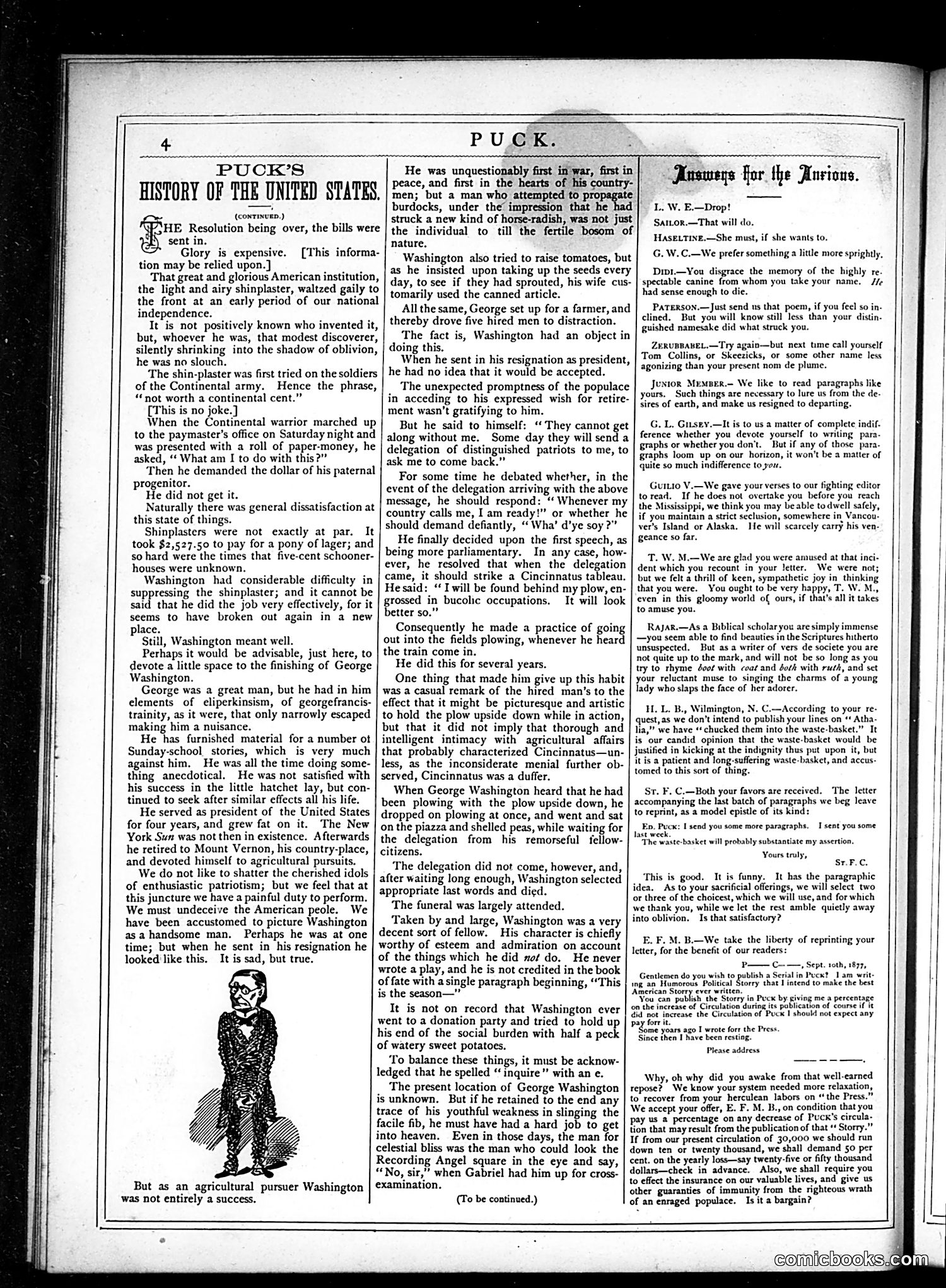
This page contains **"Puck's History of the United States (Continued)"** — a satirical historical article about George Washington's agricultural experiments, particularly his failures as a farmer. The main text mocks Washington's attempt to become a successful farmer after his presidency, describing his unsuccessful efforts growing tomatoes and his comical struggle with plowing (supposedly holding the plow "upside down"). The satire suggests that despite Washington's military and political success, he lacked practical farming knowledge. The right column contains reader responses ("Answers for the Aurious"), addressing various submitted questions on unrelated topics. **The small illustration** (bottom left) appears to be a generic decorative element rather than a specific caricature. The humor relies on textual satire rather than visual commentary.
📄 Transcribed text from this page (OCR, searchable)
Machine-transcribed from the original scan — historical spelling and the odd misread are preserved.
4 PUCK. PUCK’S HISTORY OF THE UNITED STATES. (conTiNuED.) PSHE Resolution being over, the bills were sent in. Glory is expensive. tion may be relied upon.] That great and glorious American institution, the light and airy shinplaster, waltzed gaily to the front at an early period of our national independence. It is not positively known who invented it, but, whoever he was, that modest discoverer, silently shrinking into the shadow of oblivion, he was no slouch. The shin-plaster was first tried on the soldiers of the Continental army. Hence the phrase, “not worth a continental cent.” [This is no joke.] When the Continental warrior marched up to the paymaster’s office on Saturday night and was presented with a roll of paper-money, he asked, ‘‘ What am I to do with this?’ Then he demanded the dollar of his paternal progenitor. He did not get it. Naturally there was general dissatisfaction at this state of things. Shinplasters were not exactly at par. It took $2,527.50 to pay for a pony of lager; and so hard were the times that five-cent schooner- houses were unknown, Washington had considerable difficulty in suppressing the shinplaster; and it cannot be said that he did the job very effectively, for it seems to have broken out again in a new place. Still, Washington meant well. Perhaps it would be advisable, just here, to devote a little space to the finishing of George Washington. George was a great man, but he had in him elements of eliperkinsism, of georgefrancis- trainity, as it were, that only narrowly escaped making him a nuisance. He has furnished material for a number ot Sunday-school_ stories, which is very much against him, He was all the time doing some- thing anecdotical. He was not satisfied with his success in the little hatchet lay, but con- tinued to seek after similar effects all his life. He served as president of the United States for four years, and grew fat on it. The New York Sun was not then in existence. Afterwards he retired to Mount Vernon, his country-place, and devoted himself to agricultural pursuits. We do not like to shatter the cherished idols of enthusiastic patriotism; but we feel that at this juncture we have a painful duty to perform. We must undeceive the American peole. We have been accustomed to picture Washington asahandsome man. Perhaps he was at one time; but when he sent in his resignation he looked like this. It is sad, but true. [This informa- But as an agricultural pursuer Washington was not entirely a success. He was unquestionably first in'war, first in peace, and first in the hearts of his country- men; but a man who astemapted fo propagate burdocks, under the’ impression that he struck a new kind of horse-radish, was not just the individual to till the fertile bosom of nature. Washington also tried to raise tomatoes, but as he insisted upon taking up the seeds every day, to see if they had sprouted, his wife cus- tomarily used the canned article. All the same, George set up for a farmer, and thereby drove five hired men to distraction. ‘The fact is, Washington had an object in doing this. When he sent in his resignation as president, he had no idea that it would be accepted. The unexpected promptness of the populace in acceding to his expressed wish for retire- ment wasn’t gratifying to him. But he said to himself: ‘ They cannot get along without me. Some day they will send 8 delegation of distinguished patriots to me, to ask me to come back.” For some time he debated whether, in the event of the delegation arriving with the above message, he should respond: “ Whenever my country calls me, I am ready!” or whether he should demand defiantly, Wha’ d’ye soy ?” He finally decided upon the first speech, as being more parliamentary. In any case, how- ever, he resolved that when the delegation came, it should strike a Cincinnatus tableau. Hesaid: ‘“ Iwill be found behind my plow, en- rossed in bucolic occupations. It will look etter so.” Consequently he made a practice of goin; out into the fields plowing, whenever he hear the train come in. He did this for several years. One thing that made him give up this habit was a casual remark of the hired man’s to the effect that it might be picturesque and artistic to hold the plow upside down while in action, but that it did not imply that thorough and intelligent intimacy with agricultural affairs that probably characterized Cincinnatus—un- less, as the inconsiderate menial further ob- served, Cincinnatus was a duffer. When George Washington heard that he had been plowing with the plow upside down, he dropped on plowing at once, and went and sat on the piazza and shelled peas, while wai the delegation from his remorseful fellow- citizens. The delegation did not come, however, and, after waiting long enough, Washington selected appropriate last words and died. ‘The funeral was largely attended. ‘Taken by and large, Washington was a very decent sort of fellow. His character is chiefly worthy of esteem and admiration on account of the things which he did of do. He never wrote a play, and he is not credited in the book of fate with a single paragraph beginning, “This is the season—"” It is not on record that Washington ever went to a donation party and tried to hold uy; his end of the social burden with half a peck of watery sweet potatoes, ‘To balance these things, it must be acknow- ledged that he spelled “ inquire” with an e. The present location of George Washington is unknown. But if he retained to the end any trace of his youthful weakness in slinging the facile fib, he must have had a hard job to get into heaven. Even in those days, the man for celestial bliss was the man who could look the Recording Angel square in the eye and say, “No, sir,” when Gabriel had him up for cross- examination. (To be continued.) Answers For the Aueivus. L. W. E.—Drop! SAtLoR.—That will do. HaseLtixe.—She must, if she wants to, G. W.C.—We prefer something a little more sprightly, Dii.—You disgrace the memory of the highly re spectable canine from whom you take your name. //e had sense enough to die. PATERSON.—Just send us that poem, if you feel so in- clined. But you will know still less than your distin. guished namesake did what struck you. ZeRUMBAMEL.—Try again—but next ume call yourself Tom Collins, or Skeezicks, or some other name less agonizing than your present nom de plume. OR MEMBER.— We like to read paragraphs like yours. Such things are necessary to lure us from the de- Sires of earth, and make us resigned to departing. G. L. Guusey.—It is to us a matter of complete indif. ference whether you devote yourself to writing para- graphs or whether you don't. But if any of those para- graphs loom up on our horizon, it won't be a matter of quite so much indifference to you. Gutio V.—We gave your verses to our fighting editor toread. If he does not overtake you before you reach the Mississippi, we think you may be able to dwell safely, if you maintain a strict seclusion, somewhere in. Vancou- ver's Island or Alaska, Ie will scarcely carry his ven- geance so far. T. W, M.—We are glad you were amused at that inci- dent which you recount in your letter. We were not; but we felt a thrill of keen, sympathetic joy in thinking that you were. You ought to be very happy, T. W. M., even in this gloomy world of ours, if that’s all it takes, to amuse you. Rajak.—As a Biblical scholar you are simply immense —you seem able to find beauties in the Scriptures hitherto unsuspected. But as a writer of vers de societe you are not quite up to the mark, and will not be so long as you try to rhyme doof with coat and doth with ruth, and set your reluctant muse to singing the charms of a young lady who slaps the face of her adorer. H. L. B., Wilmington, » According to your re- quest,as we don’t intend to publish your lines on’ Atha- lia,” we have «chucked them into the wastebasket.” It is ‘our candid opinion that the waste-basket would be justified in kicking at the indignity thus put upon it, but it is a patient and long-suffering waste-basket, and accus- tomed to this sort of thing. St. F. C,—Both your favors are received. ‘The letter accompanying the last batch of paragraphs we beg leave to reprint, as a model epistle of its kind: Ep, Pucx: I send you some more paragraphs. last wel ‘The waste-basket will probably substantiate my assertion. Yours truly, sent you some St.F.C. is good. It is funny. It has the paragraphic idea. As to your sacrificial offerings, we will select two or three of the choicest, which we will use, and for which we thank you, while we let the rest amble quietly away into oblivion. Is that satisfactory? ‘Thi E, F. M. B.—We take the liberty of reprinting your letter, for the benefit of our reade P, —, Sept. 10th, 1877, Gentlemen do you wish to publish a Serial in Pec? Tam writ- tng an Humorocs Political Storry that I intend to make the best rican Story cvep wetten on the increase of Circulation during its poblication of course if it Bavpot increase the Circulation of Puck | should not expect any. forr it. P Some yoars ago I wrote forr the Press fe then I have been resting. Please address Why, oh why did you awake from that well-earned repose?" We know your system needed more relaxatio to recover from your herculean labors on “the Press.”” We accept your offer, E. F. M. B., on condition that you pay us a percentage on any decrease of Puck's circula- tion that may result from the publication of that ** Storry.” If from our present circulation of 30,000 we should run down ten or twenty thousand, we shall demand 50 per cent. on the yearly loss—say twenty-five or fifty thousand dollars—check in advance. Also, we shall require you to effect the insurance on our valuable lives, and give us other guaranties of immunity from the righteous wrath of an enraged populace. Is it a bargain? comichooks, com