
Puck, 1877-09-26 · page 6 of 16
Puck — September 26, 1877 — page 6: what you’re looking at
What you’re looking at
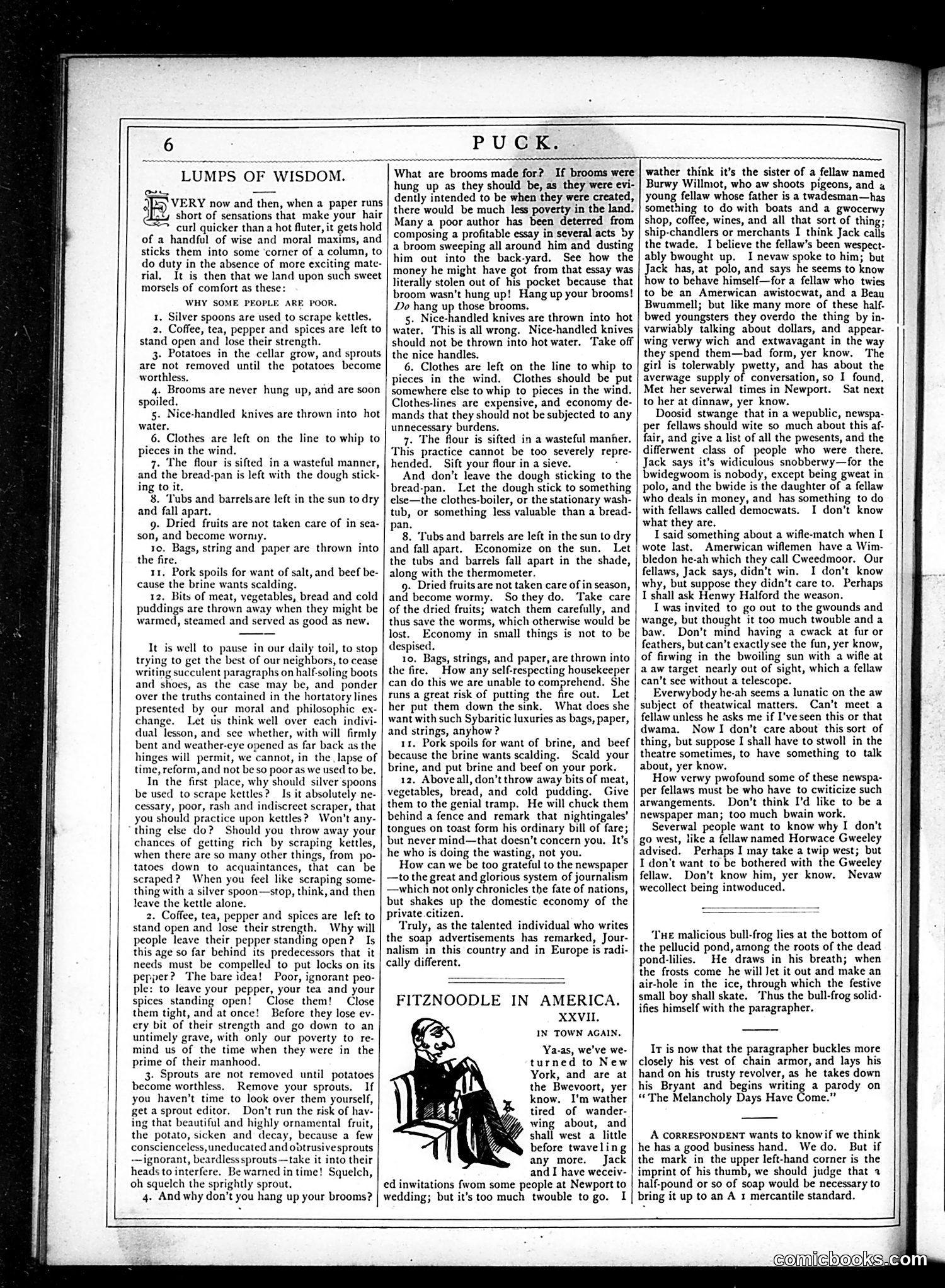
This page contains primarily **household advice columns** rather than political satire. "Lumps of Wisdom" offers practical domestic tips (using silver spoons to scrape kettles, proper clothesline etiquette, food storage methods). The only cartoon visible depicts a figure labeled "Fitznoodle in America" - a small illustration of what appears to be a poorly dressed man or vagrant. The accompanying text suggests this is a **humorous serial character**, describing Fitznoodle's wanderings and complaints about American society, particularly regarding invitations to social events like weddings that prove "too much trouble to go." The satire targets **social pretension and American hospitality norms** rather than specific political figures. This appears to be general entertainment and domestic humor rather than pointed political commentary.
📄 Transcribed text from this page (OCR, searchable)
Machine-transcribed from the original scan — historical spelling and the odd misread are preserved.
LUMPS OF WISDOM. es — VERY now and then, when a paper runs ~4 short of sensations that make your hair > curl quicker than a hot fluter, it gets hold of a handful of wise and moral maxims, and | sticks them into some ‘corner of a column, to do duty in the absence of more exciting mate- rial. It is then that we land upon such sweet morsels of comfort as these: WHY SOME PEOPLE ARE POOR. 1. Silver spoons are used to scrape kettles. 2. Coffee, tea, pepper and spices are left to stand open and lose their strength. 3- Potatoes in the cellar grow, and sprouts are not removed until the potatoes become worthless. 4. Brooms are never hung up, afd are soon spoiled. 5. Nice-handled knives are thrown into hot water, 6. Clothes are left on the line to whip to pieces in the wind. 7. The flour is sifted in a wasteful manner, and the bread-pan is left with the dough stick- ing to it. 8. Tubs and barrelsare left in the sun to dry and fall apart. 9. Dried fruits are not taken care of in sea- son, and become wormy. 1o. Bags, string and paper are thrown into the fire. 11. Pork spoils for want of salt, and beef be- cause the brine wants scalding. 12. Bits of meat, vegetables, bread and cold puddings are thrown away when they might be warmed, steamed and served as good as new. It is well to pause in our daily toil, to stop trying to get the best of our neighbors, to cease writing succulent paragraphs on half-soling boots and shoes, as the case may be, and ponder over the truths contained in the hortatory lines presented by our moral and philosophic ex- change. Let us think well over each indivi- dual lesson, and see whether, with will firmly bent and weather-eye opened as far back as the hinges will permit, we cannot, in the lapse of time, reform, and not be so poor as we used to be. In the first place, why should silver spoons be used to scrape kettles? _Is it absolutely ne- cessary, poor, rash and indiscrect scraper, that you should practice upon kettles? Won't any- thing else do? Should you throw away your chances of getting rich by scraping kettles, when there are so many other things, from po- tatoes down to acquaintances, that can be scraped? When you feel like scraping some- thing with a silver spoon—stop, think, and then leave the kettle alone. 2. Coffee, tea, pepper and spices are left to stand open and lose their strength. Why will people leave their pepper standing open? Is this age so far behind its predecessors that it needs must be compelled to put locks on its pper? The bare idea! Poor, ignorant peo- to leave your pepper, your tea and your s standing open! Close them! Close them tight, and at once! Before they lose ev- ery bit of their strength and go down to an untimely grave, with only our poverty to re- mind us of the time when they were in the prime of their manhood. 3. Sprouts are not removed until potatoes become worthless. Remove your sprouts. If you haven't time to look over them yourself, geta sprout editor. Don’t run the risk of hav- ing that beautiful and highly ornamental fruit, the potato, sicken and decay, because a few consciencciess, uneducated and odtrusivesprouts -—ignorant, beardless sprouts —take it into their heads to interfere. Be warned in time! Squelch, oh squelch the sprightly sprout. 4. And why don’t you hang up your brooms? PUCK. What are brooms made for? If brooms were hung up as they should be, as they were evi- dently intended to be when they were created, there would be much less poverty in the land. Many a poor author has been deterred from composing a profitable essay in several acts by a broom sweeping all around him and dusting him out into the back-yard. See how the money he might have got from that essay was literally stolen out of his pocket because that broom wasn’t hung up! Hang up your brooms! Do hang up those brooms. 5. Nice-handled knives are thrown into hot water. This is all wrong. Nice-handled knives should not be thrown into hot water. Take off the nice handles. 6. Clothes are left on the line to whip to pieces in the wind. Clothes should be put somewhere else to whip to pieces in the wind. Clothes-lines are expensive, and economy de- mands that they should not be subjected to any unnecessary burdens. 7. The flour is sifted in a wasteful manher. This practice cannot be too severely repre- hended. Sift your flour in a sieve. . And don’t leave the dough sticking to the bread-pan. Let the dough stick to something else—the clothes-boiler, or the stationary wash- tub, or something less valuable than a bread- pan, ; 8. Tubs and barrels are left in the sun to dry and fall apart. Economize on the sun. Let the tubs and barrels fall apart in the shade, along with the thermometer. 9. Dried fruits are not taken care of in season, and become wormy. So they do. Take care of the dried fruits; watch them carefully, and thus save the worms, which otherwise would be lost. Economy in small things is not to be despised. 10. Bags, strings, and paper, are thrown into the fire. How any self-respecting housekeeper can do this we are unable to comprehend. She runs a great risk of putting the fire out. Let her put them down the sink. What does she want with such Sybaritic luxuries as bags, paper, and strings, anyhow ? 11. Pork spoils for want of brine, and beef because the brine wants scalding. Scald your brine, and put brine and beef on your pork. 12. Aboveall, don’t throw away bits of meat, vegetables, bread, and cold pudding. Give them to the genial tramp. He will chuck them behind a fence and remark that nightingales’ tongues on toast form his ordinary bill of fare; but never mind—that doesn’t concern you. It’s he who is doing the wasting, not you. How can we be too grateful to the newspaper —to the great and glorious system of journalism —which not only chronicles the fate of nations, but shakes up the domestic economy of the private.citizen. Truly, as the talented individual who writes the soap advertisements has remarked, Jour- nalism in this country and in Europe is radi- cally different. FITZNOODLE IN AMERICA. XXVII. IN TOWN AGAIN. Ya-as, we've we- turned to New York, and are at the Bwevoort, yer know. I'm wather tired of wander- wing about, and shall west a little before twaveling any more. Jack and I have weceiv- ed inwitations fwom some people at Newport to wedding; but it’s too much twouble to go. I wather think it’s the sister of a fellaw named Burwy Willmot, who aw shoots pigeons, and a young fellaw whose father is a twadesman—has something to do with boats and a gwocerwy shop, coffee, wines, and all that sort of thing; ship-chandlers or merchants I think Jack calls the twade. I believe the fellaw’s been wespect- ably bwought up. I nevaw spoke to him; but Jack has, at polo, and says he seems to know how to behave himself—for a fellaw who twies to be an Amerwican awistocwat, and a Beau Bwummell; but like many more of these half- bwed youngsters they overdo the thing by in- varwiably talking about dollars, and appear- wing verwy wich and extwavagant in the way they spend them—bad form, yer know. The girl is tolerwably pwetty, and has about the averwage supply of conversation, so I found. Met her severwal times in Newport. Sat next to her at dinnaw, yer know. Doosid stwange that in a wepublic, newspa- per fellaws should wite so much about this af- fair, and give a list of all the pwesents, and the differwent class of people who were there. Jack says it’s widiculous snobberwy—for the bwidegwoom is nobody, except being gweat in polo, and the bwide is the daughter of a fellaw who deals in money, and has something to do with fellaws called democwats. I don’t know what they are. I said something about a wifle-match when I wote last. Amerwican wiflemen have a Wim- bledon he-ah which they call Cweedmoor. Our fellaws, Jack says, didn’t win. I don’t know why, but suppose they didn’t care to, Perhaps I shall ask Henwy Halford the weason. I was invited to go out to the gwounds and wange, but thought it too much twouble and a baw. ‘Don't mind having a cwack at fur or feathers, but can’t exactly see the fun, yer know, of firwing in the bwoiling sun with a wifle at a aw target nearly out of sight, which a fellaw can’t see without a telescope. Everwybody he-ah seems a lunatic on the aw subject of theatwical matters. Can’t meet a fellaw unless he asks me if I’ve seen this or that dwama. Now I don’t care about this sort of thing, but suppose I shall have to stwoll in the theatre sometimes, to have something to talk about, yer know, How verwy pwofound some of these newspa- per fellaws must be who have to cwiticize such arwangements. Don’t think I'd like to be a newspaper man; too much bwain work. Severwal people want to know why I don’t go west, like a fellaw named Horwace Gweeley advised. Perhaps I may take a twip west; but I don’t want to be bothered with the Gweeley fellaw. Don't know him, yer know. Nevaw wecollect being intwoduced. ‘THe malicious bull-frog lies at the bottom of the pellucid pond, among the roots of the dead pond-lilies. He draws in his breath; when the frosts come he will Jet it out and make an air-hole in the ice, through which the festive small boy shall skate. ‘Thus the bull-frog solid ifies himself with the paragrapher. Ir is now that the paragrapher buckles more closely his vest of chain armor, and lays his hand on his trusty revolver, as he takes down his Bryant and begins writing a parody on “The Melancholy Days Have Come.” A CORRESPONDENT wants to know if we think he has a good business hand. Wedo. But if the mark in the upper left-hand corner is the imprint of his thumb, we should judge that 2 half-pound or so of soap would be necessary to bring it up to an A 1 mercantile standard.