
A complete issue · 16 pages · 1877
Puck — August 22, 1877
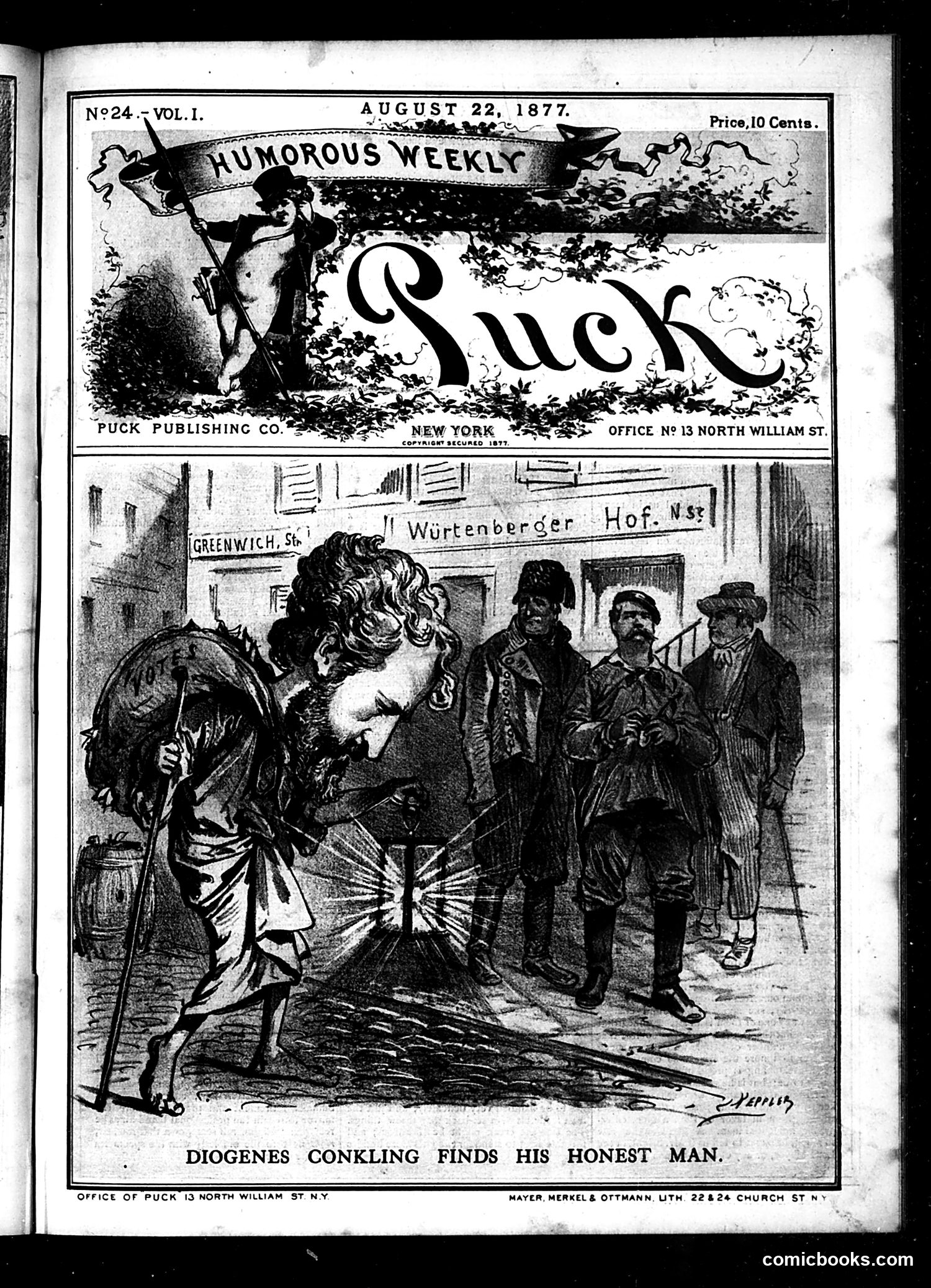
The cartoon depicts "Diogenes Conkling Finds His Honest Man." This is a satirical reference to the ancient Greek philosopher Diogenes, who famously searched with a lantern for an honest man. The figure on the left with the lantern appears to be Roscoe Conkling, a prominent Republican politician of the era. The cartoon suggests that Conkling's search for honesty in politics has been successful—he's found his "honest man" among the various figures gathered outside what appears to be a German hotel in Greenwich Street, New York. The satire likely mocks Conkling's political integrity or reputation, implying that finding an honest man (even among questionable characters) represents a notable achievement during this era of political corruption.
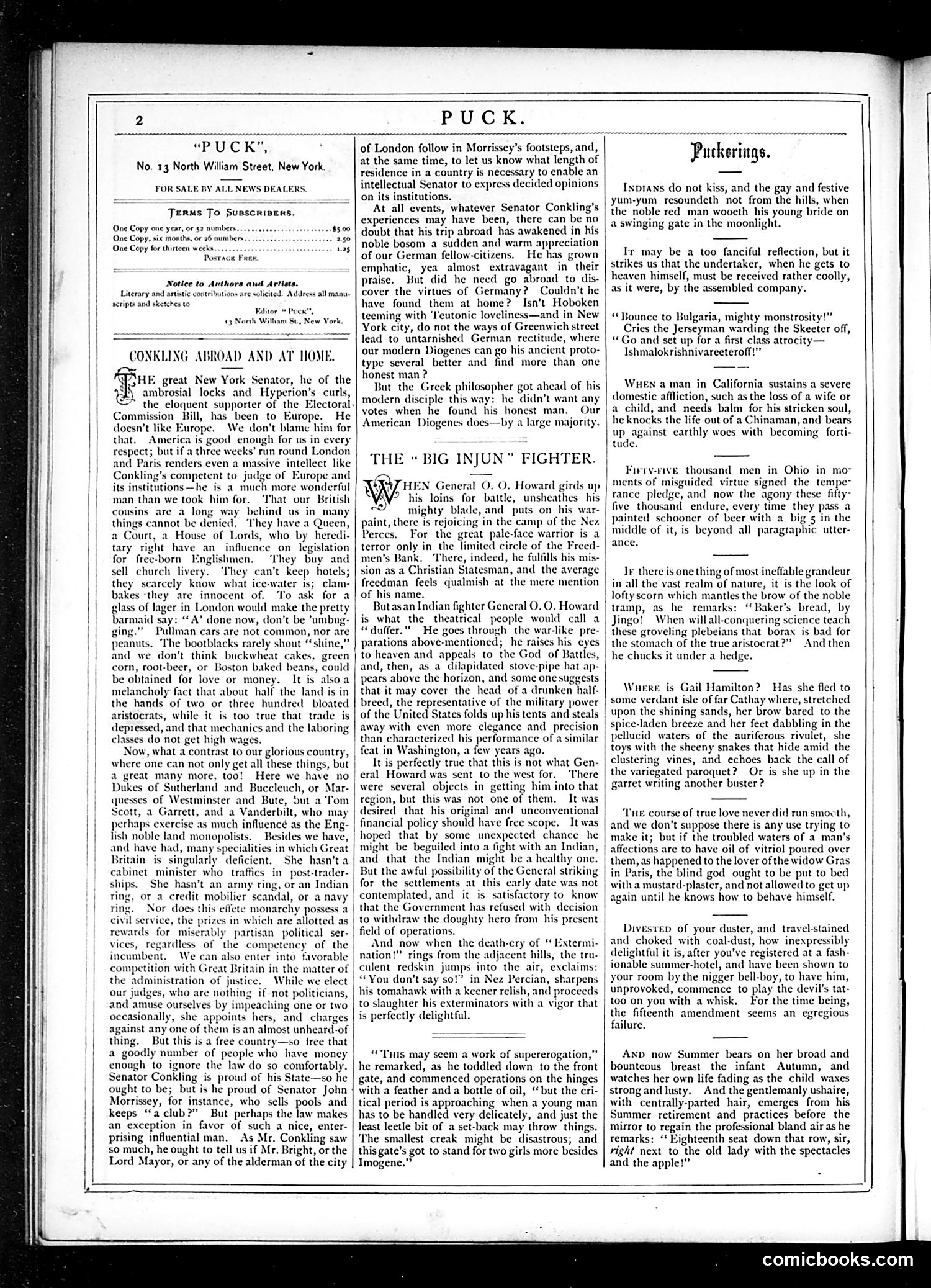
This page contains no political cartoons, only text articles and advertisements. The main content includes: **"Conkling Abroad and at Home"** — a satirical article criticizing Senator Roscoe Conkling (identifiable from context). The piece mocks his pretentious affectations and suggests his time abroad has made him overly enamored with European manners, while questioning his effectiveness as a senator who should represent American interests. **"The 'Big Injun' Fighter"** — commentary on General O. O. Howard, apparently discussing his military conduct and character, though the exact historical reference remains unclear from this excerpt alone. The **"Puckerings"** column offers brief satirical social commentary on various topics including Native Americans, California domestic life, and Ohio virtue. The page functions primarily as editorial commentary rather than visual satire.
This page contains three distinct sections: a advice column ("Dana, the Lover's Friend"), a gossip/intelligence section ("Puck's Personal Intelligence"), and a poem ("A Postal Romance"). The content is primarily **literary and social commentary rather than political cartoons**. "Dana, the Lover's Friend" offers relationship advice to a man uncertain whether to pursue a woman. The "Personal Intelligence" section contains brief satirical remarks about public figures—including O'Donovan Rossa (Irish patriot), General Benson, Carl Schurz, and others—but these are witty jabs rather than illustrated political cartoons. **There are no visible political cartoons on this page.** The humor relies on written satire targeting contemporary personalities and romantic/social situations rather than visual caricature.
This page contains primarily **text content**, not political cartoons. The main article, "A Growing Evil," discusses the dangers of piano practice, particularly how excessive, unstructured practicing by amateur musicians produces cacophonous noise that disturbs households and degrades musical taste. The piece satirizes middle-class domestic life, specifically critiquing the cultural pretension of families who purchase pianos as status symbols without proper musical training. The author argues this "growing evil" corrupts communities and produces wretched music. The right column contains "Answers for the Anxious"—a Q&A advice section addressing readers' concerns about social etiquette, music, and personal matters. This reflects Puck's role as a humor and satire magazine addressing middle-class anxieties of its era.
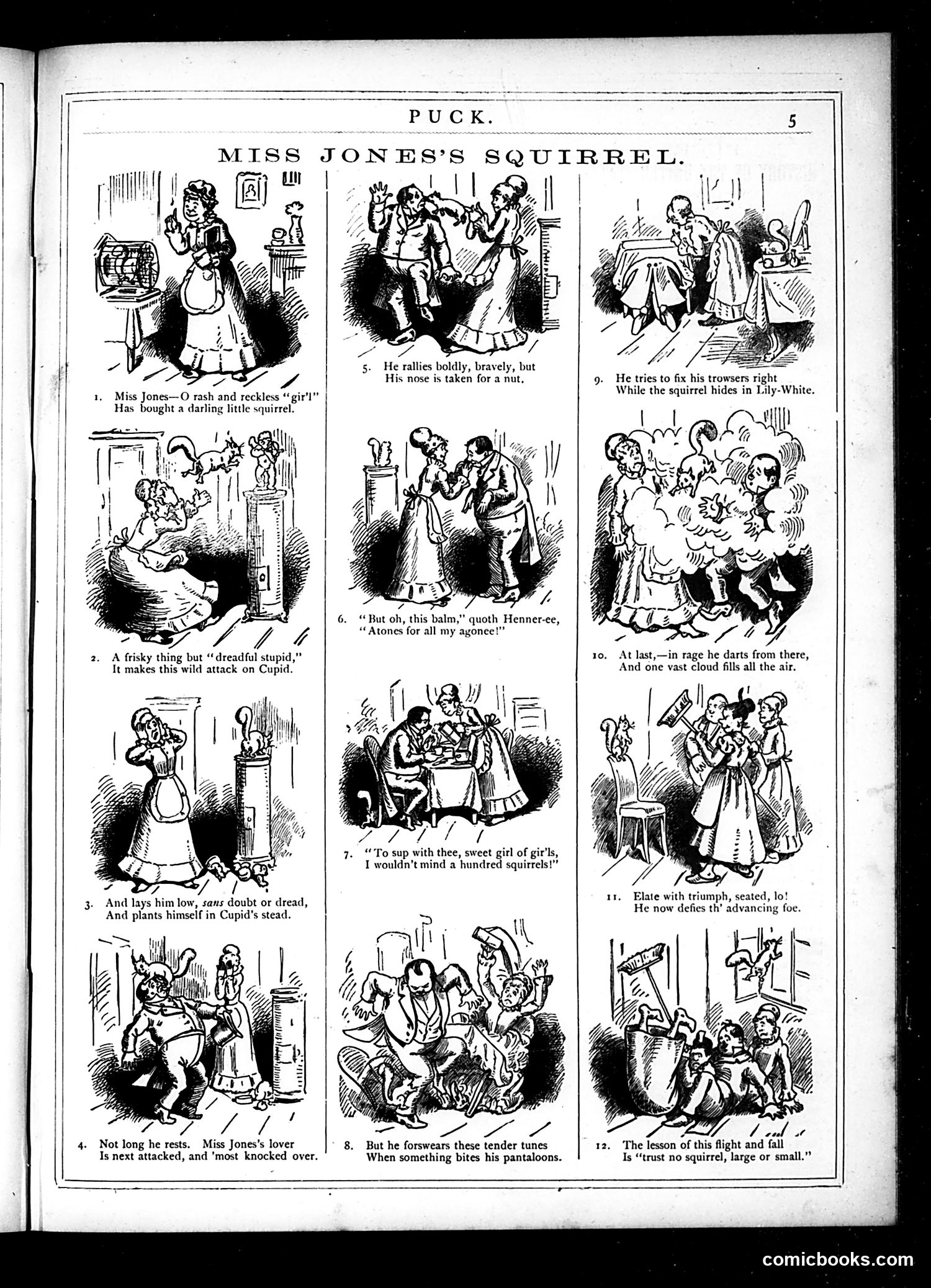
This is a sequential comic strip satirizing a woman named Miss Jones and her pet squirrel. The narrative follows a romantic misadventure: Miss Jones buys a "darling little squirrel" (panel 1), which attacks a man named Cupid—a pun on love interests (panel 2). She knocks down her lover (panel 4), and a man named Henneree attempts to woo her with balm (panel 6). The squirrel hides in her clothing while she pursues a suitor (panel 9), eventually escapes in a chaotic cloud (panel 10), and she triumphantly claims victory (panel 11). The humor relies on wordplay, physical comedy, and the squirrel as a comedic device disrupting romantic pursuits. The strip appears to mock both courting customs and women's unpredictability through exaggerated situations rather than targeting specific political figures or events.
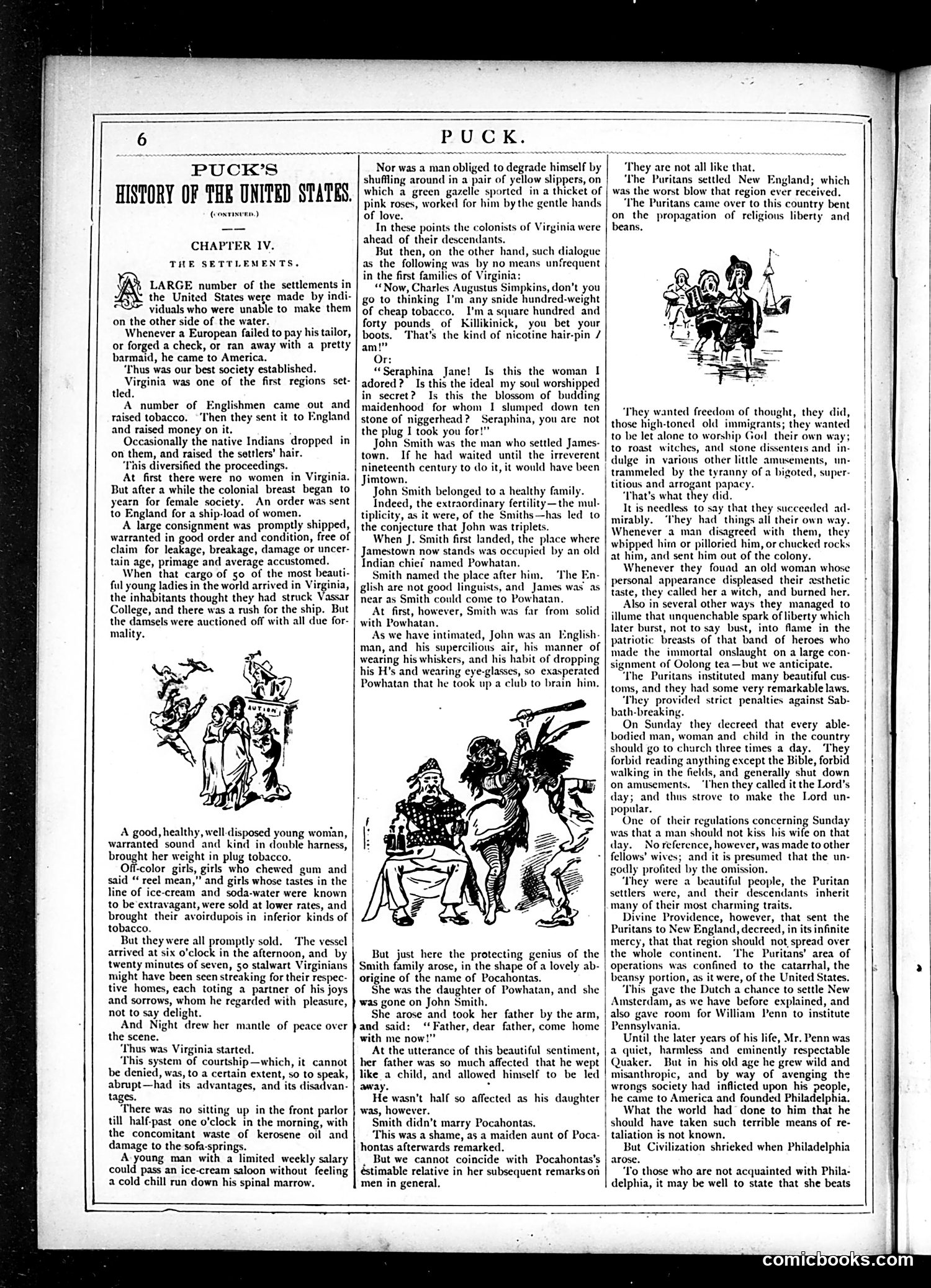
This page is from Puck's "History of the United States," Chapter IV on "The Settlements." The content is primarily **historical narrative text** rather than political satire. It humorously recounts early colonial settlement, including anecdotes about Virginia's John Smith and Pocahontas, the Puritan settlers of New England, and William Penn in Pennsylvania. The small illustrations scattered throughout are decorative vignettes accompanying the historical storytelling—showing colonists, Native Americans, and domestic scenes—rather than pointed political cartoons. The satirical humor is gentle and retrospective: Puck mocks the Puritans' rigid moralism and the colonists' various character quirks, but this is **antiquarian humor** about 17th-century history rather than commentary on contemporary (late 19th-century) politics. The page functions as illustrated history with comedic flourishes rather than as political satire.
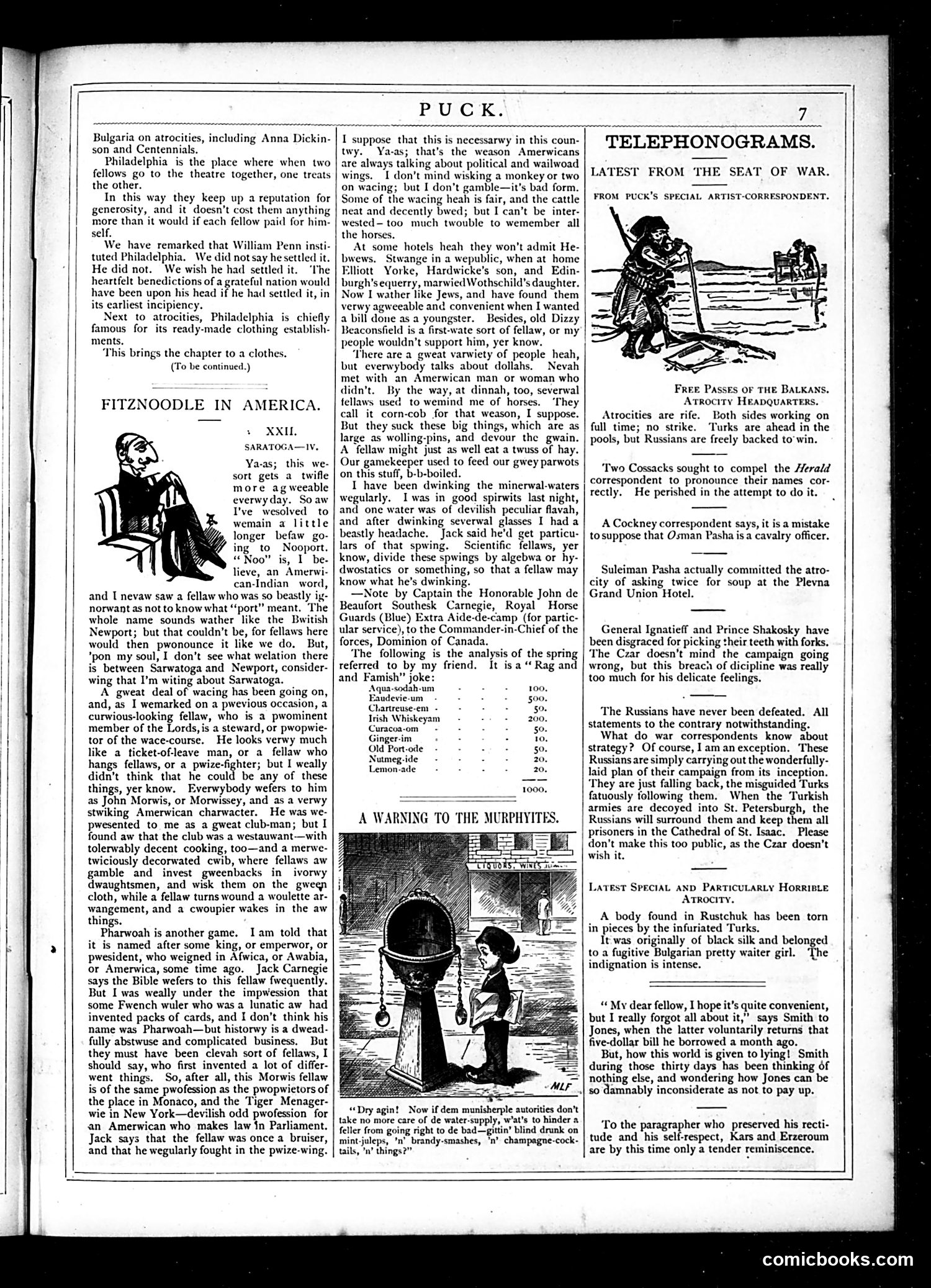
This page contains two main sections: **"Fitznoodle in America" (left):** A serialized humorous travelogue where the narrator describes American customs to British readers—hotel practices, drinking habits, gambling, and social eccentricities. The satire mocks both American behavior and British attitudes toward it. **"Telephonograms" (right):** Brief dispatches from war correspondents covering the Russo-Turkish War. These mock military reporting and include anecdotes about cavalry officers, atrocities, and supply issues. One item humorously corrects a correspondent's mistaken identification of "Osman Pasha" as cavalry rather than infantry. **"A Warning to the Murphyites" (bottom):** An illustrated cautionary tale about a con artist's trick. The image shows a street swindle scenario, with accompanying verse warning against such deception. The page satirizes American culture, military incompetence, and urban crime through humor.
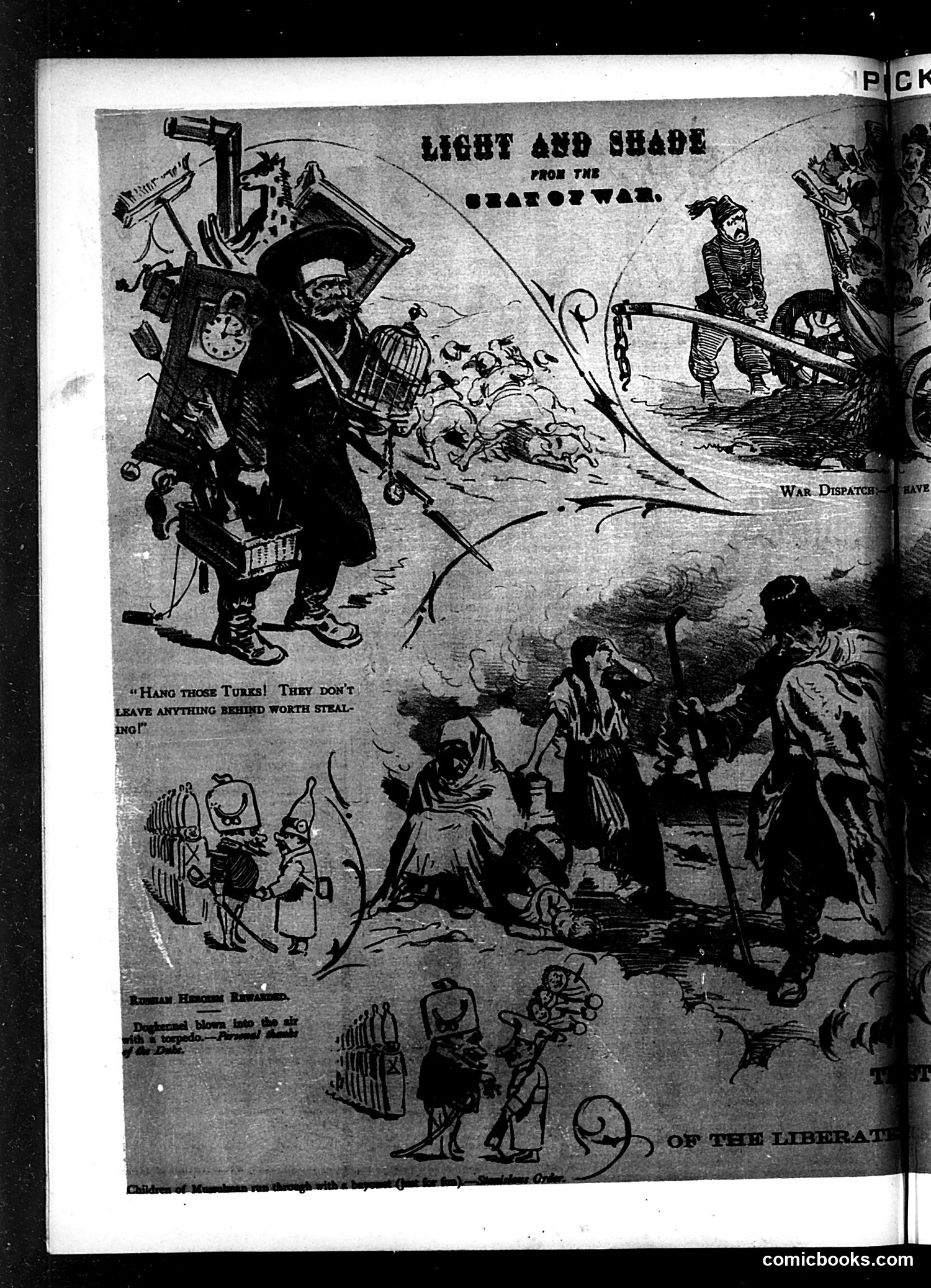
This political cartoon satirizes the treatment of Turkish forces during a military conflict. The central figure appears to be a Turkish officer or leader, depicted with exaggerated caricatured features typical of period anti-Turkish propaganda. The quote "Hang those Turks! They don't leave anything behind worth stealing!" suggests commentary on plundering and wartime destruction. Multiple panels show Turkish soldiers and civilians in various states, likely depicting aftermath or displacement. The bottom panels labeled "Of the Liberation" appear ironic, questioning whether the depicted scenes truly represent liberation. The cartoon reflects Western attitudes toward Ottoman/Turkish forces during what the title indicates is a specific conflict—likely the Balkan Wars or WWI era—using satirical commentary on war crimes and military conduct to shape public opinion.
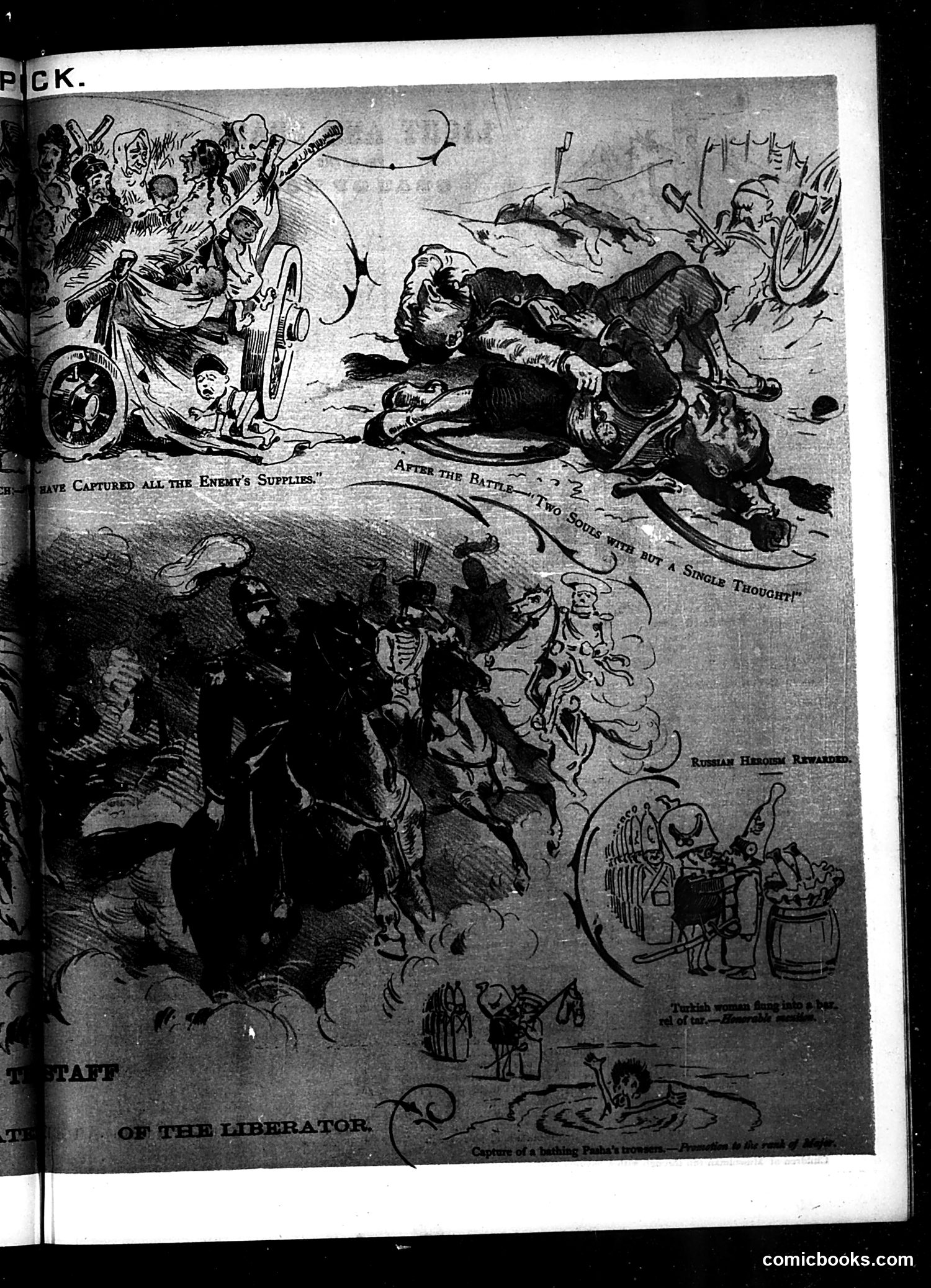
This Puck page contains war-themed satirical cartoons, likely from World War I era. The top panel shows "We Have Captured All the Enemy's Supplies" contrasted with "After the Battle—Two Sides with Not a Single Thought," depicting the contrast between military victory and psychological/moral exhaustion. The middle section titled "Russian Heroism Rewarded" appears to satirize Russian military leadership or political figures receiving honors despite battlefield conditions. The bottom section "Staff of the Liberator" likely references military command structure, possibly critiquing leadership decisions. The heavy use of skeletal imagery and fallen soldiers suggests dark commentary on war's human cost versus official propaganda about supplies and heroism. The cartoons appear skeptical of military narratives, emphasizing suffering over glorious victory—typical Puck satirical stance.
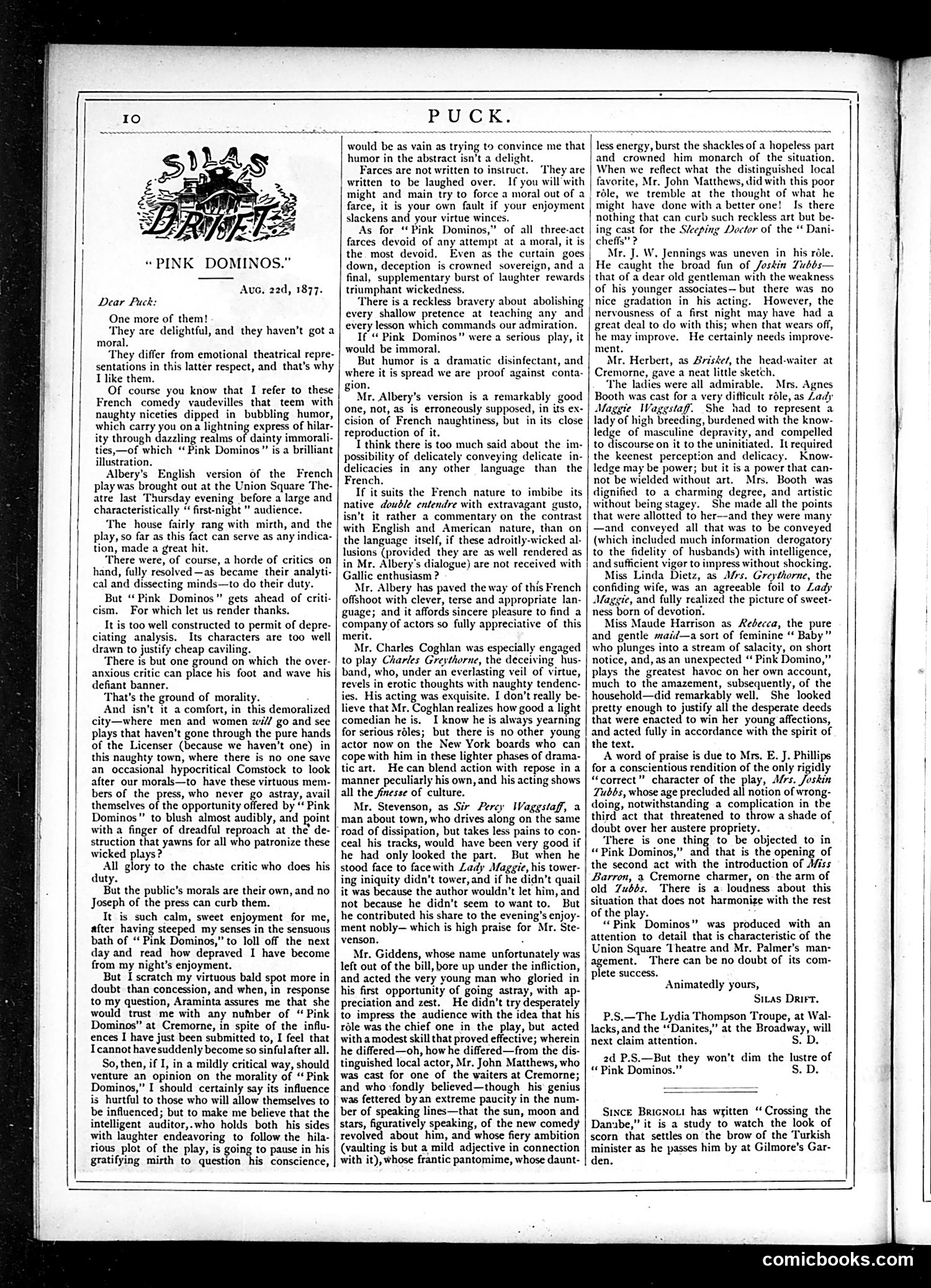
This page contains a theatrical review, not a political cartoon. The header illustration shows a silhouetted figure in dramatic pose. The lengthy letter critiques a three-act French farce called "Pink Dominos," praising its entertainment value while debating whether it contains sufficient moral instruction. The reviewer argues farces needn't have morals to succeed and praises the cast performances—particularly Mr. Albury's French rendition and Mr. Charles Coghan's comic acting. The piece reflects 19th-century theater criticism standards, where reviewers seriously considered whether entertainment should serve moral purposes. The tone is witty and sophisticated, typical of Puck's cultural commentary, though aimed at theatrical rather than political satire.
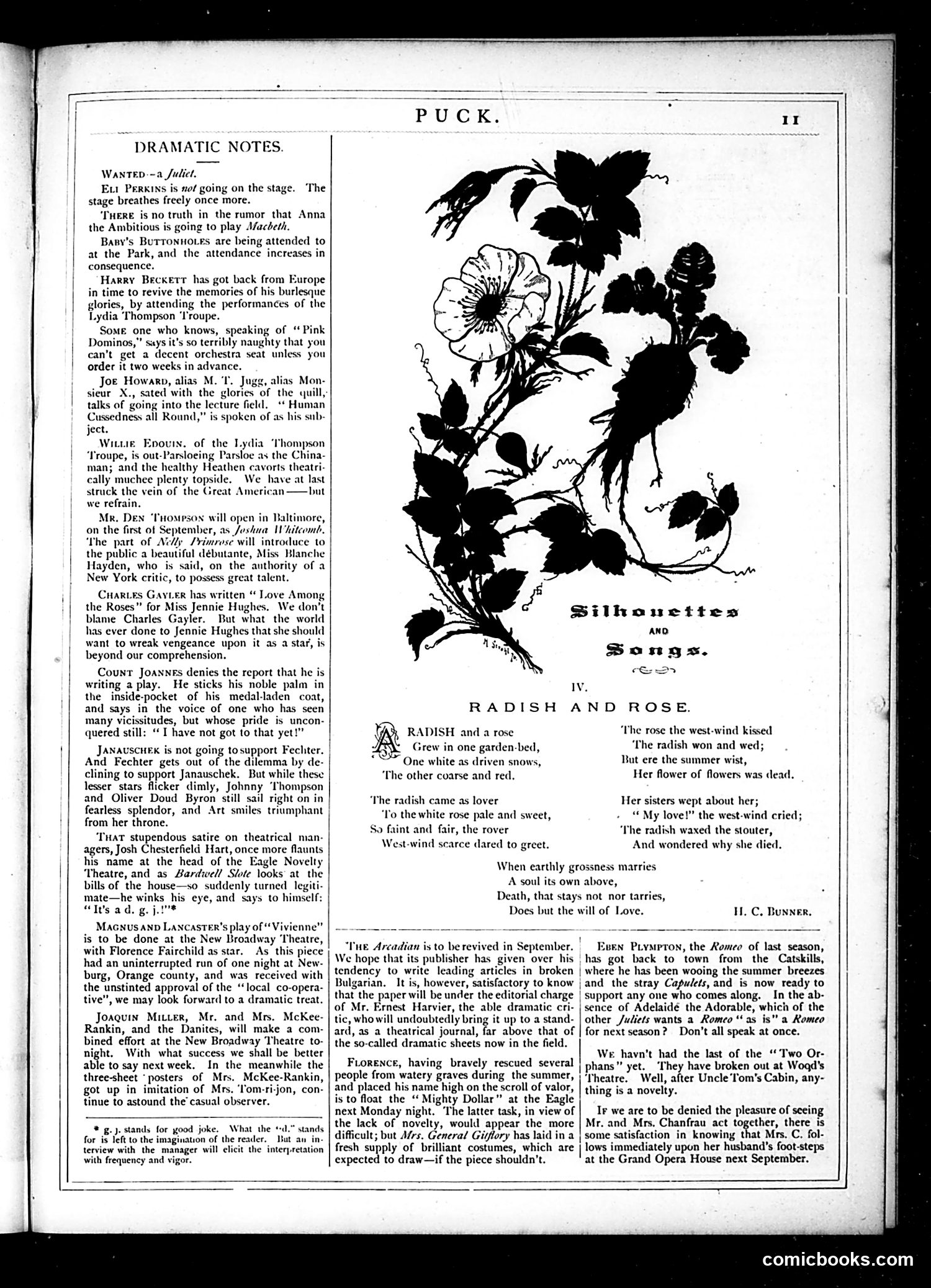
This page is primarily **theatrical gossip and drama criticism** rather than political satire. The left column contains "Dramatic Notes" discussing contemporary theater personalities and productions (Harry Beckett, Willie Dodds, Charles Gayler, among others). The main illustrated content is a romantic poem titled "Radish and Rose" (IV), accompanied by an Art Nouveau-style botanical silhouette illustration of flowers. The poem contrasts two lovers—one "white as driven snows" and "coarse and red," the other "pale and sweet"—with the rose ultimately dying. The page serves as entertainment commentary and literary content rather than political commentary. It reflects Puck's broader cultural coverage beyond satire.
This page contains the continuation of a serialized story titled "Two Knaves and a Queen" by Frank Barrett, presented as text fiction rather than as a cartoon or comic strip. The narrative follows Tom Reynolds and Mattie Biron, who appear to be romantically involved characters dealing with personal complications. The text depicts their emotional interactions—Mattie's joy at seeing Tom, their physical affection, and Tom's internal conflict about his circumstances. The dialogue reveals period social concerns: financial struggles, marital propriety, and class considerations. References to "eighteen shillings" and domestic duties suggest Victorian-era working-class life. This is **not a political cartoon or satirical visual content**—it's serialized fiction using Puck magazine's pages as a publishing platform, common for 19th-century periodicals that mixed satirical cartoons with literary content.
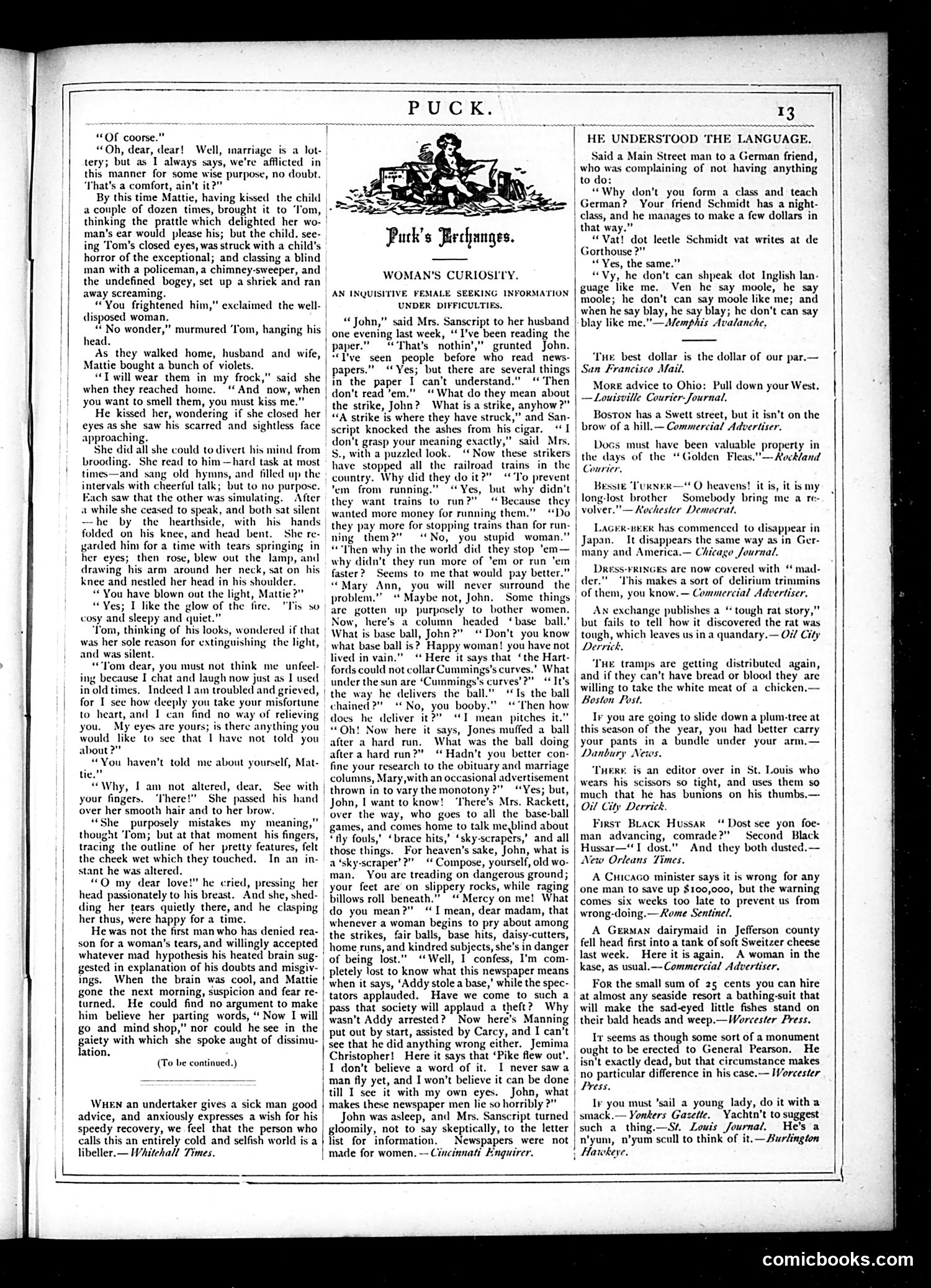
This page contains "Puck's Pertinges" — a humor column mixing short jokes and satirical observations rather than a political cartoon. The content addresses social issues of the era: women's curiosity about newspapers, marital dynamics, labor strikes (mentioned regarding railroad workers), and ethnic stereotypes (German and English characters). One recurring theme mocks women for reading newspapers despite supposedly not understanding complex topics like strikes and "base ball." Another jokes about German immigrants' accented English. The column also includes brief items satirizing small-town life, undertakers' opportunism, and newspaper editors' practices. Without identifying specific historical figures, the humor reflects turn-of-the-century American attitudes toward gender roles, labor unrest, immigration, and social class — typical of Puck's satirical approach to contemporary life.
This page is primarily **advertising and miscellaneous content** rather than political cartoons. The main elements include: **Advertisements:** - Gaff, Fleischmann & Co.'s Compressed Yeast (with product image) - Fredk H. Levey & Co. (Black and Colored Printing Inks) - Dix, Dietz (Pamphlet & Book Binder) **Puck-Related Notices:** - Patent covers for filing Puck ($1.00 each) - Back numbers availability information **Left column content:** Brief humorous anecdotes and observations on various topics (snake bites, whiskey, newspaper work, etc.)—typical Puck filler material meant to entertain readers between major satirical pieces. The page lacks significant political commentary or identifiable caricatures. It represents the commercial and transitional space within the magazine between featured articles.
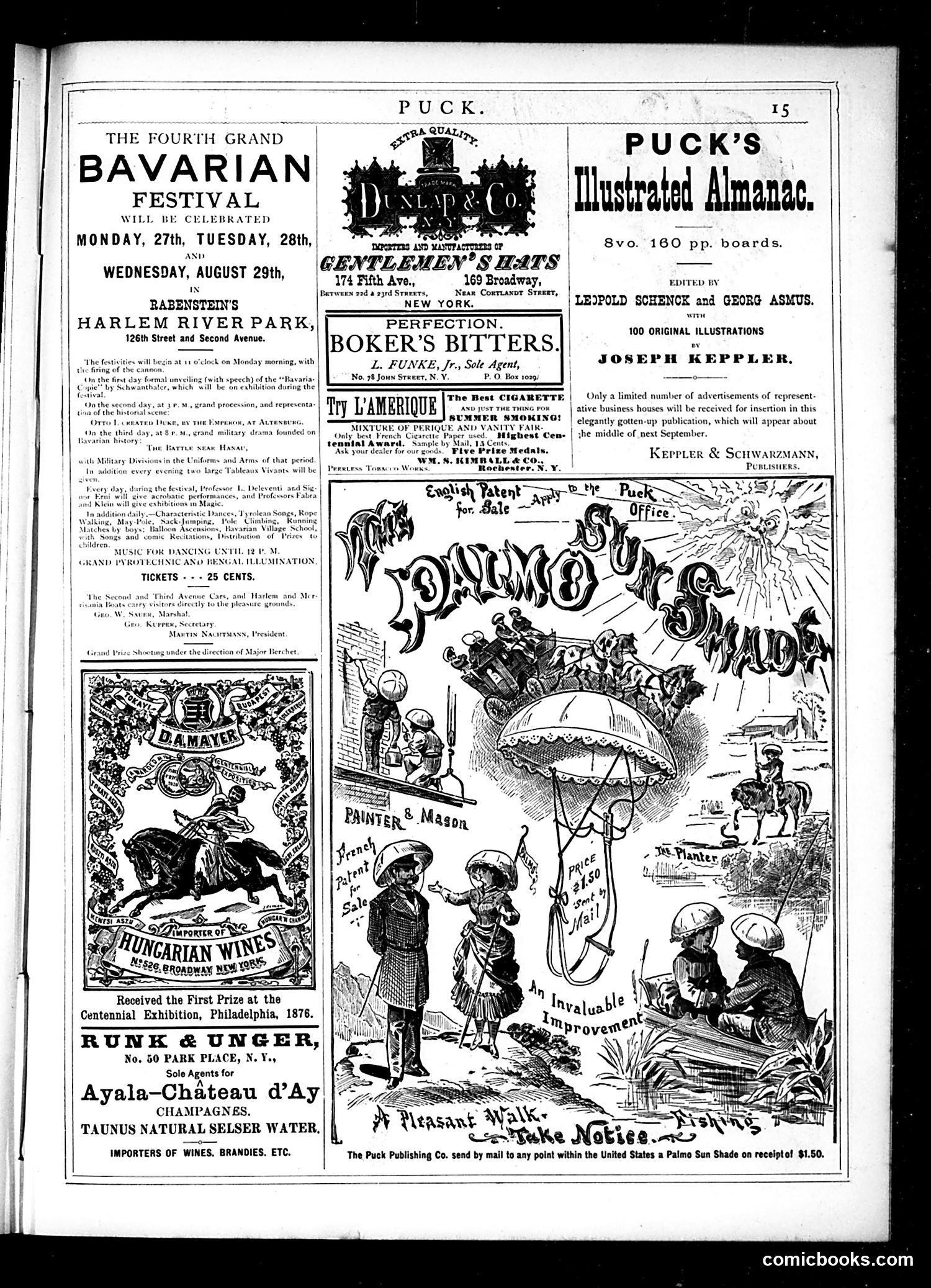
This page is primarily **advertising and promotional content** rather than political satire. The left column features advertisements for Hungarian wines (Runk & Unger), gentlemen's hats (Dunlap & Co.), and other commercial products. The upper right advertises Puck's own "Illustrated Almanac." The largest image—a elaborate engraving titled "Boomerang"—appears to be a fantastical illustration advertising a patent or product, featuring people, machinery, and whimsical elements in a chaotic scene. Text references "English Patent for Sale" and "Puck Office." Below are smaller domestic vignettes showing children with umbrellas and people outdoors, captioned with what appears to be humorous observations ("At Pleasant Walk," "Lake Notices"). The page demonstrates how 19th-century magazines integrated advertising with editorial content and illustrations.
This Puck magazine cartoon satirizes what appears to be political corruption or self-serving behavior among Nazi figures. The title references "pork" (slang for wasteful government spending or corrupt patronage) among Nazi leadership. The image depicts caricatured figures in military/Nazi uniforms engaged in violent or chaotic behavior, with smaller figures below them. This suggests commentary on how Nazi leaders enriched themselves or engaged in corrupt practices while claiming ideological purity. Without clearer identification of specific individuals or a precise date, the exact political moment remains uncertain. However, the satire clearly mocks hypocrisy within Nazi ranks—the contrast between their rhetoric and actual conduct regarding personal gain and power distribution.