
Puck, 1877-08-22 · page 6 of 16
Puck — August 22, 1877 — page 6: what you’re looking at
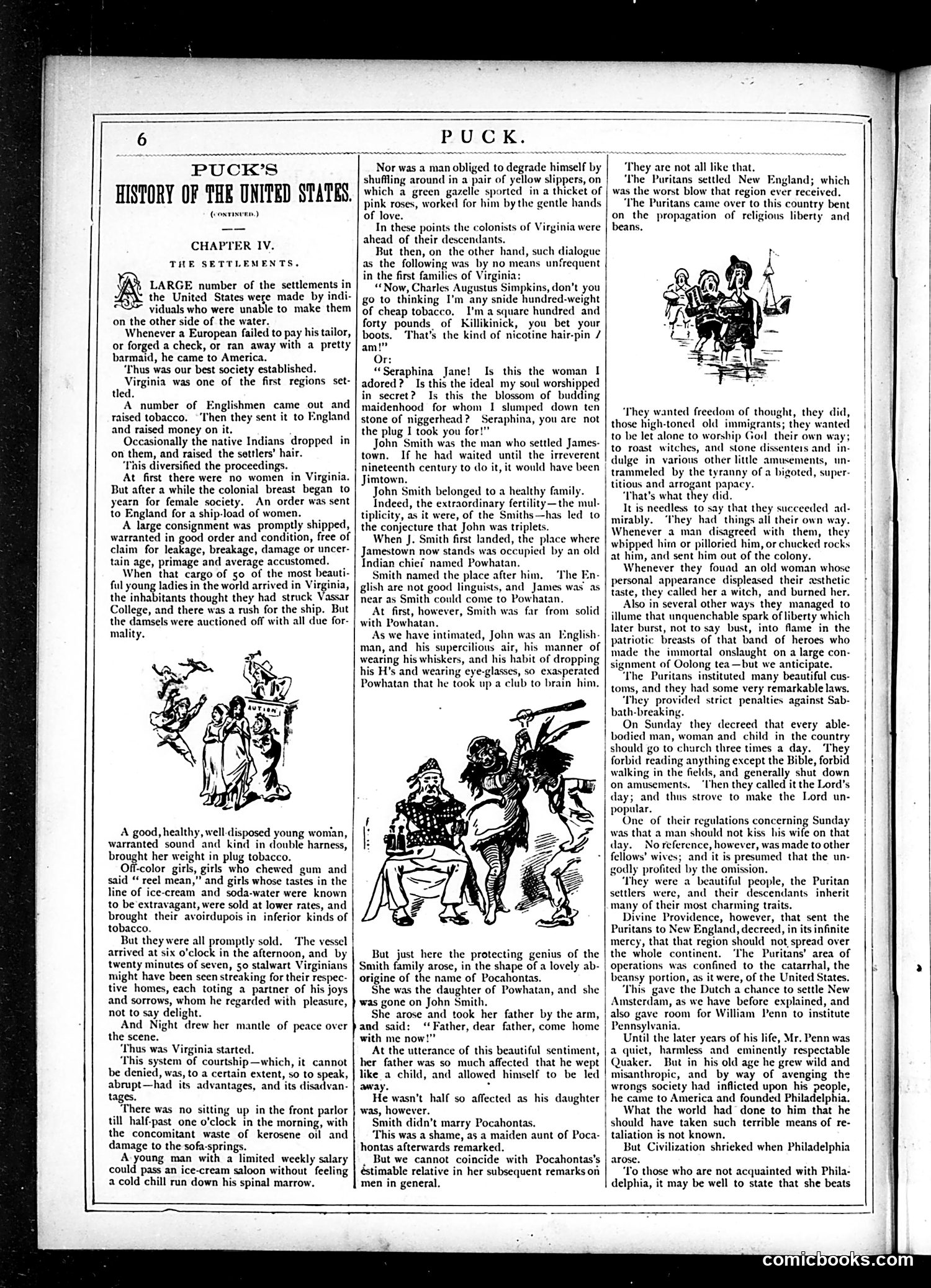
What you’re looking at
This page is from Puck's "History of the United States," Chapter IV on "The Settlements." The content is primarily **historical narrative text** rather than political satire. It humorously recounts early colonial settlement, including anecdotes about Virginia's John Smith and Pocahontas, the Puritan settlers of New England, and William Penn in Pennsylvania. The small illustrations scattered throughout are decorative vignettes accompanying the historical storytelling—showing colonists, Native Americans, and domestic scenes—rather than pointed political cartoons. The satirical humor is gentle and retrospective: Puck mocks the Puritans' rigid moralism and the colonists' various character quirks, but this is **antiquarian humor** about 17th-century history rather than commentary on contemporary (late 19th-century) politics. The page functions as illustrated history with comedic flourishes rather than as political satire.
📄 Transcribed text from this page (OCR, searchable)
Machine-transcribed from the original scan — historical spelling and the odd misread are preserved.
PUCK’S HISTORY OF THE UNITED STATES. CONTINUED.) CHAPTER IV. THE SETTLEMENTS, LARGE number of the settlements in the United States were made by indi- < viduals who were unable to make them on the other side of the water. Whenever a European failed to pay his tailor, or forged a check, or ran away with a pretty barmaid, he came to America. ‘Thus was our best society established. Virginia was one of the first regions set- tled. A number of Englishmen came out and raised tobacco. ‘Then they sent it to England and raised money on Occasionally the native Indians dropped in on them, and raised the settlers’ hair. ‘This diversified the proceedings. At first there were no women in Virginia. But after a while the colonial breast began to yearn for female society. An order was sent to England for a ship-load of women. A large consignment was promptly shipped, warranted in good order and condition, free of claim for leakage, breakage, damage or uncer- tain age, primage and average accustomed. When that cargo of 50 of the most beauti- ful young ladies in the world arrived in Virginia, the inhabitants thought they had struck Vassar College, and there was a rush for the ship. But the damsels were auctioned off with all due for- mality. warranted sound and kind in double harness, brought her weight in plug tobacco. Oft-color girls, girls who chewed gum and said “ reel mean,” and girls whose tastes in the line of ice-cream and soda-water were known to be extravagant, were sold at lower rates, and brought their avoirdupois in inferior kinds of tobacco. But they were all promptly sold. ‘The vessel arrived at six o'clock in the afternoon, and by twenty minutes of seven, so stalwart Virginians might have been seen streaking for their respec- tive homes, each toting a partner of his joys and sorrows, whom he regarded with pleasure, not to say delight. And Night drew her mantle of peace over the scene. ‘Thus was Virginia started. ‘This system of courtship—which, it cannot be denied, was, to a certain extent, so to speak, abrupt—had its advantages, and its disadvan- tages. ‘There was no sitting up in the front parlor till half-past_ one o'clock in the morning, with the concomitant waste of kerosene oil and damage to the sofa-springs. A-young man with a limited weekly salary could pass an ice-cream saloon without feeling A good, healthy, well-disposed young wonian, | PUCK. Nor was a man obliged to degrade himself by shuffling around in a pair of yellow slippers, on which a green gazelle sported ina thicket of pink roses, worked for him by the gentle hands of love. In these points the colonists of Virginia were ahead of their descendants. But then, on the other hand, such dialogue as the following was by no means unfrequent in the first families of Virginia “Now, Charles Augustus Simpkins, don’t you go to thinking I’m any snide hundred-weight of cheap tobacco. I’m a square hundred and forty pounds. of Killikinick, you bet your boots. That's the kind of nicotine hair-pin 7 Or: “Seraphina Jane! Is this the woman I adored? _Is this the ideal my soul worshipped in secret? Is this the blossom of budding maidenhood for whom I slumped down ten stone of niggerhead? Seraphina, you are not the plug I took you for!” John Smith was the man who settled James- town. If he had waited until the irreverent nineteenth century to do it, it would have been | Jimtow: John Smith belonged to a healthy family. Indeed, the extraordinary fertility—the mul- tiplicity, as it were, of the Smiths—has led to the conjecture that John was triplets. When J. Smith first landed, the place where Jamestown now stands was occupied by an old Indian chief named Powhatan. Smith named the place after him.‘ - glish are not good linguists, and James was as near as Smith could come to Powhatan. At first, however, Smith was far from. solid with Powhatan. As we have intimated, John was an English- man, and his supercilious air, his manner of wearing his whiskers, and his habit of dropping his H’s and wearing eye-glasses, so exasperated Powhatan that he took up a club to brain him. But just here the protecting genius of the Smith family arose, in the shape of a lovely ab- origine of the name of Pocahontas. She was the daughter of Powhatan, and she | was gone on John Smith. She arose and took her father by the arm, and said: ‘‘Father, dear father, come home with me now!” At the utterance of this beautiful sentiment, her father was so much affected that he wept like a child, and allowed himself to be led away. : He wasn’t half so affected as his daughter was, however. Smith didn’t marry Pocahontas, ‘This was a shame, as a maiden aunt of Poca- | hontas afterwards remarked. But we cannot coincide with Pocahontas's éstimable relative in her subsequent remarks on men in general. ‘They are not all like that. ‘The Puritans settled New England; which was the worst blow that region ever received. ‘The Puritans came over to this country bent on the propagation of religious liberty and beans, ‘They wanted freedom of thought, they did, those high-toned old immigrants; they wanted to be let alone to worship God_ their own way; to roast witches, and stone dissenters and in- dulge in various other little amusements, un- trammeled_ by the tyranny of a bigoted, super us and arrogant papacy. hat’s what they did. It is needless to say that they succeeded ad- mirably. ‘They had things all their own way. Whenever a man disagreed with them, they whipped hirn or pilloried him, or chucked rocks at him, and sent him out of the colony. Whenever they found an old woman whose personal appearance displeased their wsthetic taste, they called her a witch, and burned her. Also in several other ways they managed to illume that unquenchable spark of liberty which later burst, not to say bust, into flame in the patriotic breasts of that band of heroes who made the immortal onslaught on a large con- signment of Oolong tea —but we anticipate. ‘The Puritans instituted many beautiful cus- toms, and they had some very remarkable laws. ‘They provided strict penalties against Sab- bath-breakit On Sunday they decreed that every able- bodied man, woman and child in the country should go to church three times a day. They forbid reading anything except the Bible, forbid walking in the fields, and generally shut down on amusements. ‘Then they called it the Lord’s day; and thus strove to make the Lord un- popular. One of their regulations concerning Sunday was that a man should not kiss his wife on that day. No reference, however, was made to other fellows’ wives; and it is presumed that the un- godly profited by the omission, ‘They were a beautiful people, the Puritan settlers were, and their descendants inherit many of their most charming traits. Divine Providence, however, that sent the Puritans to New England, decreed, in its infi mercy, that that region should not, spread over the whole continent. ‘he Puritans’ area of operations was confined to the catarrhal, the beansy portion, as it were, of the United States. ‘This gave the Dutch a chance to settle New Amsterdam, as we have before explained, and also gave room for William Penn to institute Pennsylvania. Until the later years of his life, Mr. Penn was jet, harmless and eminently respectable But in_ his old age he grew wild and misanthropic, and by way of avenging the wrongs society had inflicted upon his people, he came to America and founded Philadelphia. What the world had done to him that he should have taken such terrible means of re- taliation is not known, But Civilization shrieked when Philadelphia arose. ‘To those who are not acquainted with Phila- delphia, it may be well to state that she beats je cold chill run down his spinal marrow.