
Puck, 1877-08-22 · page 4 of 16
Puck — August 22, 1877 — page 4: what you’re looking at
What you’re looking at
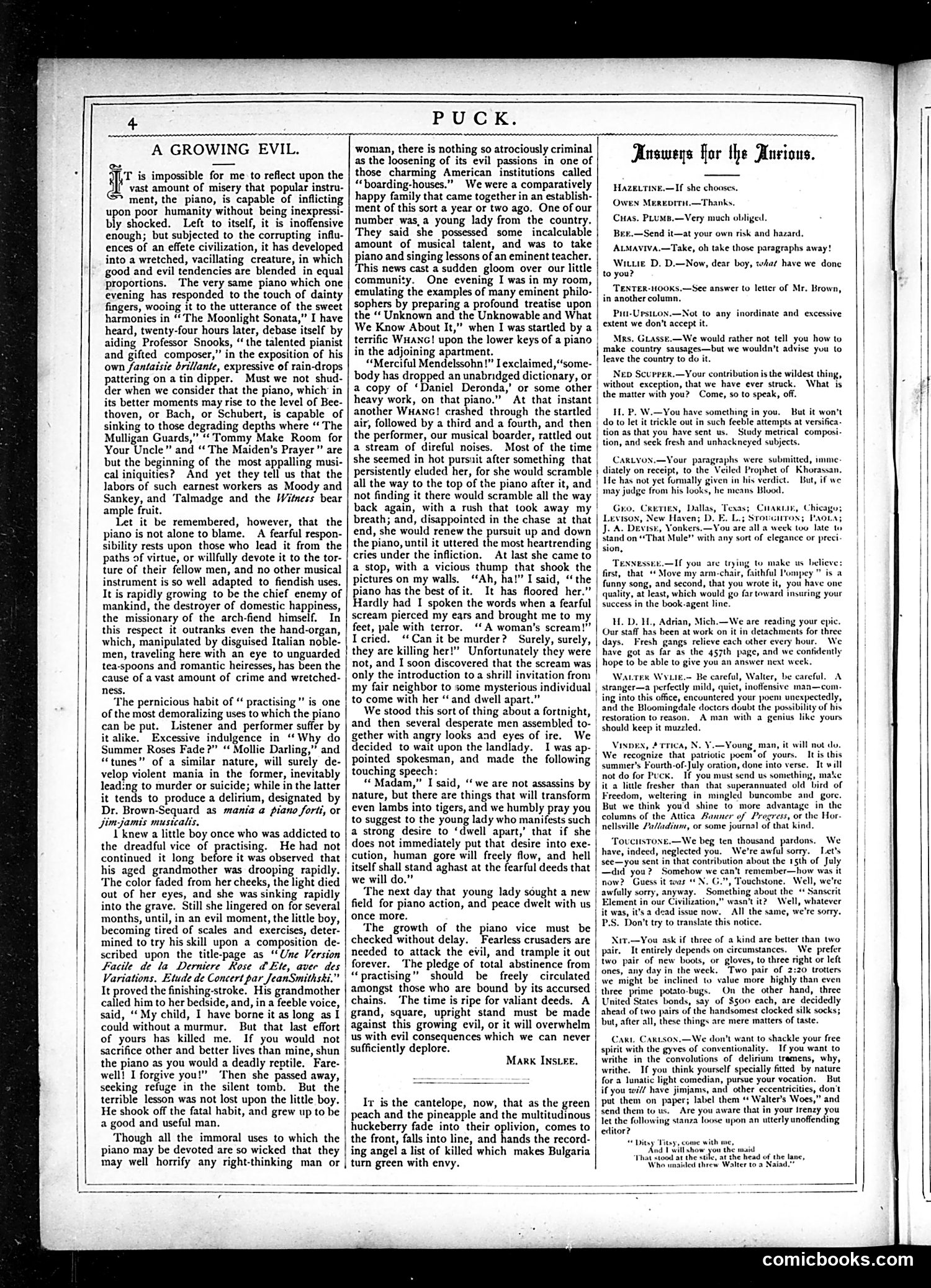
This page contains primarily **text content**, not political cartoons. The main article, "A Growing Evil," discusses the dangers of piano practice, particularly how excessive, unstructured practicing by amateur musicians produces cacophonous noise that disturbs households and degrades musical taste. The piece satirizes middle-class domestic life, specifically critiquing the cultural pretension of families who purchase pianos as status symbols without proper musical training. The author argues this "growing evil" corrupts communities and produces wretched music. The right column contains "Answers for the Anxious"—a Q&A advice section addressing readers' concerns about social etiquette, music, and personal matters. This reflects Puck's role as a humor and satire magazine addressing middle-class anxieties of its era.
📄 Transcribed text from this page (OCR, searchable)
Machine-transcribed from the original scan — historical spelling and the odd misread are preserved.
PUCK. A GROWING EVIL. cn — 'T is impossible for me to reflect upon the vast amount of misery that popular instru- ment, the piano, is capable of inflicting upon poor humanity without being inexpressi- tly shocked. Left to itself, it is inoffensive enough; but subjected to the corrupting influ- ences of an effete civilization, it has developed into a wretched, vacillating creature, in which good and evil tendencies are blended in equal proportions. The very same piano which one evening has responded to the touch of dainty fingers, wooing it to the utterance of the sweet harmonies in “The Moonlight Sonata,” I have heard, twenty-four hours later, debase itself by aiding Professor Snooks, ‘‘ the talented pianist and gifted composer,” in the exposition of his own fantaisie brillante, expressive of rain-drops pattering on atin dipper. Must we not shud- der when we consider that the piano, which in its better moments may rise to the level of Bee- thoven, or Bach, or Schubert, is capable of sinking to those degrading depths where “ The Mulligan Guards,” “Tommy Make Room for Your Uncle” and “‘ The Maiden’s Prayer” are but the beginning of the most appalling musi- cal iniquities? And yet they tell us that the labors of such earnest workers as Moody and Sankey, and Talmadge and the Witness bear ample fruit. Let it be remembered, however, that the piano is not alone to blame. A fearful respon- sibility rests upon those who lead it from the paths of virtue, or willfully devote it to the tor- ture of their fellow men, and no other musical instrument is so well adapted to fiendish uses. It is rapidly growing to be the chief enemy of mankind, the destroyer of domestic happiness, the missionary of the arch-fiend himself. In this respect it outranks even the hand-organ, which, manipulated by disguised Italian noble- men, traveling here with an eye to unguarded tea-spoons and romantic heiresses, has been the cause of a vast amount of crime and wretched- ness. The pernicious habit of “ practising” is one of the most demoralizing uses to which the piano can be put. Listener and performer suffer by it alike. Excessive indulgence in “Why do Summer Roses Fade?” “ Mollie Darling,” and “tunes” of a similar nature, will surely de- velop violent mania in the former, inevitably leading to murder or suicide; while in the latter it tends to produce a delirium, designated by Dr. Brown-Sequard as mania a piano forti, or jimjamis musicals, 1 knew a little boy once who was addicted to the dreadful vice of practising. He had not continued it long before it was observed that his aged grandmother was drooping rapidly. The color faded from her cheeks, the light died out of her eyes, and she was sinking rapidly into the grave. Still she lingered on for several months, until, in an evil moment, the little boy, becoming tired of scales and exercises, deter- mined to try his skill upon a composition de- scribed upon the title-page as “Une Version Facile de la Derniere Rose @Ete, avec des Variations. Etude de Concert par JeanSmithski.” It proved the finishing-stroke. His grandmother called him to her bedside, and, in a feeble voice, said, ‘‘ My child, I have borne it as long as I could without a murmur. But that last effort of yours has killed me. If you would not sacrifice other and better lives than mine, shun the piano as you would a deadly reptile. Fare- well! I forgive you!” ‘Then she passed away, | seeking refuge in the silent tomb. But the terrible lesson was not lost upon the little boy. | He shook off the fatal habit, and grew up to be a good and useful man. Though all the immoral uses to which the | piano may be devoted are so wicked that they | may well horrify any right-thinking man or | | “practising” should be freely circulated | peach and the pineapple and the multitudinous woman, there is nothing so atrociously criminal as the loosening of its evil passions in one of those charming American institutions called “boarding-houses.” We were a comparatively happy family that came together in an establish- ment of this sort a year or two ago. One of our number was, a young lady from the country. They said she possessed some incalculable amount of musical talent, and was to take piano and singing lessons of an eminent teacher. This news cast a sudden gloom over our little community. One evening I was in my room, emulating the examples of many eminent philo- sophers by preparing a profound treatise upon the ‘‘ Unknown and the Unknowable and What We Know About It,” when I was startled by a terrific WHANG! upon the lower keys of a piano in the adjoining apartment. “Merciful Mendelssohn!” exclaimed, “‘some- | body has dropped an unabridged dictionary, or | a copy of ‘Daniel Deronda,’ or some other | heavy work, on that piano.” At that instant | another WHANG! crashed through the startled | air, followed by a third and a fourth, and then | the performer, our musical boarder, rattled out a stream of direful noises. Most of the time | she seemed in hot pursuit after something that persistently eluded her, for she would scramble } all the way to the top of the piano after it, and | not finding it there would scramble all the way back again, with a rush that took away my | breath; and, disappointed in the chase at that end, she would renew the pursuit up and down the piano, until it uttered the most heartrending cries under the infliction, At last she came to | a_stop, with a vicious thump that shook the | pictures on my walls, ‘Ah, ha!” I said, “the | iano has the best of it. It has floored her.” ardly had I spoken the words when a fearful | scream pierced my ears and brought me to my feet, pale with terror. ‘A woman's scream!” Icried. “Can it be murder? Surely, surely, they are killing her!” Unfortunately they were not, and I soon discovered that the scream was only the introduction to a shrill invitation from my fair neighbor to some mysterious individual | to come with her ‘and dwell apart.” We stood this sort of thing about a fortnight, and then several desperate men assembled to- gether with angry looks and eyes of ire. We) decided to wait upon the landiady. I was ap- | pointed spokesman, and made the following touching speech: “Madam,” I said, “we are not assassins by nature, but there are things that will transform even lambs into tigers, and we humbly pray you to suggest to the young lady who manifests such a strong desire to ‘dwell apart,’ that if she does not immediately put that desire into exe- cution, human gore will freely flow, and hell itself shall stand aghast at the fearful deeds that we will do.” The next day that young lady sought a new | field for piano action, and peace dwelt with us once more. | The growth of the piano vice must be checked without delay. Fearless crusaders are | needed to attack the evil, and trample it out | forever. The pledge of total abstinence from | amongst those who are bound by its accursed chains. ‘The time is ripe for valiant deeds. A grand, square, upright stand must be made against this growing evil, or it will overwhelm us with evil consequences which we can never sufficiently deplore. Mark INsLEE. Ir is the cantelope, now, that as the green huckeberry fade into their oplivion, comes to the front, falls into line, and hands the record- ing angel a list of killed which makes Bulgaria turn green with envy. | it was, it’s a dead issue nor Answers for ths Hivien E Hazeutixe.—If she chooses. Owen Merevrtn Citas. PLuMB.—Very much obliged. Bee.—Seni ALMAvIVA.—Take, oh take those paragraphs away! —at your own risk and hazard, Wittte D. D.—Now, dear boy, what have we done to you? TENTER-MOOKS, in another column. See answer to letter of Mr. Brown, Pitt-Upsiton.—Not to any inordinate and excessive extent we don’t accept it. Mrs. GLAsse.—We would rather not tell you how to | make country sausages—but we wouldn't advise you to leave the country to do it. Nep ScurreR.—Your contribution is the wildest thing, without exception, that we have ever struck. What is the matter with you? Come, so to speak, off. II, P. W.—You have something in you. But it won't do to let it trickle out in such feeble attempts at versifica- tion as that you have sent us. Study metrical composi- ion, and seek fresh and unhackneyed subjects. CaRivoy.—Your paragraphs were submitted, imme diately on receipt, to the Veiled Prophet of Khorasan, He has not yet formally given in his verdict. But, if we may judge from his looks, he means Blood. Crees, Dallas, Texas; Ciant New Haven; D. E. L.; Srovauros You are all a we Sand on “That Mule” with any sort of elegance or preci jon, If you are uying to make us believe: first, that * Move my arm-chair, faithful Pompey ” is a funny song, and second, that you wrote it, you have one quality, at least, which would go far toward insuring your success in the book-agent line. U. D, H., Adrian, Mich.—We are reading your epic. Our staff has been at work on it in detachments for three days. Fresh gangs relieve each other every hour. We have got as far as the 457th page, and we confidently hope to be able to give you an answer next week. Wattex Wyiie.- Be careful, Walter, be carefi A stranger—a perfectly mild, quiet, inoffen ‘om. ing into this office, encountered your poem unexpectedly, and the Bloomingdale doctors doubt the possibility of his restoration to reason. A man with a genius like yours should keep it muzzled. Vinnex, 4 rrica, N. ¥.—Young, man, it will not do. We recognize that patriotic poem’ of yours. It is this summer’s Fourth-of-July oration, done into verse. It will not do for Puck. If you must send us something, make it a little fresher than that superannuated old bird of Freedom, weltering in mingled buncombe and_ gore. But we think youd shine to more advanta; in the columns of the Attica Banner of Progress, or the Hor- nellsville Pa/ladium, of some journal of that kind. Toucusroxe.—We beg ten thousand pardons. "We have, indeed, neglected you. We're awful sorry. Let's see—you sent in that contribution about the 1sth of July —did you? Somehow we can't remember—how was it now? Guess it was *N. G.", Touchstone. Well, we' awfully sorry, anyway. Something about the + Sanscrit Element in our Civilization,” wasn't it? Well, whatever All the same, we're sorry. P.S. Don’t try to translate this notice. X1v—You ask if three of a kind are better than two pair. It entirely depends on circumstances. We prefer | two pair of new boots, or gloves, to three right or left ones, any day in the week. Two pair of 2:20 trotters we might be inclined to value more highly than even three prime potato-bugs. On the other hand, three United States bonds, say of $500 each, are decidedly ahead of two pairs of the handsomest clocked silk socks; but, after all, these things are mere matters of taste. Cant, Cartsox.—We don’t want to shackle your free spirit with the gyves of conventionality. If you want to writhe in the convolutions of delirium tremens, why, writhe. If you think yourself specially fitted by nature for a lunatic light comedian, pursue your vocation. But if you will have jimjams, and other eccentricities, don't put them on paper; label them * Walter's Woes,” and send them tous, Are you aware that in your Irenzy you let the follow 2 loose upon an utterly unoffending editor? * Dityy ‘Titsy, come with me, JT will show you the comicbooks.com