
Puck, 1877-08-22 · page 13 of 16
Puck — August 22, 1877 — page 13: what you’re looking at
What you’re looking at
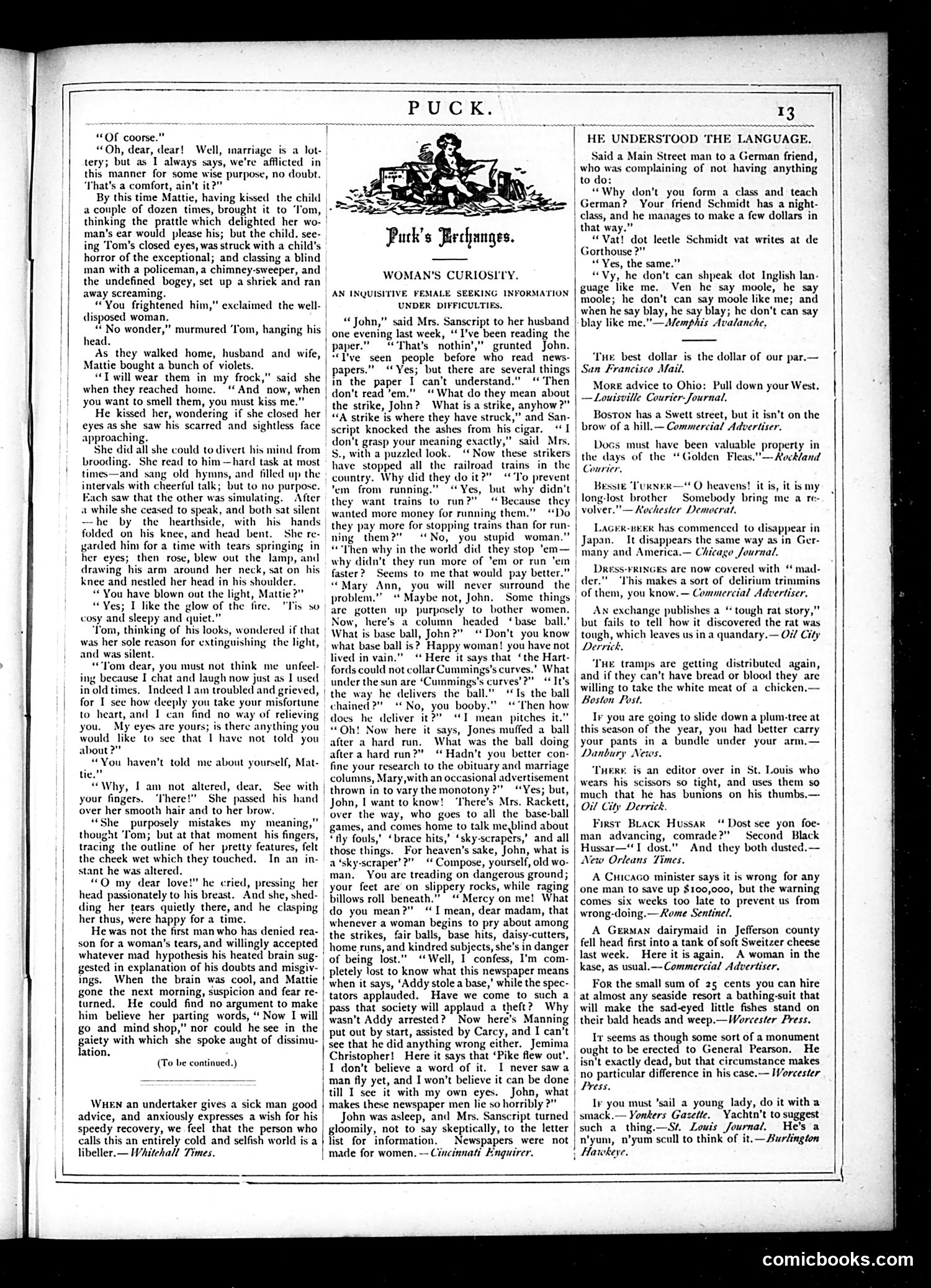
This page contains "Puck's Pertinges" — a humor column mixing short jokes and satirical observations rather than a political cartoon. The content addresses social issues of the era: women's curiosity about newspapers, marital dynamics, labor strikes (mentioned regarding railroad workers), and ethnic stereotypes (German and English characters). One recurring theme mocks women for reading newspapers despite supposedly not understanding complex topics like strikes and "base ball." Another jokes about German immigrants' accented English. The column also includes brief items satirizing small-town life, undertakers' opportunism, and newspaper editors' practices. Without identifying specific historical figures, the humor reflects turn-of-the-century American attitudes toward gender roles, labor unrest, immigration, and social class — typical of Puck's satirical approach to contemporary life.
📄 Transcribed text from this page (OCR, searchable)
Machine-transcribed from the original scan — historical spelling and the odd misread are preserved.
“Of coorse.” “Oh, dear, dear! Well, marriage is a lot- tery; but as 1 always says, we're afflicted in this manner for some wise purpose, no doubt. ‘That's a comfort, ain't it?” By this time Mattie, having kissed the child a couple of dozen times, brought it to ‘om, - thinking the prattle which delighted her wo- | man’s ear would please his; but the child. see- ing ‘Tom's closed eyes, was struck with a child’s horror of the exceptional; and classing a blind man with a policeman, a chimney-sweeper, and the undefined bogey, set up a shrick and ran away screaming. “You frightened him disposed woman. | “No wonder,” murmured ‘Tom, hanging his head. | As they walked home, husband and wife, Mattie bought a bunch of violets. | claimed the well- | “Twill wear them in my frock,” said she | P when they reached home. ‘And now, when | you want to smell them, you must kiss me.” He kissed her, wondering if she closed her | s she saw his scarred and sightless face ing. id all she could to divert his mind from brooding. She read to him —hard task at most times—and sang old hymns, and filled up the intervals with cheerful talk; but to no purpose. Each saw that the other was simulating. After a while she ceased to speak, and both sat silent —he by the hearthside, with his hands folded on his knee, and head bent. She re- xarded him for a time with tears springing in her eyes; then rose, blew out the lamp, and drawing his arm around her neck, sat on his knee and nestled her head in his shoulder, “You have blown out the light, Mattie ?’ “Yes; I like the glow of the fire. "Tis so y and sleepy and quiet.” ‘Tom, thinking of his looks, wondered if that was her sole reason for extinguishing the light, and was silent. “Tom dear, you must not think me unfeel- ing because I chat and laugh now just as I used inoldtimes. Indeed I am troubled and grieved, for I see how deeply you take your misfortune to heart, and I can find no way of relieving you. My eyes are yours; is there anything you would like to see that I have not told you about?” “You haven't told me about yourself, Mat- co: t “Why, I am not altered, dear, See with your fingers. ‘There! She passed his hand over her smooth hair and to her brow, “She purposely mistakes my meaning,” thought ‘Tom; but at that moment his fingers, tracing the outline of her pretty features, felt the cheek wet which they touched. In an in- stant he was altered. “O my dear love!" he cried, pressing her head passionately to his breast. And she, shed- ding her tears quietly there, and he clasping | her thus, were happy for a time. He was not the first man who has denied rea- son for a woman’s tears, and willingly accepted whatever mad hypothesis his heated brain sug- gested in explanation of his doubts and mis; ings. When the brain was cool, and Mattie | gone the next morning, suspicion and fear re- turned. He could find no argument to make him believe her parting words, “ Now I will go and mind shop,” nor could he see in the gaiety with which she spoke aught of dissimu- | lation, (To be continued.) | Wuew an undertaker gives a sick man good advice, and anxiously expresses a wish for his | speedy recovery, we feel that the person who ls this an entirely cold and selfish world is a } libeller.— Whitehall Times. | | thrown in to vary the monotony ?”” | home runs, and kindred subjects, she’s in danger | | last week. WOMAN'S CURIOSITY. FEMALE SEEKING INFORMATION UNDER DIFFICULTIES. “ John,” said Mrs. Sanscript to her husband one evening last week, “I’ve been reading the paper. “That's nothin’,” grunted John. “I've seen people before who read news- pers.” “Yes; but there are several things in the paper I’ can’t understand.” “Then don’t read ’em.” “What do they mean about the strike, John? What is a strike, anyhow?” “A strike is where they have struck,” and San- | script knocked the ashes from his cigar. “I don’t grasp your meaning exactly,” said Mrs, S., with a puzzled look. ‘‘ Now these. strikers have stopped all the railroad trains in the country. Why did they do it?” “To prevent | ‘em from running.” “Yes, but why didn’t | they want trains to run?” “Because they | wanted more money for running them.” “Do they pay more for stopping trains than for run- | ning them?” ‘No, you stupid woman.” | “Then why in the world did_ they stop ’em— why didn’t they run more of em or run 'em faster? Seems to me that would pay better.” “Mary Ann, you will never surround. the | problem.” “ Maybe not, John. Some things | are gotten up purposely to bother women. Now, here’s a column headed ‘base ball.” What is base ball, John?” ‘Don’t you know what base ball is? Happy woman! you have not lived in vain.” ‘ Here it says that ‘the Hart- fords could not collar Cummings’s curves.’ What under the sun are ‘Cummings’s curves’?” “It's the way he delivers the ball.” ‘Is the ball chained?” ‘No, you booby.” ‘Then how does he deliver it?” “I mean pitches it.’ | “Oh! Now here it says, Jones muffed a ball | after a hard run, What was the ball doing | after a hard run?” “Hadn't you better con- fine your research to the obituary and marriage columns, Mary, with an occasional advertisement “Yes; but, John, I want to know! ‘There's Mrs. Rackett, over the way, who goes to all the base-ball games, and comes home to talk me,blind about iy fouls, ‘brace hits,’ ‘sky-scrapers,’ and all | those things. For heaven’s sake, John, what is | a‘sky-scraper’?” “Compose, yourself, old wo- | man, You are treading on dangerous ground; | your feet are on slippery rocks, while raging | billows roll beneath.” ‘ Mercy on me! What do you mean?” “I mean, dear madam, that whenever a woman begins to pry about among the strikes, fair balls, base hits, daisy-cutters, AN INQUISI of being lost.” “Well, I confess, I’m com- | pletely lost to know what this newspaper means | when it says, ‘Addy stole a base,’ while the spec- | tators applauded. Have we come to such a | pass that society will applaud a theft? Why | wasn’t Addy arrested? Now here’s Manning | put out by start, assisted by Carcy, and I can’t see that he did anything wrong either. Jemima Christopher! Here it says that ‘Pike flew out’. I don’t believe a word of it. 1 never sawa man fly yet, and I won't believe it can be done till I sce it with my own eyes. John, what makes these newspaper men lie so horribly ?” John was asleep, and Mrs. Sanscript turned gloomily, not to say skeptically, to the letter | list for information. Newspapers were not | made for women. — Cincinnati Enguirer. ; | smack.— Yonkers Gaselte. Said a Main Street man to a German friend, | who was complaining of not having anything | to do: “Why don't you form a class and teach | German? Your friend Schmidt has a night- | class, and he manages to make a few dollars in that way.” “Vat! dot leetle Schmidt vat writes at de Gorthouse ?” “Yes, the same.” “Vy, he don’t can shpeak dot Inglish lan- guage’ like me. Ven he say moole, he say moole; he don’t can say moole like me; and when he say blay, he say blay; he don't can say blay like me."—Afemphis Avalanche, ‘Tne best dollar is the dollar of our par.— San Francisco Mail. More advice to Ohio: Pull down your West. —Louisville Courier-Journal. Boston hi brow of a hil a Swett street, but it isn’t on the Commercial Advertiser. Docs must have been valuable property in of the “Golden Fleas."”— Rockland Bessie ‘Turner—‘ O heavens! it is, it is my long-lost brother Somebody bring me a re- volver.” — Kochester Democrat. LaGER-nEER has commenced to disappear in Japan. It disappears the same way as in Ger- many and America.— Chicago Journal. Dress-rRinces are now covered with “ mad- der.” ‘This makes a sort of delirium trimmins of them, you know. — Commercial Advertiser. Av exchange publishes a “ tough rat story,” but fails to tell how it discovered the rat was tough, which leaves us in a quandary.— Oi City Derria ‘THe tramps are getting distributed again, and if they can't have bread or blood they are willing to take the white meat of a chicken.— Boston Post. Ir you are going to slide down a plum-tree at this season of the year, you had better carry your pants in a bundle under your arm.— Danbury News. ‘Tere is an editor over in St. Louis who wears his scissors so tight, and uses them so | much that he has bunions on his thumbs.— Oil City Derrick. First Brack Hussar ‘‘ Dost see yon foe- man advancing, comrade?” Second Blac Hussar—“I dost.” And they both dusted.— New Orleans Times. A Cuicaco minister says it is wrong for any one man to save up $100,000, but the warning comes six weeks too late to prevent us from wrong-doing.— Rome Sentinel. A German dairymaid in Jefferson county fell head first into a tank of soft Sweitzer cheese Here it is again. A woman in the kase, as usual.— Commercial Advertiser, For the small sum of 25 cents you can hire at almost any seaside resort a bathing-suit that will make the sad-eyed little fishes stand on their bald heads and weep.—Weorcester Press. Ir seems as though some sort of a monument ought to be erected to General Pearson. He isn’t exactly dead, but that circumstance makes no particular difference in his case.— Worcester Press. Ir you must ’sail_ a young lady, do it with a Yachtn’t to suggest such a thing.—St. Louis Journal, He's a n’'yum, n’yum scull to think of it.— Burlington Hawkeye. comicbooks.com