
Puck, 1877-08-22 · page 12 of 16
Puck — August 22, 1877 — page 12: what you’re looking at
What you’re looking at
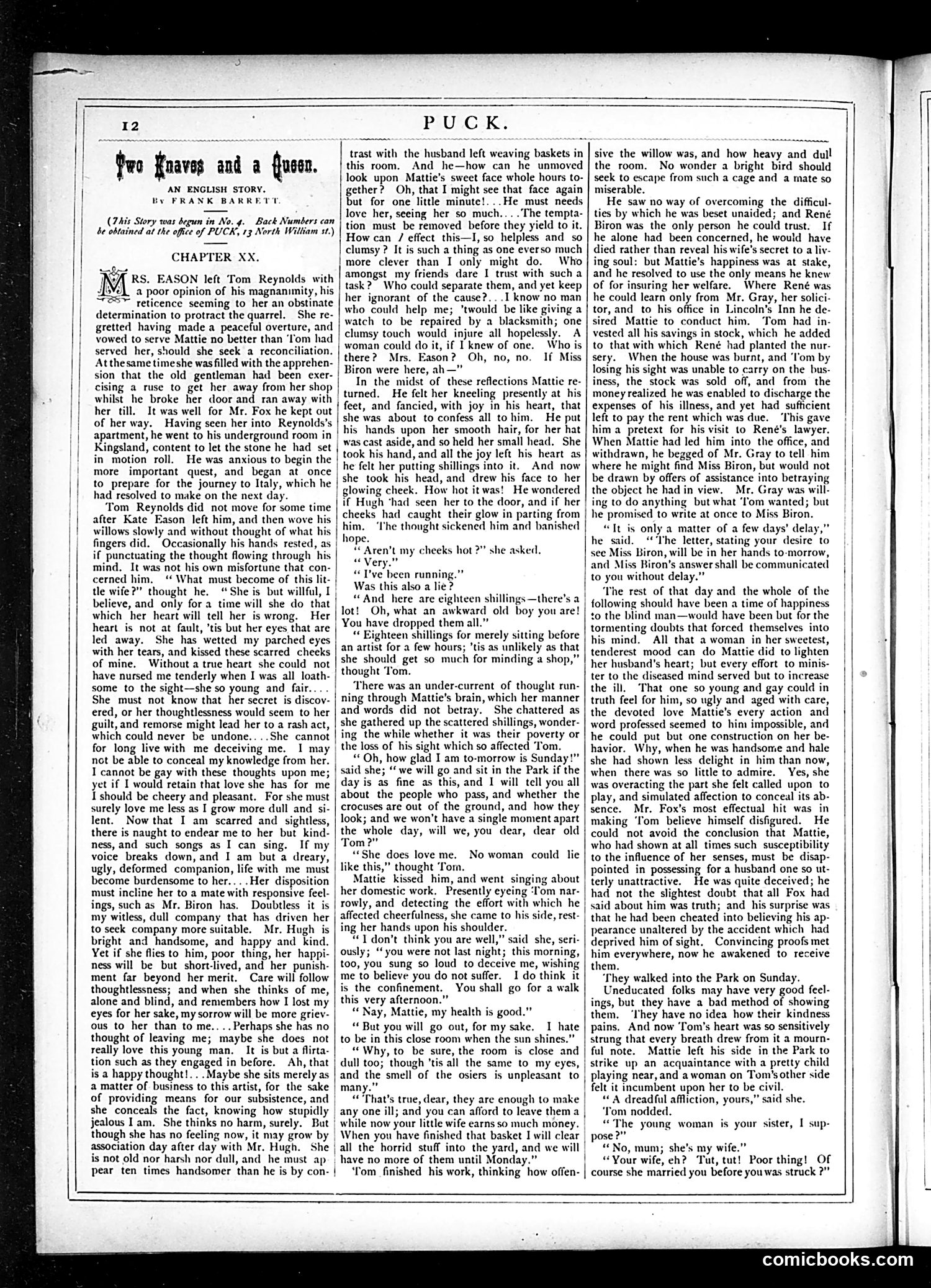
This page contains the continuation of a serialized story titled "Two Knaves and a Queen" by Frank Barrett, presented as text fiction rather than as a cartoon or comic strip. The narrative follows Tom Reynolds and Mattie Biron, who appear to be romantically involved characters dealing with personal complications. The text depicts their emotional interactions—Mattie's joy at seeing Tom, their physical affection, and Tom's internal conflict about his circumstances. The dialogue reveals period social concerns: financial struggles, marital propriety, and class considerations. References to "eighteen shillings" and domestic duties suggest Victorian-era working-class life. This is **not a political cartoon or satirical visual content**—it's serialized fiction using Puck magazine's pages as a publishing platform, common for 19th-century periodicals that mixed satirical cartoons with literary content.
📄 Transcribed text from this page (OCR, searchable)
Machine-transcribed from the original scan — historical spelling and the odd misread are preserved.
tee foaves and a jueen. AN ENGLISH STORY. By FRANK BARRETt (This Story was begun in No. g. Back Numbers can be obtained at the office of PUCK, 13 North William st.) CHAPTER XX. woe INV RS. EASON left Tom Reynolds with NEL a poor opinion of his magnanimity, his “S™ reticence seeming to her an obstinate determination to protract the quarrel. She re- gretted having made a peaceful overture, and vowed to serve Mattie no better than ‘om had served her, should she seek a reconciliation. Atthesame timeshe was filled with the apprehen- sion that the old gentleman had been exer- cising a ruse to get her away from her shop whilst he broke her door and ran away with her till. It was well for Mr. Fox he kept out | of her way. Having seen her into Reynolds's apartment, he went to his underground room in Kingsland, content to let the stone he had set | in motion roll. He was anxious to begin the more important quest, and began at once | to prepare for the journey to Italy, which he had resolved to make on the next day. Tom Reynolds did not move for some time after Kate Eason left him, and then wove his willows slowly and without thought of what his. fingers did. Occasionally his hands rested, as | if punctuating the thought flowing through his mind. It was not his own misfortune that con- cerned him, ‘ What must become of this lit- | tle wife?” thought he. “She is but willful, I | believe, and only fora time will she do that | which her heart will tell her is wrong. Her heart is not at fault, ‘tis but her eyes that are led away. She has wetted my parched eyes with her tears, and kissed these scarred cheeks of mine. Without a true heart she could not have nursed me tenderly when I was all loath- | some to the sight—she so young and fair.... | She must not know that her secret is discov- ered, or her thoughtlessness would seem to her guilt, and remorse might lead her to a rash act, which could never be undone....She cannot for long live with me deceiving me. 1 may not be able to conceal my knowledge from her. I cannot be gay with these thoughts upon me; yet if I would retain that love she has for me I should be cheery and pleasant. For she must surely love me less as I grow more dull and si- lent. Now that I am scarred and sightless, there is naught to endear me to her but kind- ness, and such songs as I can sing. If my voice breaks down, and I am but a dreary, | ugly, deformed companion, life with me must | become burdensome to her... .Her disposition must incline her to a mate with responsive feel- | ings, such as Mr. Biron has. Doubtless it is | my witless, dull company that has driven her to seck company more suitable. Mr. Hugh is bright and handsome, and happy and kind. Yet if she flies to him, poor thing, her happi- ness will be but short-lived, and her punish- ment far beyond her merit. Care will follow thoughtlessness; and when she thinks of me, alone and blind, and remembers how I lost my eyes for her sake, my sorrow will be more griev- ous to her than to me....Perhaps she has no thought of leaving me; maybe she does not really love this young man. It is but a flirta- tion such as they engaged in before. Ah, that is a happy thought!.. . Maybe she sits merely as | PUCK. trast with the husband left weaving baskets in this room. And he—how can he unmoved look upon Mattie’s sweet face whole hours to- gether? Oh, that I might see that face again but for one little minute!...He must needs love her, seeing her so much... .The tempta- tion must be removed before they yield to it. How can / effect this—I, so helpless and so clumsy ? It is such a thing as one everso much | more clever than I only might do. Who amongst my friends dare I trust with such a task ?- Who could separate them, and yet keep her ignorant of the cause?...I know no man who could help me; ‘twould be like giving a watch to be repaired by a blacksmith; one | clumsy touch would injure all hopelessly. A woman could do it, if I knew of one. Who is there? Mrs. Eason? Oh, no, no. If Miss Biron were here, ah—" | | In the midst of these reflections Mattie re- | turned. He felt her kneeling presently at his feet, and fancied, with joy in his heart, that she was about to confess all tohim. He put his hands upon her smooth hair, for her hat was cast aside, and so held her small head. She took his hand, and all the joy left his heart as he felt her putting shillings into it. And now she took his head, and drew his face to her glowing cheek. How hot it was! He wondered if Hugh ‘had seen her to the door, and if her cheeks had caught their glow in parting from him. he thought sickened him and banished hope. * Aren’t my cheeks hot ?” she asked. “Very.” “T've been running.” Was this also a lie? “And here are eighteen shillings—there’s a lot! Oh, what an awkward old boy you are! You have dropped them all.” “ Eighteen shillings for merely sitting before an artist for a few hours; ’tis as unlikely as that she should get so much for minding a shop,” thought Tom. ‘There was an under-current of thought run- ning through Mattie’s brain, which her manner and words did not betray. She chattered as she gathered up the scattered shillings, wonder- ing the while whether it was their poverty or the loss of his sight which so affected ‘Tom. “Oh, how glad I am to-morrow is Sunday!” said she; “we will go and sit in the Park if the day is as fine as this, and I will tell you all about the people who pass, and whether the crocuses are out of the ground, and how they look; and we won't have a single moment apart the whole day, will we, you dear, dear old Tom?” “‘She does love me. No woman could lie like this,” thought ‘Tor. Mattie kissed him, and went singing about her domestic work. Presently eyeing ‘'om nar- rowly, and detecting the effort with which he affected cheerfulness, she came to his side, rest- ing her hands upon his shoulder. “T don’t think you are well,” said she, seri- ously; ‘you were not last night; this morning, too, you sung so loud to deceive me, wishing me to believe you do not suffer. I do think it is the confinement. You shall go for a walk this very afternoon.” “Nay, Mattie, my health is good.” “ But you will go out, for my sake. I hate to be in this close room when the sun shines.” “Why, to be sure, the room is close and dull too; though 'tis all the same to my eyes, and the smell of the osiers is unpleasant to a matter of business to this artist, for the sake of providing means for our subsistence, and | she conceals the fact, knowing how stupidly jealous Iam. She thinks no harm, surely. But though she has no feeling now, it may grow by association day after day with Mr. Hugh. She | is not old nor harsh nor dull, and he must ap pear ten times handsomer than he is by con- | many.” “That's true, dear, they are enough to make any one ill; and you can afford to leave them a | while now your little wife earns so much money. When you have finished that basket I will clear all the horrid stuff into the yard, and we will have no more of them until Monday.” ‘Yom finished his work, thinking how offen- sive the willow was, and how heavy and dull the room. No wonder a bright bird should seek to escape from such a cage and a mate so miserable. He saw no way of overcoming the difficul- ties by which he was beset unaided; and René Biron was the only person he could trust. If he alone had been concerned, he would have died rather than reveal his wife's secret to a liv- ing soul: but Mattie’s happiness was at stake, and he resolved to use the only means he knew of for insuring her welfare. Where René was he could learn only from Mr. Gray, her solici- tor, and to his office in Lincoln's Inn he de- sired Mattie to conduct him. ‘Tom had in- vested all his savings in stock, which he added to that with which René had planted the nur- sery. When the house was burnt, and ‘l'om by losing his sight was unable to carry on the bus- iness, the stock was sold off, and from the money realized he was enabled to discharge the expenses of his illness, and yet had sufficient left to pay the rent which was due. ‘This gave him a pretext for his visit to René’s lawyer. When Mattie had led him into the office, and withdrawn, he begged of Mr. Gray to tell him where he might find Miss Biron, but would not be drawn by offers of assistance into betraying the object he had in view. Mr. Gray was will- ing to do anything but what ‘om wanted; but he promised to write at once to Miss Biron. “It is only a matter of a few days’ delay,” he said. “The letter, stating your desire to see Miss Biron, will be in her hands to-morrow, and Miss Biron’s answer shall be communicated | to you without delay.”” ‘The rest of that day and the whole of the following should have been a time of happiness to the blind man—would have been but for the tormenting doubts that forced themselves into his mind. All that a woman in her sweetest, tenderest mood can do Mattie did to lighten her husband's heart; but every effort to minis- ter to the diseased mind served but to increase the ill, That one so young and gay could in truth feel for him, so ugly and aged with care, the devoted love Mattie’s every action and word professed seemed to him impossible, and he could put but one construction on her be- havior. Why, when he was handsome and hale she had shown less delight in him than now, when there was so little to admire. Yes, she was overacting the part she felt called upon to play, and simulated affection to conceal its ab- sence. Mr. Fox’s most effectual hit was in making ‘om believe himself disfigured. He could not avoid the conclusion that Mattie, who had shown at all times such susceptibility to the influence of her senses, must be disap- pointed in possessing for a husband one so ut- terly unattractive. He was quite deceived; he had not the slightest doubt that all Fox had said about him was truth; and _ his surprise was that he had been cheated into believing his ap- pearance unaltered by the accident which had deprived him of sight. Convincing proofs met him everywhere, now he awakened to receive them. ‘They walked into the Park on Sunday. Uneducated folks may have very good feel- ings, but they have a bad method of showing them, ‘I'hey have no idea how their kindness pains. And now ‘Tom’s heart was so sensitively strung that every breath drew from it a mourn- ful note. Mattie left his side in the Park to strike up an acquaintance with a pretty child playing near, and a woman on Tom’sother side felt it incumbent upon her to be civil. “4 dreadful aMiction, yours,” said she. ‘Tom nodded. “The young woman is your sister, I sup- se 2"” “No, mum; she’s my wife.” “Your wife, eh? Tut, tut! Poor thing! Of course she married you before youwas struck 2” comicbooks.com