
Puck, 1877-08-22 · page 10 of 16
Puck — August 22, 1877 — page 10: what you’re looking at
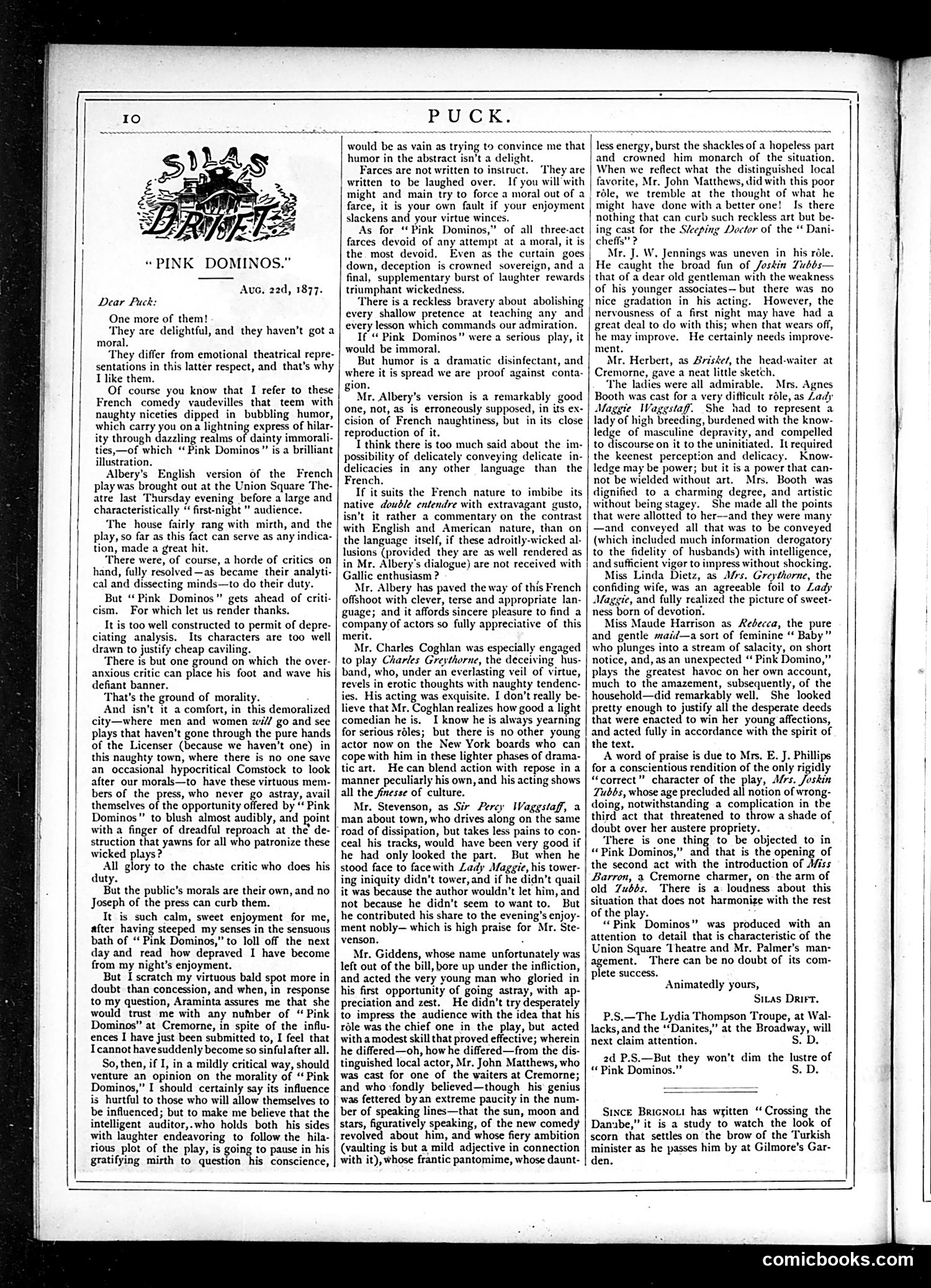
What you’re looking at
This page contains a theatrical review, not a political cartoon. The header illustration shows a silhouetted figure in dramatic pose. The lengthy letter critiques a three-act French farce called "Pink Dominos," praising its entertainment value while debating whether it contains sufficient moral instruction. The reviewer argues farces needn't have morals to succeed and praises the cast performances—particularly Mr. Albury's French rendition and Mr. Charles Coghan's comic acting. The piece reflects 19th-century theater criticism standards, where reviewers seriously considered whether entertainment should serve moral purposes. The tone is witty and sophisticated, typical of Puck's cultural commentary, though aimed at theatrical rather than political satire.
📄 Transcribed text from this page (OCR, searchable)
Machine-transcribed from the original scan — historical spelling and the odd misread are preserved.
«PINK DOMINOS.” Avo, 22d, 1877. Dear Puck: One more of them! They are delightful, and they haven't got a moral. They differ from emotional theatrical repre- sentations in this latter respect, and that’s why I like them. Of course you know that I refer to these French comedy vaudevilles that teem with naughty niceties dipped in bubbling humor, which carry you ona lightning express of hilar- ity through dazzling realms of dainty immorali- ties,—of which “ Pink Dominos” is a brilliant illustration. Albery’s English version of the French play was brought out at the Union Square The- atre last ‘Thursday evening before a large and characteristically “ first-night ” audience. The house fairly rang with mirth, and the play, so far as this fact can serve as any indica- tion, made a great hit. ‘There were, of course, a horde of critics on hand, fully resolved—as became their analyti- cal and dissecting minds—to do their duty. But “Pink Dominos” gets ahead of criti- cism. For which let us render thanks. It is too well constructed to permit of depre- ciating analysis. Its characters are too well drawn to justify cheap caviling. There is but one ground on which the over- anxious critic can place his foot and wave his defiant banner. That's the ground of morality. And isn’t it a comfort, in this demoralized city—where men and women wid/ go and see plays that haven’t gone through the pure hands of the Licenser (because we haven't one) in this naughty town, where there is no one save an occasional hypocritical Comstock to look after our morals—to have these virtuous mem- bers of the press, who never go astray, avail themselves of the opportunity offered by “ Pink Dominos” to blush almost audibly, and point with a finger of dreadful reproach at the de- struction that yawns for all who patronize these wicked plays? All glory to the chaste critic who does his duty. But the public’s morals are their own, and no Joseph of the press can curb them. It is such calm, sweet enjoyment for me, after having steeped my senses in the sensuous bath of “Pink Dominos,” to loll off the next day and read how depraved I have become from my night’s enjoyment. But I scratch my virtuous bald spot more in doubt than concession, and when, in response to my question, Araminta assures me that she would trust me with any nufber of “ Pink Dominos” at Cremorne, in spite of the influ- ences I have just been submitted to, I feel that Icannot have suddenly become so sinfulafter all. So, then, if I, in a mildly critical way, should venture an opinion on the morality of “ Pink Dominos,” I should certainly say its influence is hurtful to those who will allow themselves to be influenced; but to make me believe that the intelligent auditor,.who holds both his sides with laughter endeavoring to follow the hila- rious plot of the play, is going to pause in his gratifying mirth to question his conscience, PUCK. j would be as vain as trying to convince me that | humor in the abstract isn’t a delight. | Farces are not written to instruct. They are written to be laughed over. If you will with might and main try to force a moral out of a farce, it is your own fault if your enjoyment | slackens and your virtue winces. | As for “Pink Dominos,” of all three-act | farces devoid of any attempt at a moral, it is the most devoid. Even as the curtain goes | down, deception is crowned sovereign, and a | final, supplementary burst of laughter rewards triumphant wickedness, ‘There is a reckless bravery about abolishing every shallow pretence at teaching any and | every lesson which commands our admiration. If “ Pink Dominos” were a serious play, it would be immoral. But humor is a dramatic disinfectant, and where it is spread we are proof against conta- ion, Mr. Albery’s version is a remarkably good one, not, as is erroneously supposed, in its ex- cision of French naughtiness, but in its close reproduction of it. I think there is too much said about the im- possibility of delicately conveying delicate in- delicacies in any other language than the French. If it suits the French nature to imbibe its native double entendre with extravagant gusto, isn’t it rather a commentary on the contrast with English and American nature, than on the language itself, if these adroitly-wicked al- lusions (provided they are as well rendered as in Mr. Albery’s dialogue) are not received with | Gallic enthusiasm ? ; Mr. Albery has paved the way of this French offshoot with clever, terse and appropriate lan- guage; and it affords sincere pleasure to find a company of actors so fully appreciative of this merit. Mr. Charles Coghlan was especially engaged to play Charles Grevthorne, the deceiving hus- band, who, under an everlasting veil of virtue, revels in erotic thoughts with naughty tendenc- ies. His acting was exquisite. I don’t really be- lieve that Mr. Coghlan realizes how good a light comedian he is. I know he is always yearning for serious réles; but there is no other young actor now on the New York boards who can cope with him in these lighter phases of drama- tic art. He can blend action with repose in a manner peculiarly his own, and his acting shows all the finesse of culture. Mr. Stevenson, as Sir Percy Waggstaf, a man about town, who drives along on the same road of dissipation, but takes less pains to con- ceal his tracks, would have been very good if he had only looked the part. But when he stood face to facewith Lady Maggie, his tower- ing iniquity didn’t tower, and if he didn’t quail it was because the author wouldn’t let him, and not because he didn’t seem to want to. But he contributed his share to the evening’s enjoy- ment nobly— which is high praise for Mr. Ste- venson. ‘ Mr. Giddens, whose name unfortunately was left out of the bill, bore up under the infliction, and acted the very young man who gloried in his first opportunity of going astray, with ap- preciation and zest. He didn’t try desperately to impress the audience with the idea that his role was the chief one in the play, but acted with a modest skill that proved effective; wherein he differed—oh, how he differed—from the dis- tinguished local actor, Mr. John Matthews, who was cast for one of the waiters at Cremorne; and who sfondly believed—though his genius was fettered by an extreme paucity in the num- ber of speaking lines—that the sun, moon and stars, figuratively speaking, of the new comedy revolved about him, and whose fiery ambition (vaulting is but a mild adjective in connection with it), whose frantic pantomime, whose daunt- less energy, burst the shackles of a hopeless part and crowned him monarch of the situation. When we reflect what the distinguished local favorite, Mr. John Matthews, did with this poor réle, we tremble at the thought of what he might have done with a better one! Is there nothing that can curb such reckless art but be- ing cast for the Sleeping Doctor of the “ Dani- cheffs” ? Mr. J. W, Jennings was uneven in his role. He caught the broad fun of Joskin Tubbs— that of a dear old gentleman with the weakness of his younger associates— but there was no nice gradation in his acting. However, the nervousness of a first night may have had a great deal to do with this; when that wears off, he may improve. He certainly needs improve- ment. Mr. Herbert, as Brisket, the head-waiter at Cremorne, gave a neat little sketch. ‘The ladies were all admirable. Mrs. Agnes Booth was cast for a very difficult réle, as Lady Maggie Waggstaf. She had to represent a lady of high breeding, burdened with the know- ledge of masculine depravity, and compelled to discourse on it to the uninitiated. It required the keenest perception and delicacy. Know- ledge may be power; but it is a power that can- not be wielded without art. Mrs. Booth was dignified to a charming degree, and artistic without being stagey. She made all the points that were allotted to her—and they were many —and conveyed all that was to be conveyed (which included much information derogatory to the fidelity of husbands) with intelligence, and sufficient vigor to impress without shocking. Miss Linda Dietz, as Mrs. Greythorne, the confiding wife, was an agreeable foil to Lady Maggie, and fully realized the picture of sweet- ness born of devotion. Miss Maude Harrison as Redecca, the pure and gentle maid—a sort of feminine “ Baby” who plunges into a stream of salacity, on short notice, and, as an unexpected Pink Domino,” plays the greatest havoc on her own account, much to the amazement, subsequently, of the household—did remarkably well. She looked pretty enough to justify all the desperate deeds that were enacted to win her young affections, and acted fully in accordance with the spirit of the text. ‘A word of praise is due to Mrs. E. J. Phillips for a conscientious rendition of the only rigidly “correct” character of the play, Afrs. Joskin Tubbs, whose age precluded all notion of wrong- doing, notwithstanding a complication in the third act that threatened to throw a shade of doubt over her austere propriety. ‘There is one thing to be objected to in “Pink Dominos,” and that is the opening of the second act with the introduction of Miss Barron, a Cremorne charmer, on the arm of old 7uébs. There is a loudness about this situation that does not harmonize with the rest of the play. “Pink Dominos” was produced with an attention to detail that is characteristic of the Union Square Theatre and Mr. Palmer's man- ement. There can be no doubt of its com- plete success. Animatedly yours, Sitas Drirt, P.S.—The Lydia Thompson Troupe, at Wal- lacks, and the ‘Danites,” at the Broadway, will next claim attention. Ss. D. 2d P.S.—But they won’t dim the lustre of «Pink Dominos.” S. D. RIGNOLI has written ‘Crossing the ‘ it is a study to watch the look of scorn that settles on the brow of the Turkish minister as he passes him by at Gilmore's Gar- den. comicbooks.com