
Puck, 1877-08-22 · page 3 of 16
Puck — August 22, 1877 — page 3: what you’re looking at
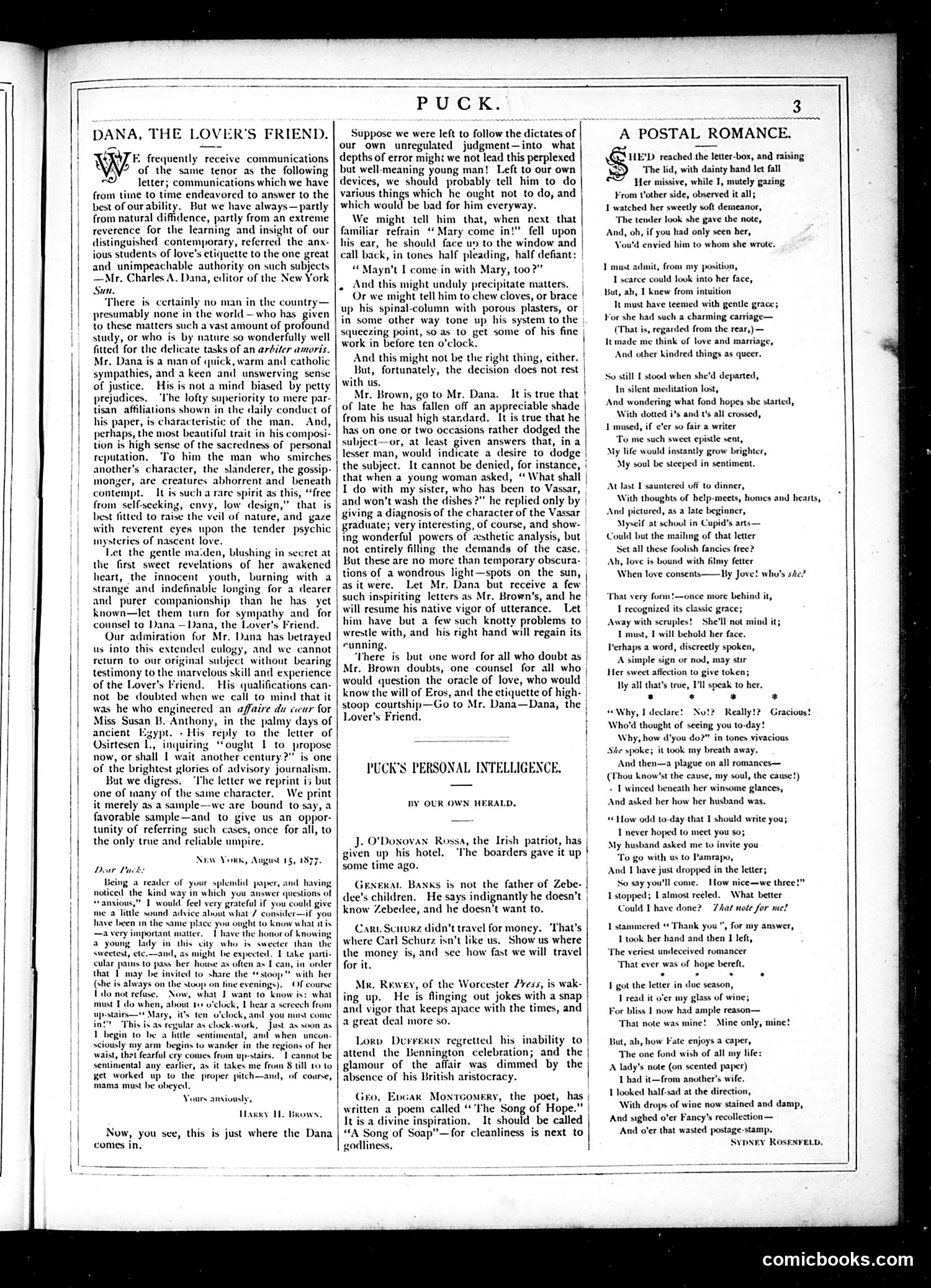
What you’re looking at
This page contains three distinct sections: a advice column ("Dana, the Lover's Friend"), a gossip/intelligence section ("Puck's Personal Intelligence"), and a poem ("A Postal Romance"). The content is primarily **literary and social commentary rather than political cartoons**. "Dana, the Lover's Friend" offers relationship advice to a man uncertain whether to pursue a woman. The "Personal Intelligence" section contains brief satirical remarks about public figures—including O'Donovan Rossa (Irish patriot), General Benson, Carl Schurz, and others—but these are witty jabs rather than illustrated political cartoons. **There are no visible political cartoons on this page.** The humor relies on written satire targeting contemporary personalities and romantic/social situations rather than visual caricature.
📄 Transcribed text from this page (OCR, searchable)
Machine-transcribed from the original scan — historical spelling and the odd misread are preserved.
DANA, THE LOVER'S FRIEND. E. frequently receive communications of the same tenor as the following letter; communications which we have from tine to time endeavored to answer to the best of our ability. But we have always—partly from natural difidence, partly from an extreme reverence for the learning and insight of our distinguished contemporary, referred the anx- ious students of love's etiquette to the one great and unimpeachable authority on such subjects —Mr. Charles A. Dana, editor of the New York Sun, ‘There is certainly no man in the country— presumably none in the world —who has given to these matters such a vast amount of profound study, or who is by nature so wonderfully well fitted for the delicate tasks of an arbiter amori: Mr. Dana is a man of quick, warm and catholic sympathies, and a keen and unswerving sense of justice. His is nota mind biased by petty prejudices. ‘I'he lofty superiority to mere par- tisan_ affiliations shown in the daily conduct of his paper, is characteristic of the man. And, perhaps, the most beautiful trait in his composi- tion is high sense of the sacredness of personal reputation, To him the man who smirches another's character, the slanderer, the gossip- monger, are creatures abhorrent and beneath contempt, It is such a rare spirit as this, “free from self-seeking, envy, low design,” that is best fitted to raise the veil of nature, and gaze with reverent eyes upon the tender psychic inysteries of nascent love. Let the gentle ma.den, blushing in secret at the first sweet revelations of her awakened heart, the innocent youth, burning with al strange and indefinabie longing for a dearer | and purer companionship than he has yet | known—lIet them turn for sympathy and for counsel te Dana — Dana, the Lover's Friend. Our admiration for Mr. Dana has betrayed us into this extended culogy, and we cannot return to our original subject’ without bearing testimony to the marvelous skill and experience of the Lover's Friend. His qualifications can- not be doubted when we call to mind that it was he who engineered an affaire du cur for Miss Susan B. Anthony, in the palmy days of ancient Egypt. - His reply to the letter of Osirtesen I., inquiring ‘ought 1 to propose now, or shall I wait another century?” is one of the brightest glories of advisory journalism. But we digress. ‘I'he letter we reprint is but one of inany of the same character. We print it merely as a sample are bound to say, a favorable sample—and_ to give us an oppor- tunity of referring such cases, once for all, to the only true and reliable umpire. 1877. New Yorn, August 15, Dear Luck Being a reader of your splendid paper, and having kind way in which you answer questions of I would’ feel very grateful if you could give ea little sound advice about what 7 consider—if you ve been in the same place y ight to know what itis avery important matter, i have the honor of knowing a young lady in this city who is sweeter than the sweetest, etc.—and, as might he expected. I take parti- cular pains to pass her howe as oft n, in order that T may be invited to share the stoop" with hy (she is always on the stoop on fine evenings). Of course To not refuse. Now, what I want to know is: what must Ido when, about 10 o’cluck, [hear a screech frot airs—* Mary, it’s ten o'clock, and you must come This is ay regular as clock-work, Just as soon as 1 begin to be a hittle sentimental, and when uncon. sciously my arm begins to wander in the regions of her waist, thet fearful cry comes from up-stairs. I cannot be sentimental any earlier, as it takes me from 8 till 10 to get worked up to the proper pitch—and, of coune, mama must be obeyed, Yours ansiuusly, Hakky HL. Brows, Now, you see, this is just where the Dana | comes in, PUCK. Suppose we were left to follow the dictates of | our own unregulated judgment—into what depths of error might we not lead this perplexed but well-meaning young man! Left to our own devices, we should probably tell him to do | varivus things which he ought not to do, and which would be bad for him everyway. We might tell him that, when next that familiar refrain “ Mary come in!” fell upon his ear, he should face up to the window and call back, in tones half pleading, half defiant: “ Mayn’t I come in with Mary, too?” « And this might unduly precipitate matters. Or we might tell him to chew cloves, or brace up his spinal-column with porous plasters, or in some other way tone up his system to the squeezing point, so as to get some of his fine work in before ten o'clock. And this might not be the right thing, either. | But, fortunately, the decision does not rest with us. Mr. Brown, go to Mr. Dana. It is true that of late he has fallen off an appreciable shade from his usual high standard. It is true that he has on one or two occasions rather dodged the subject—or, at least given answers that, ina lesser man, would indicate a desire to dodge the subject. It cannot be denied, for instance, that when a young woman asked, “What shall I do with my sister, who has been to Vassar, and won't wash the dishes ?”” he replied only by giving a diagnosis of the character of the Vassar graduate; very interesting, of course, and show- ing wonderful powers of ssthetic analysis, but not entirely filling the demands of the case. But these are no more than temporary obscura- tions of a wondrous light—spots on the sun, asitwere. Let Mr. Dana but receive a few such inspiriting letters as Mr. Brown's, and he will resume his native vigor of utterance. Let him have but a few such knotty problems to wrestle with, and his right hand will regain its cunning. ‘here is but one word for all who doubt as Mr. Brown doubts, one counsel for all who would question the oracle of love, who would know the will of Eros, and the ctiquette of high- stoop courtship—Go to Mr. Dana—Dana, the Lover's Friend. PUCK’S PERSONAL INTELLIGENCE BY OUR OWN HERALD, | J. O'DoNovay Rossa, the Irish patriot, has given up his hotel. ‘The boarders gave it up some time ago. | Genexat. Banks is not the father of Zebe- | dee’s children. He says indignantly he doesn’t know Zebedee, and he doesn’t want to. Cart Scuurz didn't travel for money. That's where Carl Schurz isn’t like us. Show us where the money is, and see how fast we will travel for it. Mr. Rewey, of the Worcester /ress, is wak- ing up. He is flinging out jokes with a snap and vigor that keeps apace with the times, and | a great deal more so. Lox» Derrexin regretted his inability to attend the Bennington celebration; and the glamour of the affair was dimmed by the absence of his British aristocracy. Gro, Epcar Mo: oMERY, the poet, has | written a poem called “he Song of Hope.” It is a divine inspiration. It should be called “A Song of Soap”—for cleanliness is next to godliness. 3 A POSTAL ROMANCE. HE'D reached the letter-box, and raising ‘The lid, with dainty hand let fall Her missive, while I, mutely gazing From other side, observed it all; I watched her sweetly soft demeanor, “The tender look she gave the note, And, ob, if you had only seen her, You'd envied him to whom she wrote. 1 mast admit, from my position, I scarce could look into her face, But, ah, 1 knew from intuition It must have teemed with gentle grace; For she had such a charming carriage— (That is, regarded from the rear,) — It made me think of love and marriage, And other kindred things as queer. So still I stood when she'd departed, In silent meditation lost, And wondering what fond hopes she started, With dotted i's and t's all crossed, 1 mused, if e’er so fair a writer ‘To me such sweet epistle sent, My life would instantly grow brighter, ‘My soul be steeped in sentiment. At last I sauntered off to dinner, With thoughts of help-meets, homes and hearts, And pictured, as a late beginner, Myself at school in Cupid's arts— Could but the mailing of that letter Set all these foolish fancies free? Ah, love is bound with filmy fetter When love consents—By Jove! who's sie? ‘That very form!—once more behind it, 1 recognized its classic grace; Away with scruples! She'll not mind it; I must, I will behold her face. Vethaps a word, discreetly spoken, A simple sign or nod, may stir Her sweet affection to give token; By all that’s true, I'll speak to her. . * * * “Why, I declare!) Nu!? Really!? Gracious! Who'd thought of seeing you to-day! Why, how d’you do?” in tones vivacious Sie spoke; it took my breath away, And then—a plague on all romances— (Thou know'st the cause, my soul, the cause!) + T winced beneath her winsome glances, And asked her how her husband was. “Mow odd to-day that I should write you; T never hoped to meet you so; My husband asked me to invite you ‘To go with us to Pamrapo, And I have just dropped in the letter; So say you'll come. How nice—we three! I stopped; [almost reeled, What better Could Thave done? hat note for me! I stammered “Thank you", for my answer, T took her hand and then I left, “The veriest undeceived romancer “That ever was of hope bereft. 1 got the letter in due season, 1 read it o'er my glass of wine; For bliss I now had ample reason— ‘That note was mine! Mine only, mine! But, ah, how Fate enjoys a caper, The one fond wish of all my life: A lady's note (on scented paper) Thad it—from another's wife. 1 looked half-sad at the direction, With drops of wine now stained and damp, And sighed o'er Fancy’s recollection— And o'er that wasted postage-stamp. SYDNEY ROSENFELD. comicbooks.com