
A complete issue · 16 pages · 1877
Puck — August 15, 1877
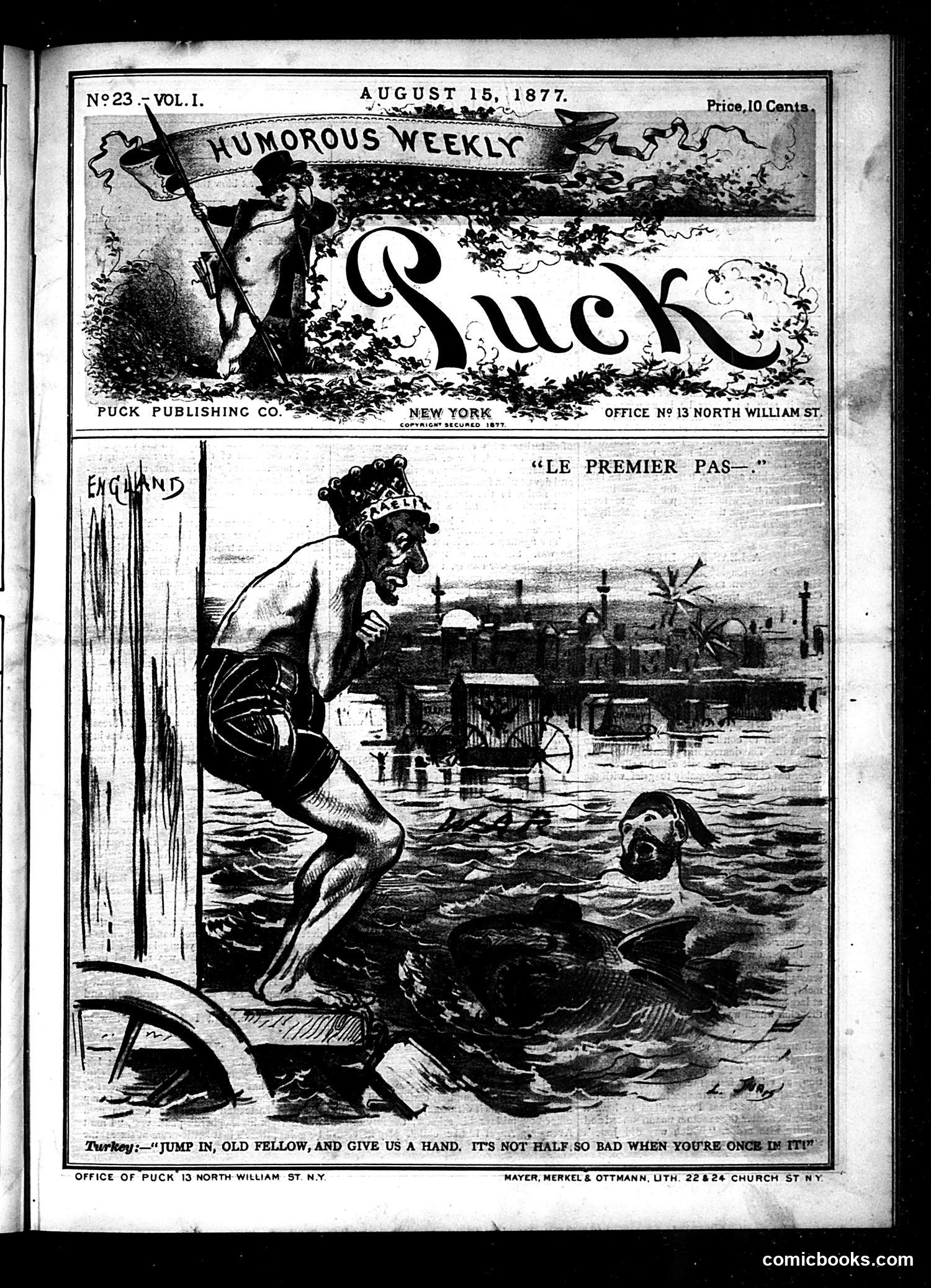
This cartoon depicts England as a crowned figure reluctantly entering water, while Turkey (labeled) in the water beckons him to join. The caption reads: "JUMP IN, OLD FELLOW, AND GIVE US A HAND. IT'S NOT HALF SO BAD WHEN YOU'RE ONCE IN IT!" This appears to reference the Russo-Turkish War (1877-1878) and international pressure on Britain to intervene militarily. Turkey invites England to enter the conflict, suggesting that jumping in—committing to war—won't be as bad as England fears. The satire mocks British reluctance to become involved while depicting Turkey as eager for British military support. The map of England on the left emphasizes the national perspective.
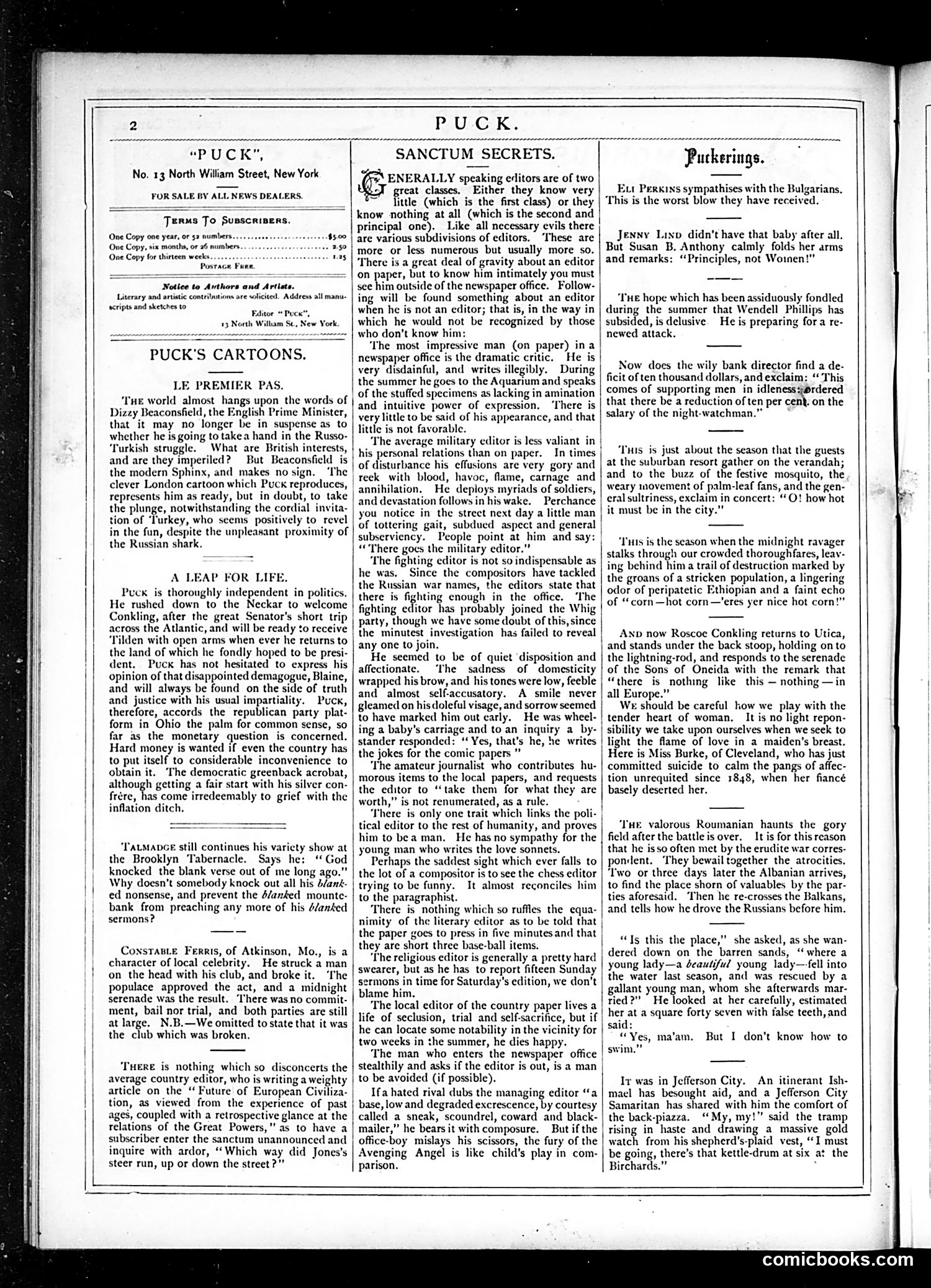
This page consists primarily of **text articles and commentary** rather than political cartoons. The main sections include: **"Sanctum Secrets"** — editorial observations about newspaper staff roles, describing various editor types (military editor, dramatic critic, chess editor, etc.) with satirical commentary on their quirks and foibles. **"Puckerings"** — brief satirical quips on current events, including references to Eli Perkins and the Bulgarians, Jenny Lind, and Wendell Phillips. **"Puck's Cartoons"** — announces "Le Premier Pas" (The First Step), though the actual cartoon image is not visible on this OCR'd page. The content targets **newspaper culture and journalism practices** of the era, mocking editorial pretensions and workplace dynamics. Without seeing the actual cartoon illustration, specific political figures or events cannot be identified.
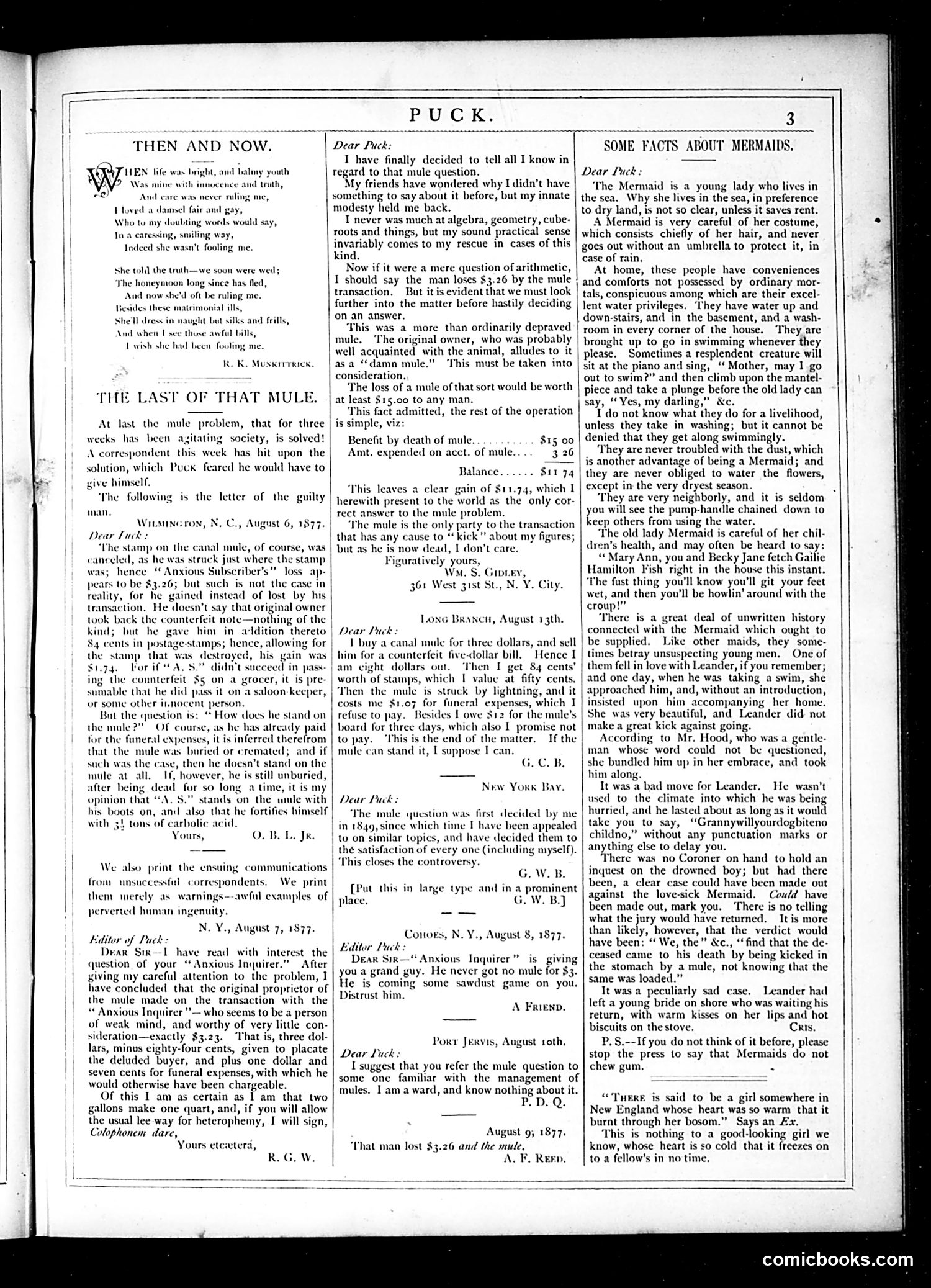
This page consists entirely of **reader letters and editorial responses** — no political cartoons or satirical illustrations are present. The content addresses three humorous topics: 1. **"The Last of That Mule"** — A correspondent reports on an ongoing joke about a canal mule, with calculations of its funeral expenses ($13.50 plus $3.26 in costs). 2. **"Some Facts About Mermaids"** — A whimsical response about a mermaid's domestic habits and peculiarities. 3. **Various other reader inquiries** — Including questions about counterfeits, a drowning incident, and personal matters. The satire is gentle, relying on wordplay and absurdist humor rather than political commentary. This appears to be a **letters-to-the-editor section** showcasing Puck's humorous editorial voice and reader engagement, typical of late-19th-century magazine format.
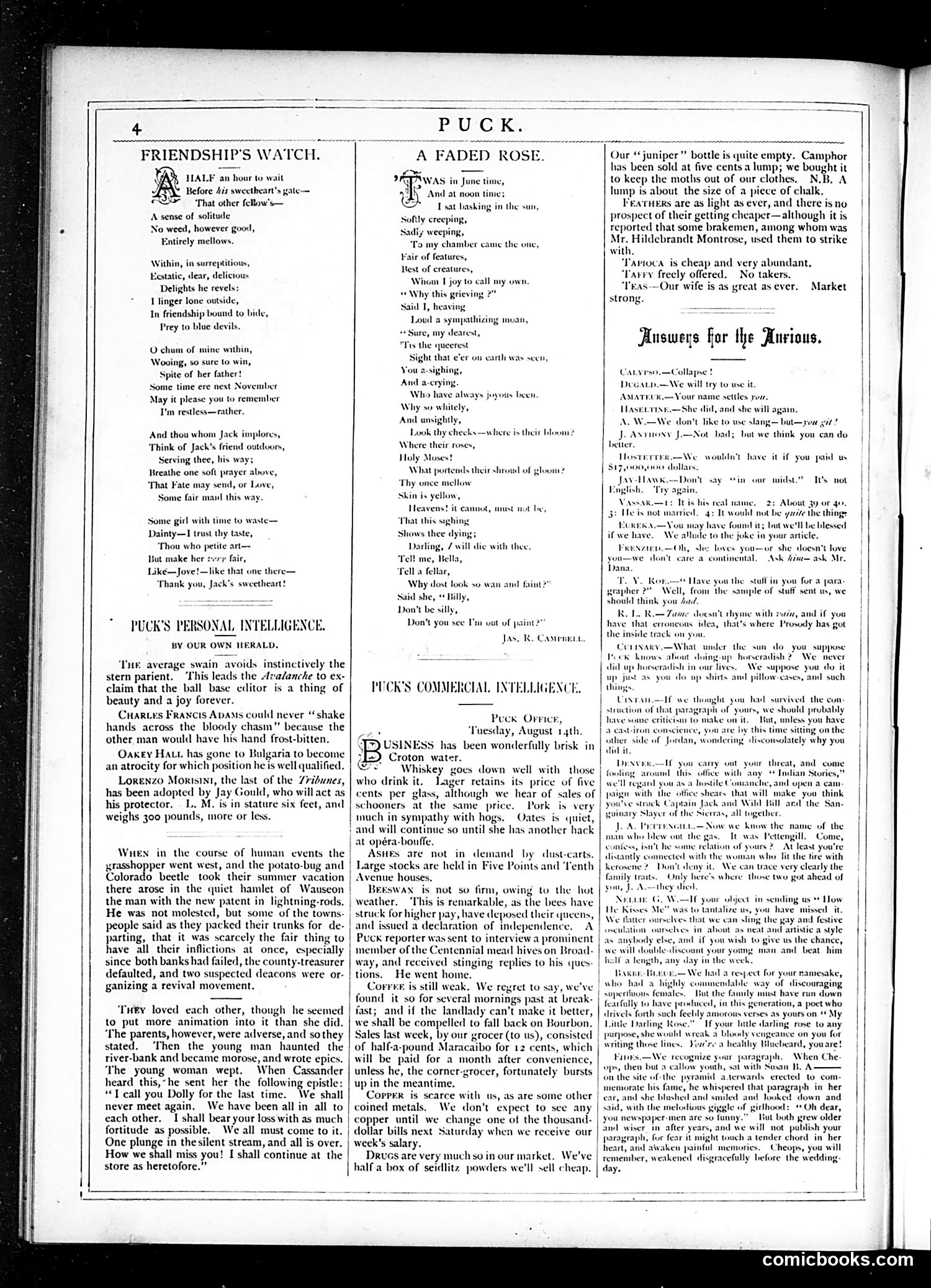
This page contains three distinct sections: **"Friendship's Watch,"** a poem about waiting for a friend; **"A Faded Rose,"** another poem about lost love; and **"Answers for the Curious,"** an advice column responding to reader questions. The most substantive content is **"Puck's Personal Intelligence"** and **"Puck's Commercial Intelligence,"** which appear to be gossip and market commentary. These discuss financial matters (croton water, whiskey prices, pork markets, oats) and social observations about wealthy New Yorkers, their business dealings, and personal scandals—typical satirical fodder for Puck's audience of urban, educated readers interested in society gossip and economic news. No specific political figures or dated events are clearly identifiable on this page.
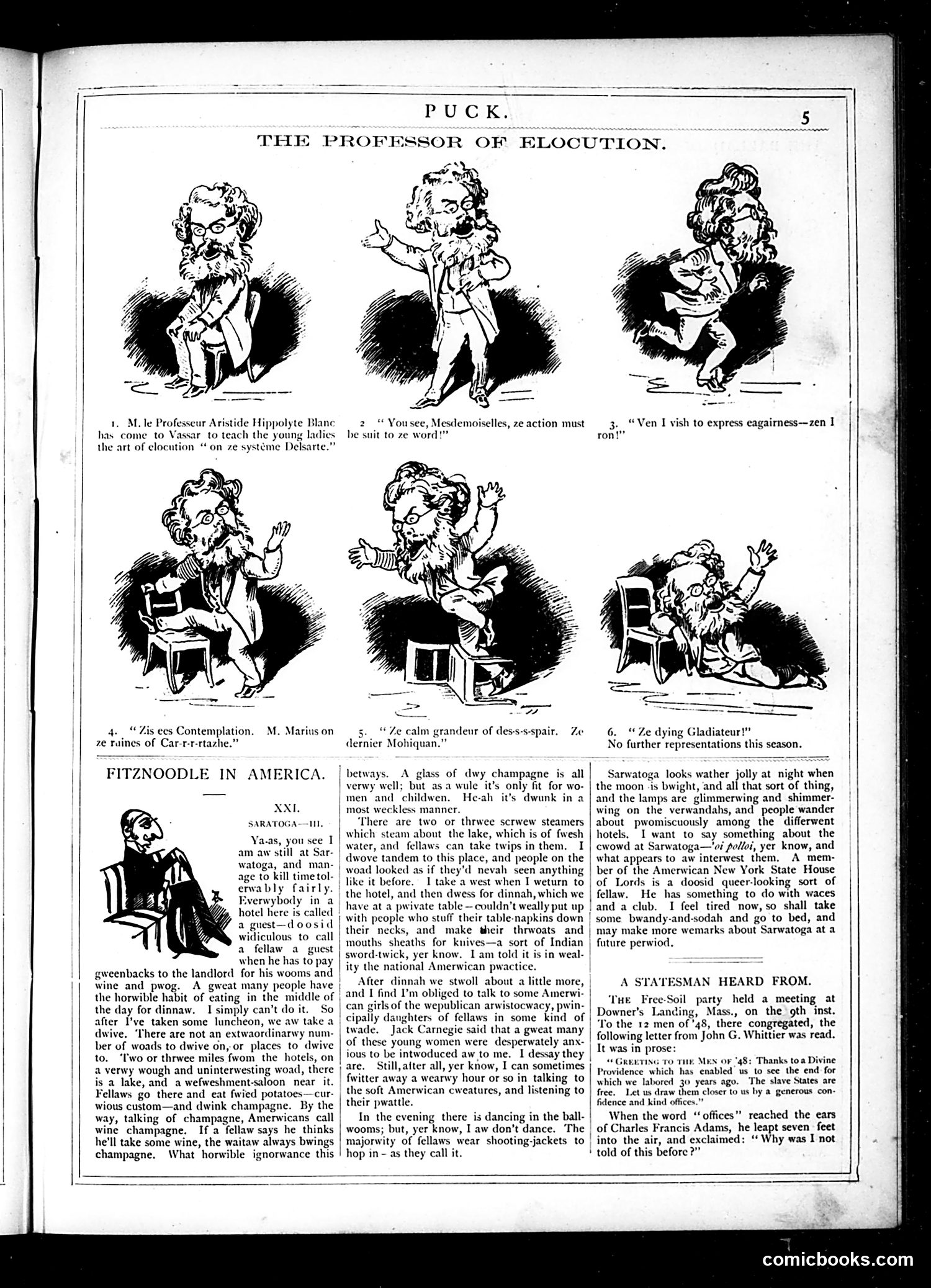
This six-panel cartoon mocks a French elocution instructor, "M. le Professeur Aristide Hippolyte Blanc," who teaches dramatic delivery through exaggerated physical gestures. Each panel depicts him demonstrating different theatrical poses—gesticulating wildly, contorting his body, and generally being absurdly animated. The satire targets pretentious European "professors" who taught fashionable speech and performance to Americans. By showing increasingly ridiculous poses with French captions about "action," "earnestness," and "dying gladiateur," Puck ridicules both the instructor's pomposity and the American upper class who paid for such lessons. The humor relies on visual exaggeration of theatrical affectation as inherently ridiculous.
This page contains a satirical poem in multiple cantos rather than a visual cartoon. It tells the story of Smithington Simms, characterized as a shallow, vain man obsessed with acquiring a fashionable wife to elevate his social status. The satire targets Victorian-era social climbing and superficiality—Simms seeks a woman primarily for appearance and status rather than genuine connection. References to "Aphrodite's" beauty standards and his ultimately shallow courtship mock both masculine vanity and the era's commodification of women in marriage markets. The poem's elaborate, mock-heroic style parodies serious literature to ridicule trivial social ambitions. Without additional historical context about specific figures or events referenced, the satire appears primarily directed at general upper-class pretension and courtship customs of the Gilded Age.
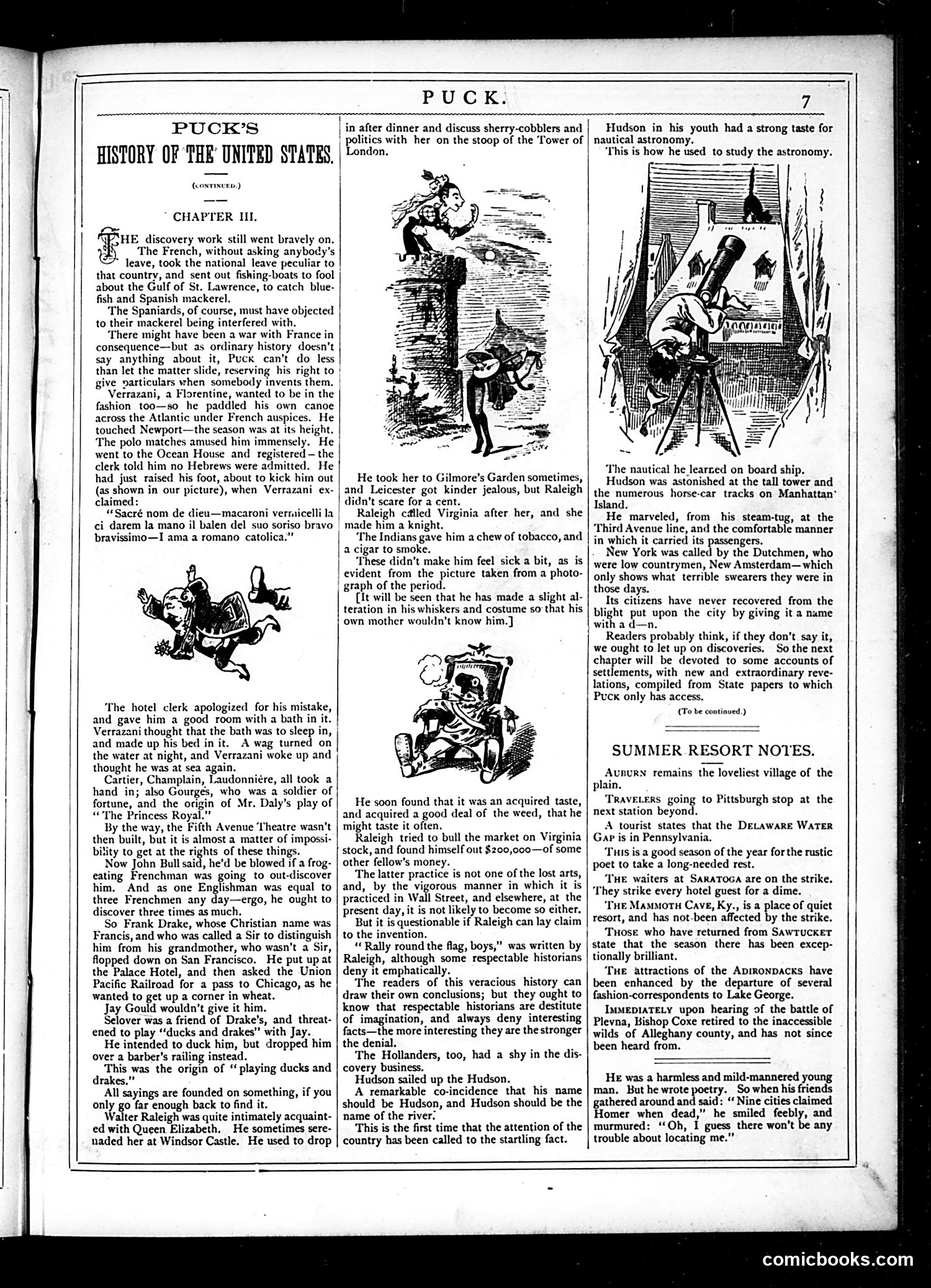
This page from Puck's "History of the United States" (Chapter III) contains historical narrative text with several accompanying satirical illustrations. The cartoons depict early American colonial figures and scenes—including what appears to be explorers, Native Americans, and colonial settlers interacting. The illustrations use exaggerated caricature typical of period humor, showing figures in absurd situations (one man appearing to fall or stumble). The accompanying text discusses Hudson, Spanish explorers, and early colonial commerce including tobacco trade. The satire appears directed at romanticized historical narratives, mocking both colonial-era figures and the tendency to mythologize early American discovery and settlement. The crude, comedic visual style undercuts any dignity these historical moments might claim.
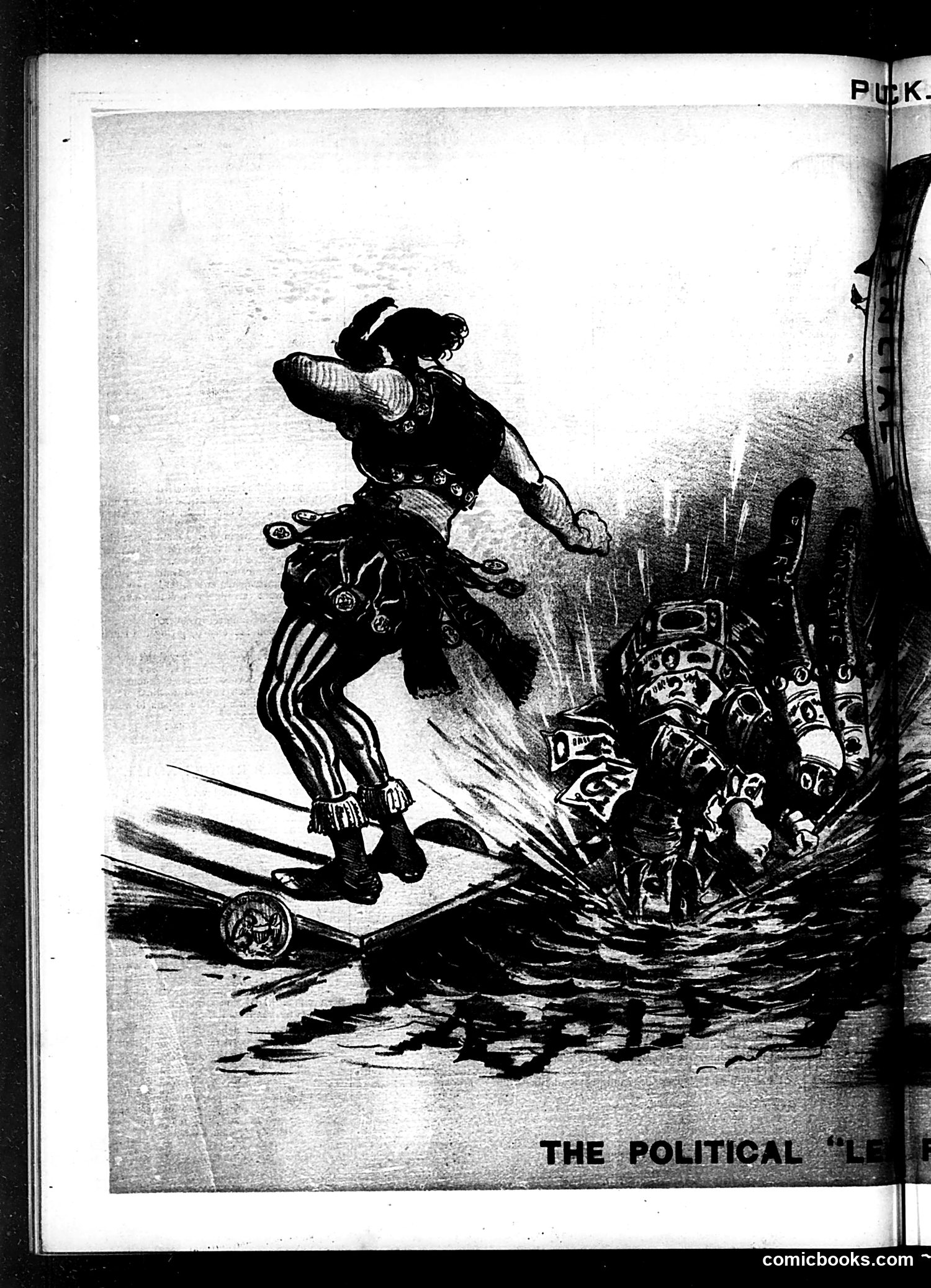
This Puck magazine illustration depicts a figure in striped patriotic clothing (appearing to represent Uncle Sam or American political authority) leaping or being propelled away from an explosion of weapons, military hardware, and armaments on the right side of the image. The satire appears to critique American political leadership's relationship with militarism and weapons production. The dynamic composition—with the figure recoiling or fleeing from the military explosion—suggests commentary on either: - Political avoidance of military/defense issues - The dangers of unchecked military-industrial growth - The chaos created by aggressive military policies The caption beginning "THE POLITICAL L—" is partially cut off, preventing full interpretation of the specific intended meaning. The style and presentation suggest this addresses early-to-mid 20th century American military or foreign policy concerns.
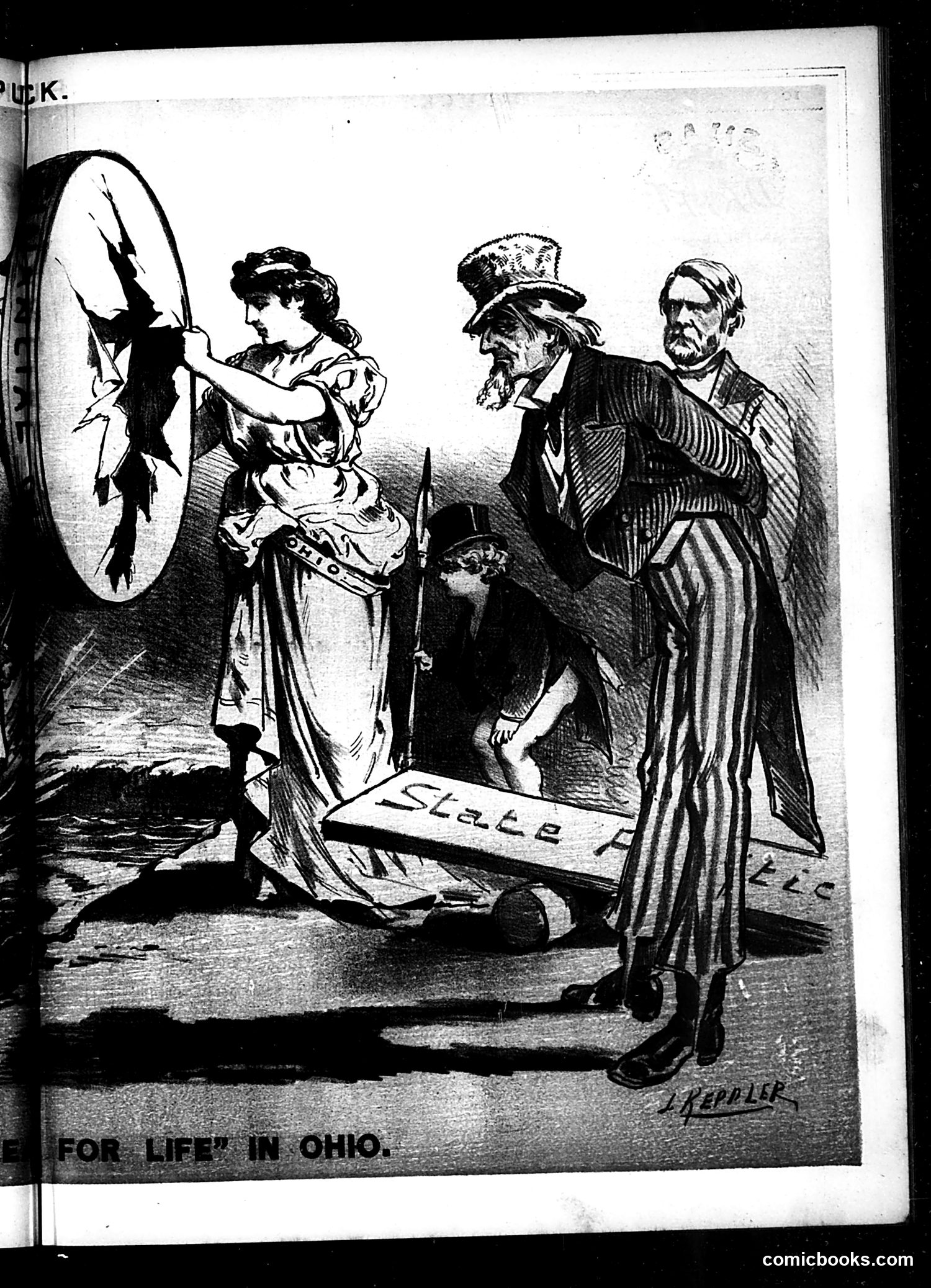
This political cartoon depicts a trial or legal proceeding. A woman (likely representing Justice or the law) holds up a mirror or reflective surface showing what appears to be a dark figure. Two men in period dress observe—one wearing a top hat with a beard, the other in striped clothing. The caption "For Life" in Ohio suggests this references a serious criminal case or death penalty trial in Ohio. The mirror imagery implies the cartoon is about revealing truth or exposing guilt. Without clearer identification of the specific figures or dated context, the exact historical event remains unclear, but the satire appears to critique either the judicial process, a particular defendant, or the nature of capital punishment in Ohio during Puck's publication era.
This page is primarily a **letter to the editor** from playwright Silas Drift discussing theatrical principles, not a political cartoon. Drift argues that ideal drama requires characters who think silently rather than delivering constant soliloquies—a technical criticism of contemporary stage conventions. He defends his own play against a visitor's critique, asserting that intelligent audiences prefer subtle character development over explicit exposition. The letter addresses theatrical realism versus artifice: Drift insists good drama should reveal character through action and restraint, not through characters constantly explaining themselves to the audience. This reflects late 19th-century debates about modern versus traditional playwriting techniques. The "Puck" masthead indicates this is satirical commentary on theater culture and dramatic theory of 1877.
This page contains the continuation of "Two Knaves and a Queen," a serialized story from *Puck* magazine (Chapter XIX). The text is entirely narrative fiction—a domestic drama involving characters named Tom, Mattie, Fox, and Jenny, dealing with themes of marital fidelity, social propriety, and class consciousness typical of Victorian-era popular fiction. There is no political cartoon visible on this page. The content is purely literary storytelling, featuring dialogue about a wife's whereabouts, jealousy, and moral questions of honesty within marriage. This appears to be a fiction feature rather than satirical commentary on contemporary political or social events.
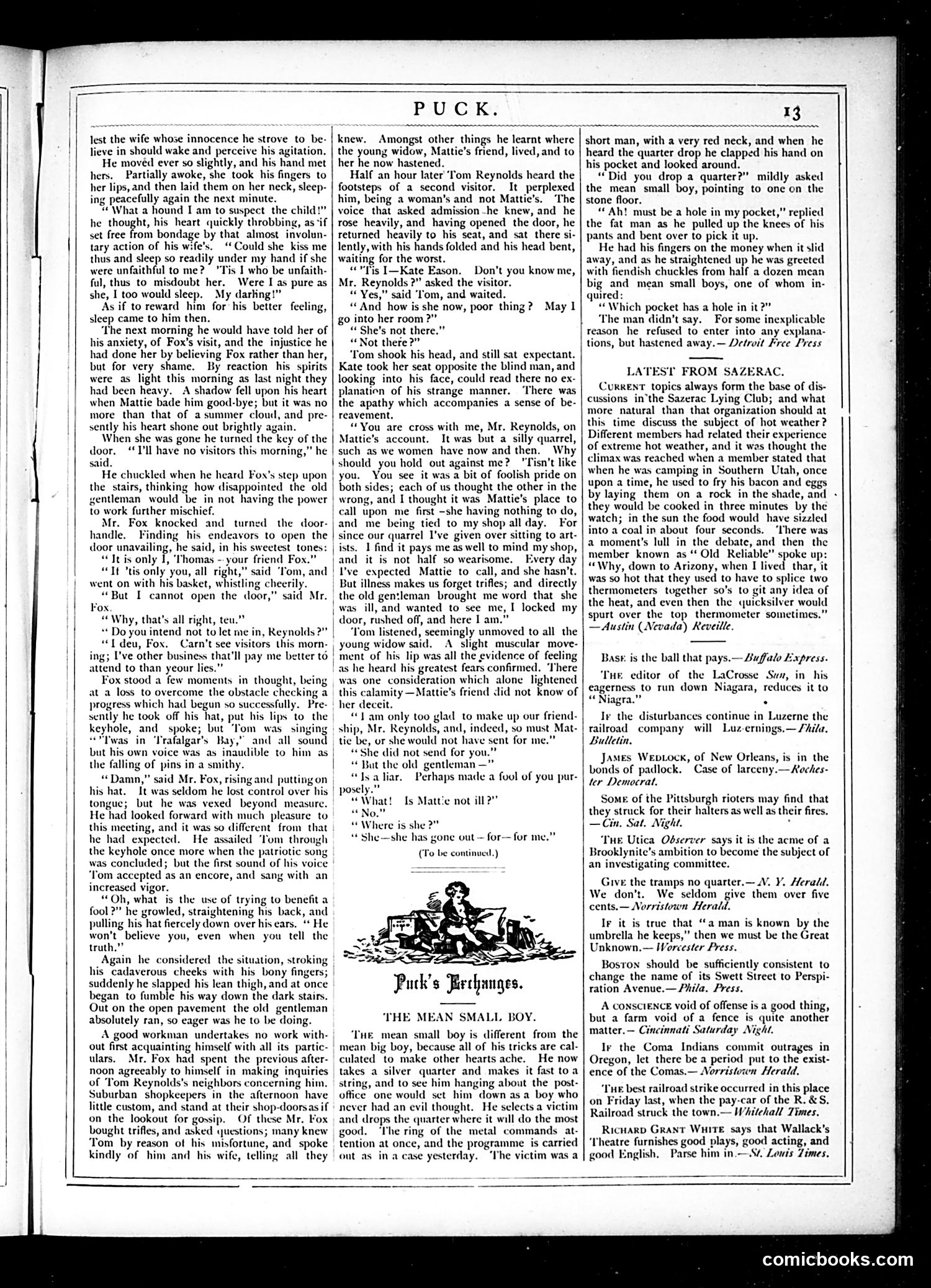
This page contains a serialized story ("Puck's Perplexities") about a "mean small boy" who tricks other children by making them believe he can perform magic with a silver quarter—getting them to hang it from a string and convincing them it will move. The story illustrates the boy's cruelty through various pranks. Below the main narrative is a section titled "Latest from Sazerac," which appears to be a humor column about the Sazerac Club, discussing hot weather and various practical jokes involving bacon and eggs. The page also includes brief satirical news items ("Puck's Brevities") commenting on contemporary issues like Pittsburgh riots and railroad labor disputes. This is primarily literary/humorous content rather than illustrated political satire.
This page appears to be primarily **text content rather than political cartoons**—it consists of short news items, jokes, and satirical commentary in column format typical of Puck magazine's "departments." While the OCR'd text includes various satirical jabs at contemporary figures and events (references to James Street strikes, railroad riots, Chicago riots, General Grant, and various social commentary), **I cannot see corresponding illustrations clearly enough in the image to identify specific caricatures or visual satire**. To properly explain the cartoons' meaning, I would need either: clearer visibility of illustrations on this page, or confirmation of which specific cartoon/image you'd like analyzed. The text alone references 1870s-era American politics and labor disputes, but without visual confirmation of depicted figures, I cannot accurately identify who is being satirized.
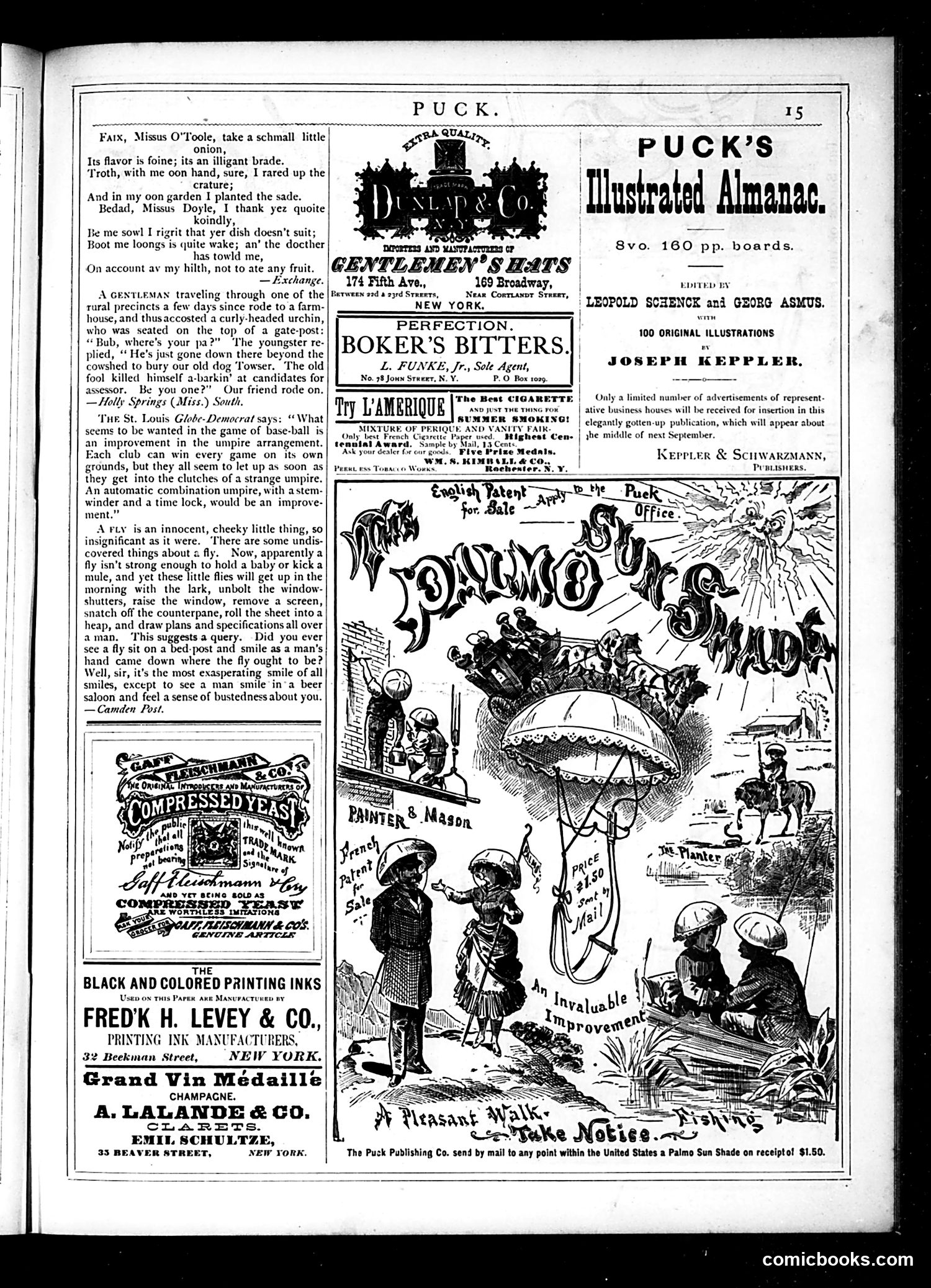
This page is primarily **advertisements and promotional material** rather than political satire. The main content includes ads for: - Gentlemen's hats (Dunlap & Co.) - Boker's Bitters - Tit L'Amerique cigarettes - Compressed yeast - Printing inks - Champagne The illustrated section on the right depicts **"Dynamos"** — appears to be a whimsical scene with umbrella-wielding figures in chaotic situations, labeled as "An Invaluable Improvement" and "A Pleasant Walk." The satirical intent seems to mock some product or social practice, though the specific reference is unclear without additional context. The page reflects Puck's business model: mixing light humor with substantial advertising revenue.
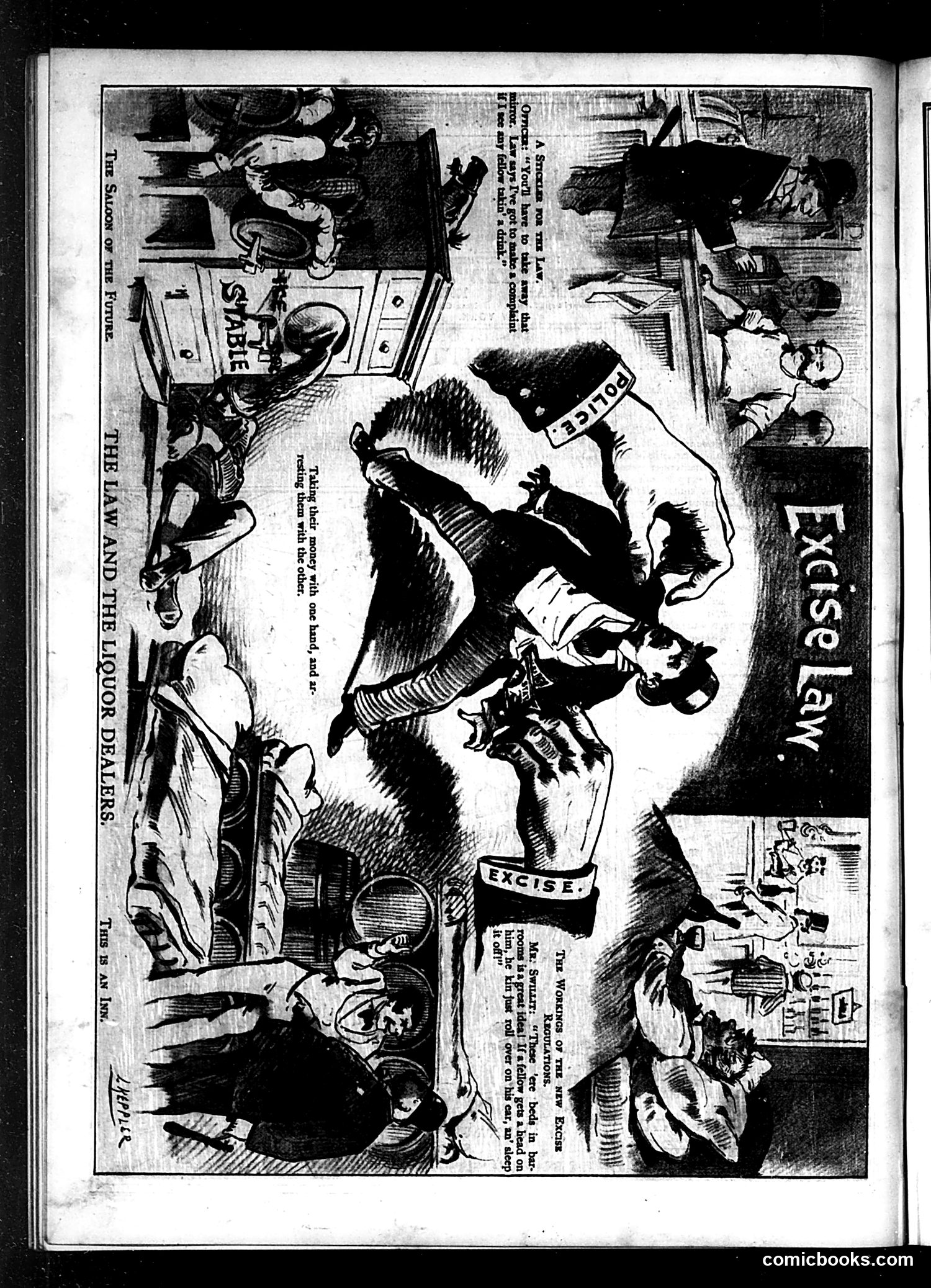
This page contains political satire centered on **"Excise"** (a tax), shown as a large figure dominating the composition. The cartoon appears to criticize excise taxation policy, depicting it as an oppressive force. The central figure labeled "EXCISE" looms over smaller human figures, likely representing ordinary citizens or taxpayers being burdened or crushed by tax obligations. Various smaller vignettes surround the main image, though specific details are difficult to read due to image quality. The satirical point appears to be **warning against or mocking excessive excise taxes** and their impact on the public. Without clearer text or date information visible, the exact historical context remains unclear, though excise tax debates were common in American political discourse throughout the 19th and early 20th centuries.