
Puck, 1877-08-15 · page 2 of 16
Puck — August 15, 1877 — page 2: what you’re looking at
What you’re looking at
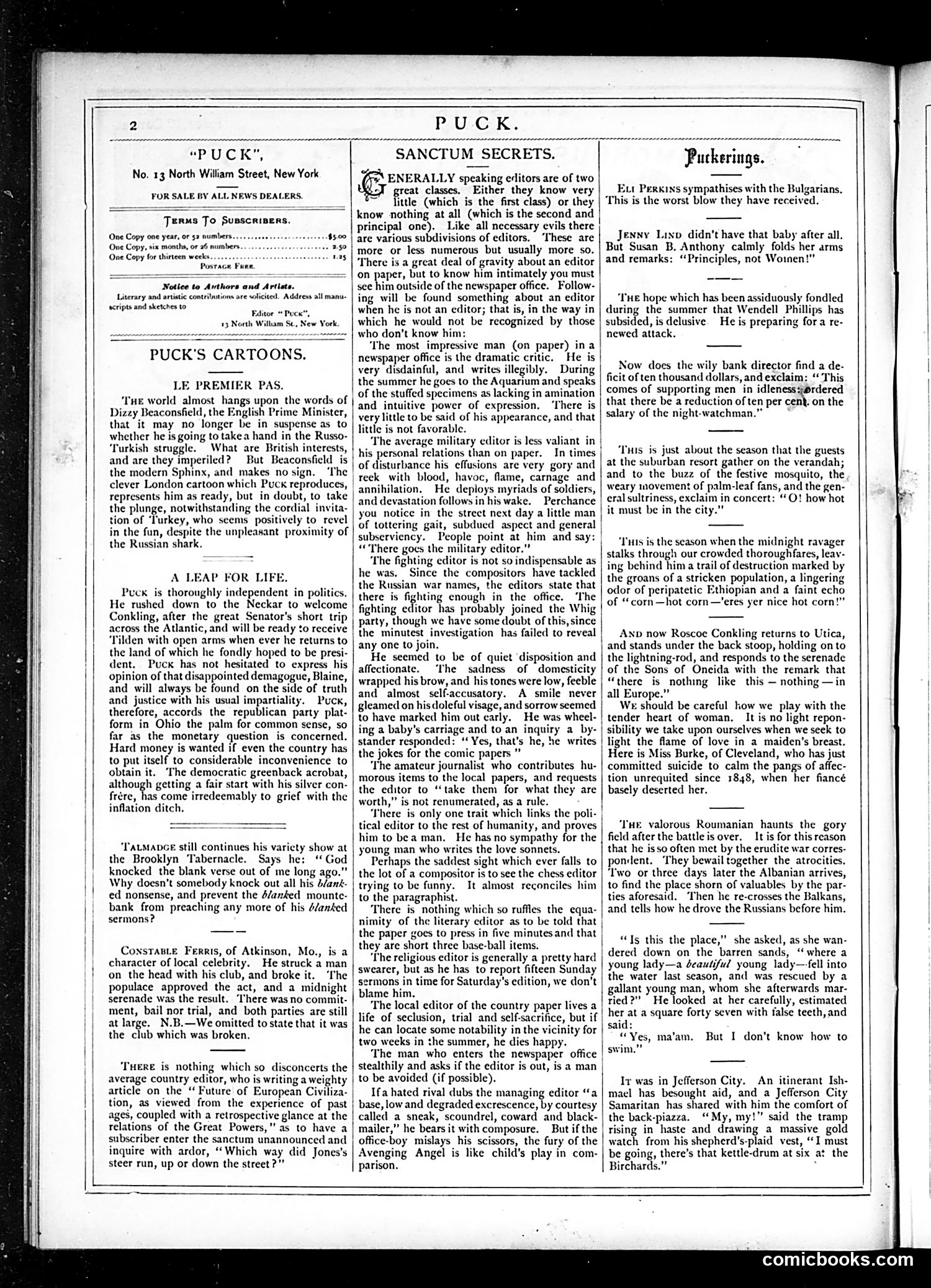
This page consists primarily of **text articles and commentary** rather than political cartoons. The main sections include: **"Sanctum Secrets"** — editorial observations about newspaper staff roles, describing various editor types (military editor, dramatic critic, chess editor, etc.) with satirical commentary on their quirks and foibles. **"Puckerings"** — brief satirical quips on current events, including references to Eli Perkins and the Bulgarians, Jenny Lind, and Wendell Phillips. **"Puck's Cartoons"** — announces "Le Premier Pas" (The First Step), though the actual cartoon image is not visible on this OCR'd page. The content targets **newspaper culture and journalism practices** of the era, mocking editorial pretensions and workplace dynamics. Without seeing the actual cartoon illustration, specific political figures or events cannot be identified.
📄 Transcribed text from this page (OCR, searchable)
Machine-transcribed from the original scan — historical spelling and the odd misread are preserved.
PUCK. “PUCK", No. 13 North William Street, New York FOR SALE BY ALL NEWS DEALERS. Terms To Sunscripers. One Copy one year, or 52 numbers... One Copy, six months, or 2 numbers. One Copy for thirteen weeks....+.6000+00+ Postrace Faure Notice to Anthors and Artists. Literary and artistic contributions are solicited. Address all manu- scripts and sketches to Editor “ Pec 15 North Willam Se, PUCK’S CARTOONS. LE PREMIER PAS. ‘Tne world almost hangs upon the words of Dizzy Beaconsfield, the English Prime Minister, that it may no longer be in suspense as to whether he is going to takea hand in the Russo- ‘Turkish struggle. What are British interests, and are they imperiled? But Beaconsfield is the modern Sphinx, and makes no sign. ‘The clever London cartoon which Puck reproduces, represents him as ready, but in doubt, to take the plunge, notwithstanding the cordial invita- tion of ‘Turkey, who seems’ posit in the fun, despite the unpleasant proximity of the Russian shark. A LEAP FOR LIFE, Puck is thoroughly independent in politics. He rushed down to the Neckar to welcome Conkling, after the great Senator's short trip across the Atlantic, and will be ready to receive the land of which he fondly hoped to be presi- dent, Puck has not hesitated to express his opinion of that disappointed demagogue, Blaine, and will always be found on the side of truth and justice with his usual impartiality. Puck, therefore, accords the republican party plat- form in Ohio the palm for common sense, so far as the monetary question is concerned. Hard money is wanted if even the country has to put itself to considerable inconvenience to obtain it. The democratic greenback acrobat, although getting a fair start with his silver con: | frére, has come irredeemably to grief with the inflation ditch. ‘Taumance still continues his varicty show at | the Brooklyn ‘Tabernacle. Says he: ‘God knocked the blank verse out of me long ago.” Why doesn’t somebody knock out all his b/ank- ed nonsense, and prevent the d/anked mounte- bank from preaching any more of his d/anked sermons? ConsTast eRRIS, Of Atkinson, Mo., is a character of local celebrity. He struck a man on the head with his club, and broke it. ‘The populace approved the act, and a midnight serenade was the result. ‘There was no commit- ment, bail nor trial, and both parties are still at large. N.B.—We omitted to state that it was the club which was broken. ‘Tuere is nothing which so disconcerts the average country editor, who is writing a weighty article on the “ Future of European Civiliza- tion, as viewed from the experience of past ages, coupled with a retrospective glance at the relations of the Great Powers," as to have a subscriber enter the sanctum unannounced and inquire with ardor, “Which way did Jones's steer run, up or down the street ?”” ely to revel | bones . | the minutest Tilden with open arms when ever he returns to SANCTUM SECRETS. ENERALLY speaking erlitors are of two reat classes. Either they know very Rite (which is the first class) or they know nothing at all (which is the second and principal one). ¢ all necessary evils there are various subdivisions of editors. more or less numerous but usually more so. ‘There is a great deal of gra about an editor ‘on paper, but to know him intimately you must see him outside of the newspaper office. Follow: ing will be found something about an editor when he is not an editor; that the way in which he would not be recognized by those who don’t know him ‘The most impressive man (on paper) ina newspaper office is the dramatic critic. He is very disdainful, and writes illegibly. During the summer he goes to the Aquarium and speaks of the stuffed specimens as lacking in amination and intuitive power of expression. ‘There is very little to be said of his appearance, and that little is not favorable. ‘The average military editor is less valiant in | his personal relations than on paper. In times of disturbance his effusions are very gory and reck with blood, havoc, flame, carnage and annihilation. He deploys myriads of soldiers, and devastation follows in his wake. Perchance you notice in the strect next day a little man | of tottering gait, subdued aspect and general subserviency. People point at him and say: | “There goes the military editor.” ‘The fighting editor is not so indispensable as he was. Since the compositors have tackled the Russian war names, the editors state that there is fighting enough in the office. ‘The fighting editor has probably joined the Whig party, though we have some doubt of this, since vestigation has failed to reveal | any one to join. He seemed to be of quiet ‘disposition and affectionate. ‘The sadness of domesticity wrapped his brow, and his tones were low, feeble and almost self-accusatory, A smile never gleamed on his doleful visage, and sorrow seemed to have marked him out carly. He was wheel- | ing a baby’s carriage and to an inquiry a by- | stander responded: ‘ Yes, that’s he, he writes | the jokes for the comic papers " | ‘The amateur journalist who contributes hu- morous items to the local papers, and requests the editor to “take them for what they are worth,” is not renumerated, as a rule. ‘There is only one trait which links the poli- tical editor to the rest of humanity, and proves him to bea man, He has no sympathy for the young man who writes the love sonnets. Perhaps the saddest sight which ever falls to the lot of a compositor is to see the chess editor trying to be funny. It almost reconciles him to the paragraphist. ‘There is nothing which so ruffles the equa- | nimity of the literary editor as to be told that | the paper goes to press in five minutes and that they are short three base-ball items. | ‘The religious editor is gencrally a pretty hard swearer, but as he has to report fifteen Sunday | sermons in time for Saturday's edition, we don’t | blame him. The local editor of the country paper lives a | life of seclusion, trial and self-sacrifice, but if he can locate some notability in the vicinity for two weeks in the summer, he dies happy. ‘The man who enters the newspaper office | stealthily and asks if the editor is out, isa man to be avoided (if possible). Ifa hated rival dubs the managing editor “a base, low and degraded excrescence, by courtesy called a sneak, scoundrel, coward and black- mailer,” he bears it with composure. But if the | office-boy mislays his scissors, the fury of the Avenging Angel is like child’s play in com- parison. Purkerings. — Ext Perkins sympathises with the Bulgarians, This is the worst blow they have received. Jenny Lixo didn’t have that baby after all, But Susan B, Anthony calmly folds her arms and remarks: “Principles, not Wornen!” ‘Ine hope which has been assiduously fondled during the summer that Wendell Phillips has subsided, is delusive. He is preparing fora re- newed attack. Now does the wily bank director find a de- ficit of ten thousand dollars, and exclaim: “ This comes of supporting men in idleness:@rdered that there be a reduction of ten per cent. on the salary of the night-watchman.” ‘Tris is just about the season that the guests at the suburban resort gather on the verandah; and to the buzz of the festive mosquito, the weary movement of palm-leaf fans, and the gen- eral sultriness, exclaim in concert: ‘‘O! how hot it must be in the city.” ‘I's is the season when the midnight ravager stalks through our crowded thoroughfares, leav- ing behind him a trail of destruction marked by the groans of a stricken population, a lingering odor of peripatetic Ethiopian and a faint echo of “corn—hot corn—'eres yer nice hot corn!” Anp now Roscoe Conkling returns to Utica, and stands under the back stoop, holding on to the lightning-rod, and responds to the serenade of the Sons of Oneida with the remark that “there is nothing like this — nothing —in all Europe.” We should be careful how we play with the tender heart of woman. It is no light repon- sibility we take upon ourselves when we seek to light the flame of love in a maiden’s breast. ere is Miss Burke, of Cleveland, who has just committed suicide to calm the pangs of affec- tion unrequited since 1848, when her fiancé basely deserted her. ‘Ie valorous Roumanian haunts the gory field after the battle is over. It is for this reason that he isso often met by the erudite war corres- pondent, They bewail together the atrocities. ‘Two or three days later the Albanian arrives, to find the place shorn of valuables by the par- ties aforesaid. ‘Then he re-crosses the Balkans, and tells how he drove the Russians before him. “(Ts this the place,” she asked, as she wan- dered down on the barren sands, “ where a young lady—a beautiful young lady—-fell into the water last season, and was rescued by a | gallant young man, whom she afterwards mar- | ried 2” He looked at her carefully, estimated her at a square forty seven with false teeth, and said: “Yes, ma’am. swim,” But I don’t know how to Ir was in Jefferson City. An itinerant Ish- mael has besought aid, and a Jefferson City Samaritan has shared with him the comfort of the back-piazza. “My, my!” said the tramp rising in haste and drawing a massive gold watch from his shepherd’s-plaid vest, ‘I must be going, there’s that kettle-drum at six at the Birchards.” * comicbooks.com