
Puck, 1877-08-15 · page 13 of 16
Puck — August 15, 1877 — page 13: what you’re looking at
What you’re looking at
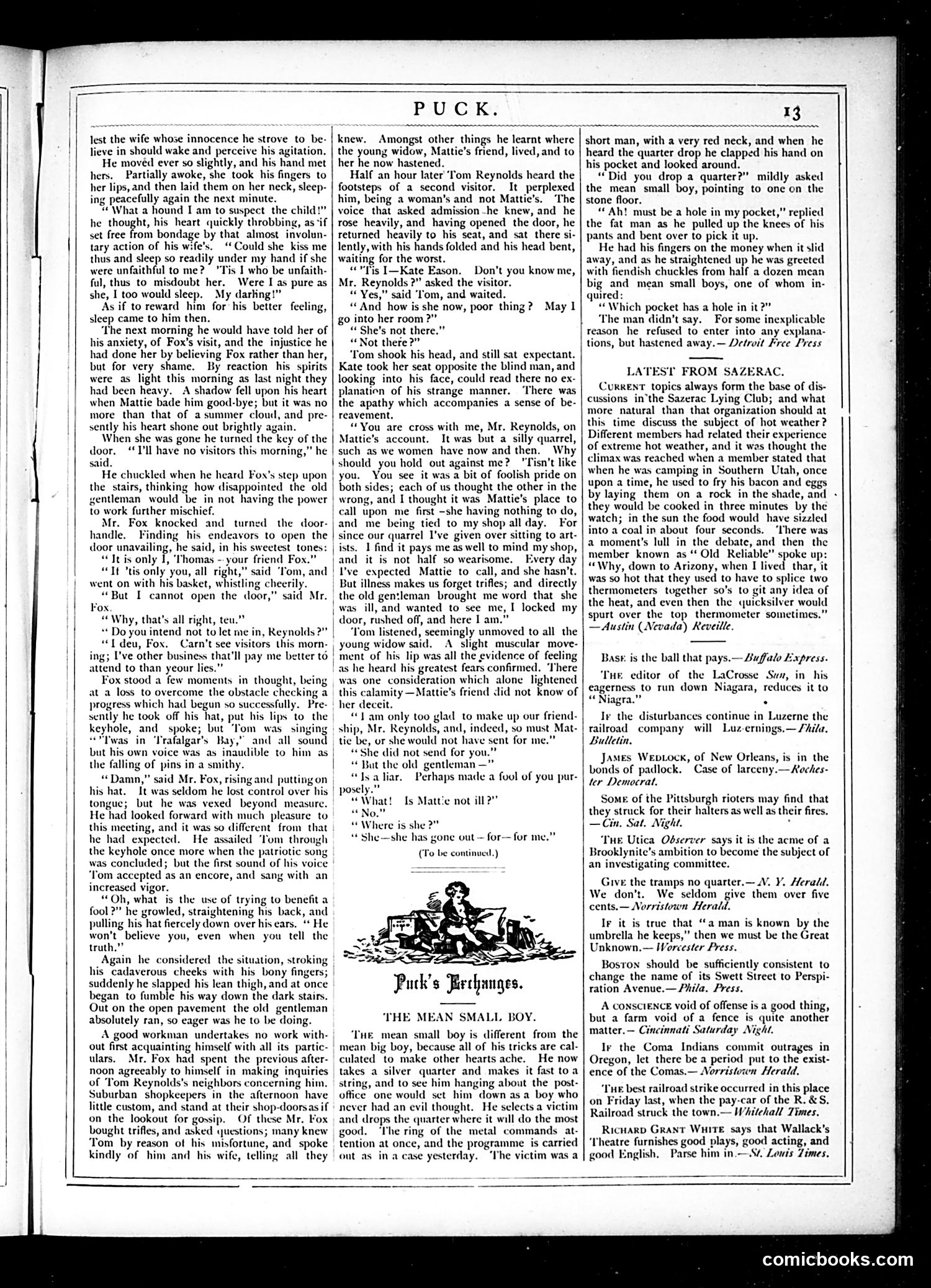
This page contains a serialized story ("Puck's Perplexities") about a "mean small boy" who tricks other children by making them believe he can perform magic with a silver quarter—getting them to hang it from a string and convincing them it will move. The story illustrates the boy's cruelty through various pranks. Below the main narrative is a section titled "Latest from Sazerac," which appears to be a humor column about the Sazerac Club, discussing hot weather and various practical jokes involving bacon and eggs. The page also includes brief satirical news items ("Puck's Brevities") commenting on contemporary issues like Pittsburgh riots and railroad labor disputes. This is primarily literary/humorous content rather than illustrated political satire.
📄 Transcribed text from this page (OCR, searchable)
Machine-transcribed from the original scan — historical spelling and the odd misread are preserved.
lest the wife whose innocence he strove to be- lieve in should wake and perceive his agitation. He movéd ever so slightly, and his hand met hers. Partially awoke, she took his fingers to her lips, and then laid them on her neck, sleep- ing peacefully again the next minute. “What a hound I am to suspect the child!” he thought, his heart quickly throbbing, as if set free from bondage | by that almost involun- tary action of his wife's. “Could she kiss me thus and sleep so readily under my hand if she were unfaithful to me? Tis I who be unfaith- ful, thus to misdoubt her. Were I as pure as she, I too would sleep. My darling!” if to reward him for his better feeling, sleep came to him then. ‘The next morning he would have told her of his anxiety, of Fox's visit, and the injustice he had done her by believing Fox rather than her, but for very shame. By reaction his. spirits were as light this morning as last night they had been heavy. A shadow fell upon his heart when Mattie bade him good-bye; but it was no more than that of a summer cloud, and pre- sently his heart shone out brightly again. When she was gone he turned the key of the door, ‘T'll have no visitors this morning,” he said. He chuckled when he heard Fox's step upon the stairs, thinking how disappointed the old gentleman would be in not having the power to work further mischief. Mr. Fox knocked and turned the door- handle. Finding his endeavors to open the door unavailing, he said, in his sweetest tones: “It is only I, Thomas - your friend Fox.” “Tt ’tis only you, all right,” said ‘Tom, and went on with his basket, whistling cheerily. “But I cannot open the door,” said Mr. Fox. “Why, that’s all right, teu.” * Do you intend not to let me in, Reynolds?” | “1 deu, Fox. Carn’t see visitors this morn- ing; I’ve other business that'll pay me better to | attend to than yeour lies.”” Fox stood a few moments in thought, li at_a loss to overcome the obstacle checking a progress which had begun so successfully. Pre- sently he took off his hat, put his lips to. the keyhole, and spoke; but ‘Tom was_ singing “twas in ‘Trafalgar’s Bay,” and all sound but his own voice was as inaudible to him as | the falling of pins in a smith “Damn,” said Mr. Fox, rising and putting on his hat tongue; but he was vexed beyond measure. He had looked forward with much pleasure to this meeting, and it was so different from that he had expected. He assailed ‘Yom through the keyhole once more when the patriotic song vas concluded; but the first sound of his vo ‘Tom accepted as an encore, and sang with an increased vigor. “Oh, what is the use of trying to benefit a fool ?” he growled, straightening his back, and pulling his hat fiercely down over his ears. ‘* He won't believe you, even when you tell the truth.” Again he considered the situation, stroking his cadaverous cheeks with his bony fingers; suddenly he slapped his lean thigh, and at once began to fumble his way down the dark stairs. Out on the open pavement the old gentleman absolutely ran, so eager was he to be doing. A good workman undertakes no work with- out first acquainting himself with all its partic- ulars. Mr. Fox had spent the previous after- noon agreeably to himself in making inquiries of Tom Reynolds's neighbors concerning him. Suburban shopkeepers in the afternoon ha little custom, and stand at their shop-doorsas if on the lookout for gossip. Of these Mr. Fox bought trifles, and asked questions; many knew Tom by reason ot his misfortune, and spoke kindly of him and his wife, telling all they ing jand It was seldom he lost control over his | knew. Amongst other things he learnt where the young widow, Mattie’s friend, lived, and to her he now hastened. Half an hour later ‘Tom Reynolds heard the footsteps of a second visitor. It perplexed him, being a woman's and not Mattie’s. The voice that asked admission-he knew, and he rose heavily, and having opened the door, he returned heavily to his seat, and sat there si- lently, with his hands folded and his head bent, waiting for the worst. «Tis I—Kate Eason. Don’t you know me, Mr. Reynolds ?” asked the visitor. “ Yes,” said ‘Yom, and waited. “ And how is she now, poor thing? May I go into her room ?” “She's not there,”” “Not there?” ‘Tom shook his head, and still sat expectant. Kate took her seat opposite the blind man, and looking into his face, could read there no ex- planation of his strange manner. ‘There was the apathy which accompanies a sense of be- reavement. “You are cross with me, Mr. Reynolds, on Mattie’s account. It was but a silly quarrel, such as we women have now and then. Why should you hold out against me? "Tisn’t like you. You see it was a bit of foolish pride on both sides; each of us thought the other in the wrong, and I thought it was Mattie’s place to call upon me first -she having nothing to do, and me being tied to my shop all day. For since our quarrel I've given over sitting to art- ists. 1 find it pays me as well to mind my shop, it is not half so wearisome. Every day I've expected Mattie to call, and she hasn’t. But illness makes us forget trifles; and directly the old gentleman brought me word that she was ill, and wanted to see me, I locked my door, rushed off, and here | am.” ‘Tom listened, seemingly unmoved to all the young widow said. A. slight muscular move- ment of his lip was all the evidence of feeling as he heard his greatest fears confirmed. There was one consideration which alone lightened this calamity —Mattie’s friend did not know of her deceit. “J am only too glad to make up our friend- ship, Mr. Reynolds, and, indeed, so must Mat- tie be, or she would not have sent for me.” “She did not send for you.” “ But the old gentleman —" “salir. Perhaps made a fool of you pur- Is Matt:e not ill?" “ Where is she ?” « She—she has gone out for—for me.” (To be continued.) Puck's Firchanges. ‘THE MEAN SMALL BOY. ‘THe mean small boy is different from the mean big boy, because all of his tricks are cal- culated to make other hearts ache. He now takes a silver quarter and makes it fast toa string, and to see him hanging about the post- office one would set him down as a boy who never had an evil thought. He selects a victim and drops the quarter where it will do the most good. ‘The ring of the metal commands at- tention at once, and the programme is carried out as ina case yesterday. ‘I'he victim was a short man, with a very red neck, and when he heard the quarter drop he clapped his hand on his pocket and looked around. “Did you drop a quarter?” mildly asked the mean small boy, pointing to one on the stone floor. “Ah! must be a hole in my pocket,” replied the fat man as he pulled up the knees of his pants and bent over to pick it up. He had his fingers on the money when it slid away, and as he straightened up he was greeted with fiendish chuckles from half a dozen mean big and mean small boys, one of whom in- quired: “Which pocket has a hole in it?” he man didn’t say. For some inexplicable reason he refused to enter into any explana- tions, but hastened away.— Detroit Free Press L t FROM ZERAC, Current topics always form the base of dis- cussions in’the Sazerac Lying Club; and what more natural than that organization should at this time discuss the subject of hot weather? Different members had related their experience of extreme hot weather, and it was thought the climax was reached when a member stated that when he was camping in Southern Utah, once upon a time, he used to fry his bacon and eggs by laying them on a rock in the shade, and they would be cooked in three minutes by the watch; in the sun the food would have sizzled into a coal in about four seconds. ‘here was a moment's lull in the debate, and then the member known as “ Old Reliable” spoke up: “Why, down to Arizony, when I lived thar, it was so hot that they used to have to splice two thermometers together so’s to git any idea of the heat, and even then the quicksilver would spurt over the top thermometer sometimes.” —Austin (Nevada) Reveille. Bast. is the ball that pays.— Buffalo Express. ‘Tne editor of the LaCrosse Sw, in his eagerness to run down Niagara, reduces it to “Niagra.” . Ir the disturbances continue in Luzerne the railroad company will Luz-ernings.— Fhila. Bulletin. James Weptock, of New Orleans, is in the bonds of padlock. Case of larceny.—Koches- ter Democrat. Some of the Pittsburgh rioters may find that k for their halters as well as their fires. —Cin, Sat. Night. ‘THe Utica Odserver says it is the acme of a Brooklynite’s ambition to become the subject of an investigating committee. jive the tramps no quarter.— 4. Y, Herald. We seldom give them over five cents.— Norristown Herald. Ir it is true that “aman is known by the umbrella he keeps,” then we must be the Great nknown.— Worcester Press. Boston should be sufficiently consistent to change the name of its Swett Street to Perspi- ration Avenue.— Phila. Press. A CONSCIENCE void of offense is a good thing, but a farm void of a fence is quite another matter.— Cincinnati Saturday Night. Ip the Coma Indians commit outrages in Oregon, let there be a period put to the e: ence of the Comas.. orristown Herald. ‘Tne best railroad strike occurred in this place on day last, when the pay-car of the R. &S. Railroad struck the town.— Whitehall Times. Ricnarp Grant Wuie says that Wallack’s : heatre furnishes good plays, good acting, and lish. Parse him in.—Sf. Louis Zin comicbooks.com