
Puck, 1877-08-15 · page 6 of 16
Puck — August 15, 1877 — page 6: what you’re looking at
What you’re looking at
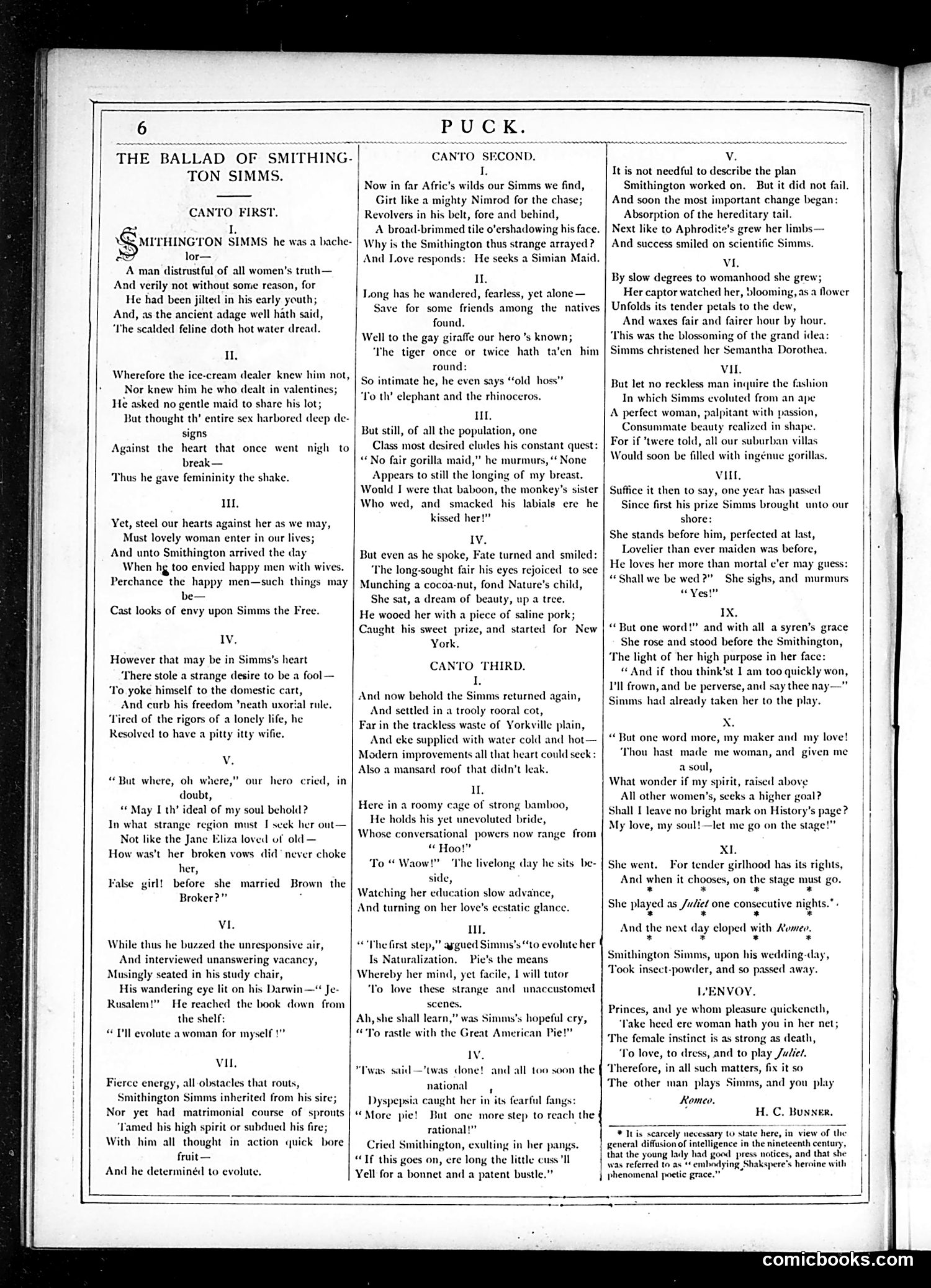
This page contains a satirical poem in multiple cantos rather than a visual cartoon. It tells the story of Smithington Simms, characterized as a shallow, vain man obsessed with acquiring a fashionable wife to elevate his social status. The satire targets Victorian-era social climbing and superficiality—Simms seeks a woman primarily for appearance and status rather than genuine connection. References to "Aphrodite's" beauty standards and his ultimately shallow courtship mock both masculine vanity and the era's commodification of women in marriage markets. The poem's elaborate, mock-heroic style parodies serious literature to ridicule trivial social ambitions. Without additional historical context about specific figures or events referenced, the satire appears primarily directed at general upper-class pretension and courtship customs of the Gilded Age.
📄 Transcribed text from this page (OCR, searchable)
Machine-transcribed from the original scan — historical spelling and the odd misread are preserved.
THE BALLAD OF SMITHING- TON SIMMS. CANTO FIRST. 16 GS urrscrow SIMMS he was a bache- e& lor— A man distrustful of all women’s truth— And verily not without some reason, for He had been jilted in his early youth; And, as the ancient adage well hath said, ‘The scalded feline doth hot water dread. Il. Wherefore the ice-cream dealer knew him not, Nor knew him he who dealt in valentines; He asked no gentle maid to share his lot; But thought th’ entire sex harbored deep de- signs Against the heart that once went nigh to break— Thus he gave femininity the shake. Ml. Yet, steel our hearts against her as we may, Must lovely woman enter in our lives; And unto Smithington arrived the day When hg too envied happy men with wives. Perchance the happy men—such things may be— Cast looks of envy upon Simms the Free. Iv, However that may be in Simms’s heart ‘There stole a strange desire to be a fool— ‘To yoke himself to the domestic cart, And curb his freedom ‘neath uxori: ‘Tired of the rigors of a lonely life, he Resolved to have a pitty itty wifie. I rule. Vv. “But where, oh where,” our hero cried, in doubt, «May I th’ ideal of my soul behold? In what strange region must I seek her out— Not like the Jane Eliza loved of old — How was’t her broken vows did’ never choke her, False girl! before she married Brown the Broker?” . Vi. While thus he buzzed the unresponsive air, And interviewed unanswering vacancy, Musingly seated in his study chair, His wandering eye lit on his Darwin —“ Je- Rusalem!” He reached the book down from the shelf: “Tl evolute a woman for myself !” Vi. Fierce energy, all obstacles that routs, Smithington Simms inherited from his sire; Nor yet had matrimonial course of sprouts ‘famed his high spirit or subdued his fire; With him all thought in action quick bore fruit— And he determinéd to evolute, | But still, of all the population, one PUCK. OND. CANTO SE I. Now in far Afric’s wilds our Simms we find, Girt like a mighty Nimrod for the chase; Revolvers in his belt, fore and behind, A broad-brimmed tile o’ershadowing his face. Why is the Smithington thus strange arrayed ? And Love responds: He seeks a Simian Maid. Il. Long has he wandered, fearless, yet alone — 3: for some friends among the natives found. Well to the gay giraffe our hero ’s known; ‘The tiger once or twice hath ta’en him round: So intimate he, he even says “old hoss’’ ‘Yo tl’ elephant and the rhinoceros. Il. Class most desired eludes his constant quest: “No fair gorilla maid,” he murmurs, ‘‘ None Appears to still the longing of my breast. Wonld I were that baboon, the monkey's sister Who wed, and smacked his labials ere he kissed her!” Iv. But even as he spoke, Fate turned and smiled: ‘The long-sought fair his eyes rejoiced to see Munching a cocoa-nut, fond Nature’s child, She sat, a dream of beauty, up a tree. He wooed her with a piece of saline porl Caught his sweet prize, and started for New York. CANTO THIRD. I, And now behold the Simms returned again, And settled in a trooly rooral cot, Far in the trackless waste of Yorkville plain, And eke supplied with water cold and hot— Modern improvements all that heart could seek: Also a mansard roof that didn’t leak. W. Here in a roomy cage of strong bamboo, He holds his yet unevoluted bride, Whose conversational powers now range from “ Hoo!” ‘To “ Waow!"” side, Watching her education slow advance, And turning on her love's ecstatic glan ‘The livelong day he sits be- il. “The first step,” aggued Simmns's “to evolute her Is Naturalization. Pie's the means Whereby her mind, yet facile, 1 will tutor ‘Yo love these strange and unaccustomed scenes. Ah, she shall learn,” was Simms’s hopeful cry, “To rastle with the Great American Pie!” IV. "Lwas. said —'twas done! and all too soon the national =, caught her in its fearful fangs: But one more step to reach the rational!” Dyspepsi “More pie! Cried Smithington, exulting in her pangs. Vv. It is not needful to describe the plan Smithington worked on. But it did not fail. And soon the most important change began: Absorption of the hereditary tail Next like to Aphrodite's grew her limbs— And success smiled on scientific Simms. Vi. By slow degrees to womanhood she grew; Her captor watched her, Slooming, as a flower Unfolds its tender petals to the dew, And waxes fair and fairer hour by hour. ‘This was the blossoming of the grand idea: Simms christened her Semantha Dorothea. Vi. But let no reckless man inquire the fashion In which Simms evoluted from an ape A perfect woman, palpitant with passion, Consummate beauty realized in shape. For if ’twere told, all our suburban vill: Would soon be filled with ingénue gorillas, VU. Suffice it then to say, one year has passed Since first his prize Simms brought unto our shore: She stands before him, perfected at last, Lovelier than ever maiden was before, He loves her more than mortal c’er may gues “Shall we be wed ?” She sighs, and murmurs “Yes!” IX, “ But one word!” and with all a syren’s grace She rose and stood before the Smithington, ‘The light of her high purpose in her face: “And if thou think’st I am too quickly won, I'll frown, and be perverse, and say thee nay—” Simms had already taken her to the play. “ But one word more, my maker and my love! ‘Thou hast made me woman, and given me asoul, What wonder if my spirit, rais All other women’s, seeks a higher goal? Shall I leave no bright mark on History's page? My love, my soul!—let me go on the stage!” ed above Xi. She went. For tender girlhood has its rights, And when it chooses, on the stage must go. * * * * She played as /w/ief one consecutive nights.” « * * * * And the next day eloped with Aomeo, * * * * Smithington Simms, upon his wedding-day, Took insect-powder, and so passed away. ENVOY. Princes, and ye whom pleasure quickeneth, ‘fake heed ere woman hath you in her net; The female instinct is as strong as death, ‘To love, to dress, and to play Juliet. ‘Therefore, in all such matters, fix it so The other man plays Simms, and you play Komeo, ER. H.C, Buns * tis scarcely necessary to state here, in view of the | general diffusion of intelligence in the nineteenth century, that the young lady had good press notices, and that she “If this goes on, ere long the little cuss ‘Il Yell for a bonnet and a patent bustle.” | was referred to as “ embndying Shakspere’s heroine with | phenomenal poetic grace.” comicbooks.com