
Puck, 1877-08-15 · page 3 of 16
Puck — August 15, 1877 — page 3: what you’re looking at
What you’re looking at
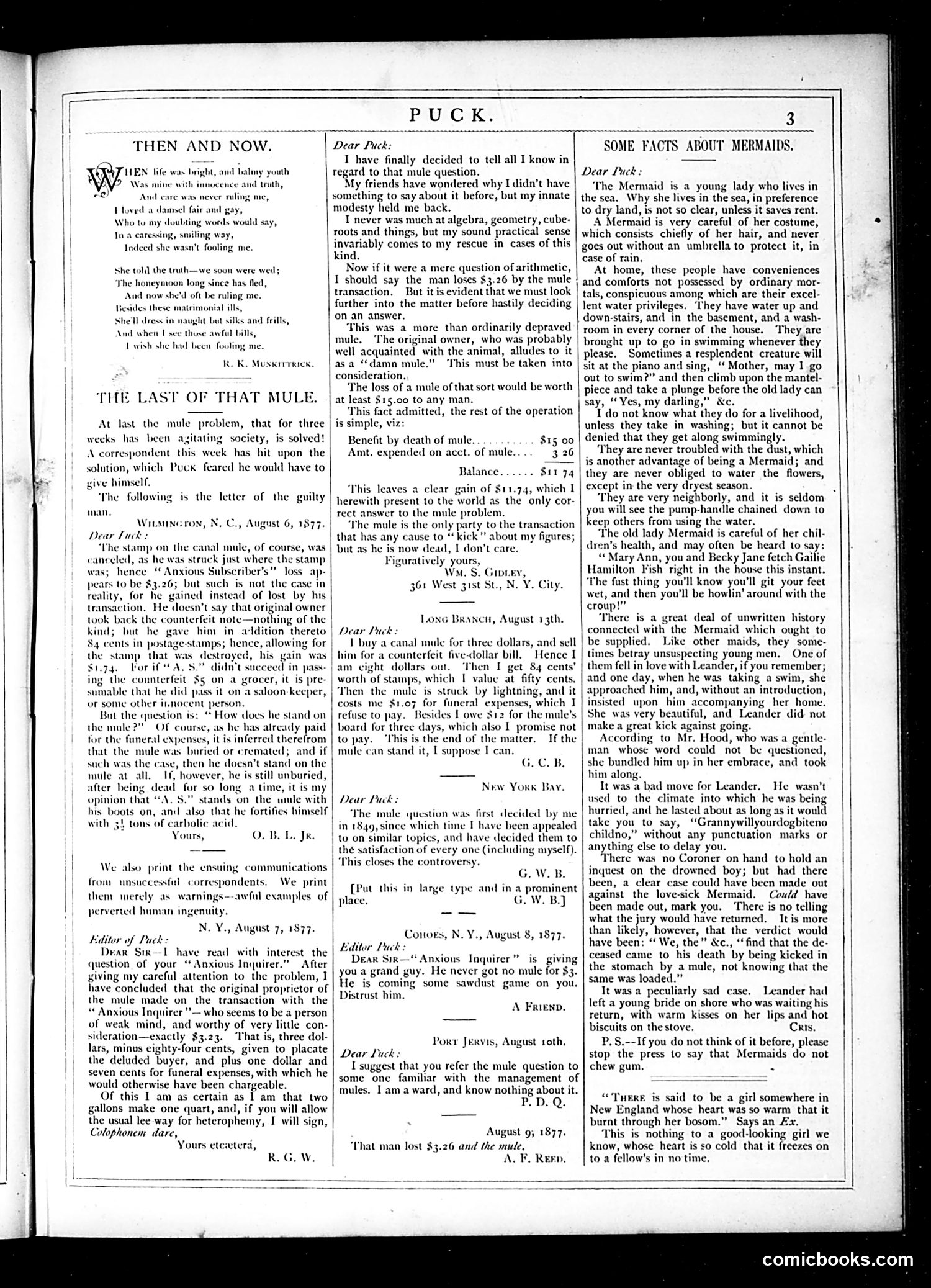
This page consists entirely of **reader letters and editorial responses** — no political cartoons or satirical illustrations are present. The content addresses three humorous topics: 1. **"The Last of That Mule"** — A correspondent reports on an ongoing joke about a canal mule, with calculations of its funeral expenses ($13.50 plus $3.26 in costs). 2. **"Some Facts About Mermaids"** — A whimsical response about a mermaid's domestic habits and peculiarities. 3. **Various other reader inquiries** — Including questions about counterfeits, a drowning incident, and personal matters. The satire is gentle, relying on wordplay and absurdist humor rather than political commentary. This appears to be a **letters-to-the-editor section** showcasing Puck's humorous editorial voice and reader engagement, typical of late-19th-century magazine format.
📄 Transcribed text from this page (OCR, searchable)
Machine-transcribed from the original scan — historical spelling and the odd misread are preserved.
THEN AND NOW. PAT EN life was bright, 9 Was mine w ¢ was never ruling me, outh 1 innocence and truth, Who tu my doubti Ina caressing, smiling way, Indeed she wasn’t fooling me. She told the trath—we soon were wed; ‘The honeymoon long since has fled, And now sh Hevides these She'll dress in naught but silks and frills, And when F see those awful bills, T wish she had been fouling me, K. K. Muxgirrrick. THE LAST OF THAT MUL At last the mule problem, weeks has been agi that for three ting society, is solved! A correspondent this week has hit upon the | solution, which Puck feared he would have to give himself. ‘The man, following is the letter of the guilty Witauneros, N.C, Dear Luck: ‘The stamp on the canceled, as he was struc w hence “ Anxious pears to be $3.26 reality, for he g, transaction, August 6, 1877. al mule, of course, was the stamp He doesn’t say that original owner took k the counterfeit note—nothing of the kind; but he gave him in 84 cents in postage-stamps; hene: the stamp that was destroyed Suz. For if ” didn’t succeed in-pass- ing the counterfeit ey on a grocer, it is pre- sumable that he did pass it on a saloon keeper, or some other innocent person. But the question is: ‘ How does he stand on the mule?” OF course, as he has already paid for the funeral expenses, it is inferred therefrom allowing for his gain was that the mule was buried or cremated; and if | such was the case, then he doesn’t stand on the mule at all. If, however, he is still unburied, after being dead for so long a time, it is my opinion that “A.S." stands on the mule with his boots on, and also that he fortifies himself | with 34 tons of carbolic acid. Yours, O. BLL. Jr. We also print the ensuing communications from unsuccessful: correspondents. We print them merely as) warnings—-awful examples. of perverted human ingenuity. N. Y., August 7, 1877. Editor of Puck: Dear Sik—-1 have read with interest the question of your “ Anxious Inquirer.” After giving my careful attention to the problem, I have concluded that the original proprietor of the mule made on the transaction with the | “ Anxious Inquirer "— who seems to be a person of weak mind, and worthy of very little con- sideration—exactly $3.23. ‘That is, three dol- lars, minus eighty-four cents, given to placate the deluded buyer, and plus one dollar and seven cents for funeral expenses, with which he would otherwise have been chargeable. Of this I am as certain as I am that two | gallons make one quart, and, if you will allow the usual lee-way for heterophemy, I will sign, Colophonem dare, Yours etcivterd, loss ap- | ; but such is not the case in | ned instead of lost by his awidition thereto | | costs me | Editor Puc Dear Puck: I have finally decided to tell all I know in regard to that mule question. My friends have wondered why I didn’t have something to say about it before, but my innate modesty held me back. T never was much at algebra, geometry, cube- roots and things, but my sound practical sense invariably comes to my rescue in cases of this | kind. Now if it were a mere question of arithmetic, I should say the man loses $3.26 by the mule transaction. But it is evident that we must look further into the matter before hastily deciding | on an answer. ‘This was a more than ordinarily depraved mule. ‘The original owner, who was probably well acquainted with the animal, alludes to it asa ‘damn mule.” ‘This must be taken into consideration. The loss of a mule of that sort would be worth at least $15.00 to any man. ‘This fact admitted, the rest of the operation is simple, vi Benefit by death of mule.. Amt. expended on acct. of mule... Balance ‘This leaves a clear gain of $11.74, which I herewith present to the world as the only cor- rect answer to the mule problem. ‘The mule is the only party to the transaction that has any cause to “kick” about my figure: but as he is now dead, I don't care. Figuratively yours, We. S. Gipe Lone Brancu, August 13th, Dear Pu 1 buy a canal mule for three dollars, and sell him for a counterfeit fi ollar bill. Hence I am cight dollars out. ‘Then I get 84 cents’ worth of stamps, which I value at fifty cents. ‘Then the mule is struck by lightning, and it 07 for funeral expenses, which I refuse to pay. Besides | owe $12 for the mule’s board for three days, which also I promise not to pay. ‘This is the end of the matter. If the mule can stand it, I suppose I can. G.C.B, New York Bay. Dear Puck: ‘The mule question was first decided by me in 1849, since which time I have been appealed to on similar topics, and have decided them to | the satisfaction of every one (including myself). ‘This closes the controversy. G.W. BL prominent W. BJ [Put this in large type and i place. Conors, N.Y., August 8, 1877. Deak Sik—" Anxious Inquirer" is giving you a grand guy. He never got no mule for $3. He is coming some sawdust game on you. Distrust him. A Frienp. Porr Jervis, August 10th, Dear Luck I suggest that you refer the mule question to some one familiar with the management of mules, I am a ward, and know nothing about it. P.D.Q. August 9; 1877. ‘That man lost $3.26 and the mule, "SOME FACTS ABOUT MERMAIDS. Dear Puck: ‘The Mermaid is a young lady who lives in the sea. Why she lives in the sea, in preference to dry land, is not so clear, unless it saves rent. A Mermaid is very careful of her costume, which consists chiefly of her hair, and never goes out without an umbrella to protect it, in case of rain. At home, these people have conveniences and comforts not possessed by ordinary mor- tals, conspicuous among which are their excel- lent water privileges. They have water up and down-stairs, and in the basement, and a wash- room in every corner of the house. They are brought up to go in swimming whenever they please. Sometimes a resplendent creature will sit at the piano and sing, “ Mother, may 1 go out to swim?” and then climb upon the mantel- piece and take a plunge before the old lady can say, “Yes, my darling,” &c. T do not know what they do for a livelihood, unless they take in washing; but it cannot be denied that they get along swimmingly. ‘They are never troubled with the dust, which is another advantage of being a Mermaid; and they are never obliged to water the flowers, except in the very dryest season ‘They are very neighborly, and_it is seldom you will see the pump-handle chained down to keep others from using the water. ‘The old lady Mermaid is careful of her chil- dren’s health, and may often be heard to say: Mary Ann, you and Becky Jane fetch Gailic Hamilton Fish right in the house this instant. ‘The fust thing you'll know you'll git your feet t, and then you'll be howlin’ around with the croup ‘There great deal of unwritten history connected with the Mermaid which ought to be supplied. Like other maids, they some- times betray unsuspecting young men. One of them fell in love with Leander, if you remember; and one day, when he was taking a swim, she approached him, and, without an introduction, insisted upon him accompanying her home. She was very beautiful, and Leander did not make a great kick against going. According to Mr. Hood, who was a gentle- man whose word could not be questioned, she bundled him up in her embrace, and took him along. Tt was a bad move for Leander. He wasn't used to the climate into which he was being hurried, and he lasted about as long as it would take you to say, ‘Grannywillyourdogbiteno childno,” without any punctuation marks or anything else to delay you. ‘There was no Coroner on hand to hold an inquest on the drowned boy; but had there been, a clear case could have been made out against the love-sick Mermaid. Could have been made out, mark you. ‘There is no telling what the jury would have returned. It is more than likely, however, that the verdict would have been: ‘ We, the” &c., ‘find that the de- ceased came to his death by being kicked in the stomach by a mule, not knowing that the same was loaded It was a peculiarly sad case. Leander had left a young bride on shore who was waiting his return, with warm kisses on her lips and hot biscuits on the stove. Cris. P.S.--If you do not think of it before, please stop the press to say that Mermaids do not chew gum. “Tuere is said to be a girl somewhere in New England whose heart was so warm that it burnt through her bosom.” Says an Ex. This is nothing to a good-looking girl we know, whose heart cold that it freezes on to a fellow's in no time. comicbooks.com