
Puck, 1877-08-15 · page 10 of 16
Puck — August 15, 1877 — page 10: what you’re looking at
What you’re looking at
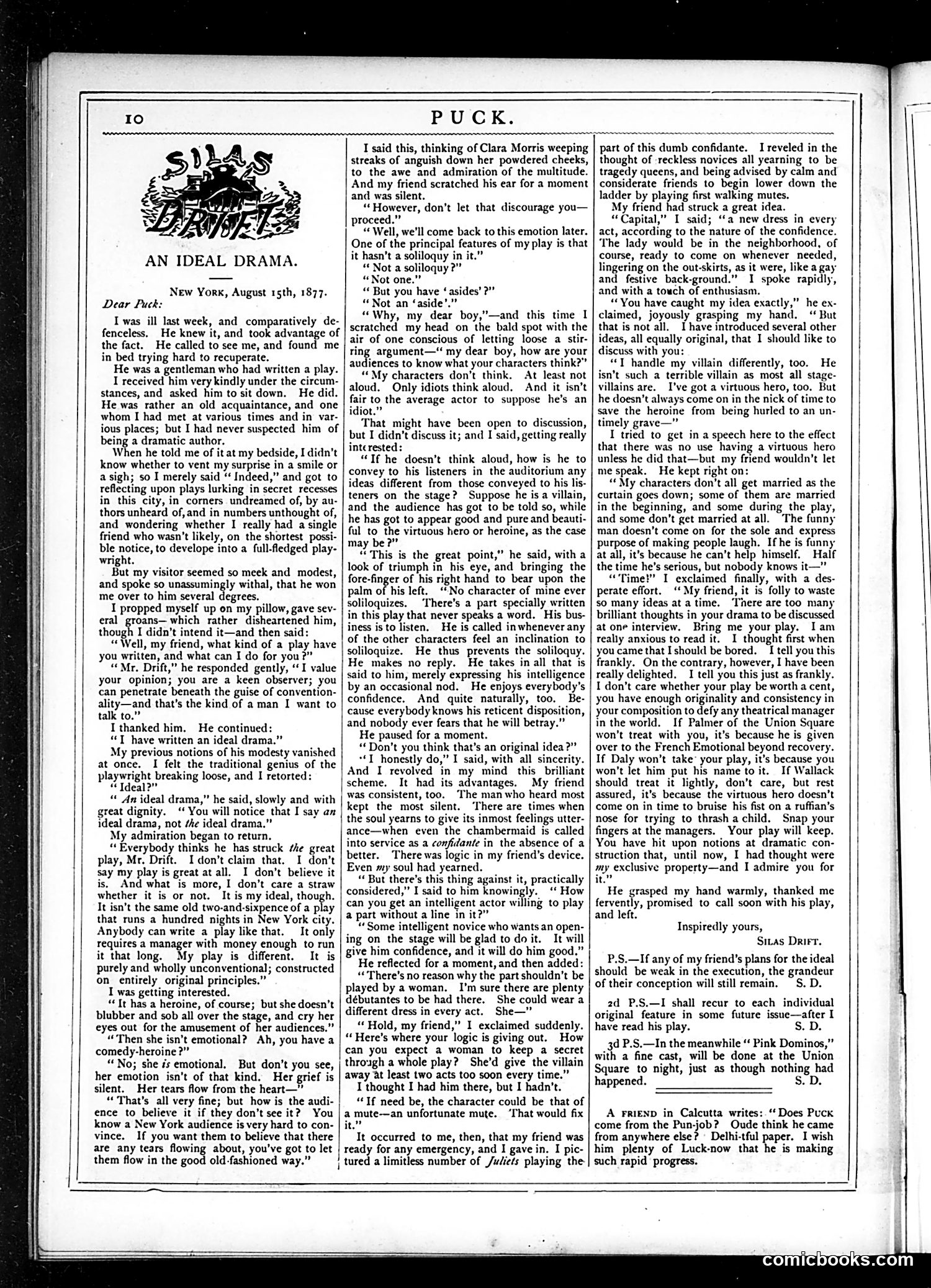
This page is primarily a **letter to the editor** from playwright Silas Drift discussing theatrical principles, not a political cartoon. Drift argues that ideal drama requires characters who think silently rather than delivering constant soliloquies—a technical criticism of contemporary stage conventions. He defends his own play against a visitor's critique, asserting that intelligent audiences prefer subtle character development over explicit exposition. The letter addresses theatrical realism versus artifice: Drift insists good drama should reveal character through action and restraint, not through characters constantly explaining themselves to the audience. This reflects late 19th-century debates about modern versus traditional playwriting techniques. The "Puck" masthead indicates this is satirical commentary on theater culture and dramatic theory of 1877.
📄 Transcribed text from this page (OCR, searchable)
Machine-transcribed from the original scan — historical spelling and the odd misread are preserved.
PUCK. AN IDEAL DRAMA. New York, August 15th, 1877. Dear Puck: I was ill last week, and comparatively de- fenceless. He knew it, and took advantage of the fact. He called to see me, and found me in bed trying hard to recuperate. He was a gentleman who had written a play. I received him very kindly under the circum- stances, and asked him to sit down. He did. He was rather an old acquaintance, and one whom I had met at various times and in var- ious places; but I had never suspected him of being a dramatic author, en he told me of it at my bedside, I didn’t know whether to vent my surprise in a ‘smile or a sigh; so I merely said “ Indeed,” and got to reflecting upon plays lurking in secret recesses in this city, in corners undreamed of, by au- thors unheard of, and in numbers unthought of, and wondering whether I really had a single friend who wasn't likely, on the shortest possi- ble notice, to develope into a full-fledged play- wright. But my visitor seemed so meek and modest, and spoke so unassumingly withal, that he won me over to him several degrees. I propped myself up on my pillow, gave sev- eral groans— which rather disheartened him, though I didn’t intend it—and then said: “Well, my friend, what kind of a play have you written, and what can I do for you?” “Mr. Drift,” he responded gently, “I value your opinion; you are a keen observer; you can penetrate beneath the guise of convention- ality—and that’s the kind of a man I want to talk to.” Ithanked him. He continued: “T have written an ideal drama.” My previous notions of his modesty vanished at once. I felt the traditional genius of the vlaywright breaking loose, and I retorted: “Ide: “An eal drama,” he said, slowly and with great dignity. “ You will notice that I say an ideal drama, not ¢he ideal drama.” My admiration began to return. “ Everybody thinks he has struck she great play, Mr. Drift. Idon’t claim that. I don’t say my play is great at all. I don’t believe it is. And what is more, I don’t care a straw whether it is or not. It is my ideal, though. It isn’t the same old two-and-sixpence of a play that runs a hundred nights in New York city. Anybody can write a play like that. It only requires a manager with money enough to run it that long. My play is different. It is purely and wholly unconventional; constructed on entirely original principles.” I was getting interested. “It has a heroine, of course; but she doesn’t blubber and sob all over the stage, and cry her eyes out for the amusement of her audiences.” “Then she isn’t emotional? Ah, you have a comedy-heroine ?” ‘No; she és emotional. But don’t you see, her emotion isn't of that kind. Her grief is silent. Her tears flow from the heart—” “That's all very fine; but how is the audi- ence to believe it if they don’t see it? You know a New York audience is very hard to con- vince. If you want them to believe that there are any tears flowing about, you've got to let them flow in the good old-fashioned way.” I said this, thinking of Clara Morris weeping streaks of anguish down her powdered cheeks, to the awe and admiration of the multitude. And my friend scratched his ear for a moment and was silent. “However, don’t let that discourage you— proceed.” “Well, we'll come back to this emotion later. One of the principal features of my play is that it hasn't a soliloquy in it.” “Not a soliloquy?” “Not one.” “But you have ‘asides’ ?” “Not an ‘aside’.” “Why, my dear boy,”—and this time I scratched my head on the bald spot with the air of one conscious of letting loose a stir- ring argument— my dear boy, how are your audiences to know what your characters think?” “My characters don’t think. At least not aloud. Only idiots think aloud. And it isn’t fair to the average actor to suppose he’s an idiot.” That might have been open to discussion, but I didn’t discuss it; and I said, getting really interested: “Tf he doesn’t think aloud, how is he to convey to his listeners in the auditorium any ideas different from_ those conveyed to his lis- teners on the stage? Suppose he is a villain, and the audience has got to be told so, while he has got to appear good and pure and beauti- ful to the virtuous hero or heroine, as the case may be?” “This is the great point,” he said, with a look of triumph in his eye, and bringing the fore-finger of his right hand to bear upon the palm of his left. ‘No character of mine ever soliloquizes. ‘There’s a part specially written in this play that never speaks a word. His bus- iness is to listen. He is called inwhenever any of the other characters feel an inclination to soliloquize. He thus prevents the soliloquy. He makes no reply. He takes in all that is said to him, merely expressing his intelligence by an occasional nod. He enjoys everybody's confidence. And quite naturally, too, Be- cause everybody knows his reticent disposition, and nobody ever fears that he will betray.” He paused for a moment. “Don’t you think that’s an original idea?” “I honestly do,” I said, with all sincerity. And I revolved my mind this brilliant scheme. It had its advantages. My friend was consistent, too. ‘The man who heard most kept the most silent. ‘There are times when the soul yearns to give its inmost feelings utter- ance—when even the chambermaid is called into service as a confidante in the absence of a better. There was logic in my friend’s device. Even my soul had yearned. “ But there's this thing against it, practically considered,” I said to him knowing]: “How can you get an intelligent actor willing to play a part without a line in it?” “Some intelligent novice who wants an open- ing on the stage will be glad to doit. It will give him confidence, and it will do him good.” He reflected for a moment, and then added: “There's no reason why the part shouldn’t be played by a woman. I'm sure there are plenty débutantes to be had there. She could wear a different dress in every act. She—” “Hold, my friend,” I exclaimed suddenly. “ Here's where your logic is giving out. How can you expect a woman to keep a secret through a whole play? She'd give the villain away at least two acts too soon every time.” I thought I had him there, but I hadn’t. “Tf need be, the character could be that of a mute—an unfortunate mute. ‘That would fix it.’ It occurred to me, then, that my friend was | ready for any emergency, and I gave in. I pic- | tured a limitless number of vjulices playing the part of this dumb confidante. I reveled in the thought of -reckless novices all yearning to be tragedy queens, and being advised by calm and considerate friends to begin lower down the ladder by playing first walking mutes. My friend had struck a great idea. “Capital,” I said; “a new dress in every act, according to the nature of the confidence. ‘The lady would be in the neighborhood, of course, ready to come on whenever needed, lingering on the out-skirts, as it were, like a gay and festive back-ground.” I spoke rapidly, and with a touch of enthusiasm. “You have caught my idea exactly,” he ex- claimed, joyously grasping my hand. “But that is not all. I have introduced several other ideas, all equally original, that I should like to discuss with you: “T handle my villain differently, too. He isn’t such a terrible villain as most all stage- villains are. I've got a virtuous hero, too. But he doesn’t always come on in the nick of time to save the heroine from being hurled to an un- timely grave—"" I tried to get in a speech here to the effect that there was no use having a virtuous hero unless he did that—but my friend wouldn’t let me Speak. He kept right on: «My characters don’t all get married as the curtain goes down; some of them are married in the beginning, and some during the play, and some don’t get married at all. The funny man doesn’t come on for the sole and express purpose of making people laugh. If he is funny at all, it’s because he can’t help himself. Half the time he’s serious, but nobody knows it—” “Time!” I exclaimed finally, with a des- perate effort. ‘ My friend, it is folly to waste so many ideas ata time. ‘There are too many brilliant thoughts in your drama to be discussed at one interview. Bring me your play. Iam really anxious to read it. I thought first when you came that I should be bored. I tell you this frankly. On the contrary, however, I have been really delighted. I tell you this just as frankly. I don’t care whether your play be worth a cent, you have enough originality and consistency in your composition to defy any theatrical manager in the world. If Palmer of the Union Square won't treat with you, it’s because he is given over to the French Emotional beyond recovery. If Daly won't take’ your play, it’s because you won't let him put his name to it. If Wallack should treat it lightly, don’t care, but rest assured, it's because the virtuous hero doesn’t come on in time to bruise his fist on a ruffian’s nose for trying to thrash a child. Snap your fingers at the managers. Your play will keep. You have hit upon notions at dramatic con- struction that, until now, I had thought were my. exclusive property—and I admire you for it.” He grasped my hand warmly, thanked me fervently, promised to call soon with his play, and left. Inspiredly yours, Siras Drier. P.S.—If any of my friend’s plans for the ideal should be weak in the execution, the grandeur of their conception will still remain. — S. D. 2d P.S.—I shall recur to each individual original feature in some future issue—after I have read his play. Ss. D. d P.S,—In the meanwhile “‘ Pink Dominos,” with a fine cast, will be done at the Union Square to night, just as though nothing had happened. Ss. D. A Frienp in Calcutta writes: “Does Puck come from the Pun-job? Oude think he came from anywhere else? © Delhi-tful paper. I wish him plenty of Luck-now that he is making such rapid progress.