
Puck, 1877-08-15 · page 7 of 16
Puck — August 15, 1877 — page 7: what you’re looking at
What you’re looking at
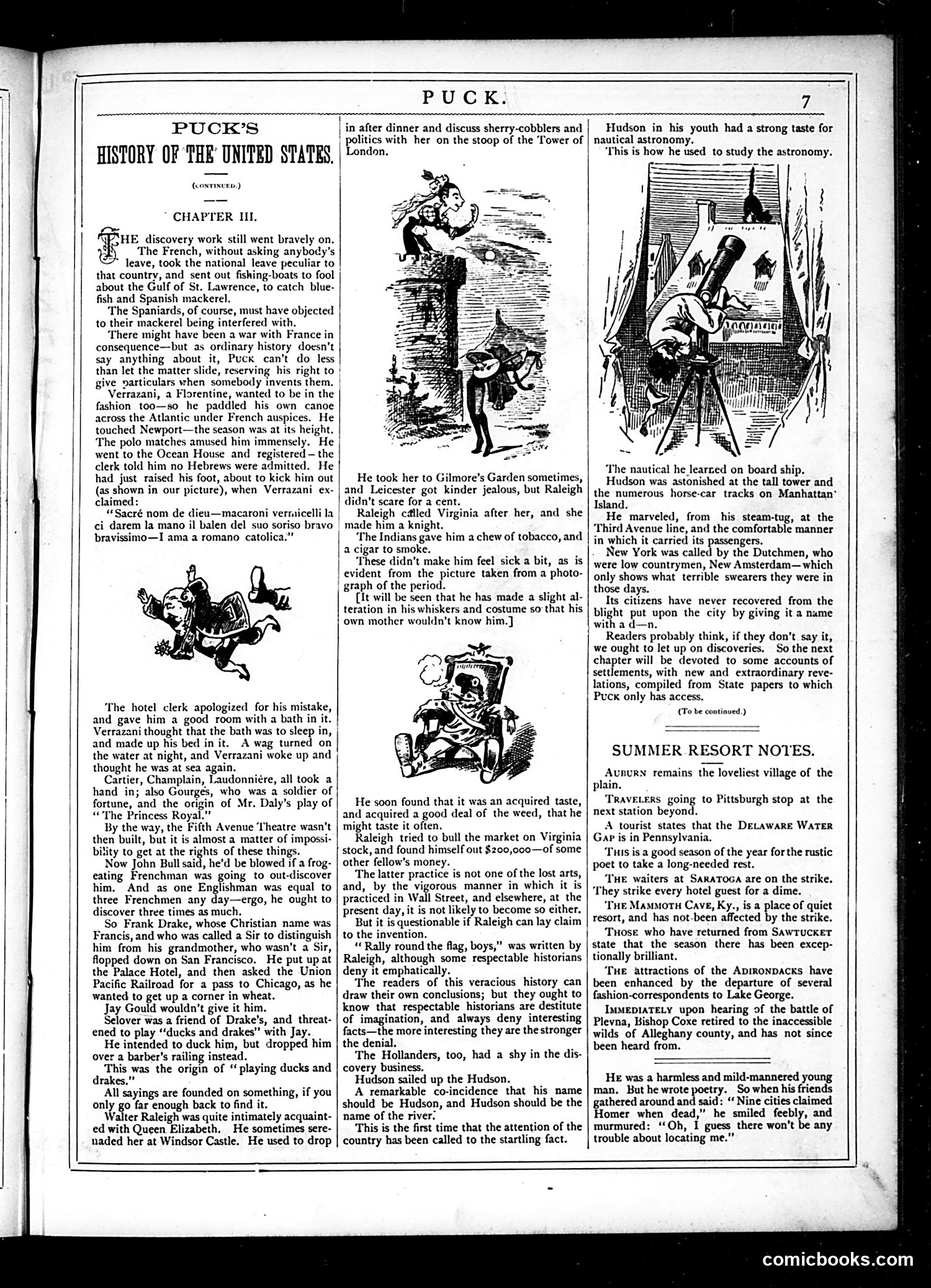
This page from Puck's "History of the United States" (Chapter III) contains historical narrative text with several accompanying satirical illustrations. The cartoons depict early American colonial figures and scenes—including what appears to be explorers, Native Americans, and colonial settlers interacting. The illustrations use exaggerated caricature typical of period humor, showing figures in absurd situations (one man appearing to fall or stumble). The accompanying text discusses Hudson, Spanish explorers, and early colonial commerce including tobacco trade. The satire appears directed at romanticized historical narratives, mocking both colonial-era figures and the tendency to mythologize early American discovery and settlement. The crude, comedic visual style undercuts any dignity these historical moments might claim.
📄 Transcribed text from this page (OCR, searchable)
Machine-transcribed from the original scan — historical spelling and the odd misread are preserved.
PUCK. 7 PUCK’S HISTORY OF THE’ UNITED STATES, (onrixeen,) CHAPTER III, APSHE discovery work still went bravely on. & ‘The French, without asking anybody's ~* leave, took the national leave peculiar to that country, and sent out fishing-boats to fool about the Gulf of St. Lawrence, to catch blue- fish and Spanish mackerel. ‘The Spaniards, of course, must have objected to their mackerel being interfered with. ‘There might have been a war with France in consequence—but as ordinary history doesn’t say anything about it, Puck can’t do less than let the matter slide, reserving his right to give particulars when somebody invents them. Verrazani, a Florentine, wanted to be in the fashion too—so he paddled his own canoe across the Atlantic under French auspices. He touched Newport—the season was at its height. The polo matches amused him immensely. He went to the Ocean House and registered — the clerk told him no Hebrews were admitted. He had just raised his foot, about to kick him out (as shown in our picture), when Verrazani ex- claimed: “Sacré nom de dieu—macaroni vermicelli la ci darem la mano il balen del suo soriso bravo bravissimo—I ama a romano catolica.” ‘The hotel clerk apologized for his mistake, and gave him a good room with a bath in it. Verrazani thought that the bath was to sleep in, and made up his bed in it. A wag turned on the water at night, and Verrazani woke up and thought he was at sea again. Cartier, Champlain, Laudonniere, all took a hand in; also Gourges, who was a soldier of fortune, and the origin of Mr. Daly’s play of “The Princess Royal.” By the way, the Fifth Avenue ‘Theatre wasn’t then built, but it is almost a matter of impossi- bitity to get at the rights of these things. Now John Bull said, he’d be blowed if a frog- eating Frenchman was going to out-discover him. And as one Englishman was equal to three Frenchmen any day—ergo, he ought to discover three times as much. So Frank Drake, whose Christian name was Francis, and who was called a Sir to distinguish him from his grandmother, who wasn’t a Sir, flopped down on San Francisco. He put up at the Palace Hotel, and then asked the Union Pacific Railroad for a pass to Chicago, as he wanted to get up a corner in wheat. Jay Gould wouldn’t give it him. Selover was a friend of Drake’s, and threat- ened to play “ducks and drakes” with Jay. He intended to duck him, but dropped him over a barber's railing instead. This was the origin of “ playing ducks and drakes.”” All sayings are founded on something, if you only go far enough back to find it. Walter Raleigh was quite intimately acquaint- ed with Queen Elizabeth. He sometimes sere- naded her at Windsor Castle. He used to drop 7 | in after dinner and discuss sherry-cobblers and | politics with her on the stoop of the ‘Tower of London. He took her to Gilmore's Garden sometimes, and Leicester got kinder jealous, but Raleigh didn’t scare for a cent. Raleigh cdiled Virginia after her, and she made him a knight. ‘The Indians gave him a chew of tobacco, and a cigar to smoke. ‘These didn’t make him feel sick a bit, as is | evident from the picture taken from a photo- graph of the period. [It will be seen that he has made a slight al- teration in his whiskers and costume so that his own mother wouldn't know him.] He soon found that it was an acquired taste, and acquired a good deal of the weed, that he might taste it often. Raleigh tried to bull the market on Virginia stock, and found himself out $200,000o—of some other fellow’s money. The latter practice is not one of the lost arts, and, by the vigorous manner in which it is practiced in Wall Street, and elsewhere, at the present day, it is not likely to become so either, But it is questionable if Raleigh can lay claim to the invention. “ Rally round the flag, boys,” was written by Raleigh, although some respectable historians deny it emphatically. The readers of this veracious history can draw their own conclusions; but they ought to know that respectable historians are destitute of imagination, and always deny interesting facts—the more interesting they are the stronger the denial. The Hollanders, too, had a shy in the dis- covery business. Hudson sailed up the Hudson. A remarkable co-incidence that his name should be Hudson, and Hudson should be the name of the river: This is the first time that the attention of the country has been called to the startling fact. Hudson in his youth had a strong taste for nautical astronomy. ‘This is how he used to study the astronomy. ‘The nautical he learzed on board ship. Hudson was astonished at the tall tower and the numerous horse-car tracks on Manhattan‘ Island. He marveled, from his steam-tug, at the ‘Third Avenue line, and the comfortable manner in which it carried its passengers. New York was called by the Dutchmen, who were low countrymen, New Amsterdam— which only shows what terrible swearers they were in those days. Its citizens have never recovered from the blight put upon the city by giving it a name \ with a d—n, Readers probably think, if they don’t say it, we ought to let up on discoveries. So the next chapter will be devoted to some accounts of settlements, with new and extraordinary reve- lations, compiled from State papers to which Puck only has access. (To be continued.) SUMMER RESORT NOTES. Aupurn remains the loveliest village of the plain. ‘TRAVELERS going to Pittsburgh stop at the next station beyond. A tourist states that the Detaware WATER Gap is in Pennsylvania, ‘Tuis is a good season of the year forthe rustic poet to take a long-needed rest. ‘THE waiters at SaraToca are on the strike. ‘They strike every hotel guest for a dime. ‘Tue Maamott Cave, Ky., is a place of quiet resort, and has not-been affected by the strike. Tose who have returned from SawruckeT state that the season there has been excep- tionally brilliant. Tne attractions of the ADIRONDACKS have been enhanced by the departure of several fashion-correspondents to Lake George. ImmeDIATELY upon hearing of the battle of Plevna, Bishop Coxe retired to the inaccessible wilds of Alleghany county, and has not since been heard from. He was a harmless and mild-mannered young man. But he wrote poetry. So when his friends gathered around and said: “ Nine cities claimed Homer when dead,” he smiled feebly, and murmured: ‘Oh, I guess there won't be any trouble about locating me.”” comicbooks.com