
A complete issue · 16 pages · 1877
Puck — August 8, 1877
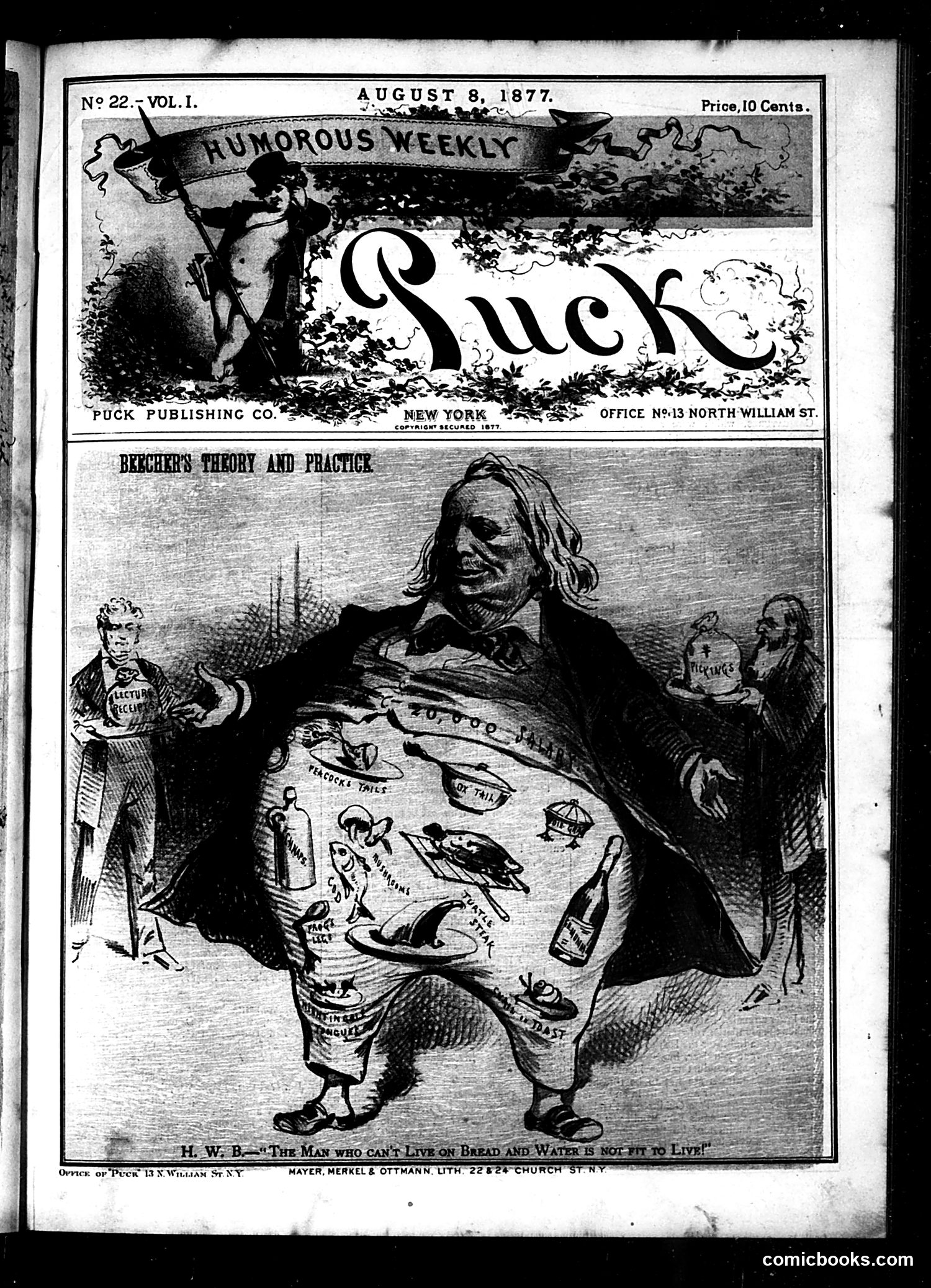
This cartoon satirizes Henry Ward Beecher, a prominent Brooklyn clergyman whose 1874 adultery scandal had recently concluded. The central figure depicts Beecher as a hypocrite: his suit displays various vices (drinking, gambling, womanizing) he publicly condemned from the pulpit. The title references the gap between his preached morality ("Theory") and his exposed personal conduct ("Practice"). Observers on either side appear to be witnesses to this revelation. The caption—"The Man Who Can't Live on Bread and Water is Not Fit to Live"—likely mocks Beecher's moral pronouncements given his exposed indulgences. The cartoon exemplifies Puck's role exposing public hypocrisy during the Gilded Age.
This editorial section critiques how the *New York Herald* newspaper covered the Russo-Japanese War. The author argues the *Herald* has grown obsessed with following Czar Nicholas II's military campaigns, planning routes for "every army corps" and predicting cavalry charges with suspicious precision. The satire suggests the *Herald* overstepped from journalism into propaganda, essentially fighting the war alongside Russia through its coverage. The piece mocks the newspaper's claimed omniscience about battle strategy while criticizing its uncritical cheerleading for Russian military interests—presenting this as dangerous bias that misleads American readers about a foreign conflict. This reflects broader Progressive-era skepticism toward yellow journalism and corporate newspaper influence on public opinion.
This page is primarily a letters-to-editor section titled "Answers for the Anxious" rather than featuring political cartoons. The content consists of humorous responses to reader inquiries on various topics: a woman asking "Wouldn't she?", marital advice, poetry composition feedback, and insurance/financial matters. One recurring item is "The Mule Problem"—multiple letters debate an algebraic puzzle about settling accounts involving a mule's purchase and expenses. Readers propose competing solutions, with one accountant declaring their answer "self-evident and necessary to exhibit." The section also includes a satirical piece about "Minister Pierpont," a man with his hair and wears a diamond pin, used as social commentary. Overall, this page reflects *Puck*'s mix of satire and reader engagement rather than single political cartoons.
This page contains three distinct sections rather than a single unified cartoon: 1. **"Moments with Mr. Simpkin"** (left column): A humorous anecdote about the author's visit to a country residence where the host, Mr. Simpkin, attempted elaborate musical entertainment using trained frogs and other complicated schemes—all ultimately unsuccessful. 2. **"Fitznoodle in America"** (center): A satirical illustration and text mocking pretentious European tourists visiting American resorts. The figure appears to be a wealthy European gentleman criticizing American accommodations and customs while describing his travels to various spas. 3. **"Summer Resort Notes" and "Puck's Personal Intelligence"** (right): Brief gossip items about American locations, celebrities, and social figures—typical magazine filler content critiquing various public personalities and behaviors. The page emphasizes Puck's satirical focus on class pretension and social absurdity.
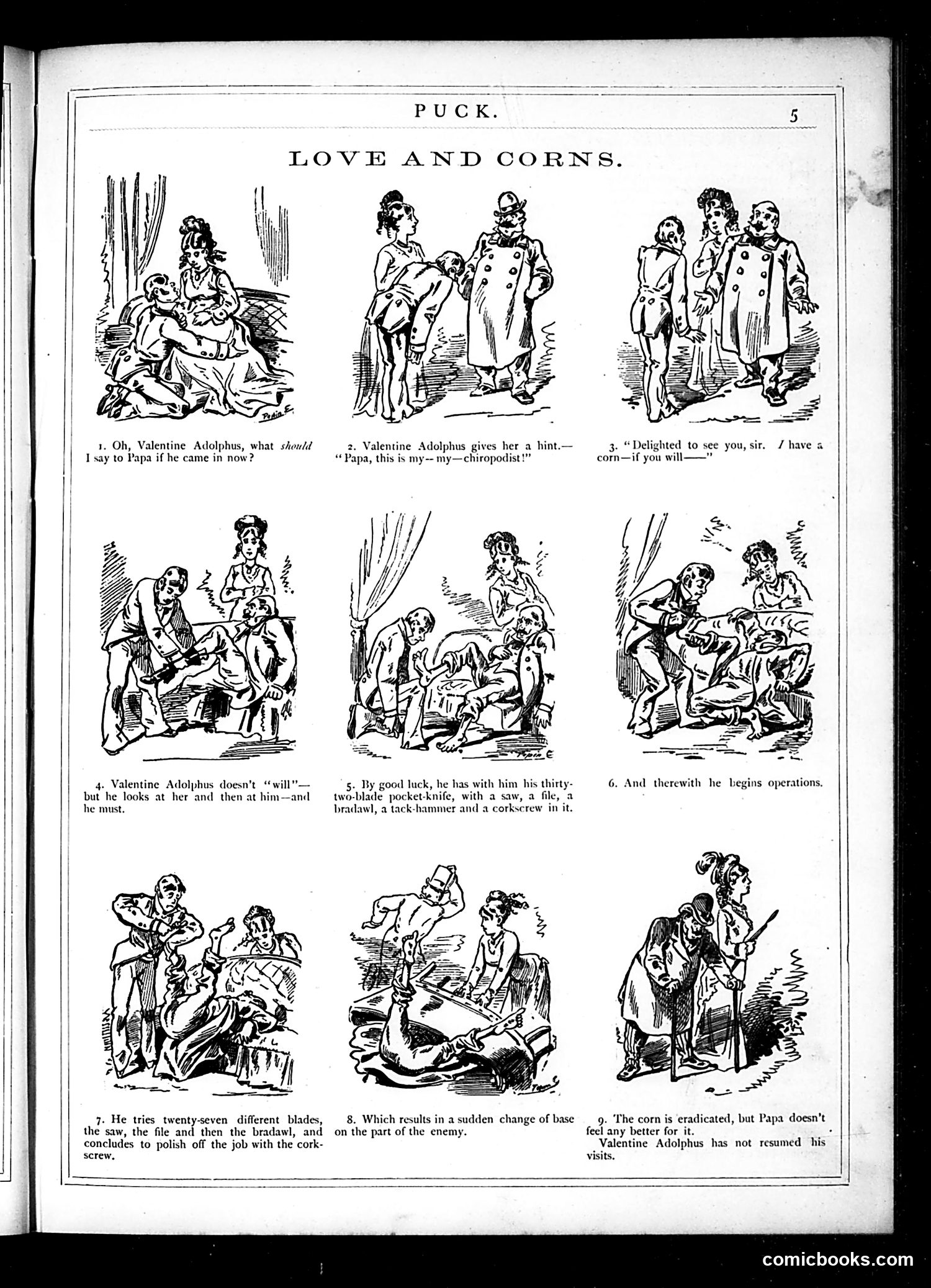
This is a nine-panel comic strip satirizing a character named "Valentine Adolphus" and his relationship troubles. The narrative follows Valentine attempting to court a woman while managing a painful corn (foot ailment). The satire centers on the physical comedy of Valentine's predicament: he tries romantic gestures but is constantly distracted and disabled by his corn condition. In panels 5-9, he attempts increasingly desperate "operations"—trying various tools (knife, file, saw, brashlash, hammer, corkscrew) to remove the corn, resulting in slapstick chaos. The joke plays on the period's obsession with personal grooming and romantic pursuits being thwarted by mundane physical ailments. The title "Love and Corns" juxtaposes romantic aspiration against bodily discomfort—a common theme in Victorian-era humor magazines.
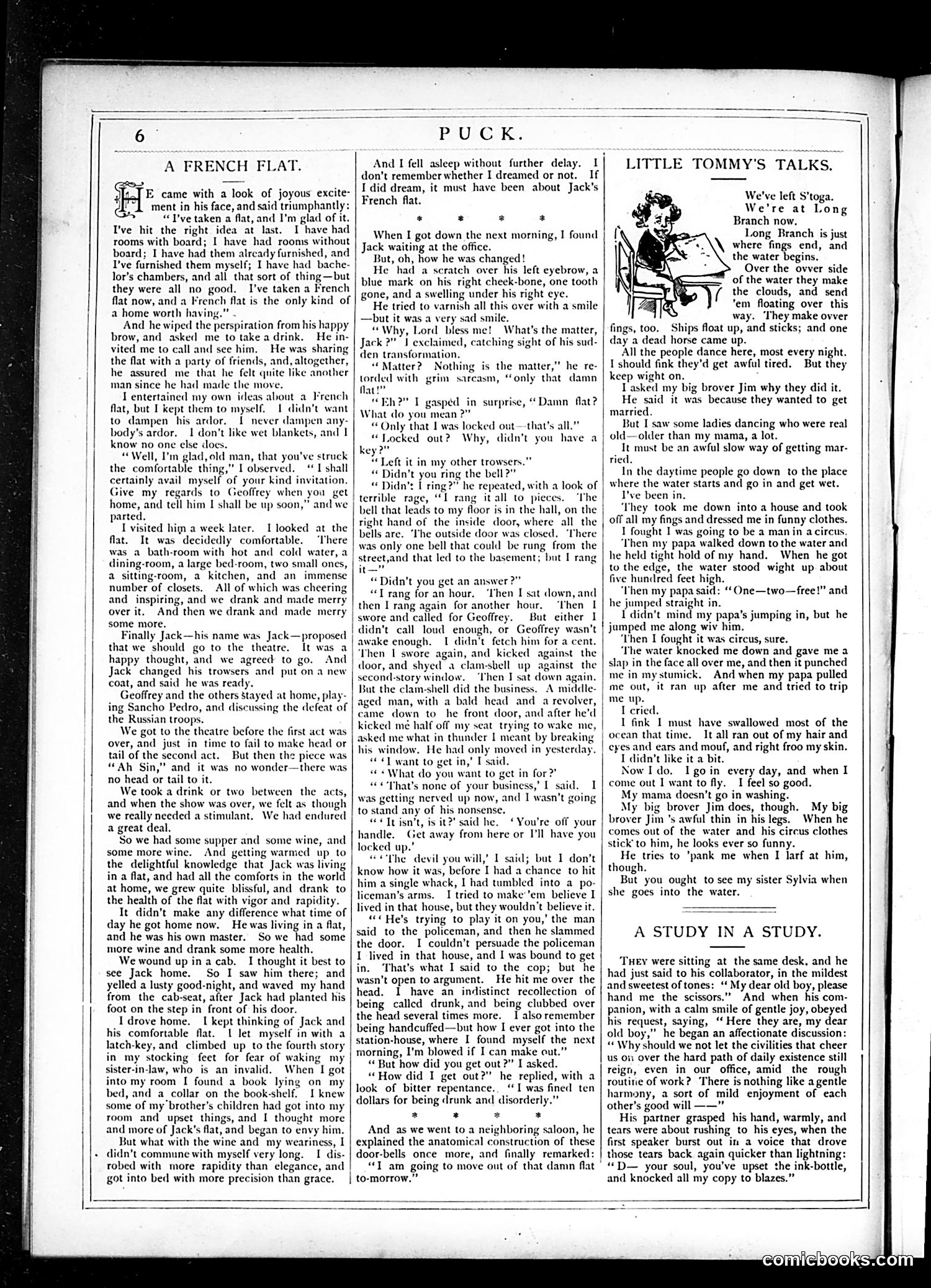
This page contains two distinct pieces: **"A French Flat"** (left column): A humorous essay about renting a Parisian apartment. The narrator describes discovering his friend Jack has transformed into an unrecognizable, melancholy version of himself after living in a shabby French flat. The piece satirizes Bohemian life in Paris and romantic notions of continental living, suggesting that supposedly charming European apartments are actually uncomfortable and depressing. It's social satire targeting American fascination with European aestheticism. **"Little Tommy's Talks"** (right): A children's column featuring a young boy's anecdotes about life and observations. This appears to be lighthearted domestic humor rather than political satire. The page is primarily literary/humorous content rather than visual political cartoons, typical of Puck's satirical magazine format from this era.
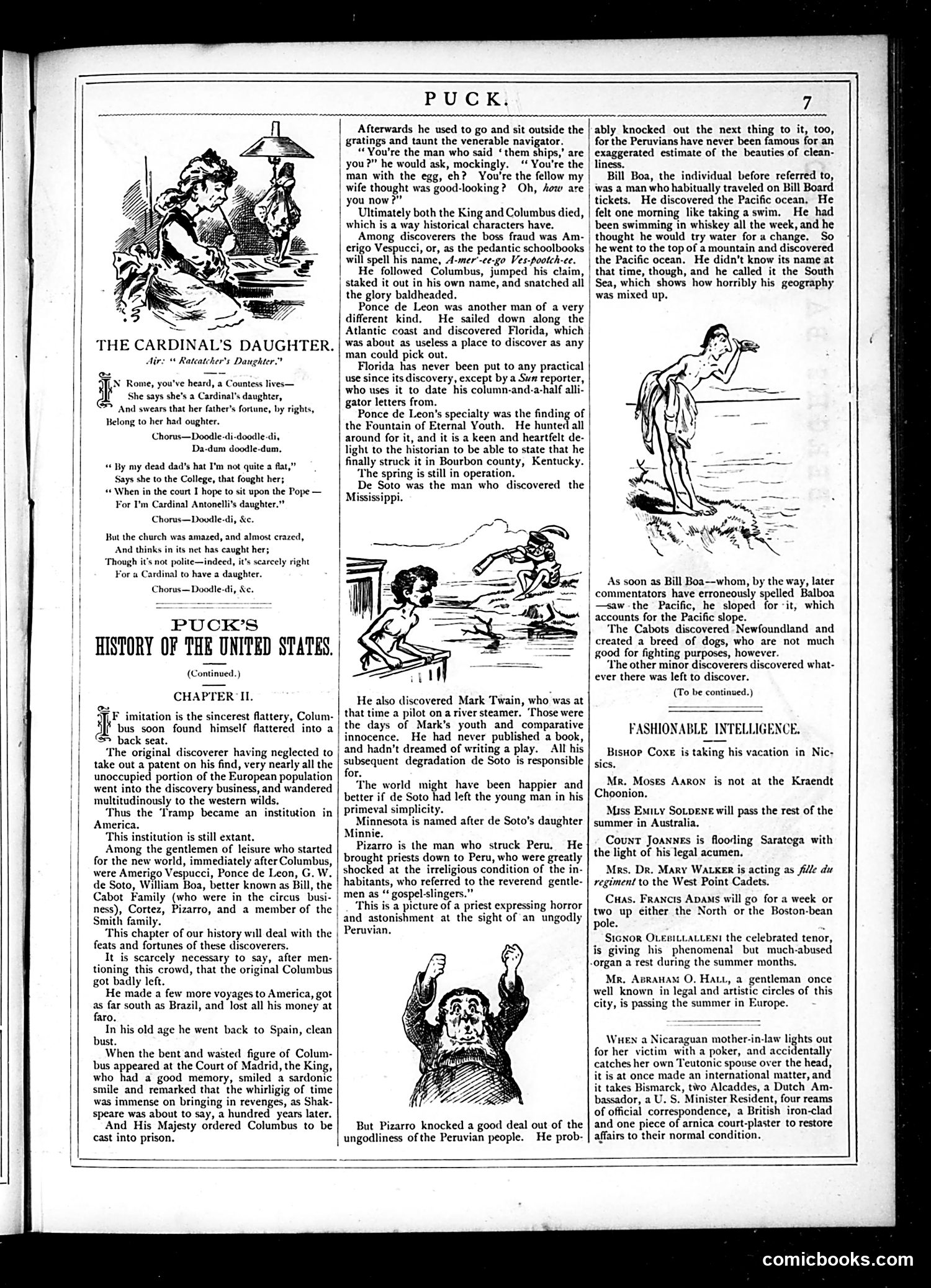
This page contains two distinct sections: **"The Cardinal's Daughter"** (left): A humorous poem about a woman claiming to be a Cardinal's daughter, mocking her pretensions. The accompanying illustration shows figures in conversation, satirizing social climbing and false claims to nobility. **"Puck's History of the United States" (center/right)**: A satirical historical narrative mocking early explorers' discoveries and their actual contributions. It ridicules Columbus, de Soto, Pizarro, and others, suggesting their achievements were overblown. References to finding the "Fountain of Eternal Youth" and discovering useless places like Florida mock the grandiose claims made about exploration. **"Fashionable Intelligence"** (right column): Society gossip items about wealthy individuals' vacations and social activities. The overall thrust satirizes American mythology, pretension, and the gap between historical narratives and reality.
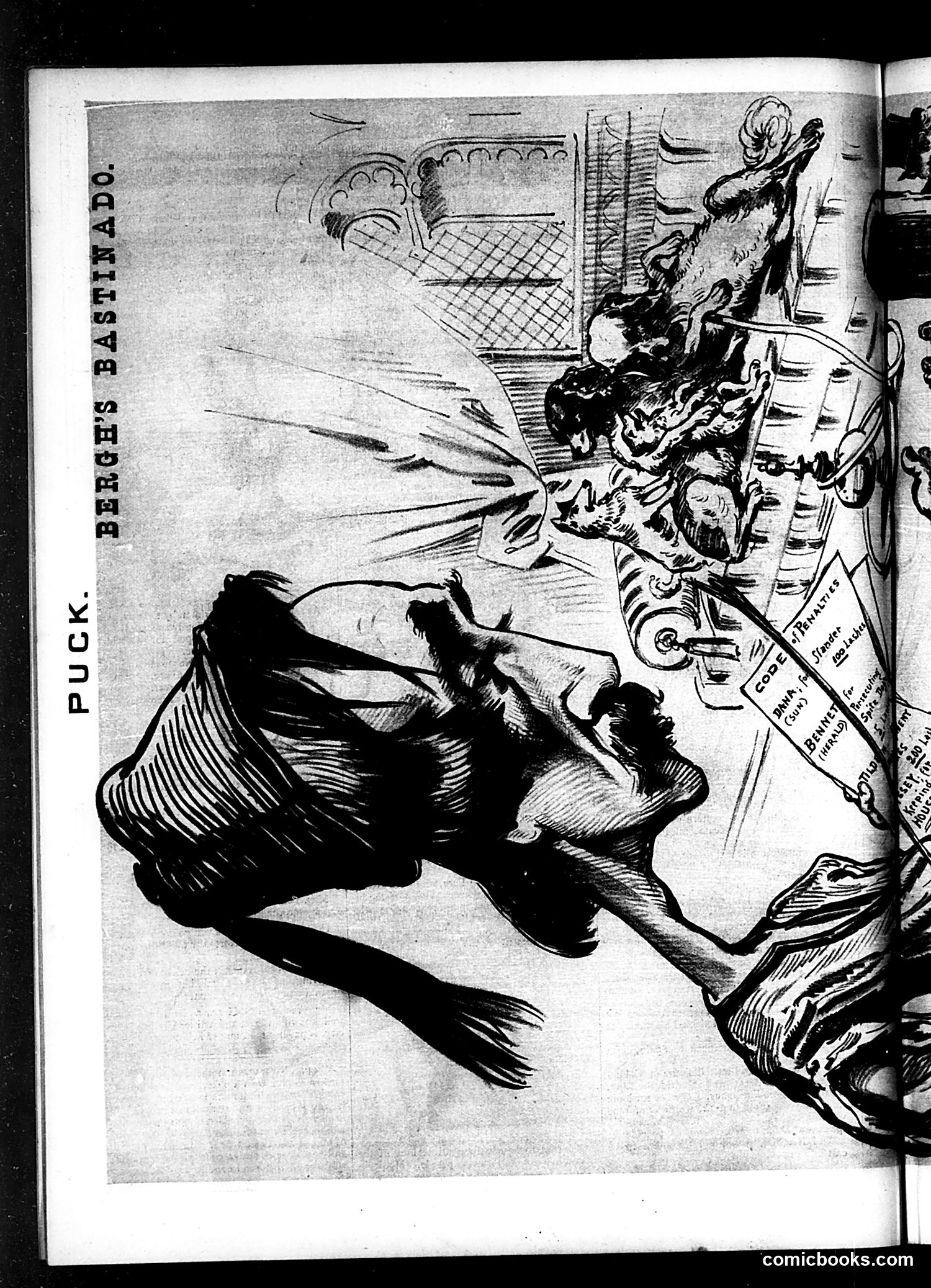
This appears to be a satirical cartoon from Puck magazine depicting a violent confrontation scene. The text header reads "PUCK" on the left and "BEGGEY'S BASTINADO" (likely "Beggar's Bastinado," referencing beatings or punishment). The illustration shows what appears to be a figure being struck or attacked by another character, with dynamic action lines suggesting violence. The style and composition suggest social or political satire typical of Puck's content. Without clearer visibility of specific identifying details, labels, or dates on the page, I cannot definitively identify which historical figures or specific events are being satirized. The "bastinado" reference suggests commentary on punishment, possibly relating to contemporary political or social conflicts, but further context would be needed for precise interpretation.
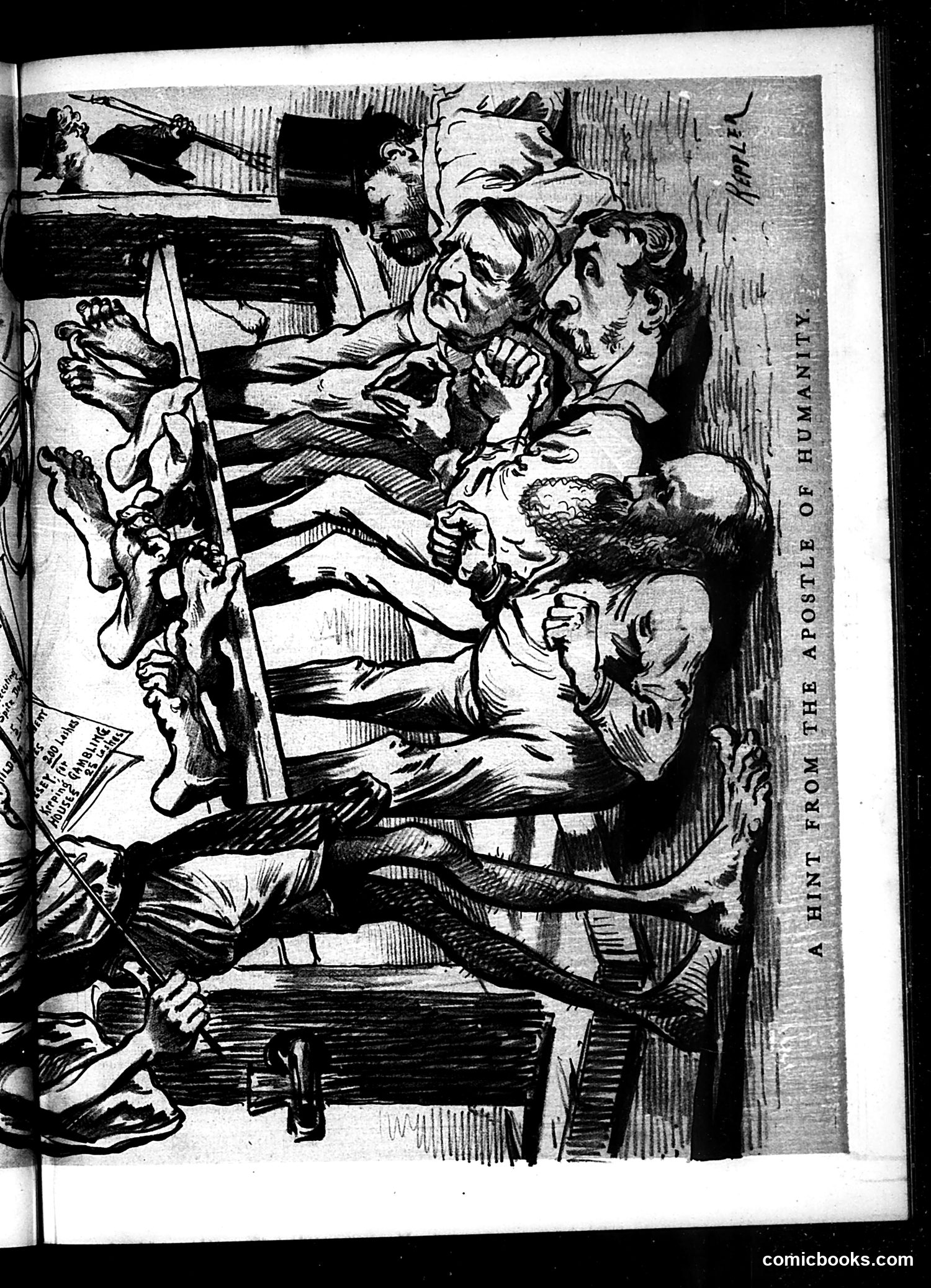
This appears to be a Puck magazine cartoon titled "A HINT FROM THE APOSTLE OF HUMANITY." The image shows several figures in what appears to be a violent or chaotic scene, rendered in the magazine's characteristic satirical style. The composition depicts men in period dress engaged in what looks like a physical altercation or struggle. Without being able to clearly read all text labels in the image or having additional context about the specific historical moment, I cannot definitively identify which political figures or events are being satirized here. The title's reference to "the Apostle of Humanity" suggests this may be criticizing someone's stated humanitarian principles versus their actual actions—a common Puck theme—but the specific political or social reference remains unclear from the visible elements alone.
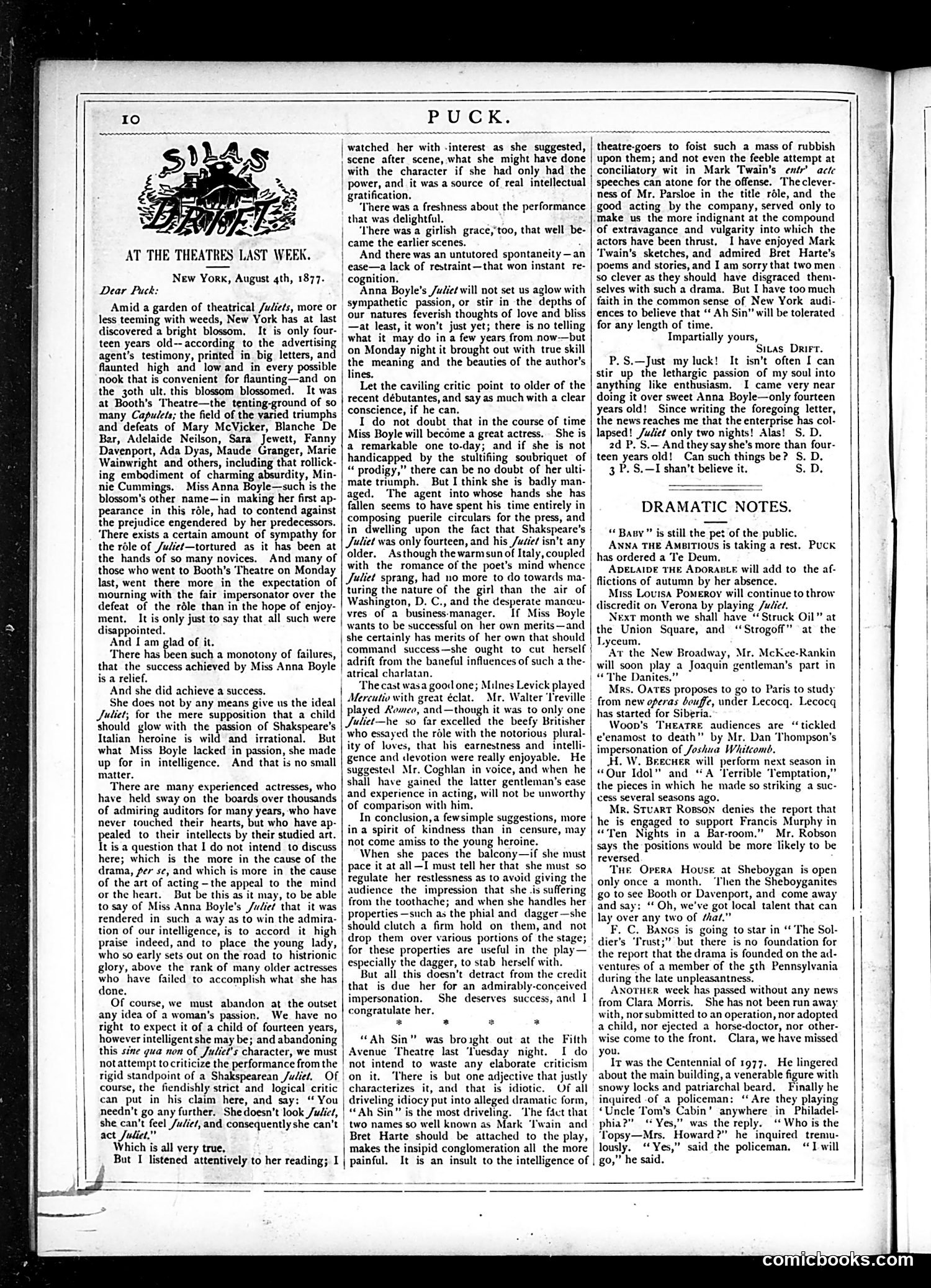
This page contains theatrical criticism and dramatic notes from Puck magazine (New York, August 4th, 1877), not a political cartoon. The main content is a letter ("Dear Puck") critiquing Miss Anna Boyle's performance in "Juliet" at Booth's Theatre. The critic argues that while Boyle's acting showed promise and genuine talent, the production itself was poorly conceived. The letter defends Boyle against those who attended expecting her to fail, praising her natural ability despite the play's weak staging and the fact that she was only fourteen years old. The "Dramatic Notes" section briefly mentions upcoming theatrical productions and cast changes in New York theaters during the 1877 season.
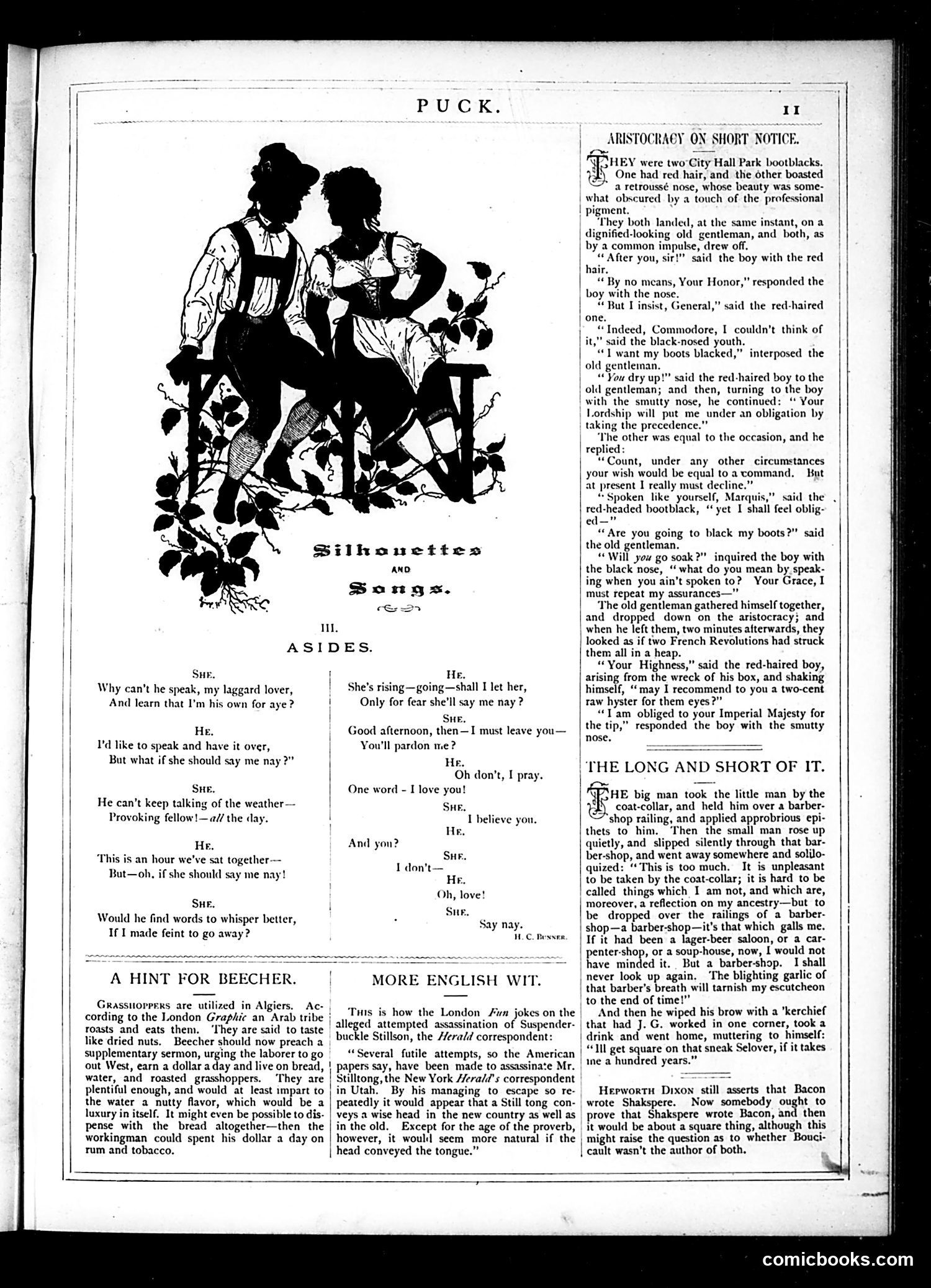
This silhouette cartoon depicts two working-class men meeting a dignified old gentleman. The satire mocks American social pretension: one man has red hair, the other a "retrousse nose" (turned-up nose)—physical markers of lower-class status that the text suggests they're trying to conceal to appear aristocratic. The dialogue shows the men attempting to claim noble standing ("Your Honor," "General") while the old gentleman responds with dry wit, exposing their obvious fraud. The humor targets Americans who adopt fake aristocratic airs despite obvious working-class origins, suggesting that true nobility cannot be instantly improvised or hidden beneath superficial claims of rank. This reflects Puck's recurring theme of satirizing American social climbing and false gentility.
This page is primarily **literary content**, not a political cartoon. It contains: 1. **"An Accommodating Poet"** — a humorous article about poet improvements, criticizing a poem called "Where She Lies" by C. Delt from the *Norristown Herald*. The piece sarcastically praises an editor's "improvements" to weak verses. 2. **"Two Knaves and a Queen"** — a serialized story (Chapter XVIII), featuring dialogue between characters discussing confidentiality, blackmail, and marriage arrangements. The plot involves secrets, coercion, and financial pressure. The satire targets **pretentious amateur poetry** and journalistic editing practices. The story content suggests melodramatic fiction typical of the era's serialized narratives. **No specific political figures or events are clearly referenced** on this visible page.
This page consists primarily of text columns from "Puck's Perplexings," a satirical commentary section. The header illustration shows a jester or fool figure sitting on scattered items—typical of Puck's masthead. The content tackles various contemporary social and political issues through brief, sardonic observations: labor strikes paralyzing business, temperance debates about alcohol, women's rights lectures, government inefficiency, and everyday absurdities (like kerosene explosions in kitchens). The satirical approach mocks both reformers and the status quo—striking workers, teetotalers, women's suffrage advocates, and corrupt officials all receive criticism. The tone suggests Puck's generally centrist, establishment-friendly perspective, finding humor in social disruption rather than championing reform. No major political figures are clearly identified in the visible text or illustration.
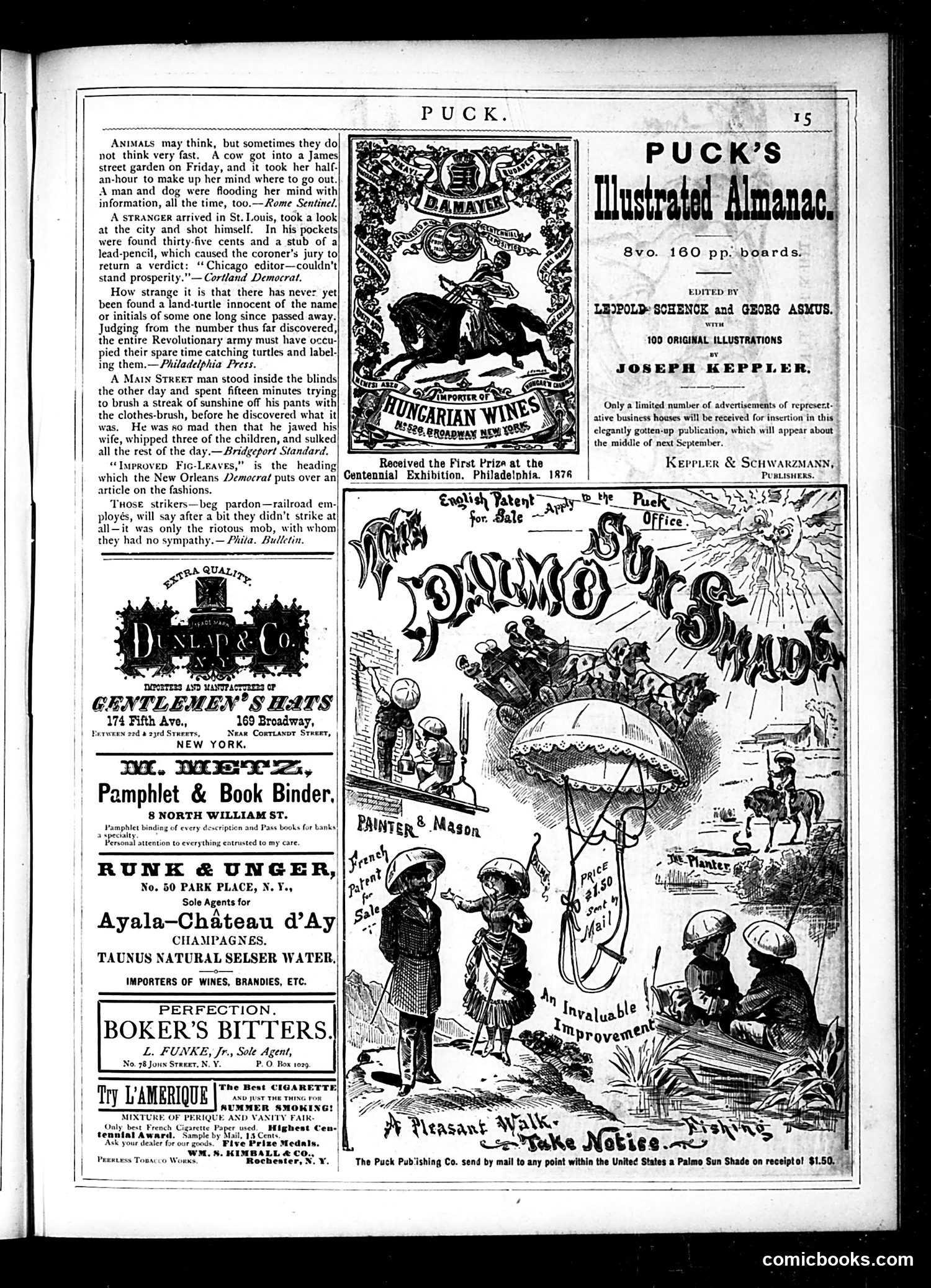
This page is primarily **advertising and promotional content** for Puck's "Illustrated Almanac," rather than political satire. The main central cartoon titled "Puck's Annual Smash" depicts a chaotic scene with various figures and objects being launched or scattered, appearing to represent the magazine's humorous, destructive approach to annual events or topics. The imagery suggests absurdist comedy rather than specific political commentary. The surrounding content consists entirely of **commercial advertisements** for products including gentlemen's hats, champagne, book binding services, wine importers, cigarette papers, and digestive bitters—typical late-19th-century magazine advertisements. No clear political figures or events are identifiable from the visual content alone.
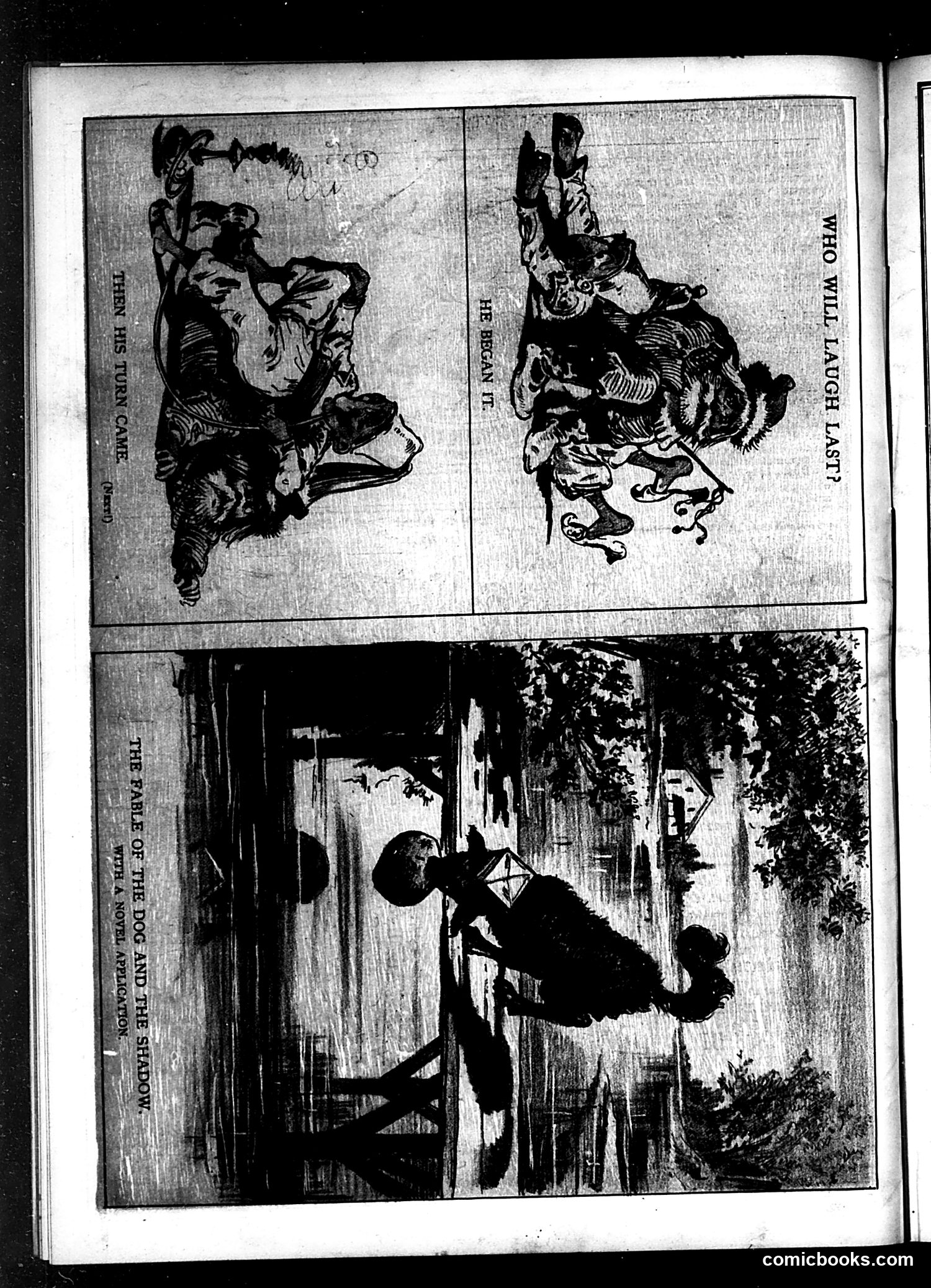
This page contains three satirical illustrations, though the OCR text is largely illegible. The top two panels appear to be caricature studies showing grotesquely exaggerated facial features—a common Puck technique for political mockery. The right panel's caption mentions "Who will laugh last," suggesting a commentary on comeuppance or revenge. The larger bottom illustration depicts figures in what appears to be an interior domestic or social scene, though the specific political or social reference remains unclear from the image alone. Without legible captions, I cannot definitively identify the intended targets of these satires or their historical context. The style and composition suggest late 19th or early 20th-century American political commentary, but the specific events, people, or issues being mocked are not discernible from this reproduction's quality.