
Puck, 1877-08-08 · page 6 of 16
Puck — August 8, 1877 — page 6: what you’re looking at
What you’re looking at
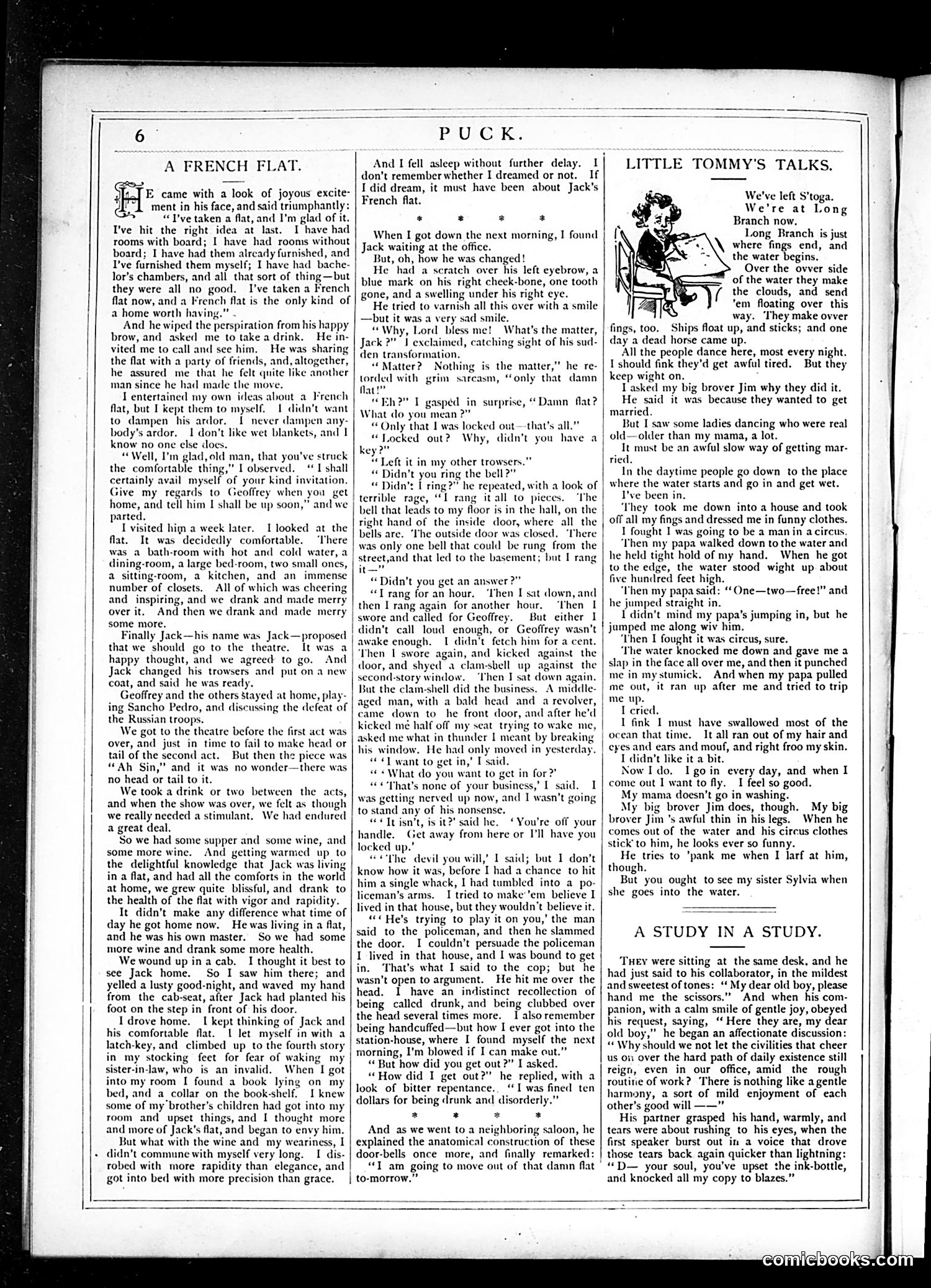
This page contains two distinct pieces: **"A French Flat"** (left column): A humorous essay about renting a Parisian apartment. The narrator describes discovering his friend Jack has transformed into an unrecognizable, melancholy version of himself after living in a shabby French flat. The piece satirizes Bohemian life in Paris and romantic notions of continental living, suggesting that supposedly charming European apartments are actually uncomfortable and depressing. It's social satire targeting American fascination with European aestheticism. **"Little Tommy's Talks"** (right): A children's column featuring a young boy's anecdotes about life and observations. This appears to be lighthearted domestic humor rather than political satire. The page is primarily literary/humorous content rather than visual political cartoons, typical of Puck's satirical magazine format from this era.
📄 Transcribed text from this page (OCR, searchable)
Machine-transcribed from the original scan — historical spelling and the odd misread are preserved.
A FRENCH FLAT. Fe came with a look of joyous excite- de ment in his face, and said triumphantly: “ Vve taken a flat, and I'm glad of it. I've hit the right idea at last. I have had rooms with board; I have had rooms without board; I have had them already furnished, and I’ve furnished them myself; I have had bache- lor’s chambers, and all that sort of thing—but they were all no good. I’ve taken a French flat now, and a French flat is the only kind of a home worth having.” ‘And he wiped the perspiration from his brow, and asked me to take a drin vited me to call and see him, He was sharing the flat with a party of friends, and, altogether, he assured me that he felt quite like another man since he had made the move. Tentertained my own ideas about a French flat, but I kept them to myself. 1 didn’t want to dampen his ardor. I never dampen any- body's ardor. 1 don’t like wet blankets, and I know no one else does. “Well, I’m glad, old man, that you've struck the comfortable thing,” I observed. ‘1 shall certainly avail myself of your kind invitation. Give my regards to home, and tell him I shall be up soon," parted. I visited him a week later. I looked at the flat. It was decidedly comfortable. ‘here was a bath-room with hot and cold water, a dining-room, a large bed-room, two small ones, a sitting-room, a kitchen, and an immense number of closets. All of which was cheering and inspiring, and we drank and made merry over it. And then we drank and made merry some more. Finally Jack—his name was Jack—proposed that we should go to the theatre. It was a happy thought, and we agreed to go. Jack changed his trowsers and put on a new coat, and said he was ready. Geoffrey and the others stayed at home, play- ing Sancho Pedro, and discussing the defeat of the Russian troops. We got to the theatre before the first act was over, and just in time to fail to make head or tail of the second act. But then the piece was “Ah Sin,” and it was no wonder—there was no head or tail to it. We took a drink or two between the acts, and when the show was over, we felt as though we really needed a stimulant. We had endured a great deal. So we had some supper and some wine, and some more wine. And getting warmed up to the delightful knowledge that Jack was living in a flat, and had all the comforts in the world at home, we grew quite blissful, and drank to the health of the flat with vigor and rapidity. It didn’t make any difference what time of day he got home now. He was living in a flat, and he was his own master. So we had some more wine and drank some more health. We wound up in a cab. I thought it best to see Jack home. So I saw him there; and yelled a lusty good-night, and waved my hand from the cab-seat, after Jack had planted his foot on the step in front of his door. I drove home. I kept thinking of Jack and his comfortable flat. I let myself in with a latch-key, and climbed up to the fourth story in my stocking feet for fear of waking my sister-in-law, who is an invalid. When I got into my room I found a book lying on my bed, and a_ collar on the book-shelf. I knew some of my"brother’s children had got into my room and upset things, and I thought more and more of Jack’s flat, and began to envy him. But what with the wine and my Searin ests I didn’t commune with myself very long. I dis- robed with more rapidity than elegance, and got into bed with more precision than grace. * and we offrey when you get | And } | | | know how it was, before I had a chance to hit PUCK. And I fell asleep without further delay, I don’t remember whether I dreamed or not. If I did dream, it must have been about Jack’s French flat. * * 2 * When I got down the next morning, I found Jack waiting at the office. But, oh, how he was changed! He had a scratch over his left eyebrow, a blue mark on his right cheek-bone, one tooth gone, and a swelling under his right eye. He tried to varnish all this over with a smile —but it was a very sad smile. “Why, Lord bless me! What's the matter, Jack ?” | exclaimed, catching sight of his sud- den transformation. “Matter? Nothing is the matter,” he re- torded with grim sarcasm, ‘only that damn flat!” "Ih?" T gasped in surprise, Damn flat? What do you mean “Only that I was locked out—that’s all.” “Locked out? Why, didn't you have key 2” “Left it in my other trowsers.” “ Didn't you ring the bell?” “ Didn't [ ring?” he repeated, with a look of terrible rage, “1 rang itall to pieces. ‘The bell that leads to my floor is in the hall, on the right hand of the inside door, where all the bells are. ‘The outside door was closed. ‘There was only one bell that could be rung from the street,and that led to the basement; but I rang it—" “Didn't you get an answer?” “Trang for an hour. ‘Ihen I sat down, and then I rang again for another hour, ‘Then I swore and called for Geoffrey. But either I didn't call loud enough, or Geoffrey wasn’t awake enough. I didn’t fetch him for a cent. ‘Then [ swore again, and kicked against the door, and shyed a clam-sbell up against the second-story window. ‘Then I sat do} in, But the clam-shell did the business. A middle aged man, with a bald head and a revolver, | came down to he front door, and after he'd | kicked mé half off my scat trying to wake me, asked me what in thunder 1 meant by breaking his window. He had only moved in’ yesterday. “¢T want to get in,’ T said. **What do you want to get in for?’ “«'That’s none of your business,’ I said. I was getting nerved up now, and I wasn’t going to stand any of his nonsense. “Tt isn’t, is it?’ said he. ‘You're off your handle. Get away from here or I'll have you | locked up.’ “«The devil you will,’ 1 said; but I don’t him a single whack, I had tumbled into a po- | liceman’s arms. I tried to make’’em believe 1 lived in that house, but they wouldn't believe it. “He's trying to play it on you,’ the man said to the policeman, and then he slammed the door. I couldn’t persuade the policeman | I lived in that house, and I was bound to get | in. ‘That's what I said to the cop; but he wasn’t open to argument. He hit me over the head. I have an indistinct recollection of being called drunk, and being clubbed over the head several times more. I also remember being handcuffed—but how I ever got into the station-house, where I found myself the next morning, I'm blowed if I can make out.” “ But how did you get out ?” I asked. “How did I get out?” he replied, with a look of bitter repentance.. ‘I was fined ten dollars for being drunk and disorderly.” * * * And as we went to a neighboring saloon, he explained the anatomical construction of these door-bells once more, and finally remarked: “1 am going to move out of that damn flat to-morrow.”” * We've left We're at Branch now. Long Branch is just where fings end, and the water begins. Over the ovver side of the water they make the clouds, and send "em floating over this way. ‘They make ovver hips float up, and sticks; and one day a dead horse came up. All the people dance here, most every night. I should fink they'd get awful tired. But they keep wight on. Lasked my big brover Jim why they did it. He said it was because they wanted to get married. But I saw some ladies dancing who were real old—older than my mama, a lot. It must be an awful slow way of getting mar- toga. Long | ried. In the daytime people go down to the place where the water starts and go in and get wet. I've been in, ‘They took me down into a house and took off all my fings and dressed me in funny clothes. I fought I was going to be a manin acircus. ‘Then my papa walked down to the water and he held tight hold of my hand. When he got to the edge, the water stood wight up about five hundred feet high. “Then my papa said: “One—two—free!” and he jumped straight in. I didn't mind my papa’s jumping in, but he jumped me along wiv him. ‘Then I fought it was circus, sure. ‘The water knocked me down and gave me a slap. in the face all over me, and then it punched me in mystumick. And when my papa pulled me out, it ran up after me and tried to trip me up. I cried. I fink I must have swallowed most of the ocean that time. It all ran out of my hair and cyes and ears and mouf, and right froo my skin. I didn’t like it a bit. Now Ido. Igo in every day, and when I come out I want to fly. I feel so good, My manta doesn’t go in washing. brover Jim does, though. My big nee Jin 's awful thin in his legs. When he comes out of the water and his circus clothes stick to him, he looks ever so funny. He tries to ’pank me when I larf at him, though. But you ought to see my sister Sylvia when she goes into the water. A STUDY IN A STUDY. ‘Tuey were sitting at the same desk, and he had just said to his collaborator, in the mildest and sweetest of tones: ‘* My dear old boy, please hand me the scissors. And when his com- panion, with a calm smile of gentle joy, obeyed his request, saying, ‘Here they are, my dear old boy,” he began an affectionate discussion: “« Why should we not let the civilities that cheer us on over the hard path of daily existence still reign, even in our office, amid the rough routitie of work? ‘There is nothing like a gentle harmony, a sort of mild enjoyment of each other’s good will — His partner grasped his hand, warmly, and tears were about rushing to his eyes, when the first speaker burst out in a voice that drove those tears back again quicker than lightning: “D— your soul, you've upset the ink-bottle, and knocked all my copy to blazes.””