
Puck, 1877-08-08 · page 13 of 16
Puck — August 8, 1877 — page 13: what you’re looking at
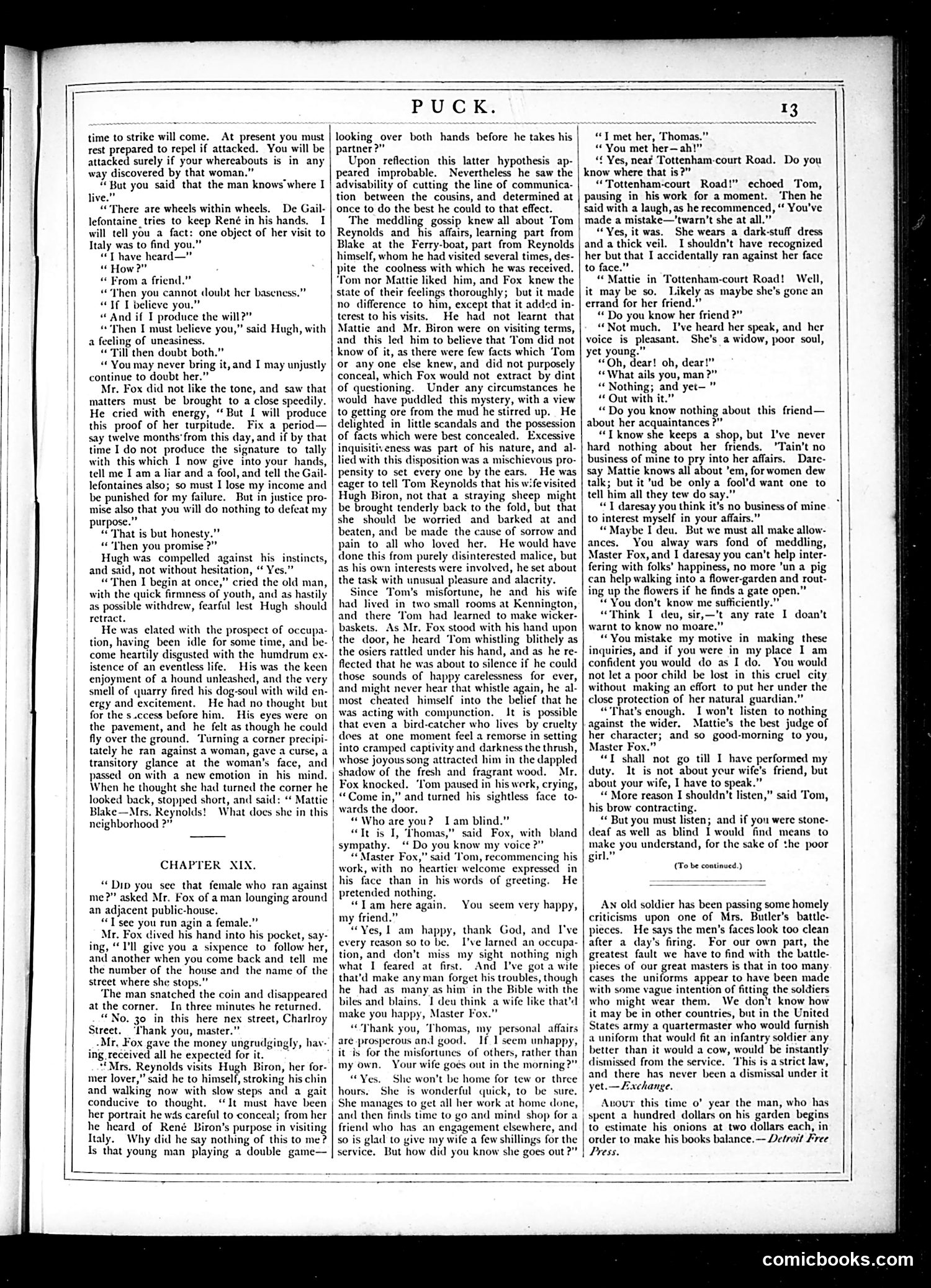
A restored page from Puck, 1877-08-08. Page through the whole issue in the reader above.
📄 Transcribed text from this page (OCR, searchable)
Machine-transcribed from the original scan — historical spelling and the odd misread are preserved.
time to strike will come. At present you must rest prepared to repel if attacked. You will be attacked surely if your whereabouts is in any way discovered by that woman.” “But you said that the man knows’ where I live.” “There are wheels within wheels. De Gail- lefontaine tries to keep René in his hands. 1 will tell you a fact: one object of her visit to Italy was to find you.” “T have heard—'’ “ How?” “ From a friend.” “Then you cannot doubt her baseness.” “If I believe you.” “And if I produce the will?” “Then I must believe you,” said Hugh, with a feeling of uneasiness. “ Till then doubt both." “You may never bring it, and I may unjustly continue to doubt her.” Mr. Fox did not like the tone, and saw that matters must be brought to a close speedily. He cried with energy, “But I will produce | this proof of her turpitude. Fix a period— twelve months'from this day, and if by that time I do not produce the signature to tally with this which I now give into your hands, tell me I am a liar and a fool, and tell the Gail- lefontaines also; so must I lose my income and be punished for my failure. But in justice pro- mise also that you will do nothing to defeat my purpose.” “That is but honesty “Then you promise 2” Hugh was compelled against his instincts, and said, not without hesitation, ‘ Yes.” “Then I begin at once,” cried the old man, with the quick firmness of youth, and as hastily as possible withdrew, fearful lest’ Hugh should retract. He was clated with the prospect of occupa- tion, having been idle for some time, and be- come heartily disgusted with the humdrum ex- istence of an eventless life. His was the keen enjoyment of a hound unleashed, and the very smell of quarry fired his dog-soul with wild en- ergy and excitement. He had no thought but for the s .ccess before him. His eyes were on the pavement, and he felt as though he could fly over the ground. Turning a corner precipi- tately he ran against a woman, gave a curse, a transitory glance at the woman's face, and passed on with a new emotion in his mind. When he thought she had turned the corner he looked back, stopped short, and said: ‘ Mattie Blake—Mrs. Reynolds! What does she in this neighborhood ?” CHAPTER XIX, “ Dip you see that female who ran against me?” asked Mr. Fox of aman lounging around an adjacent public-house. “T see you run agin a female.” Mr. Fox dived his hand into his pocket, say- ing, “I'll give you a sixpence to follow her, and another when you come back and tell me the number of the house and the name of the street where she stops."” ‘The man snatched the coin and disappeared at the corner. In three minutes he returned. “No. 30 in this here nex street, Charlroy Street. ‘hank you, master.” _-Mr, Fox gave the money ungrudgingly, hav- ing received all he expected for it. : *! Mrs. Reynolds visits Hugh Biron, her for- mer lover,” said he to himself, stroking his chin and walking now with slow steps and a gait conducive to thought. “It must have been her portrait he ws careful to conceal; from her he heard of René Biron’s purpose in visiting Italy. Why did he say nothing of this to me? Is that young man playing a double game— PUCK. looking over both hands before he takes his | partner?” Upon reflection this latter hypothesis ap- | peared improbable. Nevertheless he saw the advisability of cutting the line of communica- tion between the cousins, and determined at once to do the best he could to that effect. The meddling gossip knew all about ‘Tom Reynolds and his affairs, learning part from Blake at the Ferry-boat, part from Reynolds himself, whom he had visited several times, des- pite the coolness with which he was received. ‘Tom nor Mattie liked him, and Fox knew the state of their feelings thoroughly; but it made no difference to him, except that it added in- terest to his visits. He had not learnt that Mattie and Mr. Biron were on visiting terms, and this led him to believe that ‘Tom did not know of it, as there were few facts which ‘Tom or any one else knew, and did not purposely conceal, which Fox would not extract by dint | of questioning. Under any circumstances he | would have puddled this mystery, with a view to getting ore from the mud he stirred up. He delighted in little scandals and the possession of facts which were best concealed. Excessive inquisitis eness was part of his nature, and al- lied with this disposition was a mischievous pro- pensity to set every one by the ears. He was eager to tell Tom Reynolds that his w:fe visited Hugh Biron, not that a straying sheep might be brought tenderly back to the fold, but that she should be worried and barked at and beaten, and be made the cause of sorrow and pain to all who loved her. He would have done this from purely disinterested malice, but as his own interests were involved, he set about the task with unusual pleasure and alacrity. Since Tom’s misfortune, he and his wife had lived in two small rooms at Kennington, and there Tom had learned to make wicker- baskets. As Mr. Fox stood with his hand upon the door, he heard ‘Tom whistling blithely as the osiers rattled under his hand, and as he re- | flected that he was about to silence if he could those sounds of happy carelessness for ever, and might never hear that whistle again, he al- | most cheated himself into the belief that he was acting with compunction. It is possible that even a bird-catcher who lives by cruelty does at one moment feel a remorse in setting into cramped captivity and darkness the thrush, whose joyous song attracted him in the dappled shadow of the fresh and fragrant wood. Mr. Fox knocked. ‘Yom paused in his work, crying, | Come in,” and turned his sightless face to- wards the door. Who are you? Iam blind.” “Tt is I, Thomas,” said Fox, with bland sympathy.“ Do you know my voice ?” “Master Fox,” said ‘Tom, recommencing his work, with no heartier welcome expressed in his face than in his words of greeting. He | pretended nothing. “Tam here again. my friend. “Yes, 1 am happy, thank God, and I've every reason so to be. I've larned an occupa- tion, and don’t miss my sight nothing nigh what I feared at first. And I’ve gota wite that'd make any man forget his troubles, though he had as many as him in the Bible with the biles and blains. 1 deu think a wife like that'd make you happy, Master Fox.” “Thank you, ‘Thomas, my personal affairs are prosperous and good. If 1 seem unhappy, | it is for the misfortunes of others, rather than my own, Your wife goés out in the morning?” “Yes. She won't be home for tew or three | hours. She is wonderful quick, to be sure. | She manages to get all her work at home done, and then finds time to go and mind shop for a friend who has an engagement elsewhere, and | so is glad to give my wife a few shillings for the You seem very happy, service. But how did you know she goes out?” | “T met her, Thomas.” “You met her—ah!” “£ Yes, near Tottenham-court Road. Do you know where that is?” “Tottenham-court Road!” echoed Tom, pausing in his work for a moment. ‘Then he said with a laugh, as he recommenced, “ You've made a mistake—'twarn’t she at all.” “Yes, it was. She wears a dark-stuff dress and a thick veil. I shouldn’t have recognized her but that I accidentally ran against her face to face.” “Mattie in Tottenham-court Road! Well, it may be so. Likely as maybe she’s gone an errand for her friend.” “ Do you know her friend ?” “Not much. I’ve heard her speak, and her voice is pleasant. She’s a widow, poor soul, yet young.” “Oh, dear! oh, dear!” ‘What ails you, man ? “Nothing; and yet- " “Out with it.” “Do you know nothing about this friend— about her acquaintances ?” “T know she keeps a shop, but I've never hard nothing about her friends. 'Tain’t no business of mine to pry into her affairs. Dare- say Mattie knows all about 'em, for women dew talk; but it ’ud be only a fool’d want one to tell him all they tew do say.”” “«T daresay you think it’s no business of mine to interest myself in your affairs.” “Maybe I'deu. But we must all make allow- ances. You alway wars fond of meddling, Master Fox, and I daresay you can’t help inter- fering with folks’ happiness, no more ‘un a pig can help walking into a flower-garden and rout- ing up the flowers if he finds a gate open.” You don’t know me sufficiently.” k I deu, sir,—'t any rate warnt to know no moare.” “You mistake my motive in making these inquiries, and if you were in my place I am confident you would do as I do. You would not let a poor child be lost in this cruel city without making an effort to put her under the close protection of her natural guardian.” “That's enough. I won't listen to nothing against the wider. Mattie’s the best judge of her character; and so good-morning to you, Master Fox.” “T shall not go till I have performed my duty. It is not about your wife's friend, but about your wife, I have to speak.” “« More reason I shouldn't listen,” said Tom, his brow contracting. “ But you must listen; and if you were stone- deaf as well as blind I would find means to make you understand, for the sake of the poor girl. I doan’t (To be continued.) Av old soldier has been passing some homely criticisms upon one of Mrs. Butler's battle- pieces. He says the men’s faces look too clean after a day’s firing. For our own part, the greatest fault we have to find with the battle- pieces of our great masters is that in too many cases the uniforms appear to have been made with some vague intention of fitting the soldiers who might wear them. We don't know how it may be in other countries, but in the United States army a quartermaster who would furnish a uniform that would fit an infantry soldier any better than it would a cow, would be instantly dismissed from the service. ‘This is a strict law, and there has never been a dismissal under it yet.— Exchange. uour this time o’ year the man, who has spent a hundred dollars on his garden begins to estimate his onions at two dollars each, in order to make his books balance.— Detroit Free Press. comicbooks.com